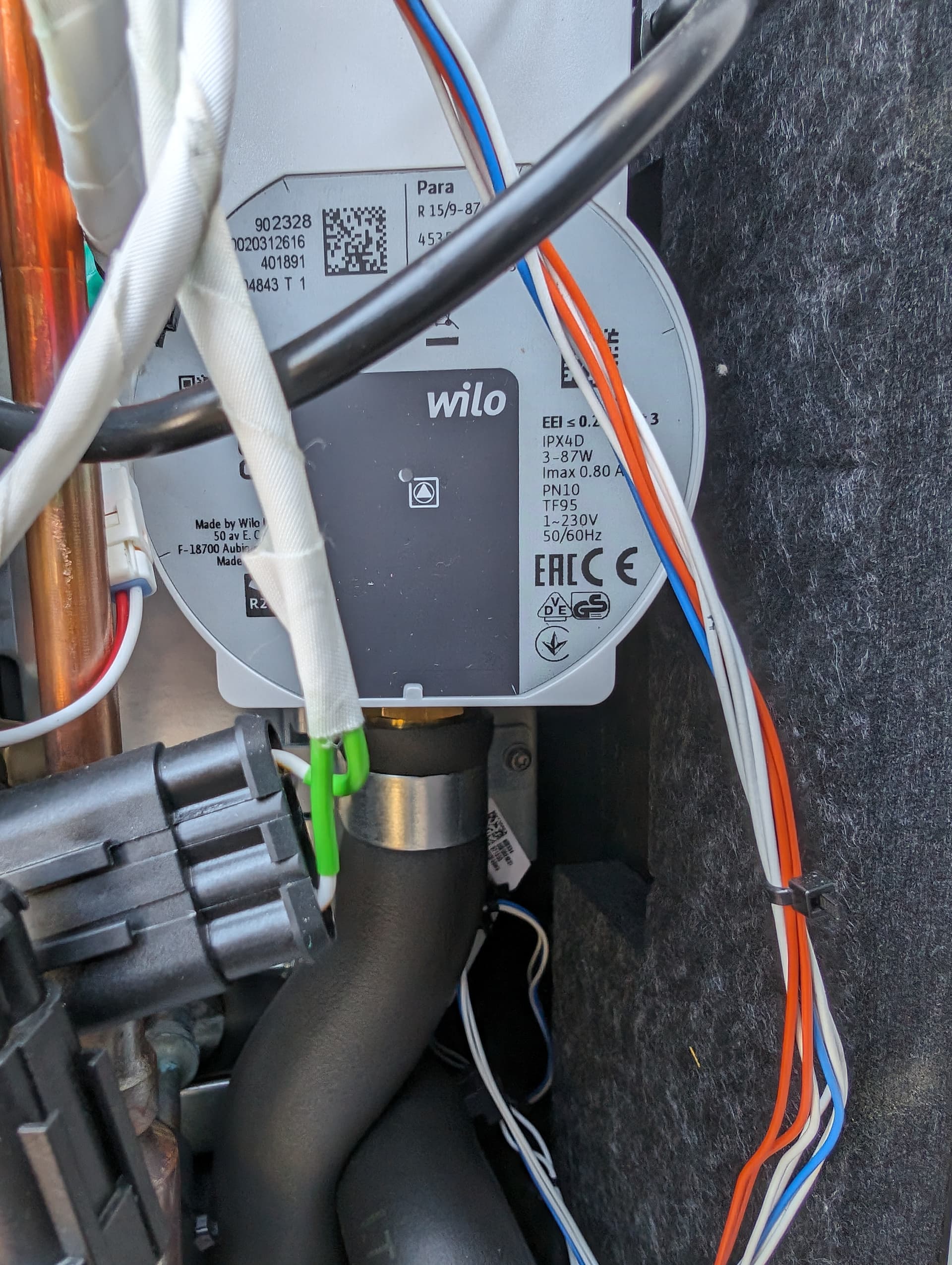
That article from @Zarch is really good and definitely highlights that my fixed flow rate calc is too low. Really interesting that flow rate on Aerotherm ASHPs is fixed and the DeltaT varies. Whilst my algorithm did have a fixed value at 18L/min it’s well below 33L/min that Vaillant aroTHERM | DT5 | Mass Flow Rate Triangle suggests for my 10kw Aerotherm+.
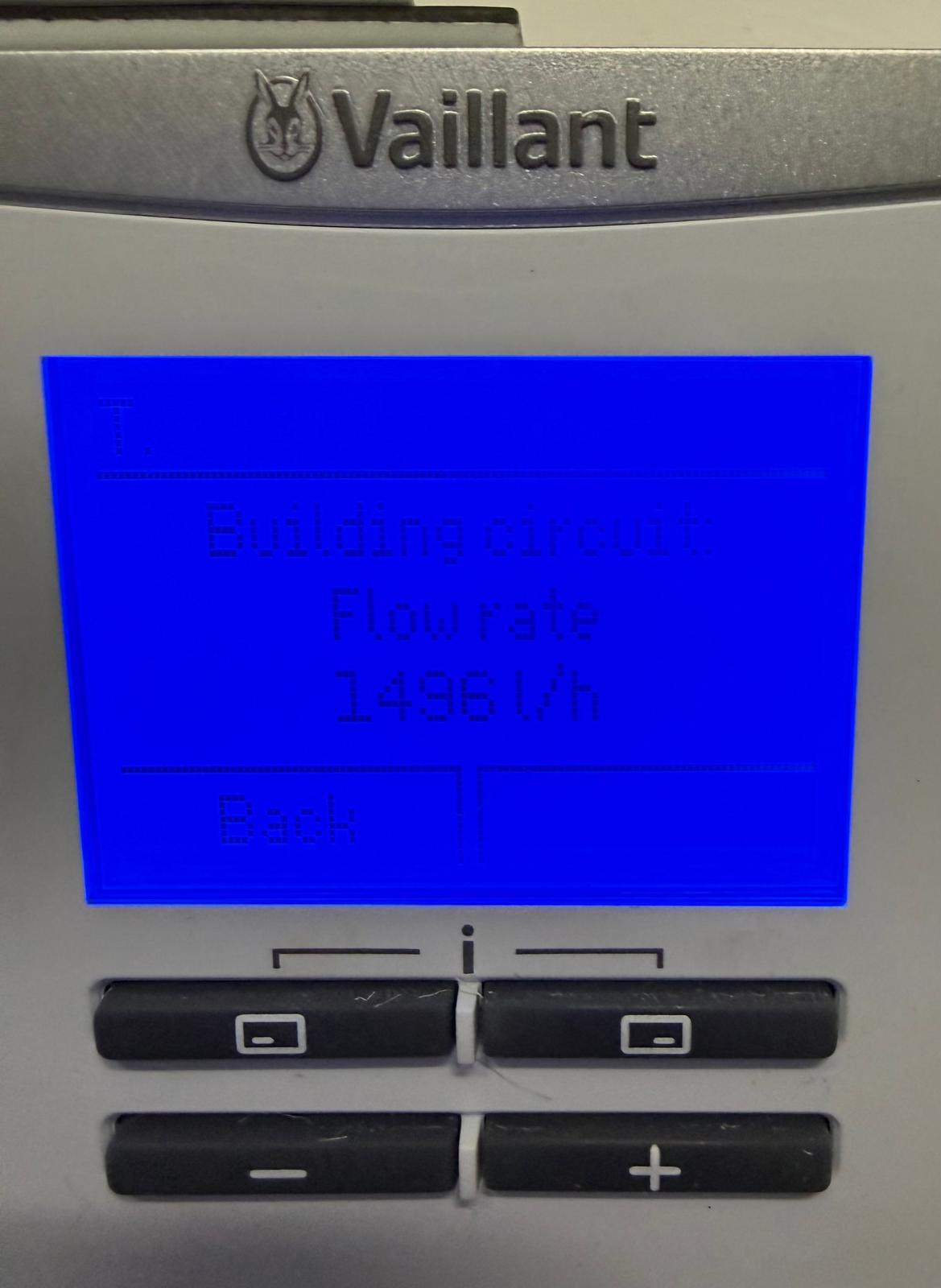
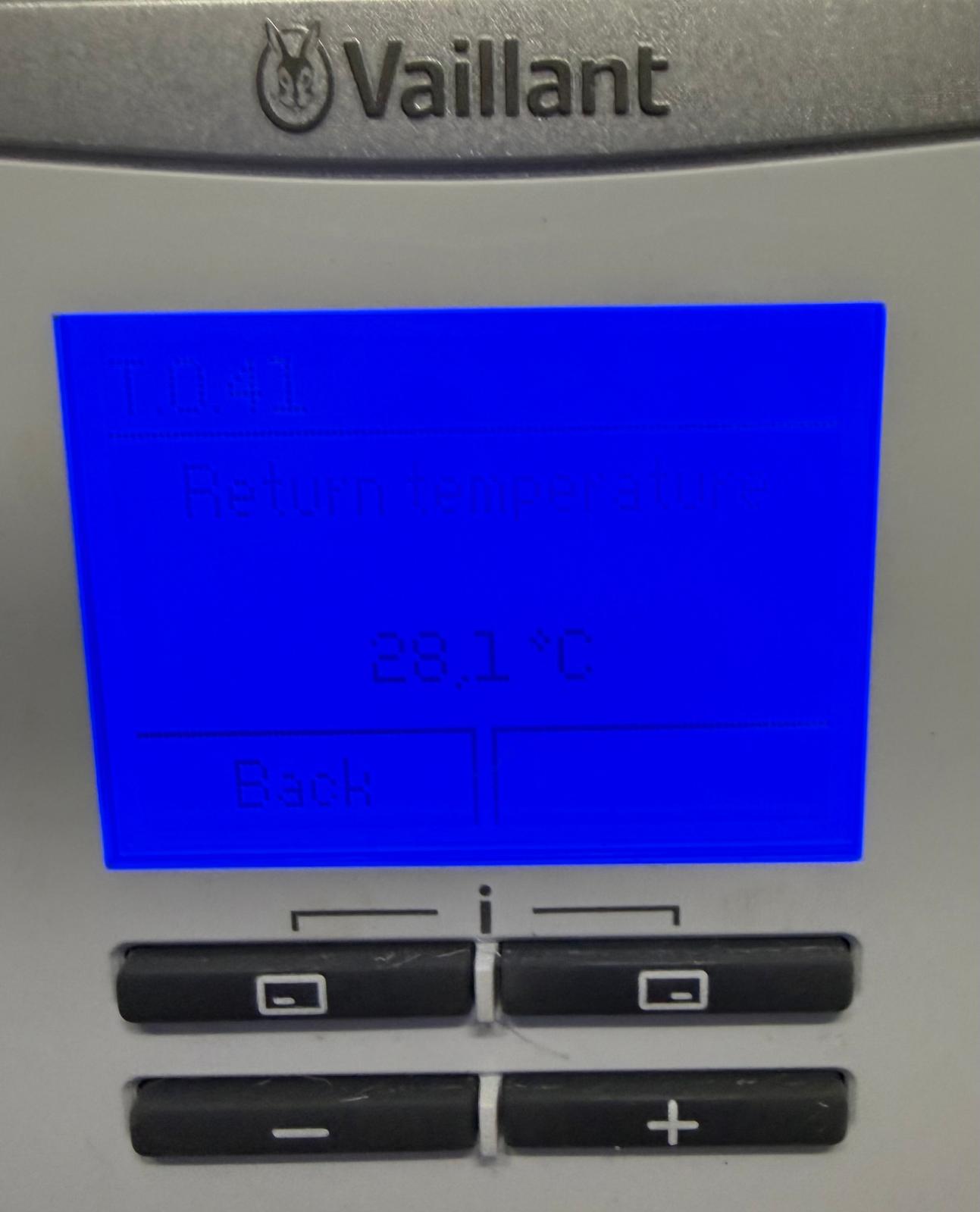
On a related note, today I followed your advice and took 3 different readings throughout the day from the controller. They’re pretty much been the same throughout the day, here’s the latest
Looking at Vaillant aroTHERM | DT5 | Mass Flow Rate Triangle , the Flow Rate for a 10kW should be fixed at 33L/min, mine seems to be fixed more around 24.9L/min, I’m thinking the installer must have set it lower than 33L/min, or the console is showing an average and this is taking into account the fluctuation you referred to in your chart. Would be interesting to know your thoughts. Thanks for all the input so far, I’ve learnt more in this thread than I have myself over the last two months
Use the ‘Installer level → Test menu → Sensor/actuator test → Conf. heat. build. pump’ setting (code: 17) to check if your pump speed has been manually set; unless there’s a specific reason to do so, it should not be set to anything other than ‘Auto’, which then uses PWM to target a steady ~2000l/h when the compressor is running and the unit is in space-heating mode.
If this value is set to ‘Auto’, then you have a flow rate issue, usually caused by a blocked strainer/filter. Get these checked and cleaned. Very rarely, this may be caused by flow restrictions due to poor design; this becomes drastically more disruptive and expensive to fix.
Thanks, I checked my config : heat.pump.build.pump setting and can confirm it’s set to auto. I only took three readings today but they call came out at around 1490l/h for my system. Interestingly I made a Google sheet showing the flow rates of all 10kw Vaillant Aerotherm+ systems on Openheatmonitor.org Whilst it’s a small sample there’s still quite a lot of variance although nothing quite a low as mine: Average Flow Rate for 10kw Vaillant Aerotherm+ ASHPs - Google Sheets
I guess my other question, is how accurate is the Vaillant Flow measurement compared to the Heat Meters from Open Energy Monitor.
BTW: I opened up the strainer, there was a load of crap in there. I gave it a good rinse out and popped it back in. As this install is only 4 months old, I was surprised how much crap was actually in there. I’m not sure there was enough crap to make a difference to the flow rate, even so I’ll check the numbers tomorrow.
While the unit is designed to run at 33, the actual flow rate may be limited by the pipework. I’m not an expert, but 25 L/min is probably fine if your property is getting enough heat.
That’s not quite true. Anything above the minimum acceptable flow rate of 1000l/min is fully OK. The resultant flow rate depends on the Max.Rem.Head setting and of course on your pipes and settings on flow regulators. I have flow rates for my 12 radiators dialed in at the manifold in the basement and could never get to the 2000 l/min simply because I don’t need that much flow and hence have restricted the flow according to the required thermal balance of my rooms. The roughly 1500 l/h we’re seeing in Ian’s system are absolutely fine. At auto and full head setting (900 mbar) I’m seeing 1500 l/h as well. When optimized for best COP, I’m dropping down to 1000 l/h without any issues whatsoever.
Sorry I missed this one, I know how to read the flow and return from the console, but how would I know when the compressor is off but the circulator is on. Do I just look at the electric power draw to see when the compressor is off? Or is there something I set to actually switch the compressor off temporarily. Apologies in advance for the limited newbie knowledge.
You’ll need some moderate weather when the heat pump has to cycle because it cannot modulate low enough. The fans out the outside unit will turn off and the compressor stops for some time, while the water is still kept circulating, and that’s when you’ll want to look at the temperatures. Alternatively, you could temporarily set a significantly lower target temperature on your controller, e.g. 15°C instead of the typical 20°C. As your system is still running at the required flow temperature for the warmer indoor temperature, it will turn off shortly after the change until the flow temperature drops to its new, lower setpoint. During that time you can read the temperatures off the controller and then we’ll know exactly what your COP error is. You can turn the desired temperature right back up afterwards, just check the fans are turned off while you still see a nonzero flow rate. Allow a few minutes for equilibrium to settle in and then read the temperatures.
I think I’ve found the perfect opportunity to do what you asked. At 10pm every night my 2.0C setback kicks in, dropping the target temp from 21C to 19C. When this happens the compressor shuts down for a couple of hours as the UFH slab maintains the whole house temp really well.
Following what you said, I checked the outside unit and the fans have totally stopped, as such I assume that the compressor has stopped but the pump is still circulating.
I don’t quite understand why the Return is higher than the flow but it is only 0.6C so I’m assuming that’s some form of calibration error (as you previously mentioned). Interested in what you think of these numbers and if I’ve got this right.
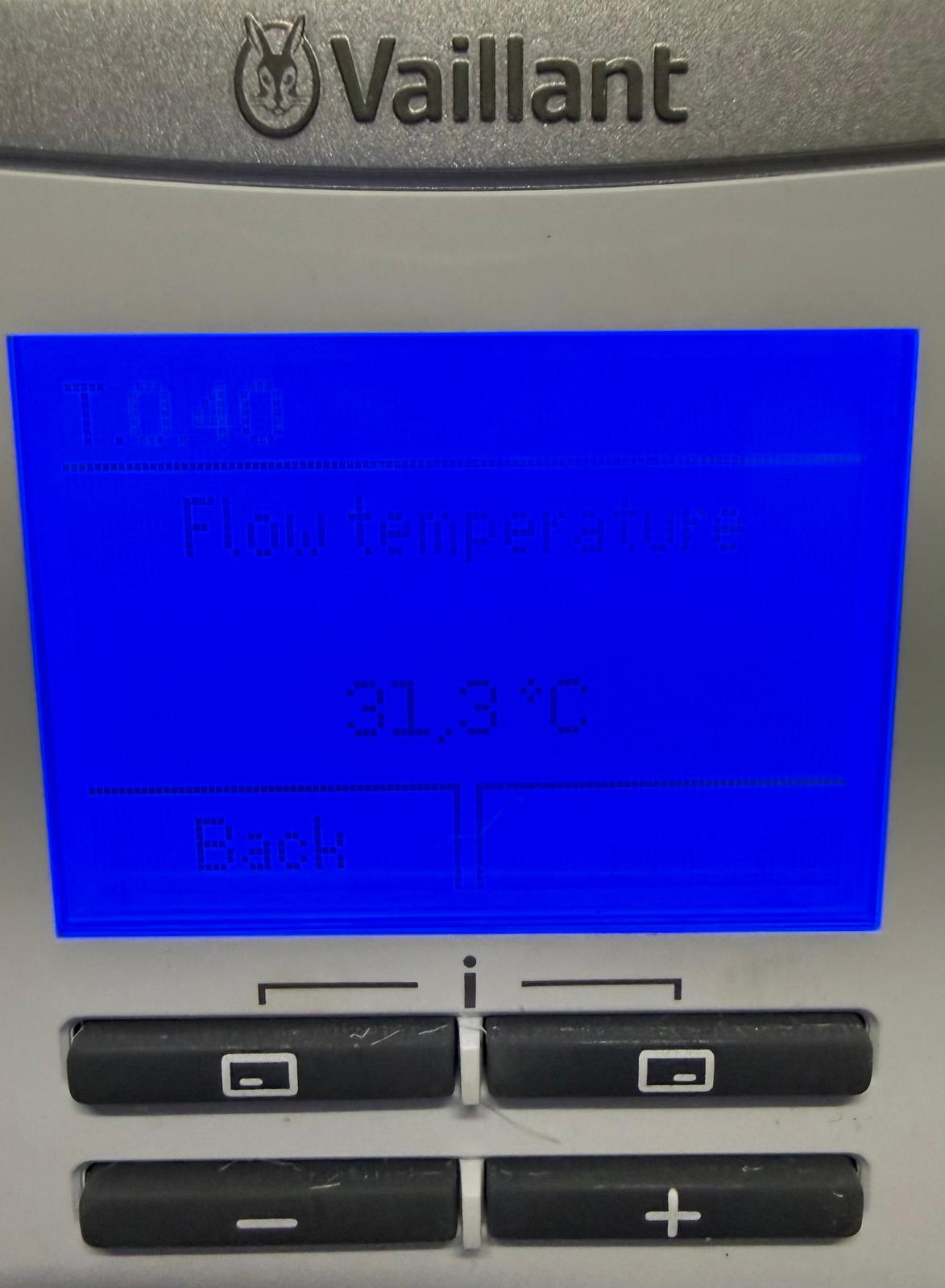
From your earlier measurements we have T_{flow} = 31.3 °C and T_{return} = 28.8 °C. Now we also have the offset between themas measured by T_{flow} - T_{return} when the compressor is off, which is T_{off} = -0.6 °C.
The measurement of heating power directly depends on the difference between flow and return temperature \Delta T, in your case \Delta T_{meas} = T_{flow} - T_{return} = 2.5 °C. But this includes the incorrect offset, so we have \Delta T_{true} = T_{flow} - T_{return} - T_{off}= 3.1 °C.
With your flow rate of 1500 l/h (0.417 kg/s) the heatpump computes a heat power of 4360 W based on the 2.5°C measured delta. But the true heat power is actually higher by a factor of \Delta T_{true} / \Delta T_{meas}, so in your case thats 3.1/2.5=1.24, translating to 5406 W. Essentially, your heat pump thinks you’re currently producing 1kW less heat than you actually do, which naturally translates to a lower COP.
As a simple estimate, just increase Vaillant’s displayed COP figures by 24% to get the true COP.
Nice work. I read in one of the Valliant community blogs that the company itself recognises a 20% variation on the stated COP value for a simple system. I guess that means +/- 20%.
Low flow temperature is king in my system. I do not chase COP values, since it is way too variable.
In truth, I have no calibrated heat meter installed and cannot share data with the OEM community. However, I can control and operate towards as low a flow temperature that still achieves a comfortable house and have more time in life to walk the dog!
I’m guessing the 20% comes from allowing a 1°C error between the sensors, which at the typical 5K spread between flow and return would result in a 20% error. Unfortunately, if you have a lower \Delta T, the error rises. I had an error of 1K at around \Delta T = 3K, getting me a whopping 33% COP error.
Thank you so much, that explains it nicely. After everything I’ve learnt on this thread, today I ordered a full Open Energy Monitor bundle. It will be interesting to validate everything when that’s all installed and sending data. Thank you all for your help it makes so much sense. Interestingly, the 24% you mention is pretty much the difference to my reported Carnot COP calculation that @Timbones put me onto.
Does this assume the flow rate measurement method adopted by Valliant is accurate?
I was thinking of Q=mCp deltaT. The error in deltaT is spot on, but it seems to assume the flow rate has a zero tolerance band. Sorry if I am missing something obvious. For my part, I am unsure how Valliant actually estimate the flow rate. Hopefully, it does not detract from the valuable insight you shared.
I do not have an accurate flowmeter, so it looks like another layer of variability in my COP value from Valliant. It seems possible that some folk have accurate Valliant COP results more by luck than design.
Yes, it works under the assumption that the flow meter is accurate. As far as I recall, flow measurements seem to agree quite well with independent measurements - @Zarch might be able to chime in here
Hi ectoplasmosis, Is it possible to share the source of your information?
I appreciate the community may have debated the topic in some form.
I know from monitoring that my own electrical clamp is within 4% of Valliant output, but I have no understanding of the Valliant flow device output. I have seen some information shared in the community here. The past discussion suggests the circulator pump is the Valliant source of flow information.
If this is correct, then I can see that the typical specification for a Grundfos circulator pump has a flow accuracy of +/-10%. I think Grundfos is used by Valliant, but I can confirm when I next take the panel off.
It is not the dominant +/-20% ( or more) associated with the temperature sensors, but it may be another variable to recognise.
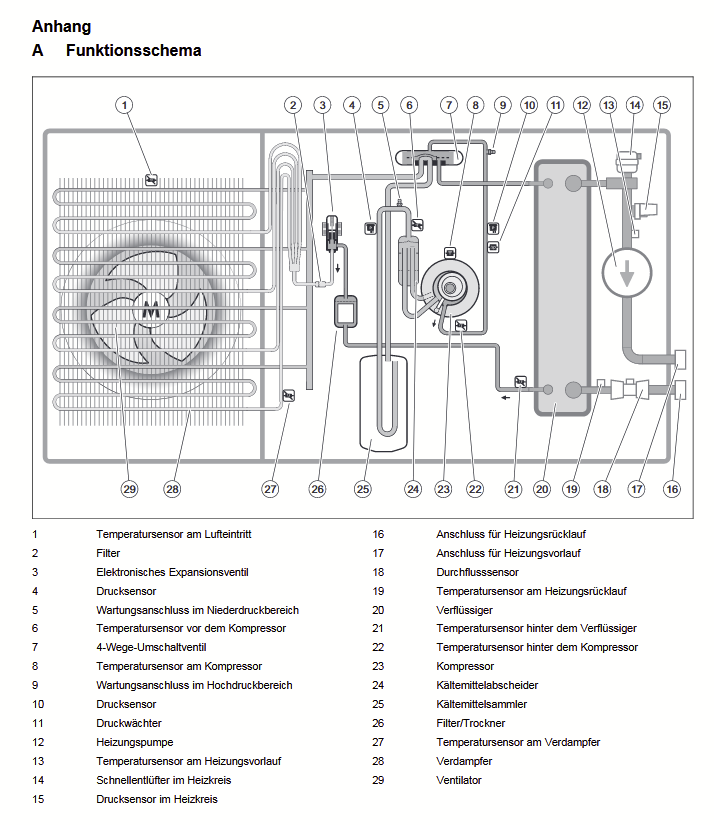
As far as I am aware there is a separate flow rate sensor in there as can be seen on this system diagram (18 - Durchflusssensor = flow sensor). I have no information on manufacturer or model of this sensor, though.
This is what I do as a rough check of current performance where no accurate monitoring is available:
If you know the energy consumption to heat the property before conversion e.g. by looking at past gas bills then after allowing for any insulation upgrades and boiler efficiency can be used as the basis for heat loss and then used for the COP calculation in the steady state heating condition. i.e. where there are no significant temperature variations.
Comparing the energy used by the heat pump with the heat loss can give some reassurance of the COP without relying on the manufacturer’s data display which is often way off.
For example for my house 12000kWh of annually heating in my location relates to approximately 8kW heat loss at -1C. I then calculate the heat loss depending on the outside temperature average for the day and use that along with the heat pump electricity usage. This is close enough to reassure that the COP for a given LWT at least matches what can be normally achieved using this calculator https://heatpumps.co.uk/cop-estimator/
PS I use a clip on meter that has been calibrated with a known load directly onto the heat pump tails just to be sure the readings are accurate.
I’ve not read the whole thread. Mine is the complete opposite, 170m2 detached 5 bed 1970s house with 7kW Arotherm, WC is 0.45 with temperature set at 21c 24/7. We’re in South East Kent.
My reported COP for this month so far, for heating is 5.06, I’m sure I’m get I’m getting a good COP, but doubt it’s that good. 162 kWh used for heating, the energy consumption is the only reliable energy figure.
 .
.