The emonTx and emonPi both use split-core c.t’s, and both measure power factor. It is having a voltage and a current wave to measure and compare that allows real and apparent powers to be calculated and the power factor to be derived.
Thanks for this, I was thinking of having a go at building it 
My trusty £10 Energy Monitor read 22.9W at @ PF of 50%, seems a rather low PF?? but must be correct because the pump itself (6M Wilo Yonos Pico) read 23W at the same time, all the fun is gone out of trying to deduce a pump’s head and flowrate because most now not only display the the power in watts but also display the flowrate in m3/hr.
I could live with that at the moment 
I would not disbelieve it. Small motors are well known for having small power factors.
Be sure to test that they agree with each other in a cup of hot water. Zero delta is more important than accuracy for this purpose. You can also use them to check some radiators too.
If you can’t monitor the pump power with a clip on meter then you can still (re) consider my method, if the pump(s) cable terminals are easily accessible, note their positions and just remove them (no cable cutting required) connect the pump cable into a 3 pin plug, plug the energy monitor into a extension lead, plug the pump cable plug into the energy monitor and plug the extension lead into any convenient mains socket to run the pump, start up the HP, take your readings. When complete, just reattach the pump terminals in their original positions. Repeat with the other pump.
Thanks John. As I think I only have 3 speeds to play with. I might just trychanging to then and see what happens. But yes I could do as you suggest 
I had a play with the speed of the secondary pump on my system, increasing it from ‘I’ to ‘II’ at 10am when the system was close to stable running. Can see how the return temperature jumped up by 1°, pushing up the flow temp. Average COP dropped from 3.6 to 3.3.
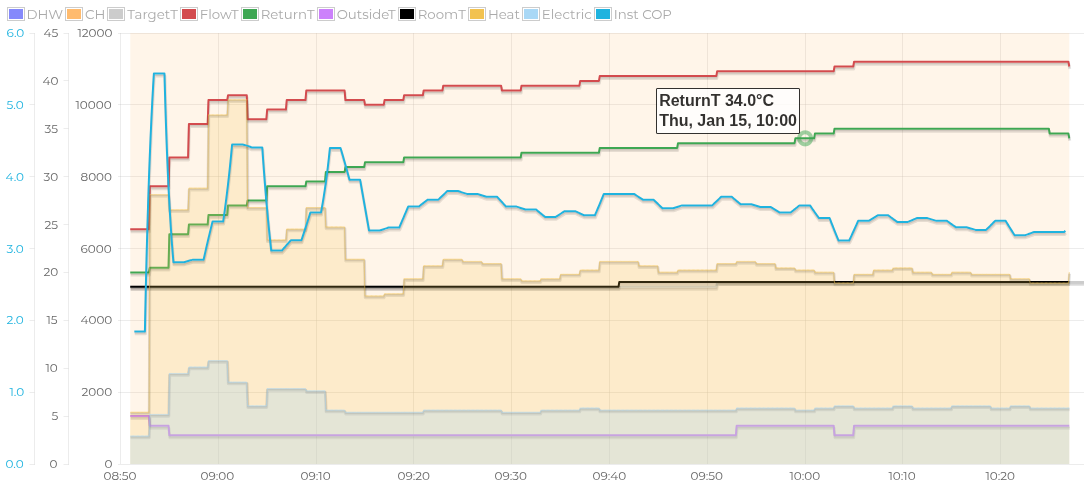
Seems like I was better off at the slower speed, so I dropped it back down again at 10:20 (a defrost happened shortly after). Can just about see that return did drop back down to 34° at the end.
At 12pm, I increased the primary pump from 9 l/min to 11 l/min, and the dT narrowed by about 1° as one would expect. COP dropped by maybe 0.1.
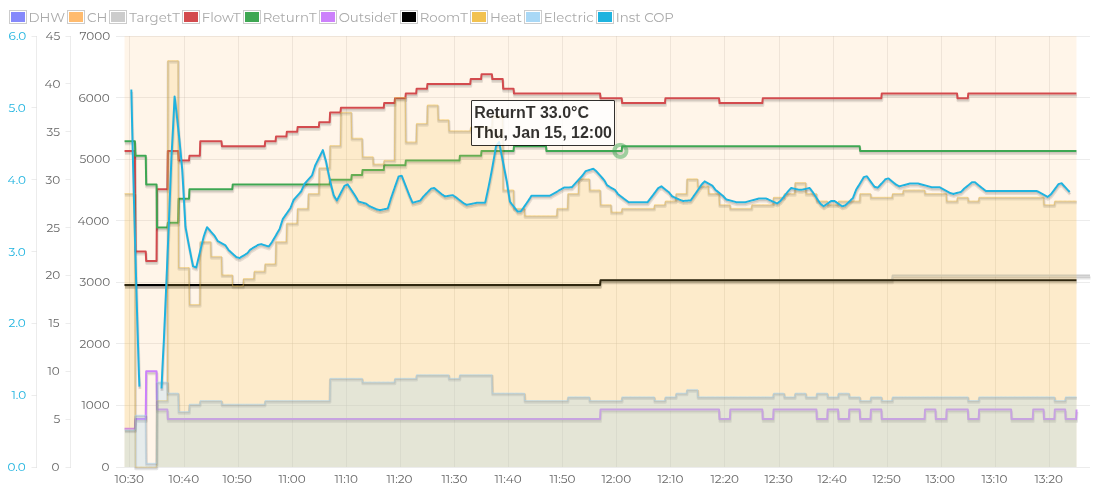
Then reset the pump speed back to what it was at about 12:45, dT widened by 1°.
Caveat: not necessarily a good experiment and conclusions may be wrong.
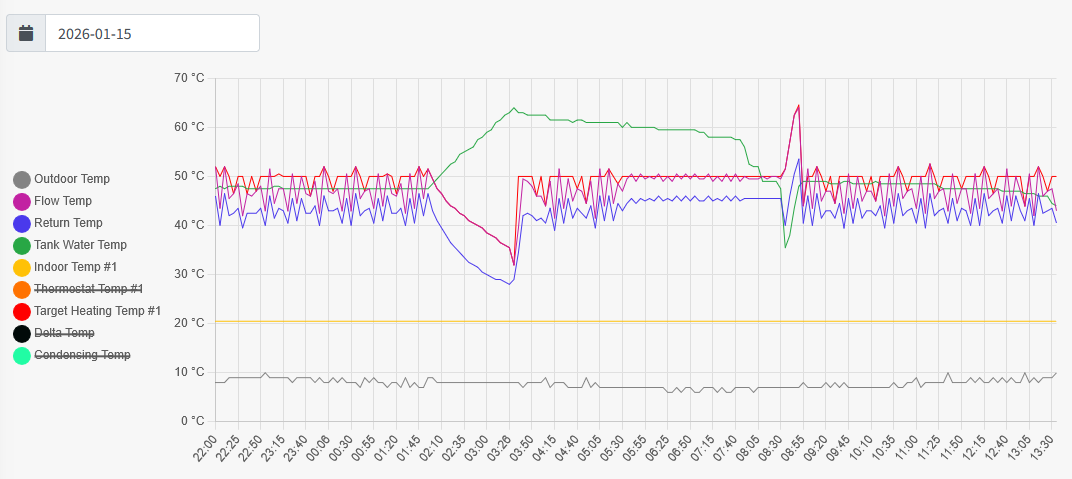
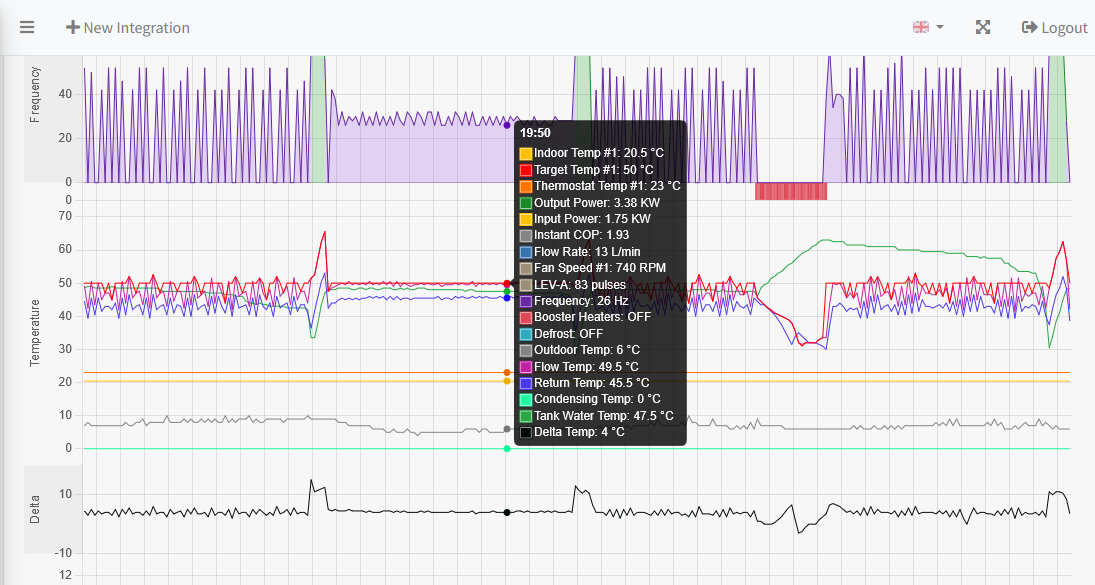
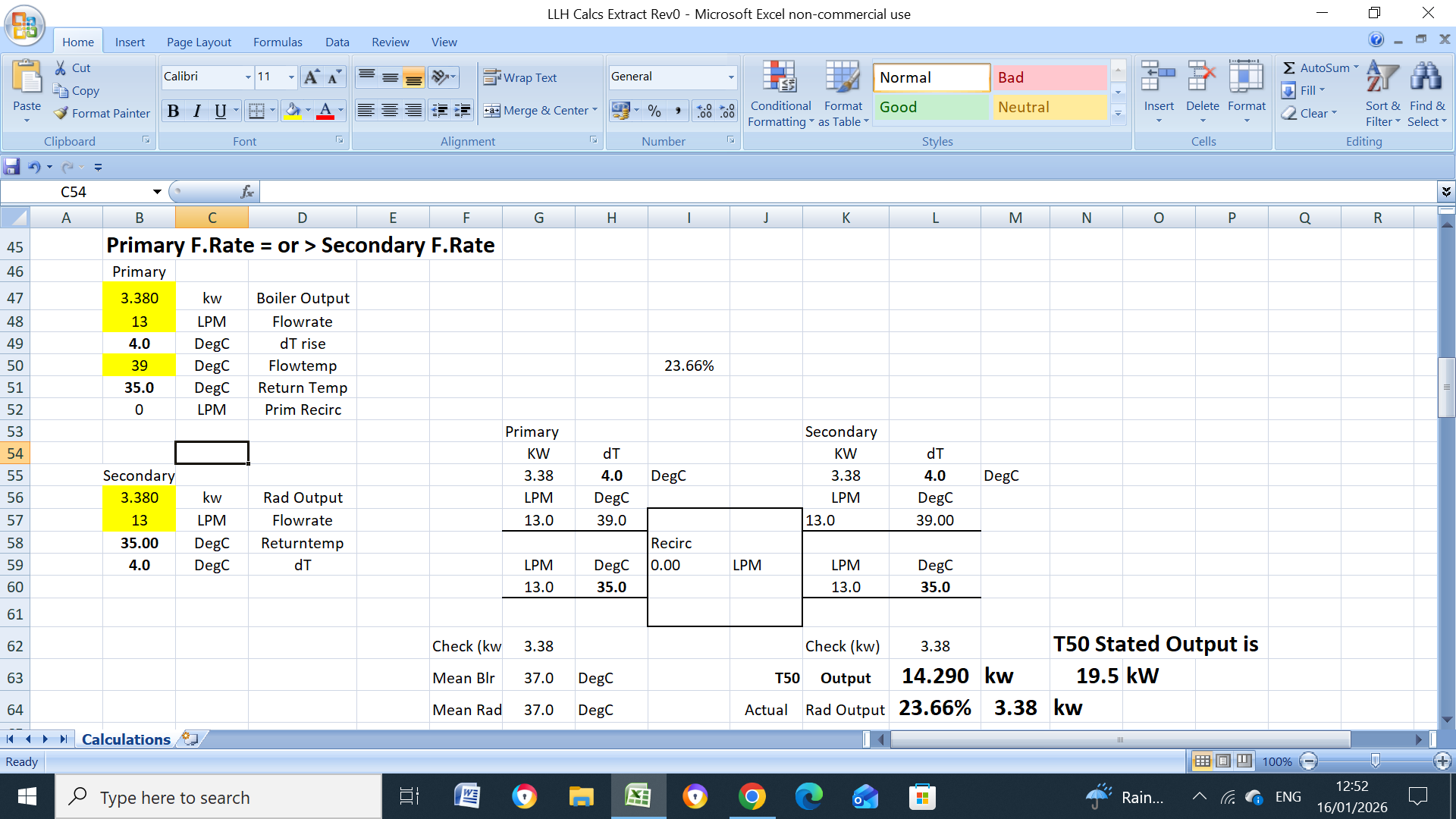
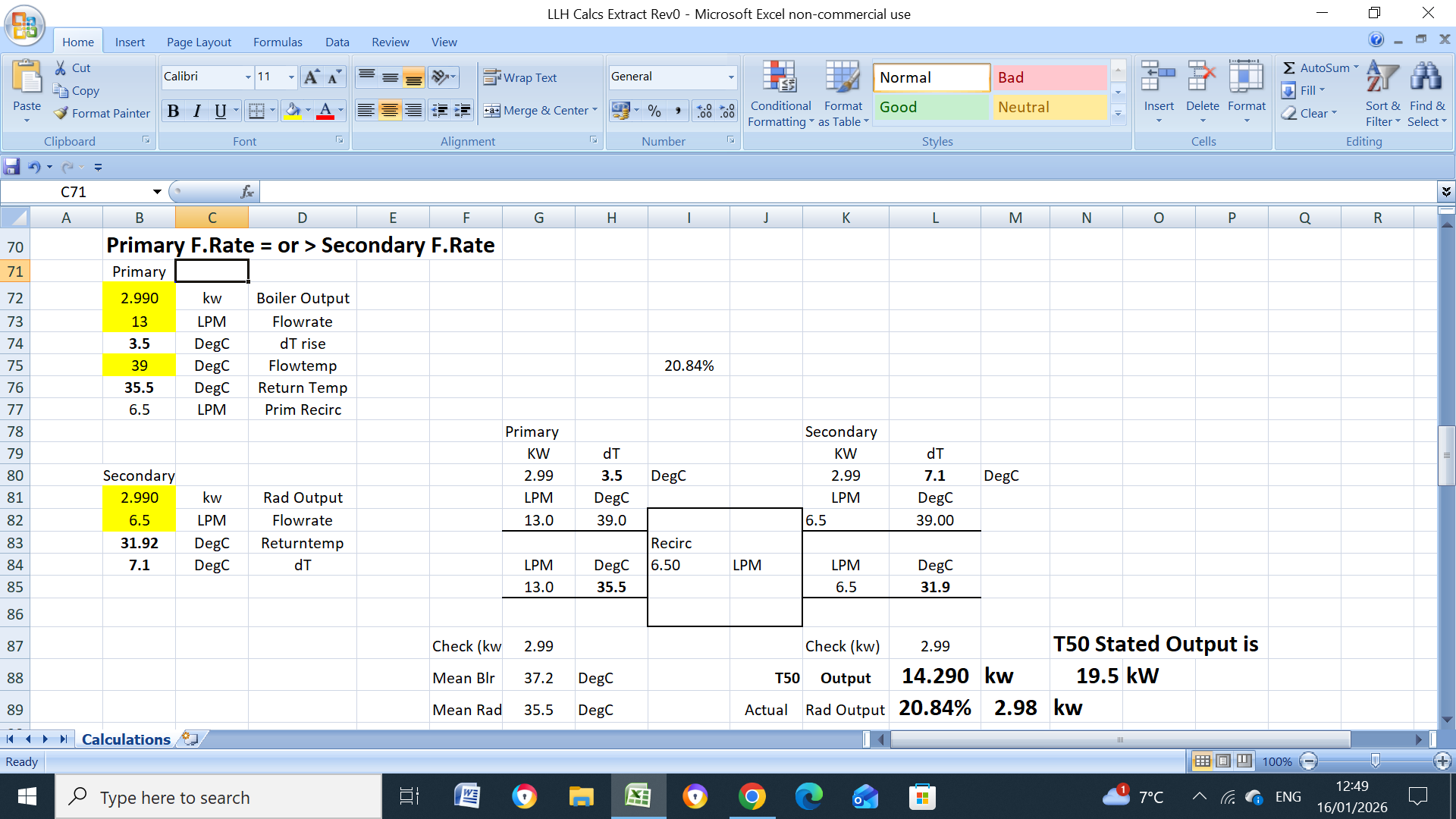
Tim, At 1300hrs you had a flowrate of 11LPM with flow/return/dT of ~ 38C/33C/5C, you can get the exact numbers in a window?. The HP output (water) should be, 11*60*5/860, 3.84kW say ~ 3.65kW on glycol?. The mean rad temp (if you have rads) is 35.5C and the room temp is ~ 18C, so the % rad output vs T50, is ((35.5-18)/50)^1.3, 25.54%, which implies T50 rad(s) output of 3.65/0.2554, 14.29kW, does this seem right?.
Exact numbers at 13:00 are 39C/33C/6C. Heat pump and emitter output both at 4400W.
Mean radiator temp assumed to be 36C, room temperature closer to 20C.
All radiators, running at ((36-20)/50)^1.3 = 22.7%.
Estimated total rating 4.4 / 0.227 = 19.4 kW, which is consistent with previous estimates.
(this includes an additional 1 kW contributed by fans fitted to a few rads)
Related topic: Infer radiator spec and system volume using the MyHeatpump app
So, your T50 rads output are practically the same as @bontwoody ?
Yes, our two systems appear to be quite similar in practically all aspects, so one would expect that they’d operate in a similar manner. The key to the puzzle is figuring out what’s different…
I remain optimistic
This afternoon I was able to get someone to change the secondary pump speed from I to !! at about 12noon. It didnt seem to make any difference and the system remained unstable.
Later in the afternoon it was changed again to speed III. The unit did settle then after a DHW run.
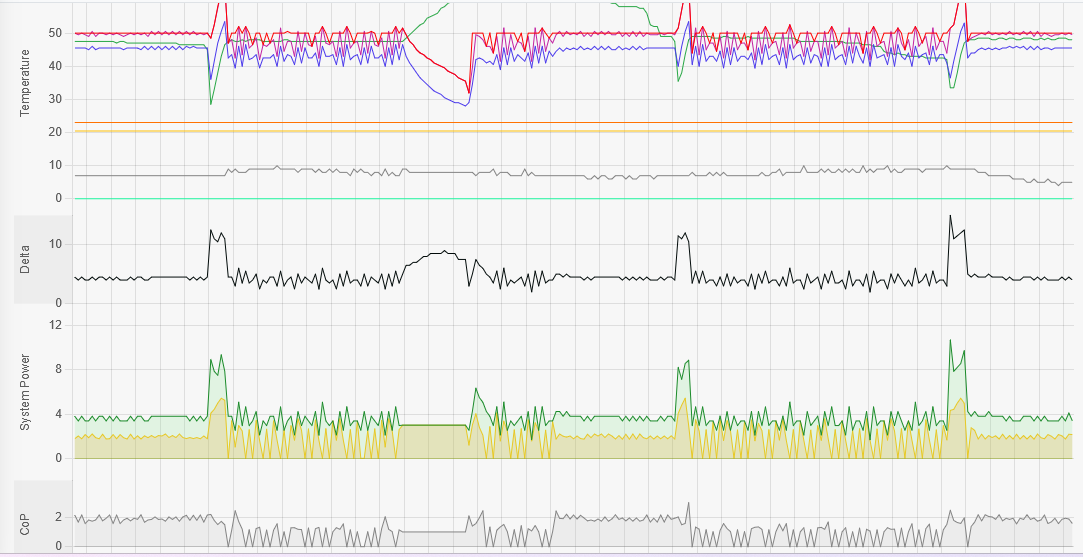
Hard to say if anything improved though. Or am I imagining that the OAT has dropped but the COP is about the same as earlier when it was warmer outside???
Mark, @bontywoody, where have you installed the 4 new probes and can you post the window or all the values of the data when running steadily earlier on?
Tim, @Timbones, Can you post photos of your primary & secondary pumps showing or posting modes/settings, your HP is 11.2kW which requires (water) a flowrate of 32LPM at a 5C dT, what is the max flowrate when/if you run the (primary) circ pump at setting3, full speed??
Primary: UPMXL GEO 25-125 130 - PWM speed set to 3 out of 5
Secondary: UPM3 AUTO 25-70 130 ZZZ - constant pressure, curve ‘I’
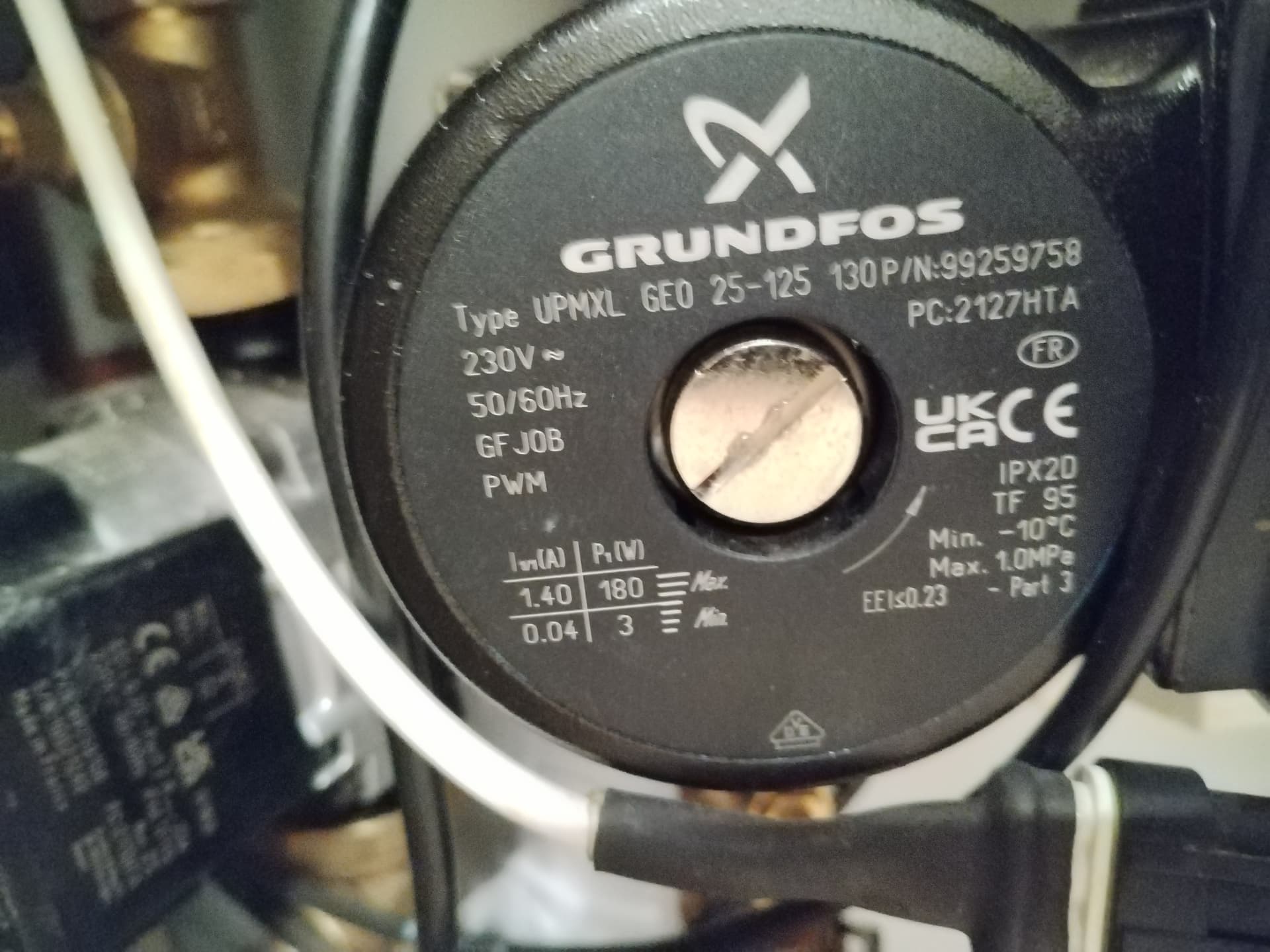
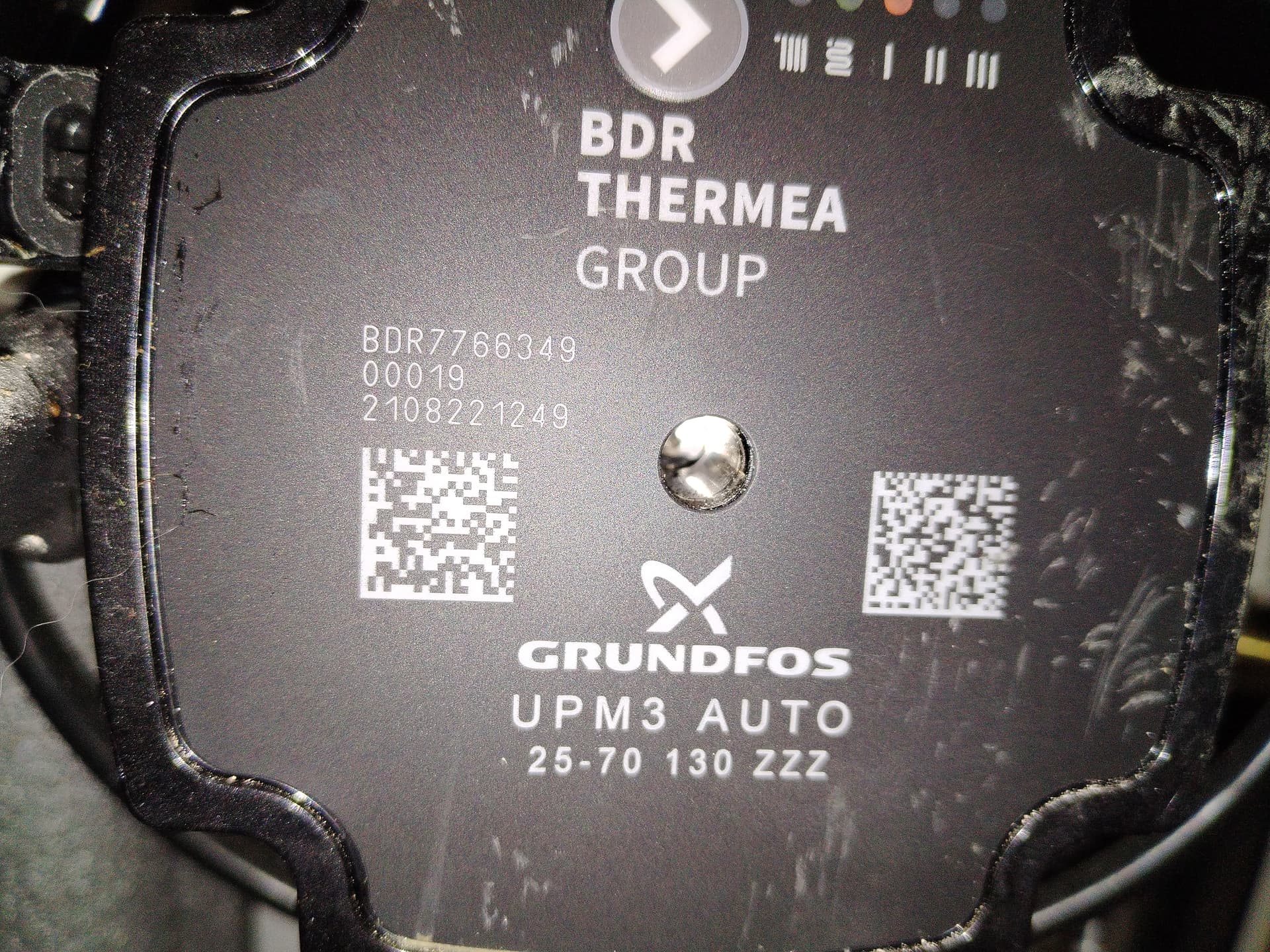
It only requires that combination to transfer the full 11.2 kW of power into the house, but it’s oversized by at least 2x. I can comfortably run at half the flow rate for half the power (and that’s still too much when it’s mild). I have set “Quiet Mode” setting in order to limit the maximum power.
I’d guess it’s around 13 l/min on full speed (5). System is actually due for a service, and ought to be another 2 or 3 l/min higher.
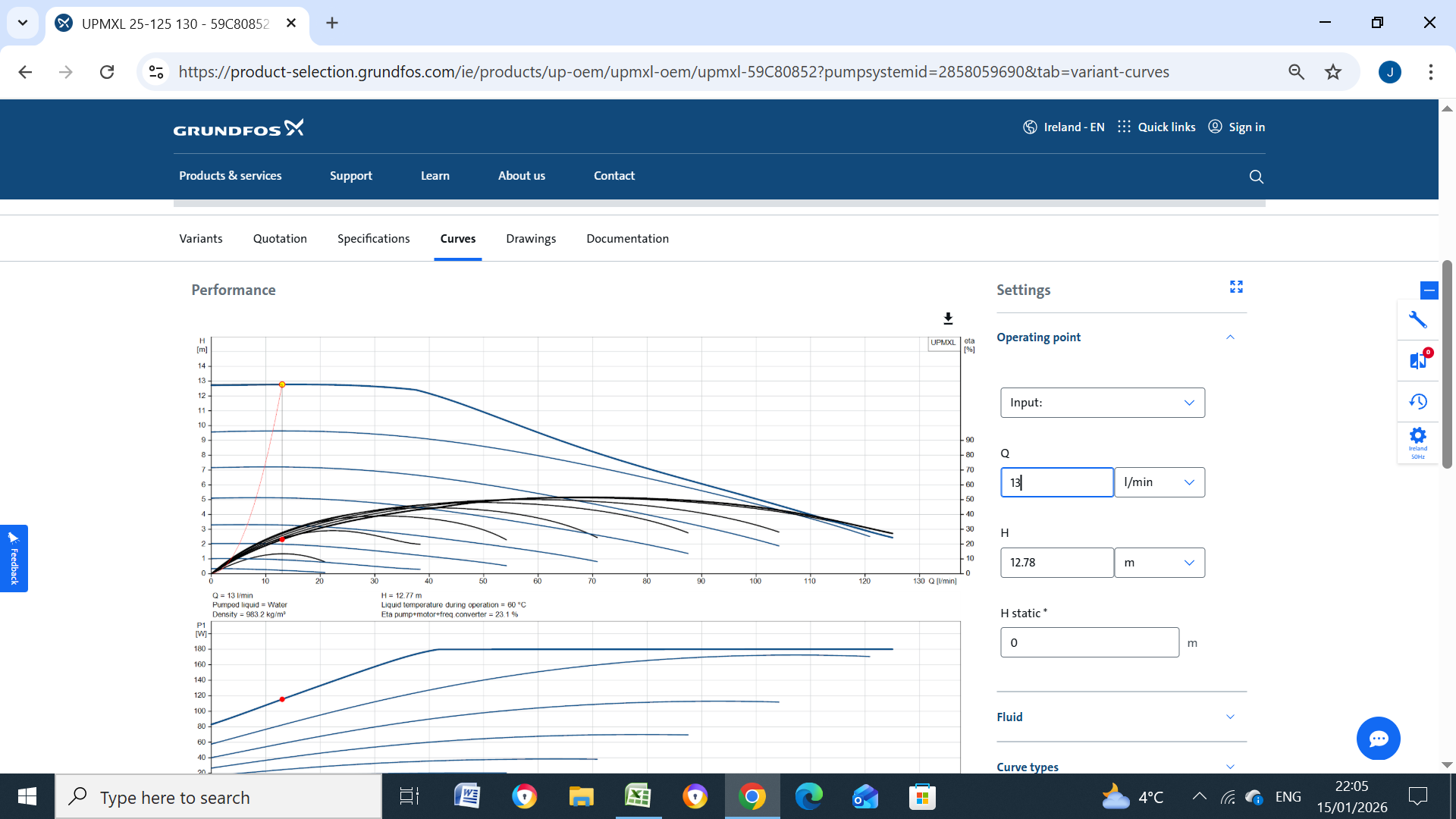
13LPM at 11.5kW output gives a dT of 12.68C, don’t know what effect this would have on the COP. The primary pump is truly massive, with a 12.5M head and a power output of 180W, yet the secondary is “only” a 7M pump, wonder why, must look up the pump curves.
Looks like, (if running at full speed) that a head of 12.78M is required to circulate 13LPM through the primary system, seems extraordinary.