Ok,
For anyone interested in a simple monitoring program which can be compiled with gcc on a Linux PC
#include <stdio.h>
#include <string.h>
#include <fcntl.h>
#include <termios.h>
#include <unistd.h>
#include <errno.h>
#include <sys/ioctl.h>

//char modem_id[] = {0xFB, 0x04, 0x11, 0x87};
char modem_id[] = {0x19, 0x12, 0x10, 0x01};
char inverter_id[] = {0x60, 0x00, 0x03, 0xC3};
char key_id[] = {0x00, 0x00};
char parm[] = {0x00, 0x00};
char cmd1[2] = {0xF2, 0x65};
//char cmd1[2] = {0xF5, 0x68};
char cmdzero[2] = {0xF0, 0x00};
char buf[256];
int  idx = 0;

int fd;
int dtr = TIOCM_DTR;

enum { HEADER1, HEADER2, CMD, TAIL1, TAIL2, DATA } state;

void r3()
{
    int i;
    for(i = 0; i< sizeof(modem_id); i++)
    {
        write(fd, &modem_id[i], 1);
    }
    for(i = 0; i< sizeof(key_id); i++)
    {
        write(fd, &key_id[i], 1);
    }
    for(i = 0; i< sizeof(parm); i++)
    {
        write(fd, &parm[i], 1);
    }
    for(i = 0; i< sizeof(inverter_id); i++)
    {
        write(fd, &inverter_id[i], 1);
    }
}

int main(int argc, char* argv[])
{
    int what;
    int i;
    int count;

    struct termios SerialPortSettings;

    fd = open("/dev/ttyUSB0",O_RDWR  | O_NOCTTY | O_SYNC);
    if (fd < 3 ) // 0, 1 and 2 are stdin, stdout and stderr
    {
        printf("\n  ERROR ! opening com port\n");
        return -1;
    }

    tcgetattr(fd, &SerialPortSettings);
    cfsetispeed(&SerialPortSettings,B9600);
    cfsetospeed(&SerialPortSettings,B9600);
    // 8N1 Mode
    SerialPortSettings.c_cflag &= ~PARENB;
    SerialPortSettings.c_cflag &= ~CSTOPB;

    SerialPortSettings.c_cflag &= ~CSIZE;
    SerialPortSettings.c_cflag |=  CS8;
    // no handhake
    SerialPortSettings.c_cflag &= ~CRTSCTS;
    SerialPortSettings.c_cflag |= CREAD | CLOCAL;
    // raw mode
    SerialPortSettings.c_iflag &= ~(ICRNL | INPCK | ISTRIP | IXON | BRKINT);
    SerialPortSettings.c_lflag &= ~(ICANON | IEXTEN | ISIG | ECHO);

    SerialPortSettings.c_oflag &= ~OPOST;

    // Setting Time outs
    SerialPortSettings.c_cc[VMIN] = 1; // Read at least 1 character
    SerialPortSettings.c_cc[VTIME] = 0; // Wait indefinetly

    if((tcsetattr(fd,TCSANOW,&SerialPortSettings)) != 0) // TCSAFLUSH
    {
        printf("\n  ERROR ! in Setting attributes\n");
        close(fd);
        return -2;
    }

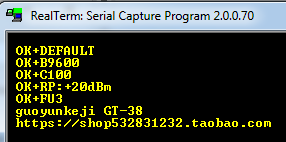
    ioctl(fd, TIOCMBIC, &dtr); // clear DTR pin == SET pin of HC-12

    if ((argc == 2) && !strcmp("zero", argv[1]))
    {
        printf("reset power total\n");
        count = write(fd, &cmdzero[0], 1);
        r3();
        count = write(fd, &cmdzero[1], 1);
        sleep(1);
        count = write(fd, &cmdzero[0], 1);
        r3();
        count = write(fd, &cmdzero[1], 1);
        sleep(1);
    }


    tcflush(fd, TCIFLUSH);
    state = HEADER1;

    what = fork();
    if(!what) // child: only handles received bytes
    {
        for(;;)
        {
            int cnt;
            ioctl(fd, FIONREAD, &cnt);
            if(cnt > 0)
            {
                switch (state)
                {
                    case HEADER1:
                    {
                        read(fd, buf, 1);
                        if (buf[0] == cmd1[0])
                        {
                            state = HEADER2;
                        }
                    }
                    break;

                    case HEADER2:
                    {
                        read(fd, &buf[1], 1);
                        if (buf[1] == modem_id[0])
                        {
                           state = CMD;
                           idx = 2;
                        }
                        else
                        {
                            state = HEADER1;
                        }
                    }
                    break;

                    case CMD:
                    {
                        read(fd, &buf[idx], 1);
                        if (++idx == 12)
                          state = TAIL1;
                    }
                    break;

                    case TAIL1:
                    {
                        read(fd, &buf[idx], 1);
                        if (buf[idx++] == inverter_id[3])
                        {
                            state = TAIL2;
                        }
                        else
                        {
                            state = HEADER1;
                        }
                     }
                    break;

                    case TAIL2:
                    {
                        read(fd, &buf[idx], 1);
                        if (buf[idx++] == cmd1[1])
                        {
                            state = DATA;
                        }
                        else
                        {
                            state = HEADER1;
                        }
                    }
                    break;

                    case DATA:
                    {
                        read(fd, &buf[idx++], 1);
                        switch (idx)
                        {
                            case 16:
                            {
                                unsigned int dc = ((buf[14] & 0xff) * 256) + (buf[15] & 0xff);
                                printf("DC voltage  : % 4u.%02u\n", dc / 100, dc % 100);
                            }
                            break;

                            case 18:
                            {
                                unsigned int ac = ((buf[16] & 0xff) * 256) + (buf[17] & 0xff);
                                printf("AC voltage  : % 4u.%02u\n", ac / 100, ac % 100);
                            }
                            break;

                            case 20:
                            {
                                //printf("%02X %02X ",buf[18] & 0xff, buf[19] & 0xff);
                                unsigned int amp = ((buf[18] & 0xff) * 256) + (buf[19] & 0xff);
                                printf("DC current  : % 4u.%02u\n", amp / 100, amp % 100);
                            }
                            break;

                            case 22:
                            {
                                //printf("%02X %02X ",buf[20] & 0xff, buf[21] & 0xff);
                                unsigned int eng = ((buf[20] & 0xff) * 256) + (buf[21] & 0xff);
                                printf("Energy kWh  : % 4u.%02u\n", eng / 100, eng % 100);
                            }
                            break;
/*
                            case 24:
                            {
                                printf("%02X %02X\n",buf[22] & 0xff, buf[23] & 0xff);
                                unsigned int eng = (((buf[20] & 0xff) * 256) + (buf[21] & 0xff) * 10);
                                printf("Energy Wh: %u\n", eng);
                            }
                            break;
*/
                            case 26:
                            {
                                //printf("%02X %02X ",buf[24] & 0xff, buf[25] & 0xff);
                                unsigned int watt = ((buf[24] & 0xff) * 256) + (buf[25] & 0xff);
                                printf("Output Watt : % 4u.%1u\n", watt / 10, watt % 10);
                            }
                            break;

                            case 28:
                            {
                                //printf("%02X %02X ",buf[26] & 0xff, buf[27] & 0xff);
                                unsigned int temp = ((buf[26] & 0xff) * 256) + (buf[27] & 0xff);
                                printf("Temperature : % 4u.%02u\n\n", temp / 100, temp % 100);
                                state = HEADER1;
                            }
                            break;
                        }
                    }
                    break;
               }
            }
        }
    }
    else //parent: poll for data every 5 secs
    {
        for(;;)
        {
            write(fd, &cmd1[0], 1);
            r3();
            write(fd, &cmd1[1], 1);
            sleep(5);
        }
    }
    close(fd);
}