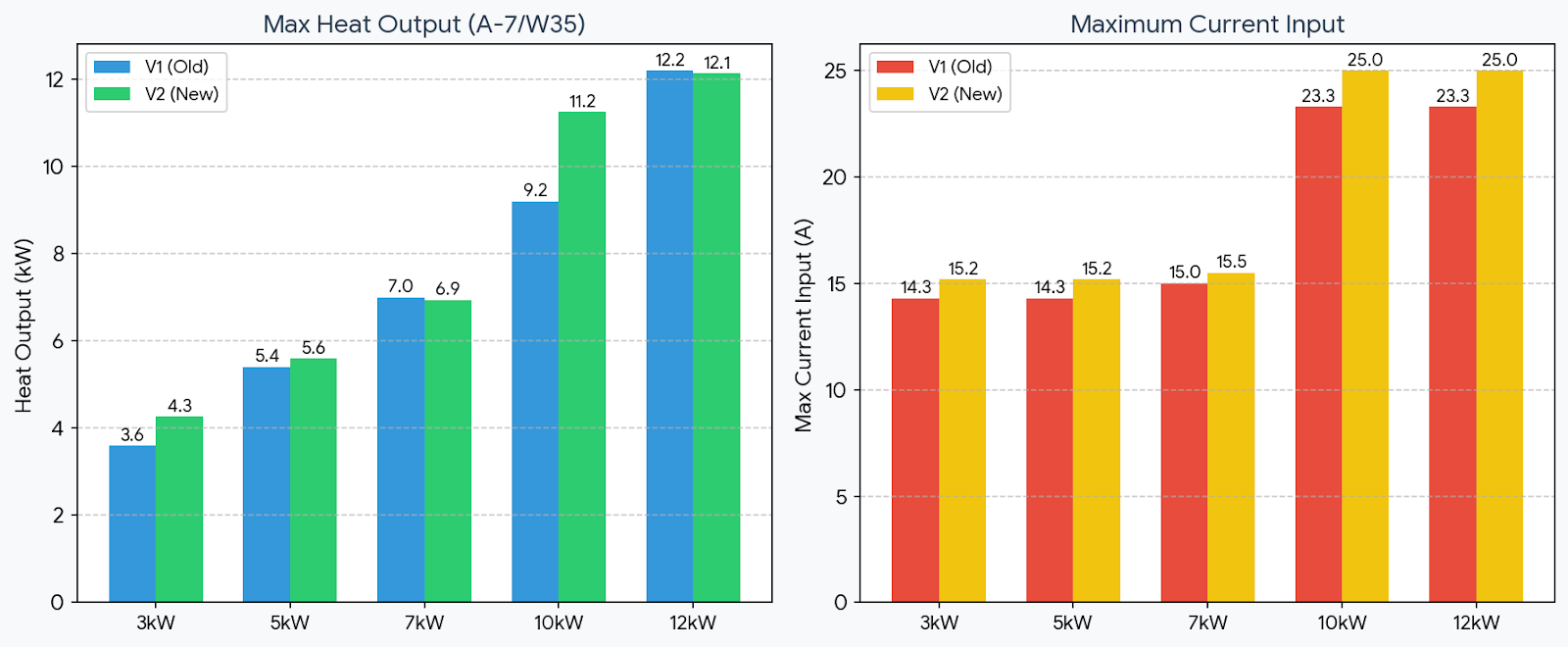
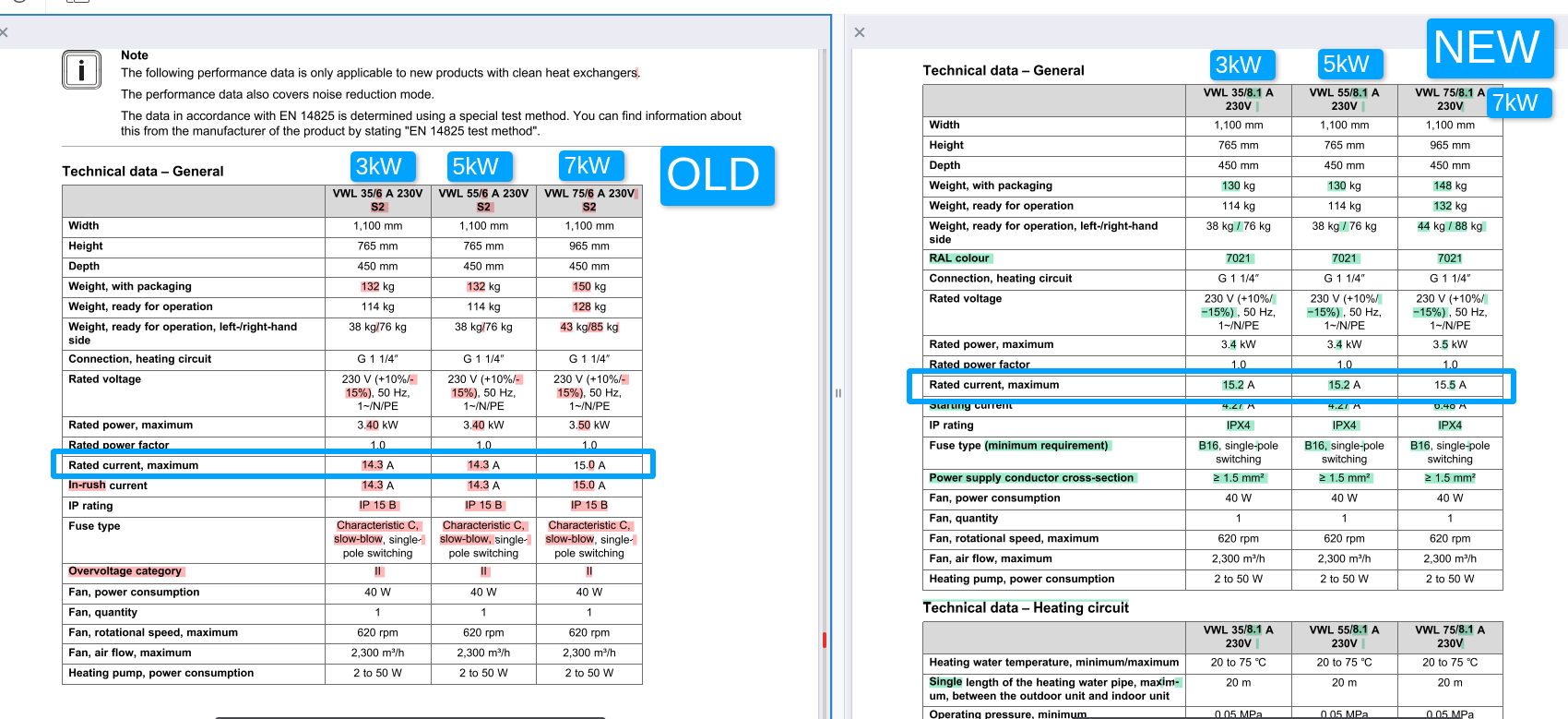
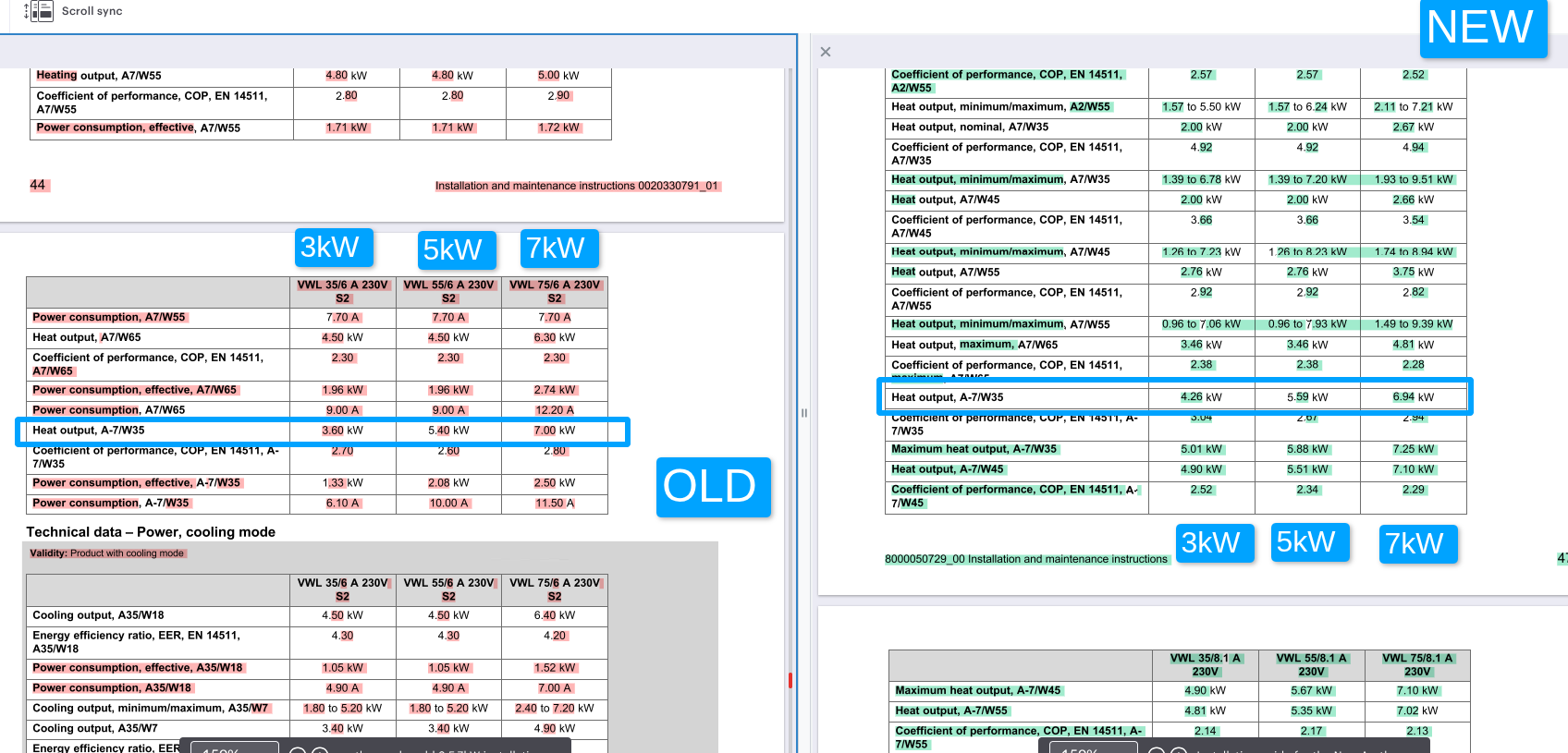
I’ve managed to get hold of the datasheets for the new V2 Vaillant Arothem+ I’ve been interested to see how the V2 compares to the existing Arotherm (V1).
As far as I can tell, the changes are very minimal. I think they’ve just tweaked the compressor current input and fitted a larger circ pump.
The main differance is the colour and the new R290 zero clearence feature which runs the fan 24/7 (if enabled).
The changes in heat output and rated COP could be due to changes in certification methods? I think the compressor current input is the most directly comparable metric to focus on. The output capacity chart for the V2 is not yet avilable, so we can only compare the EN test outputs COPs which are far from real world e.g Air -7C, Water 35C
I understood that the new V2 has dropped the ebus protocol which seems to me to be a significant consideration. The use of ebus means that you can do whatever you like in terms of control (e.g. via the openebusd device). If that doesn’t work on the new machine then we have lost some significant openness.
Is that correct? And has anyone worked out what the new protocol is?
The V2 still uses ebus AFAIK. Where did you hear otherwise?
It was on one the various youtube videos than came out a few months ago when it was revealed/announced. There was something about new controllers using a new new protocol. Ah. I think it was this: https://youtu.be/tAueYITLPyk?t=327
Looks like they have just changed the bus to the outdoor temp sensor, not any of the rest of the system (and I wasn’t listening properly
I think the ebus protocol is identical to V1.
OK. That is good news. ebus is one of the things I really like about Vaillant (insurance against ‘apps’ and things the system won’t do by itself) and helps jjustify the price.
That does look good, I found ebusd not particularly user friendly and a bit glitchy. But this was a couple of years ago, I’m assuming it’s more developed now. But I would still consider Vaillant is one of the harder heatpumps to integrate with. Most heatpumps use RS485 which is much easier to integrate with.
It’s still eBUS between the VWZ AI and the Sensocomfort user interface unit, the internet gateway, and indeed everything else except the link between the outdoor unit and the indoor controller. Which is probably for the best, as the existing ecosystem of eBUS-based integrations can continue to be used.
I think for the European market, the situation is/was meant to be different, with the VWZ AI controller integrating internet connectivity, OTA updates, and a wireless TxRx for the Sensocomfort etc, but this didn’t make it over here for some reason.
I found the install doc for the new Arotherm (part# suffix is /8.1 vs the previous /6 so I’m not sure if we should really call them V8 and V6 rather than V2 and V1?). Anyway, it’s here:
Physical dimensions are the same but obviously clearance areas have changed.
What I really want is the detailed COP and power vs compressor frequency tables in the fabled Czech datasheet for V1. Does anyone have that data? Or confirmation that they haven’t changed meaningfully on V2.
Comparing the data I have got hold of so far the new machine is not identical to the old one and appears to have a wider min/max modulation range, which is good because that was a limitation of the 3/5kW machine.
But I’ve also got conflicting data from different sources so I’m not quite sure about this yet.
Glyn, can you post your datasheet somewhere? Or if not, otherwise slip it to me
Or are those two .pngs the whole thing?
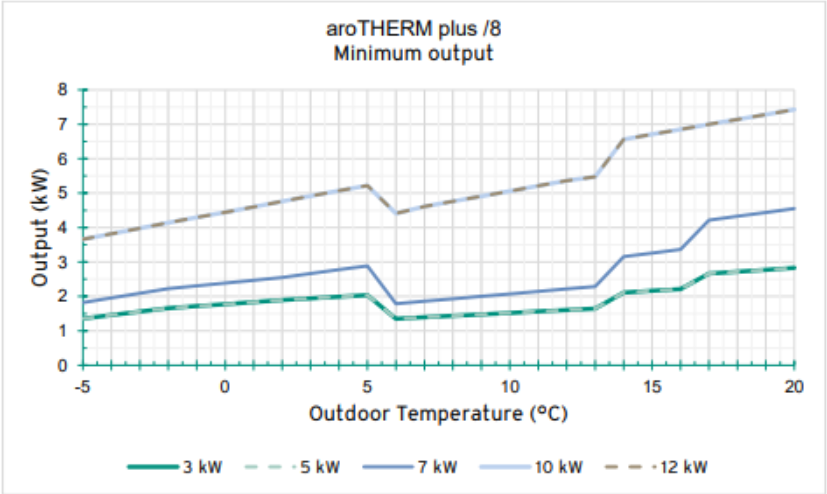
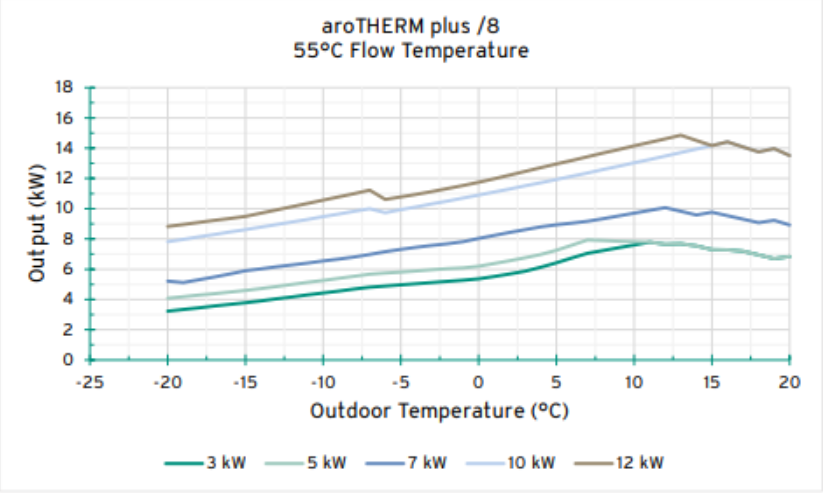
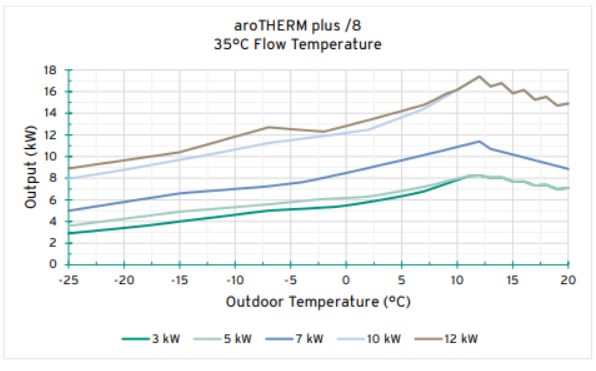
I asked Vaillant if they had more detailed docs like the fabled Czech datasheet for the /8 models. They said they don’t yet, but sent a couple of graphs, which are definitely useful. Min output power graph and behaviour at 55C output graph
Hopefully that’s useful to people.
I’m pleased to see that the minimum output for the 3/3.5kW machine stays under 1.5kW across a reasonable range of output temperatures.
Different firmware, and it’s cheaper, so if you don’t need the 5kW performance you can save a few hundred quid. And those graphs suggest that it will work better in homes with low heat demand.
I don’t know if it’s possible to make the 5kW work just as well as the 3kW version in a low-demand situation. One would presume so, so from a technical point of view it may not matter.
Also right now the larger models are on a significant back-order but you still seem to be able to get the 3/3.5kW one.
So yes this is mostly marketing, but there may well be some utility in the different firmware curves - I’ve not grokked enough about how this actually works in practice to know.
As far as I can tell, the ‘different firmware’ is just a coding plug. The hardware is totally identical, and installing a different coding plug (resistor) tells the unit whether it’s a 3kW/5kW.
OK, well that is good news - it means anyone can swap their machine from 3.5 mode to 5 mode or vice versa (I presume we know the resistor values?), should they need to. And if that’s right everyone who needs the 5kW version could buy the cheaper one and a resistor. Saves £220.