Vaillant Arotherm Owners Thread

Hey all, nearly had our ASHP for about 10 months now but first time going into a winter with it.

I have been running inactive for most part of the year but decided to run active for a little bit, Micks article is great in explaining how it all works.

The only question I have about active mode, I understand if pure WC is not quite enough then it increases the flow temperature slightly to compensate but does active work in reverse eg solar gain or other room temperature external influences then does it reduce the flow temperature.

I am undecided if to stick with active as I know inactive is the best for COP/SCOP.

They run through the kitchen ceiling as we were renovating it at the same time. They are insulated, but clipped with those white nailed to joist type clips, plumber didn’t see them as an issue as other plumbers have used them in the past. My install was part my plumber part a heat geek company., so they are blaming Vaillant each other etc. if I had know they would be noisy I would have run them round the outside of the house. Think the heat pump installers and YouTubers need to point this out if installing the Vaillant 7kw. Also the pump is on auto.

Primaries and just over half of the flow return pipes are 28mm.

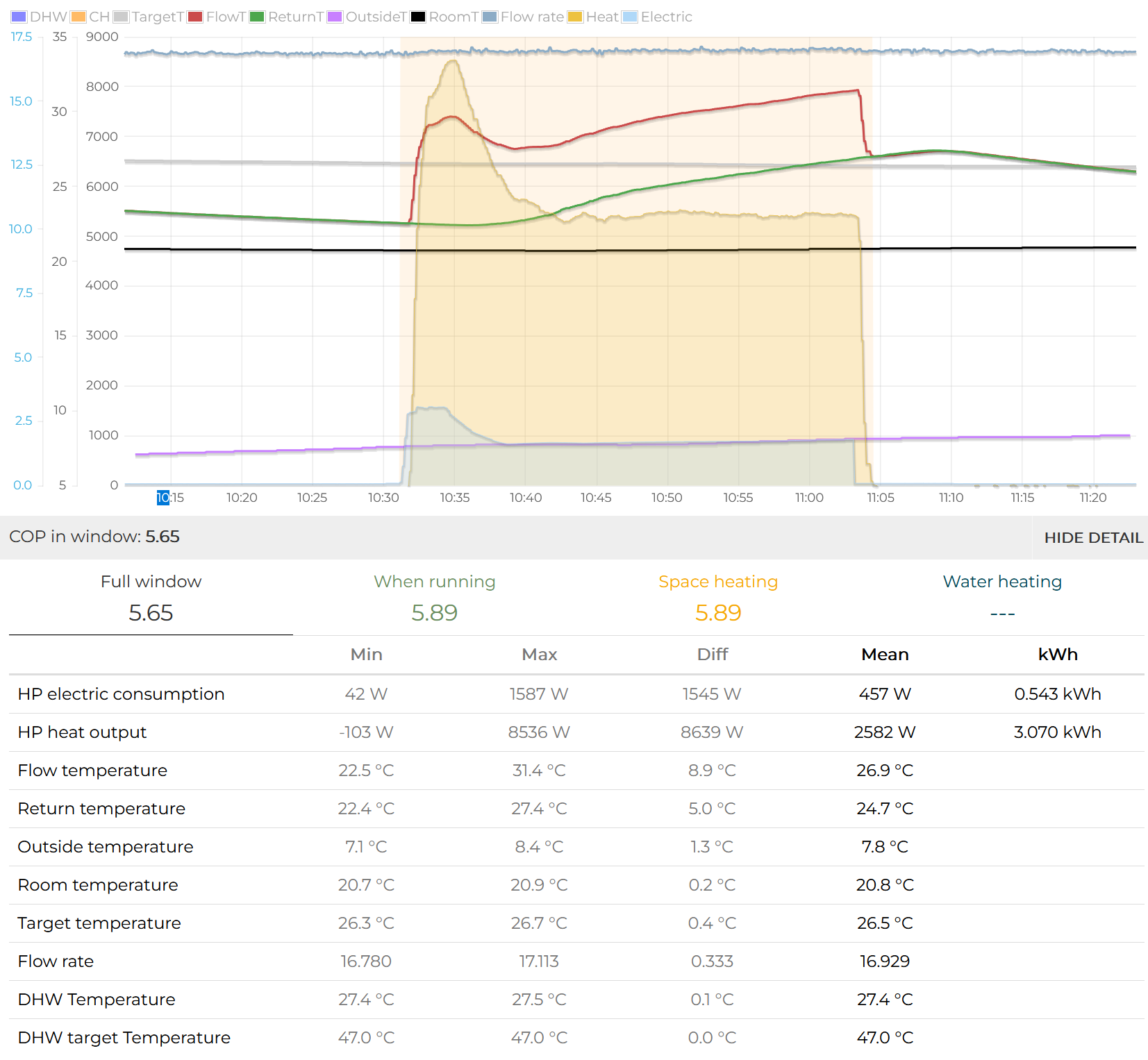
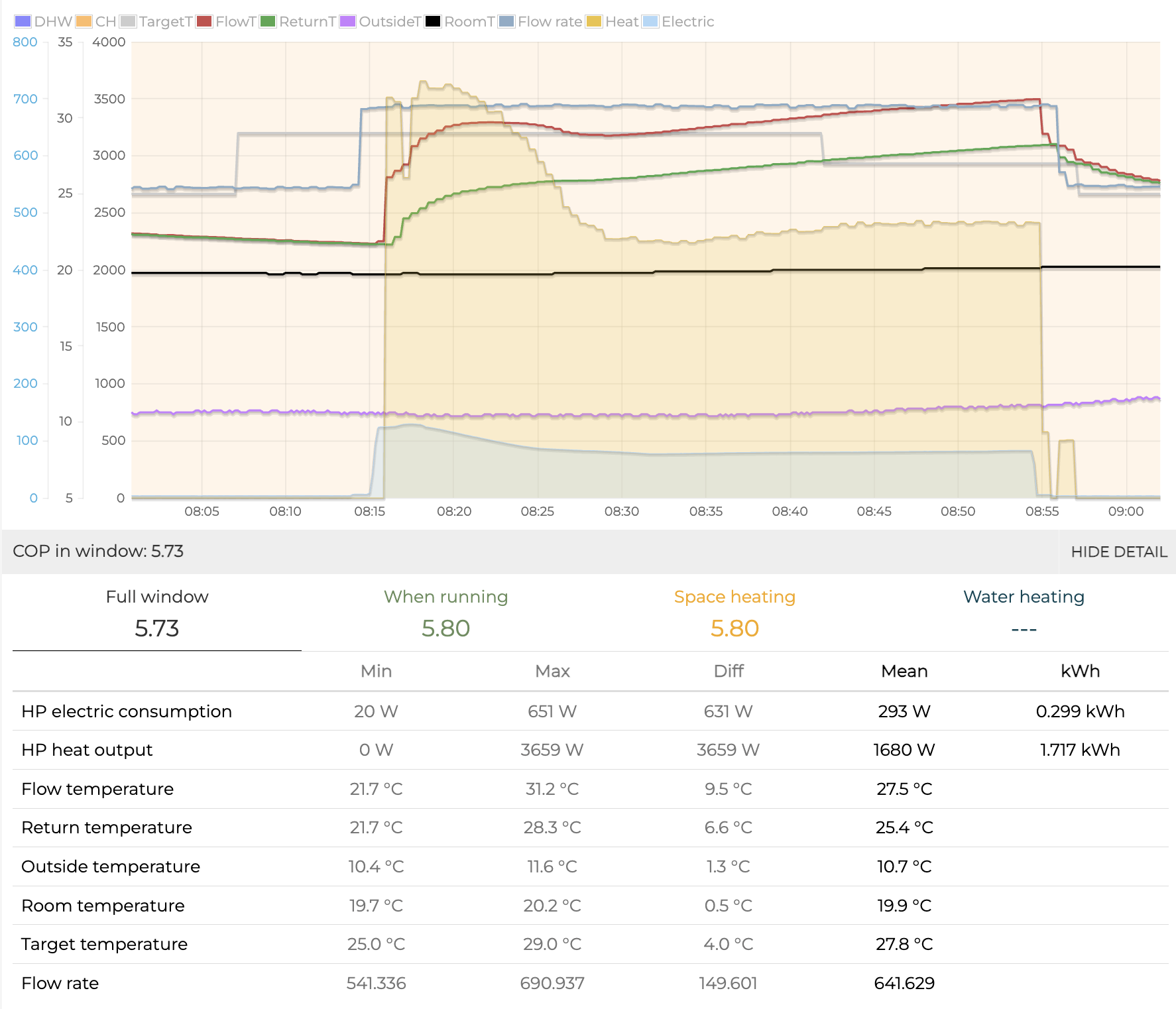
My installer came back to fix the pH balance on the water, and I noticed the flow rate changed from a sawtooth to a flat flow rate. Looking at other HPs they have a sawtooth as well. I use Havenwise to optimise the heat pump, but given the timing, I don’t think that has changed. The house is nice and warm, but is it something I should be worried about? The second picture is yesterday, where I have an air in the system problem. There are also these spike up and down on the flow.

I doubt you’d see much COP difference between active and inactive.

Inactive might be able to knock a couple of degrees off the flow temp is too high (solar gain etc), saving a bit, but i think it would be negligible. the reason i suggest active over inactive is primarily comfort.

In both active and inactive, the flow rate should drop in the off cycles. ie, i lower % than when heating within a cycle.

Havenwise has no control of flow rate or pump speed.

this is my yesterday with Havenwise

1 Like

Unless you have turned your flow rate to the absolute minimum via reducing the max. rem head setting to squeeze the last percent of performance out of your oversized heat pump as I described here. In this case, flow rate stays flat all the time. This is with Max. rem. head set to 350 mbar for me, which is barely above the stalling limit.

2 Likes

Thanks. Max head rem is set at 900 - so it should not be capped.

Conf building heat power is set to auto.

Use Expanded mode so the pump turns off when heat isn’t needed. If it does affect your efficiency, it will only be for the better. It will certainly cut your energy consumption.

I think you can schedule the circulation pump to stop running for a period via the SensoComfort. Mine is off from around midnight to 7am I think. I haven’t paid much attention to it tbh.

You can certainly schedule on/off for the secondary return pump. Never seen anything for the main pump though.

Obviously its not going to be possible to switch off the circulation pump without somehow switching off the heating as this would leave nowhere for the energy to go, however

I think that:

  • If you schedule heating off altogether then the circulation pump will switch off.
  • If you operate in expanded mode and schedule a setback, the heating will switch off entirely until the house cools to the setback temperature, which will switch off the circulation pump.

Note that doing either of these may reduce your efficiency and increase cost, depending on your house and settings.

@Zarch I have solar tubes on my house roof, which is linked into both coils in its tank. We aren’t huge hot water users either, so I decided that for the few months of they year that the immersion is needed, and with low night rate electricity, it made sense to leave DHW out of my setup and leave the Vaillant to space heating only.

It seems that @Andre_K has capably added to your bible of knowledge

1 Like

Yes, André has been a massive help in me getting this new article over the line. I can’t thank him enough for his input. :+1:

2 Likes

I just hope that end users will appreciate the time and effort that you have put into these articles. They certainly helped me when I self installed mine a year ago

I know it a long since this post but I have only just read it.

What I have done is to adjust the sharpness of the curve as the room temperature approaches the desired temperature. I did this to try an get it running in a very steady state when it is fairly cold.

What I was finding is that on low wind days it was to some extent over heating. If I just reduced the sharpness of the curve it did not heat enough on windy days.

Might be one for you @Andre_K …… and others. :laughing:

I wrote this new article, helping people understand why their Vaillant doesn’t run at DT5 very often. It’s a question I see a lot, why doesn’t it run at DT5, as they’ve heard that’s what heat pumps should run at.

Anyway, it got me thinking about my own system.

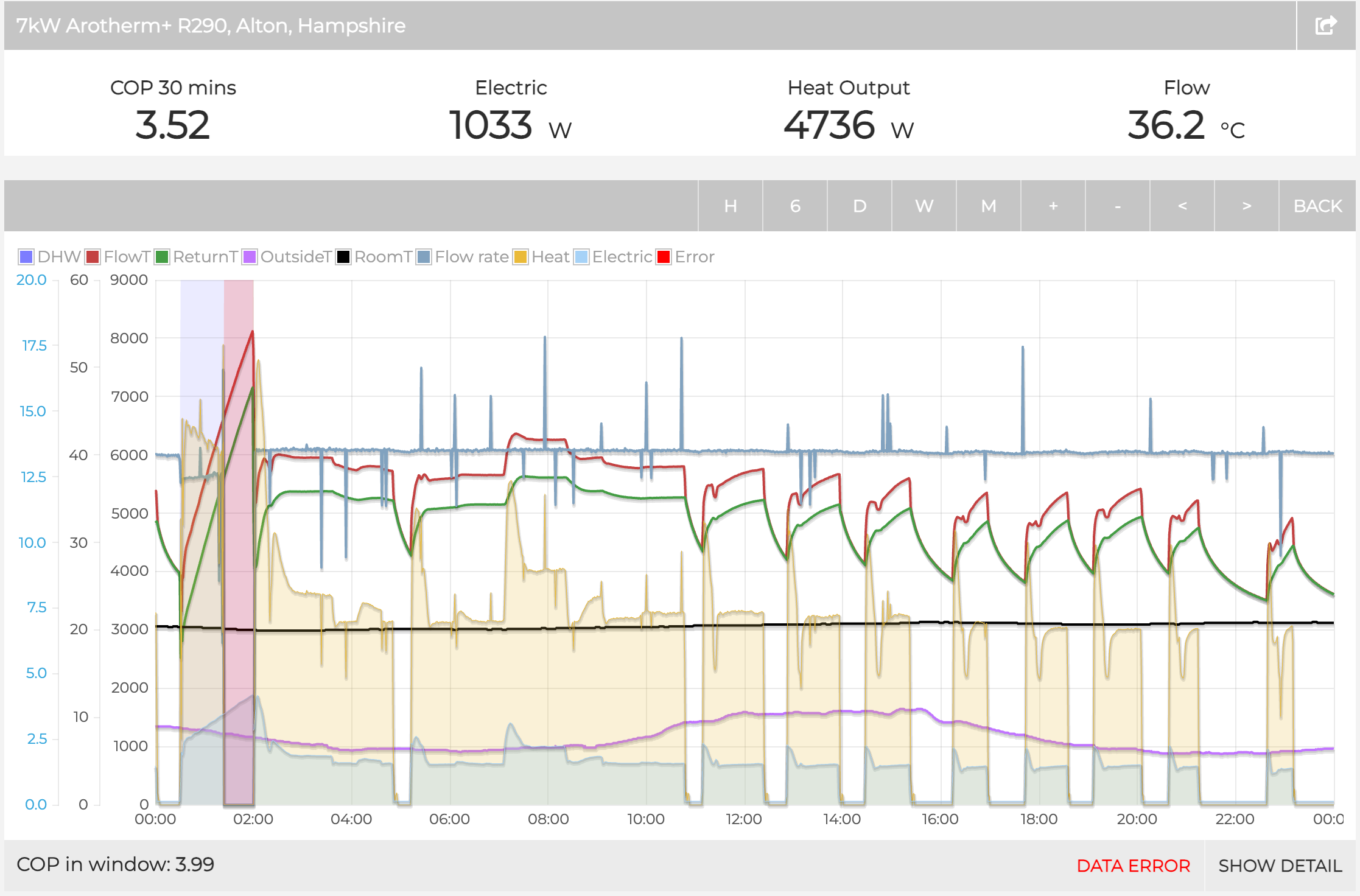
The heating pump on my 5kW is set to auto, so it defaults to 860 L/h

My heat pump spends a lot of the shoulder months at minimum output (2.2kW), so is always around DT2.2 ish when running 860 L/h.

But my heat loss is only around 3.6kW at -3C, so really I don’t need 860 L/h.

It would be more like 618 L/h

618 L/h (0.171 L/s x 4.2 x DT5) = 3.591 kW

So I’ve initially set my heating pump to 60% which gave me 686 L/h

Now I know that the vaillant doesn’t seem to care most of the time, it just gets on with the heating cycle, even at DT2.

But i’m thinking it’s surely better to run at a wider DT where possible?

In this example, DT is around 3, so perhaps better?

I might go and drop the pump a little more to get closer to 618 (the minimum is 50%).

And because it’s rarely -3C outside, I bet 50% could work well too.

I suppose the bigger question……. is this more efficient? running a wider DT at minimum outputs?
anyone done any trials?

1 Like

I think this is exactly what I investigated in my post here, just from a different viewpoint. And yes, this can definitely be better, depending on pump power requirements and actual heat loss. Your approach of adapting flow rate to the actual heating load is definitely optimal - basically if you enter different load wattages into the spreadsheet in the linked post, you’ll get your optimal flow rate for all scenarios.

I am running my oversized 10 kW pump at minimum flow rate (1000 //h) for precisely that reason: I save 50W in pump power and didn’t even have to raise flow temperature because the required increase was so small it’s negligible.

I should try to also rewrite this from the perspective of “Optimizing dT for ideal COP”…

1 Like

Hi, this is interesting and I’ve been looking into the hard ‘ramping on’ of the HP when it cycles back on, as to me it seems to promote overshooting and thus starting the count up of the energy integral. If it was smarter and ramped on slower then the cycles would be lengthened, or even stopped. Did you get an understanding if there is a way to prevent it going hard to meet the desired flow temp?

No way around it, this is just a quirk of how the Vaillant systems behave.