One thing I wanted to double check is the following.
Is it possible that the currently measured cop (ignore the absolute value for a moment), with the same outdoor environmental variables (outdoor temp) which in turns trigger the same LWT , is different if we different indoor temp?
I was thinking that if there isn’t much heat exchange between the radiators and the environment, possibly, at the same LWT, the heat produced is less resulting in lower cop? Has this any sense at all?
From a post by @glyn.hudson about his first installation, maybe 2022. I can’t find it and some of the reply links that should point to it are broken, so it seems to have disappeared. It went something like this. System installed with MID Heat Meter, COP calculated from consumption/production figures from Samsung display disagreed with Heat Meter, put down to inaccurate Samsung temperature sensors. Then realised that one of the figures was heat moved from source rather than total heat generated. With this corrected, COP figures were pretty close.
Having said that, I looked at the figures from my own Samsung Display of annual Energy Consumption and Energy Generated and (Energy Generated/Energy Consumed) gave a COP figure very close to one calculated from Q = dm/dt x cp x deltaT, so maybe my memory of what @glyn.hudson said is wrong?
Yes, that is what I do.
I have a separate MID electricity meter. I haven’t checked with 0x8411/3, but next time I have to update the system, I will add them and 0x4426/7 as well.
@SarahH Thank you for sharing the charts and data above. Very informative.
Regarding the COP discussion, I have always been under the impression for Samsung we should use energy generated/energy consumed (although I think I recall discussions that Daikin?? may have required adding the consumption to the numerator when calculating COP).
I have a MID-meter which measures electrical usage of the outdoor unit only (separate circuit), so is not connected to the same circuit as the MIM controller and circulation pumps. I record daily ‘usage’ figures in a speadsheet, from both this meter and from the Samsung controller. What I can confirm is that my meter ‘consumption’ figures are consistently lower than those reported by the Samsung controller, with a reasonable correlation that would suggest that the figures the Samsung controller reports include circulation pump usage (i.s, the difference is small in summer when the pumps run for only 20-30mins during a single DHW cycle, but are larger in winter when the pumps run for many hours per day due to continuous space heating). I do not know whether the Samsung controller reading is from 0x8411 and 0x8413, but it would appear to be for both indoor and outdoor units combined (whereas my MID-meter measures outdoor unit only as it’s on a separate isolated circuit).
Further, the correlation between meter readings and those reported by the Samsung controller seem reasonable - i.e, it is very believable that the difference between the two figures can be accounted for by circulation pump usage and MIM controller electronics, so I have reasonable confidence in the energy consumed figures reported by the Samsung controller.
As an aside, I do like that I can calculate a COP figure based purely on electrical usage of the heat pump (outdoor unit, excluding circulation pumps etc), as I consider this to give me a more direct comparison with my previous oil boiler running costs, which of course also required electrical usage for an oil pump and circulation pump etc (my house baseload would jump to 600W when the oil boiler fired up)
Not directly, @bravoleader80, but maybe indirectly. A colder indoor temp may provoke a higher compressor speed which (as postulated in earlier posts on this thread) may give an improved compressor polytropic efficiency (i.e. more energy output per unit of energy input). This would appear to you as a higher CoP…
…which begs the question of whether the Samsung CoP data included in the EHS Data Book (Table 2-9) includes Indoor loads. (The referenced test standard OM-3-2015 - which primarily covers AHUs rather than heat pumps - doesn’t make this clear, nor does EN 308:2022 which OM-3-2015 references for EATR and OACF calculation.)
Forgive my cynicism but I’d guess that the Data Book figures exclude circulating pumps/MIM, so giving Samsung heat pumps an apparent CoP boost by several percent. (On my HTQ 0x8411/0x8413 typically differ by 90-110W - quite believable for two circulating pumps plus the MIM - which would be about 10% of the total power consumed.)
@toadhall I hope I haven’t reopened a can of worms. There is a recent discussion on a Facebook forum with one member adamant that you need to add consumption to generation before dividing by consumption. His supporting evidence was a post on buildhub by a Samsung user whose generation was less than his consumption. However, subsequent posts from later days showed a generation of 0 despite a warm house, so clearly this was faulty.
There is an entry that implies that Glyn had said something along those lines, although nowhere in this topic does Glyn say this. Could there be some missing comments? Could @glyn.hudson clarify whether he is the author of the ‘heat shifted from the source’ comment please?
I remain of the opinion that Samsung figures for generation can vary widely and should not be relied upon - my Samsung overestimates by 15% compared to my MID approved heat meter and Glyn’s underestimates by 30%.
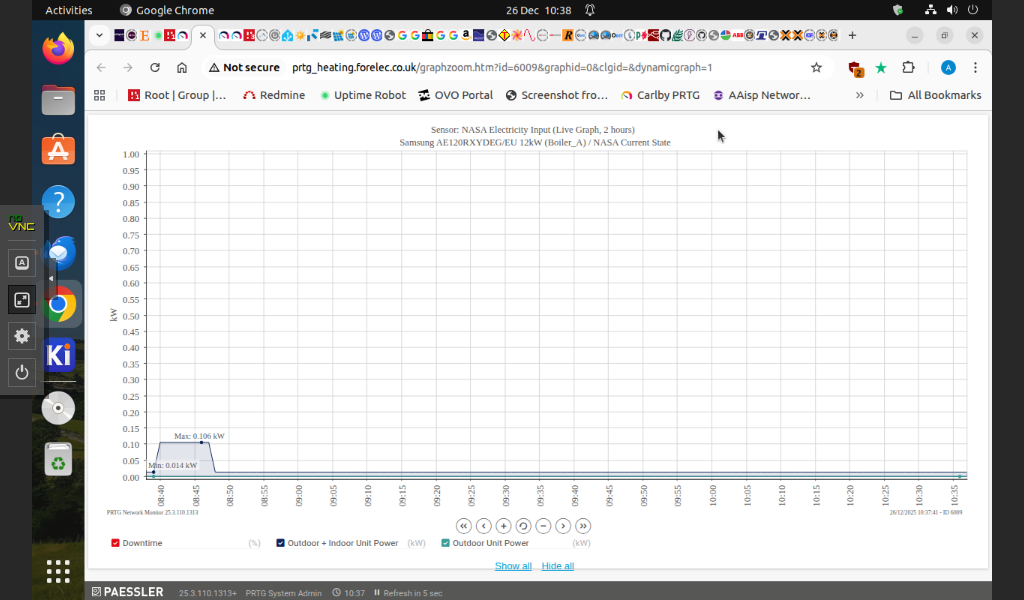
0x8413. This is definitely Outdoor + Indoor Unit power in Watts. If the primary pump is wired to the Indoor Unit it includes pump power as well. This is a graph of a pump anti-seize cycle …..
The standby power is 14w, compared with my MID meter that registers 10w, and this increases to 100w when the primary pump is running. The accuracy at this low standby level will not be particularly good, so I don’t think the difference between 14w and 10w is significant. Anyway, I was quite impressed by how low it is.
0x8411. This is definitely the Outdoor Unit power in Watts. The standby power is zero, impressive again.
0x4426. This is the current Generated Power (heat shifted from source + electrical input) in Watts. Compared to my calculated power it reads high, but I calculate based on 30% propylene glycol, so I assume this reading is based on pure water. Since you can also read Flow Rate, Flow Temperature and Return Temperature it would be possible to correct this reading for glycol and compare.
0x4427. This is the Total Generated Energy (heat shifted from source + electrical input) in WattHrs. The Generated Energy numbers on the display look like they are generated from this.
Out of interest, I checked the effect on density and specific heat of 20vol% propylene glycol (PG) versus water:
At 30degC: water density = 992.2kg/m3, Cp = 4.1775kJ/kg/K; PG density = 1015.9kg/m3, Cp = 4.0758kJ/kg/K
At 40degC: water density = 988.0kg/m3, Cp = 4.1799kJ/kg/K; PG density = 1011.3kg/m3, Cp = 4.0850kJ/kg/K
The interesting thing is that when calculating generated energy from a volumetric flow rate (e.g. lpm) both density and specific heat are in the numerator, and the (density x Cp) product is almost the same for water and PG. At 30degC, the error (compared to water) is -0.10%, at 40degC it is +0.04%.
These differences are trivial compared to the accuracy of typical flow and temperature instruments. So just taking the MIM-reported generated energy figure (0x4426) should be good enough for PG systems, at least up to 20vol%.
I’m back after a period of observing the system, especially in this cold snap around my area. I stil don’t get it. I though flow temp was driving the performance of my system.
Low LWT, higher efficiency. High LWT, lower efficiency.
Apparently that’s not the case..after getting some really low figures (around 2.3ish) with the weather compensation curve Min point at -2/41C, I reverted it back to -2/45 and I’m getting better numbers. Still not even close to the advertised 3.65 but better than 2.3.
I’m a bit at a loss of words/thoughts. Not sure where to go from here.