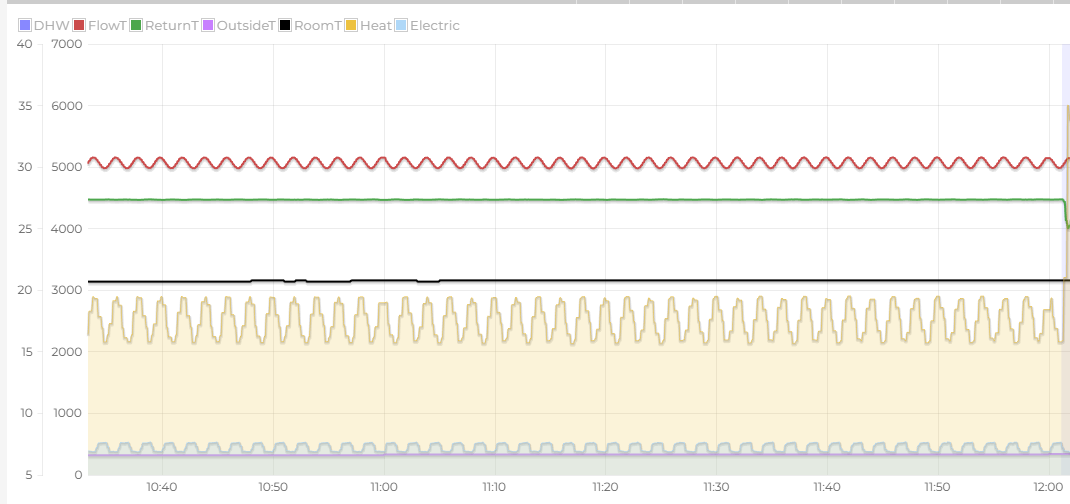
Our kitchen used to be colder than the rest of the house before, but now it’s pretty much 20/21 throughout the house. It’s quite strange how even the temperature is.
Running at a fixed pump speed I think has improved efficiency as it’s stabilised the system better, especially in milder weather. I think it’s less prone to cycling and less reluctant to drop to the lowest compressor frequency. I also think (though still nesd to test this further to prove) that variable pump speed messes with the balancing, which could explain why it seems like some of your rooms are cooler when the flow temperature is lower, but fine otherwise.
They cost around £32 each, so not cheap, but if you’re doing it at the point of fitting, you save on the cost of a TRV. Probably never going to “pay themselves off” but that wasn’t the point, for me at least.
Lastly, I no longer have a noisy pump when it starts up, its always running at the set flow rate, and now the noise is barely perceptible. The valves themselves are completely silent too, unlike the lockshields I use, which are silent when open, but can whistled when closed down.
Hey @jakeymd1 , thanks for sharing your file. I still have to play with it but I think there’s something missing there. I have asked Gemini to run your math on the data you are using and it agrees with you which is great. I mean, math is math.
Then I gave it some updated information which I was sure I have mentioned related to the living room radiator being upgraded to triple panel and the one in the bathroom changed for a 1000*600 mm (1720 but) radiator plus the removal of a window (the small one that should account for roughly 50w of heat loss).
With these updated figures, Gemini tells me that 42 degrees flow temp should be possible. I mean I’m trying to lower it to try and get to a better COP but when running at 34/35 degrees I should be getting 4.25 or similar, instead I’m lucky If I get close to 3 with 10 degrees outside.
I don’t understand if I’m doing something wrong and where I should be looking to improve the efficiency of this system (if any) but I’ve seen same heat pump having great performance so I believe there should be an explanation.
May be I’m measuring the parameters in the wrong way or considering them the wrong way. If you have any theory please let me know. Thanks
Hi, can you share your YAML for how you are getting your consumption and production and COP values in case you have the wrong codes? I am no expert, but I also use ESP32 to view Samsung data.
The other possibility is that the Samsung measurements are known not to correspond that well with proper 3rd party heat meter measurements. Mine overestimates consumption and production but in a similar proportion so COP is comparable. Others have found larger differences.
Although there’s nothing wrong with your equation, @bravoleader80, I’ve noticed that (on my MIM-E03EN at least) 0x4426 is only refreshed every 160 seconds or so (compared with about 30 seconds for 0x8413). And since a lot can happen in ~3 minutes I’m not sure I’d want to rely on this approach for CoP calculation (I’d go with a heat meter and CT if I had the money and enthusiasm). Also I don’t think I’d trust the calculation built into the 0x4426 payload:
I presume Samsung have based it on water, so if you have glycol there would be an error, and in any case I don’t know whether they have included temperature correction for density and specific heat in the calculation. (I rather suspect not, given the crudeness of their calculation for saturation temperature in their compressor pressure control algorithm.)
If (as I assume) they have based 0x4426 on Q = m.Cp.(TW2-TW1) the number is only as good as the accuracy of m and deltaT. In the latter case, TW1 and TW2 are both measured using contact thermocouples - a method prone to fairly significant error (I can see a variation of up to 2degC just from cold air recirculation on my unit), and a small difference between two large numbers only magnifies any error.
I don’t think 0x4426 or 0x8413 take into account energy flows associated with indoor equipment (mainly pump(s), but also the PCB itself), so the calculated figure will only be an approximation of the “true” CoP.
That’s a pretty amazing explanation there @SarahH , thanks!
When you say approximation, I get it, would you say underestimated or overestimated?
There are still some behaviour I don’t understand. I’m collecting some of them as a unified document and I’ll post them later.
I wanted to mention something that is usually overlooked. The Thermino. I’ve had to install it because I don’t have room in my house and I was a bit concerned about using it. Almost a year running with zero problems. If there’s anyone with questions about it, I can give my honest opinion without any bias
Thanks a lot so far for all the feedback, really appreciated
The only way you could find out for sure is to compare the CoP you calculate from 0x4426 with one measured on a heat meter. Flowmeter and thermocouple errors can be in either direction of course. Even an “accurate” flowmeter (± 1% on the tin) may not achieve this if not installed correctly. And a ±0.5degC error in a thermocouple output can turn into ±10% CoP error for a (Tw2-Tw1) of 5degC. You could check that Tw1 and Tw2 are reading the same when the heat pump has been stopped for several hours, but even this isn’t conclusive - they may differ at other temperatures. And you could filter out refresh rate errors by taking (say) daily readings from 0x8414 (outdoor unit cumulative power consumption) and 0x4427 (cumulative energy production) - both appear as Wh, so divide the daily reading differences by 24 before taking the ratio.
Personally, I take a fairly jaundiced view of absolute CoP values, because of the above errors and because some folk - including manufacturers - tend to exaggerate them (or measure them under test rig conditions). Instead, I use them just for parametric runs when trying different settings, and assuming (hoping!) that the errors will be the same for every run and thus cancel out. For example, successive DHW runs with and without Quiet mode, or successive days with different WL settings, or setback temperatures, or different #209x settings. AFAIAC, the electricity meter is mightier than the CoP…
PS I’d never heard of the (Sunamp) Thermino until you mentioned it. Why not provide us with a couple of paragraphs of what it is, when you might use it, and your experiences as a user?
Thanks for your message Sarah, as always very thorough and informative.
So the Thermino. I’m currently using this model here
Thermino xPlus - Sunamp UK paired with the heat pump “Optimino” key. It’s a board connected to the main board to enable a heat pump to trigger the phase change of the material inside the unit.
Basically you run it like a cylinder but you don’t have the legionella cycle. I had to use it because I don’t have room in my house. The only option was to put an horizontal cylinder in the loft but the costs of installing it there, plus all the pipework needed made the cost on par with the 300L Thermino. I could install it ground floor in my bathroom with minimal disruption to all the existing pipework.
Is it perfect? No. There are some bits and pieces that I don’t like. For instance from the Samsung controller you have only 2 states, the water is either at 40 or 77 degrees. 77 means “full”, as soon as you use it a bit it goes down to 44 and you have to rely on the LEDs on the Thermino itself (which as well have very poor reliability).
Another element I don’t like is that by default, as soon as you lose that 77 degrees status, the immersion heater will kick in. Very very poor design. What I did was to isolate the circuit with a ZigBee switch which I always keep disabled unless I really need it. In the meantime every night for 2 hours I have the HP running at 65 degrees to trigger the phase change. Cop of roughly 2.
By default not ideal but I made it work as it’s best for me and it has been working very well so far. If you have room for the cylinder, obviously it’s a no brainer but for me this was really a godsend
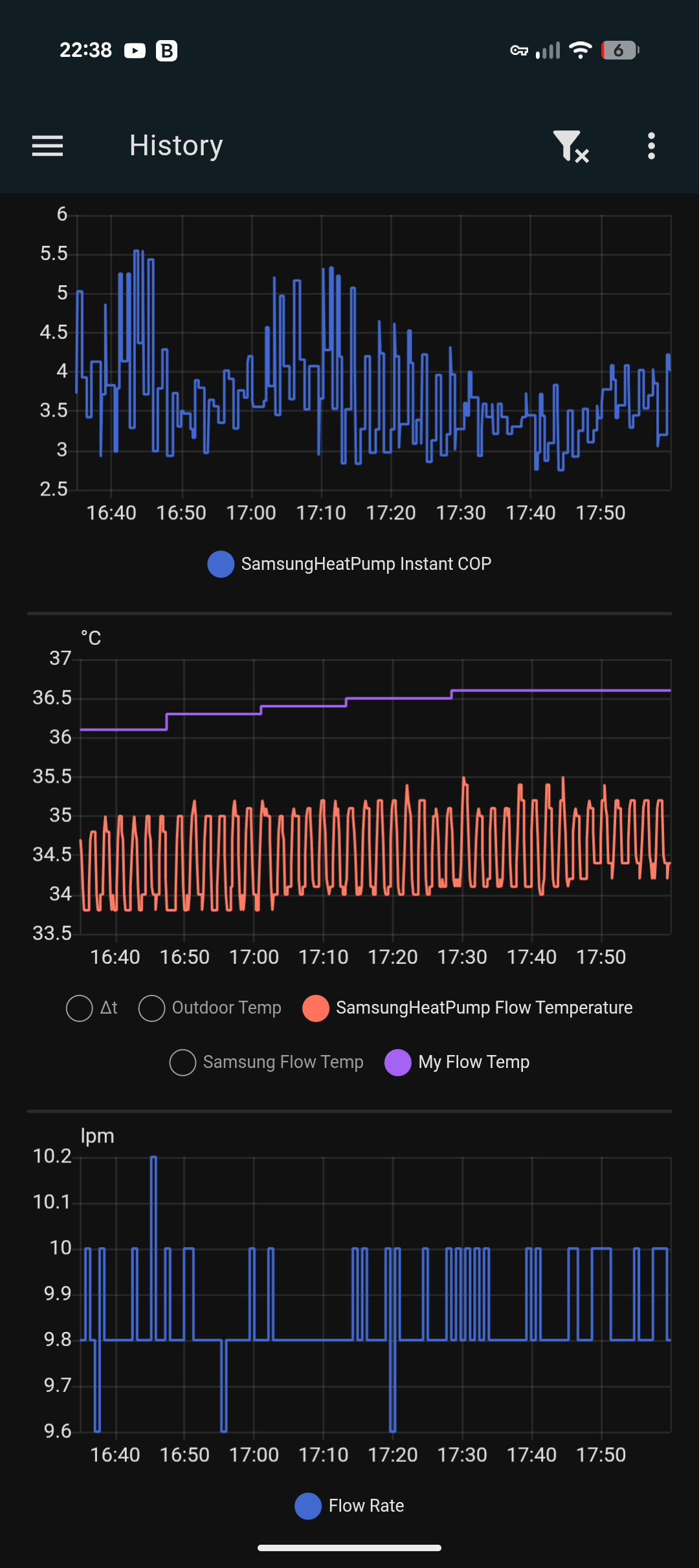
This is just a couple of hours fragment but after the initial setup the system started going like this.
Basically the purple is the set water temp , the red is the measured water temp. As you can see there"‘s some sinusoidal shape going on with very little variations which when they go up they give me higher cop Vs when they go down that apparently I get a lower cop. Does this mean anything to those more expert?
The flow rate seems to stay in there region of 9.8lpm
I’m happy to hear your opinions on this. Best regards
@bravoleader80 instantaneous CoP calcs are meaningless when based on noisy data like that. If you really need short-term CoP values, I suggest that you recalculate them from hourly averages or, if you want a smoother output, rolling hourly averages.
I’m happy to see this is a standard behaviour but then I don’t get why it’s not always like that. If I should expect the system to behave like this then I don’t get why it not doing this all the time.
The users on here have just put it down to poor control on Samsung’s part. There have been plenty of discussions on the forum about it, but most recently here:
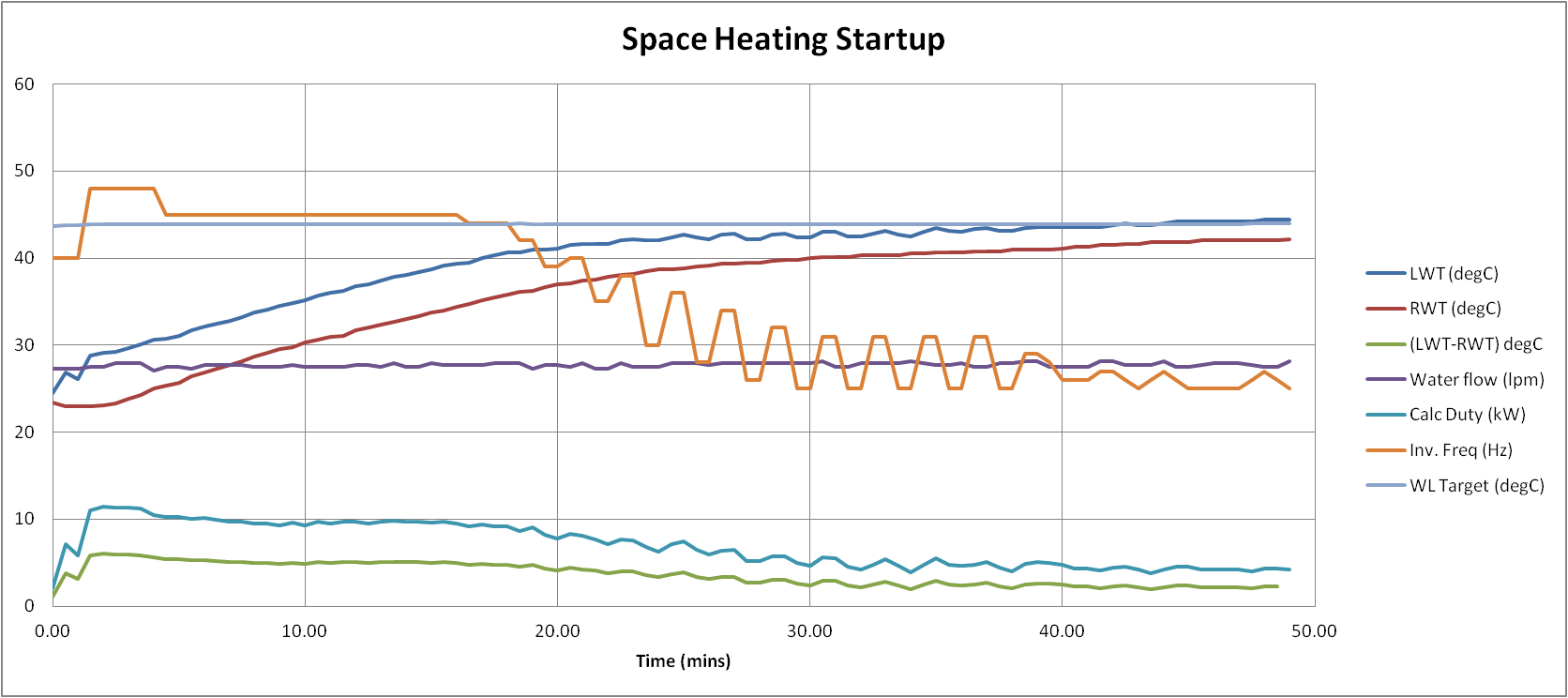
Inspired by @jakeymd1’s plot above, I thought I’d show a recent example of mine (an 8kw HTQ) which shows a few interesting things. This data was collected right after my overnight setback, and are taken from SNET data gathered at 30s intervals:
Everything is reasonably smooth until minute ~18, but then as LWT (dark blue line) approaches WL target (grey line, about 3degC delta), the compressor inverter frequency (orange line) starts to oscillate.
There is clearly 2- or 3-term control of inverter frequency in the controller algorithm - note that LWT approaches target asymptotically (so as to avoid overshoot) between minute 18 and 40.
But this frequency cycling induces a cycle in LWT, hence a cycle in (LWT-RWT) deltaT (green line), hence a cycle in calculated energy output (light blue line). (The water flow rate - purple line - is essentially constant throughout).
Once LWT reaches target (around minute 40) things settle down - the inverter frequency becomes almost constant, and as a result so does the energy output (~4kW - close to the Samsung-declared turndown of the 8kW HTQ). I should add that the roomstat was demanding throughout the whole period so was not controlling the process - WL was in control.
That the generated energy easily exceeded the nameplate 8kW (maxing at over 10kW) just confirms that Samsung have just de-rated the 14kW unit.
(PS - I’m not pretending that I run an optimised operation. I know I could reduce my LWT and maybe get a lower electricity bill, but I’m happy at £700 per year for a 3-bed detatched, so please don’t throw rocks…)
What is interesting to see in your graph is that after a bit of oscillation, the lwt stabilises, mine lately has been just oscillating. In all fairness I’ve stopped using water law from Samsung and implemented my own water law defining the lwt temperature directly based on the linear function.
How are you tracking the compressor frequency? Is there a variable I can read?
Sure, @bravoleader80, just read 0x8238 for actual frequency. 0x 8237 and 0x8236 are the ultimate target and the step frequencies (I believe the latter is to prevent excessive changes in a single controller parse).
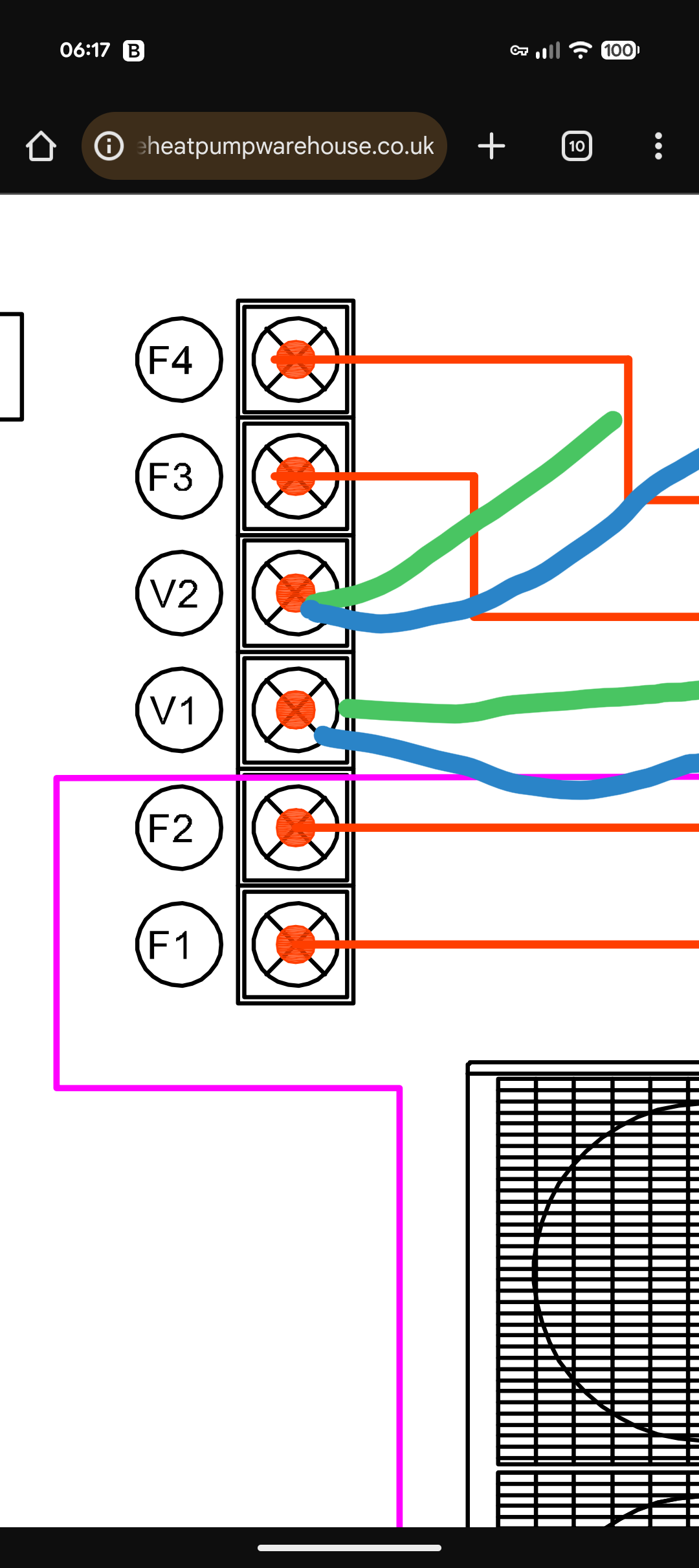
Hi @bravoleader80 I have ESP32 connected to F1 and F2. I have also purchased the Samsung WiFi unit, but I assumed that I would have to choose which device to connect as there is only one 12 volt supply. You have connected both at the same time. Have you had any problems with this and have you any advice that you can give me? How exactly have you wired these two devices?
You know? I’ve never though that the power supply could not be enough. I’m pretty sure they are both connected to the same power terminals. I’m not familiar with the technical terms in English but each + cable is connected to the + terminal and the - to the - terminal. I suppose they are in parallel. They have been working like this for a year now. If you forgive the very bad drawing, with green being the M5 and blue being the WiFi controller. Does it make sense?
I’m seeing the compressor stopping every hour (more or less) and restarting with the pump resuming every time from 22lpm like a new start each time.
This has never happened before. The system is not reaching room temp as I’m running it by setting the hot water temp on the Samsung unit (no weather comp) and implementing my own weather compensation.