Your circuits are interesting to be honest. Still not sure how exactly it is working You pump 28C water to UFH and then you switch valve and pump 50C to radiators ? Sorry for my ignorance but still not fully understand it
Thanks for the numbers for 42F1. Could you please explain what effect has 50% and 150% ? Thing is I’ve enabled frequency ratio control #5051 but haven’t change anything on address 0x42F1 yet. So it still reads 0 and not sure if there is something set or not and is really zero. Does it mean that actually is is set to 50% (like 0V)? Nevertheless I can see it has an impact already and it’s positive!
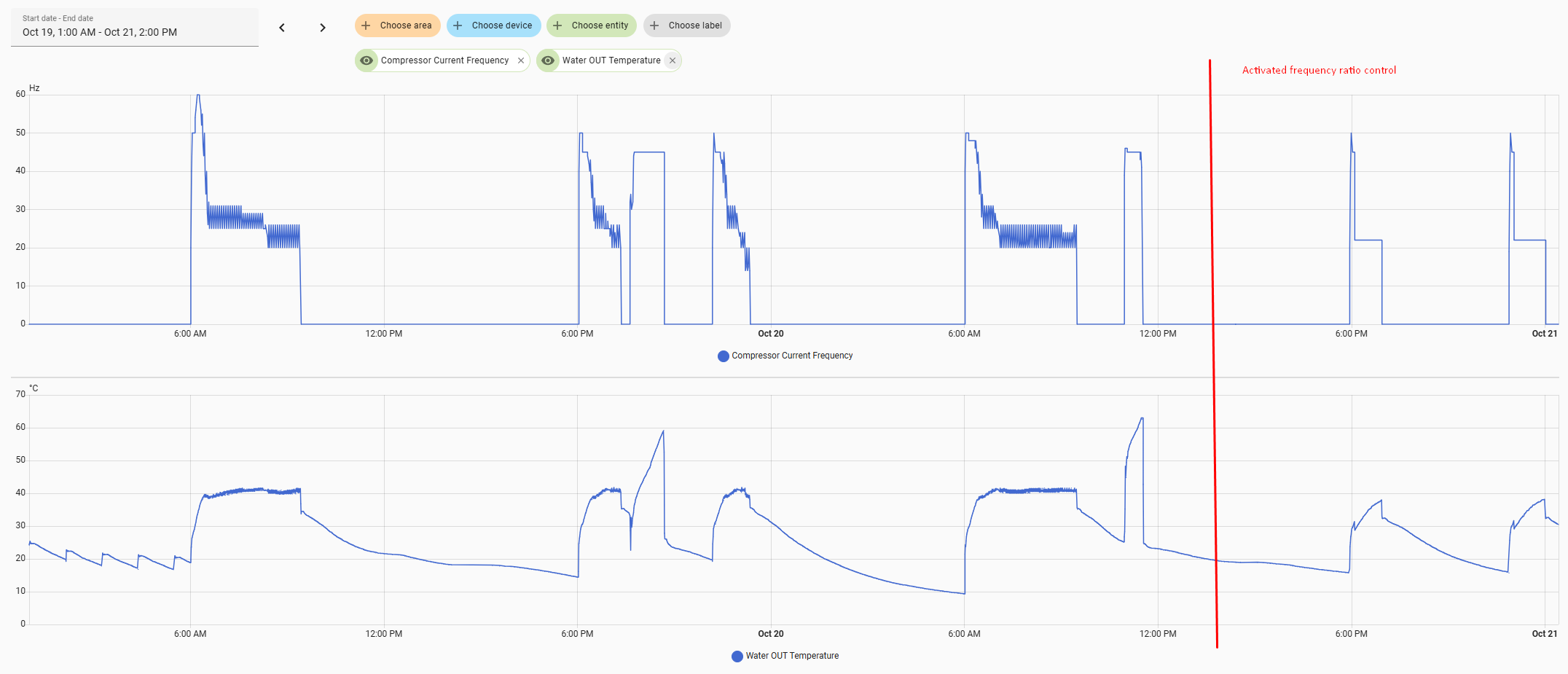
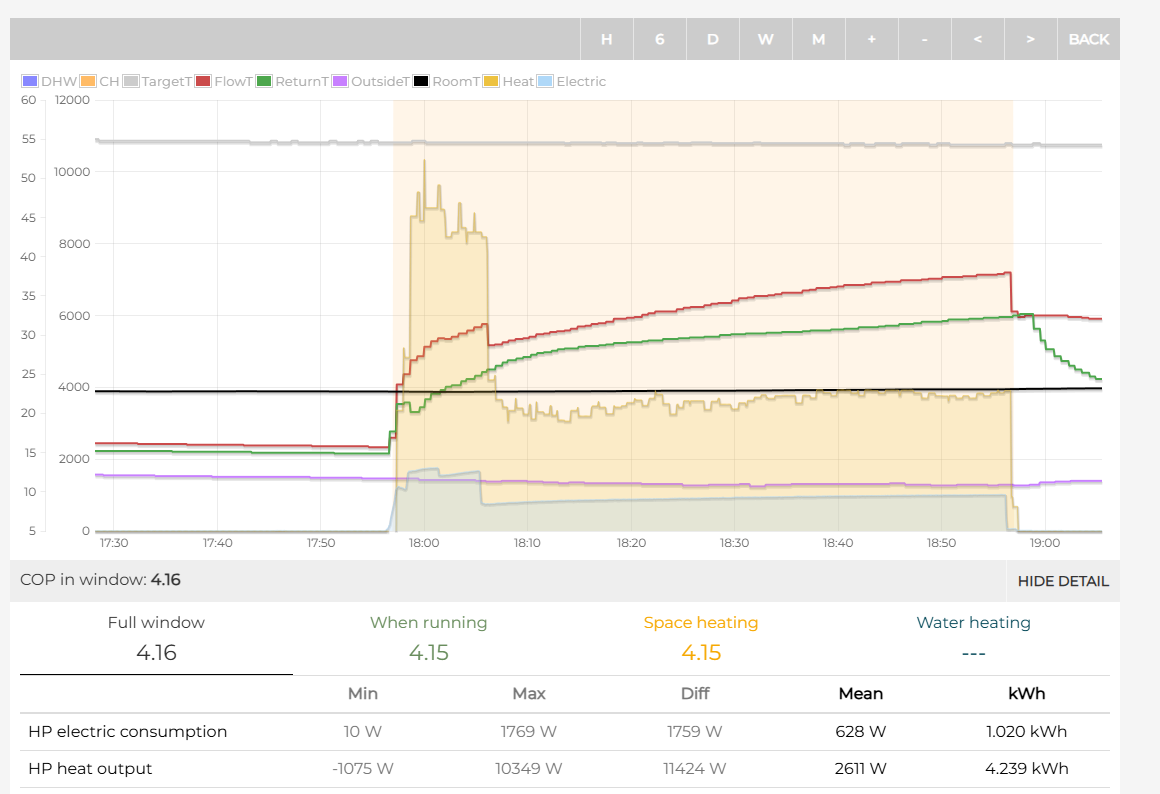
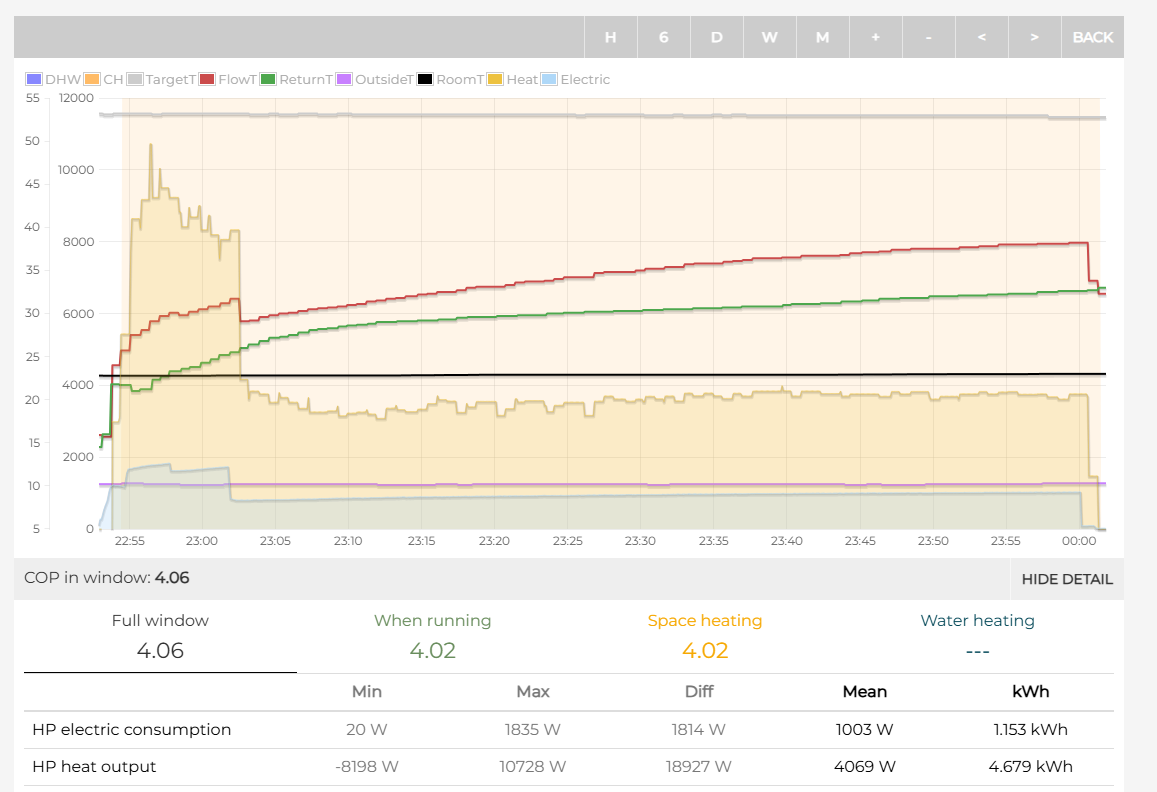
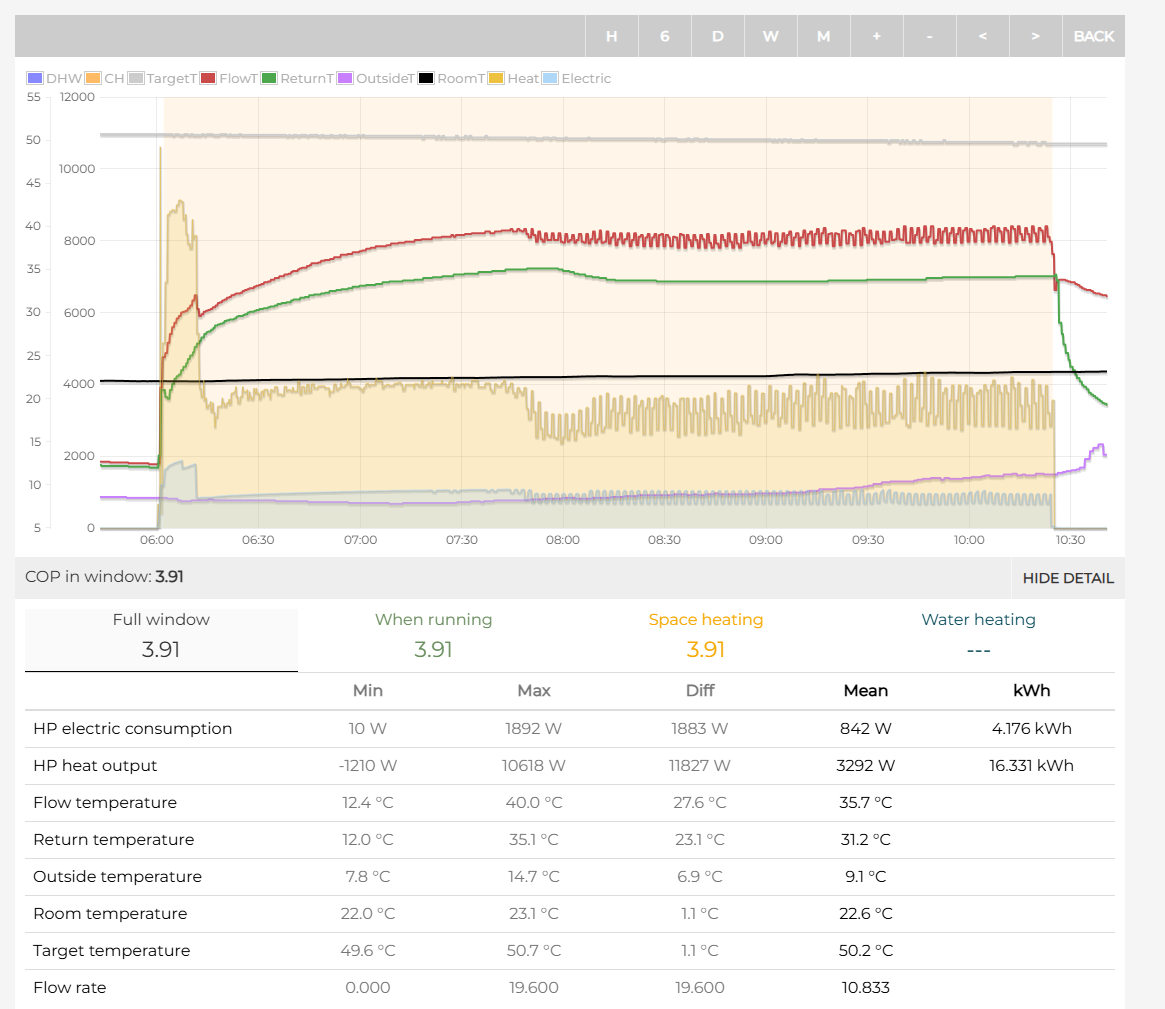
I can see the ramp up to temperature is slower and the compressor is running without any jumps and quickly establish at 22Hz.
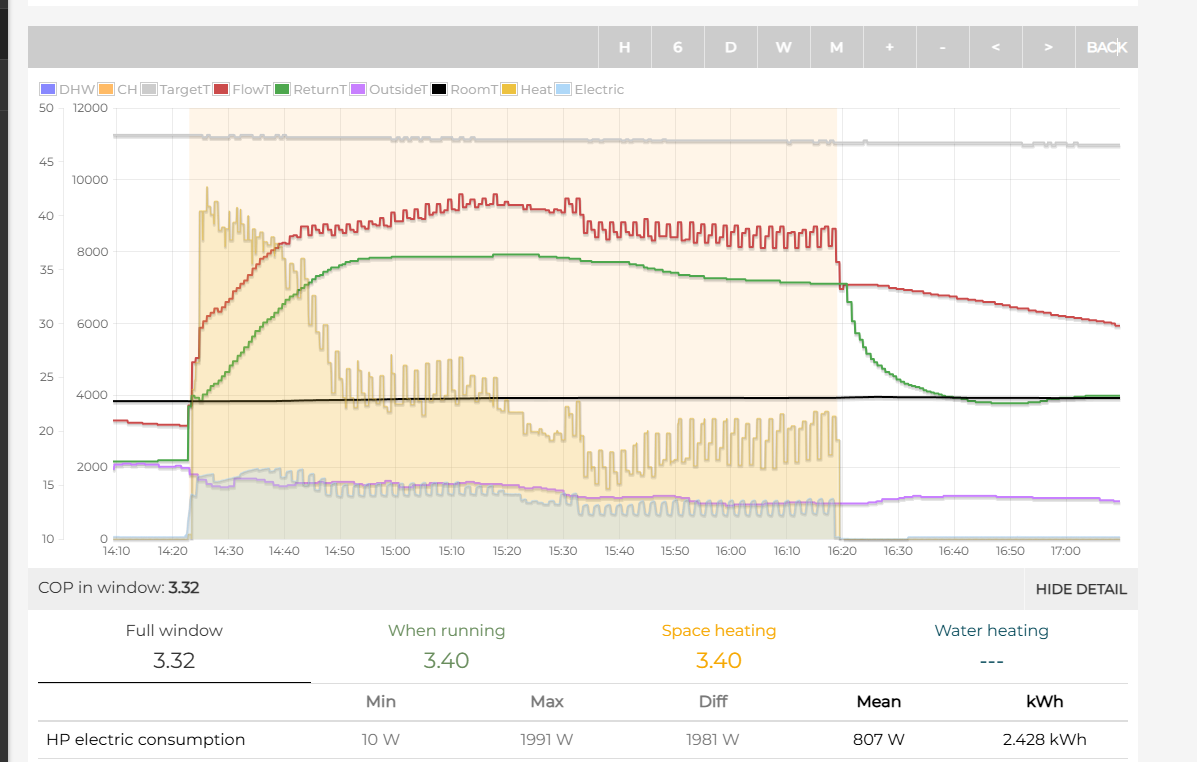
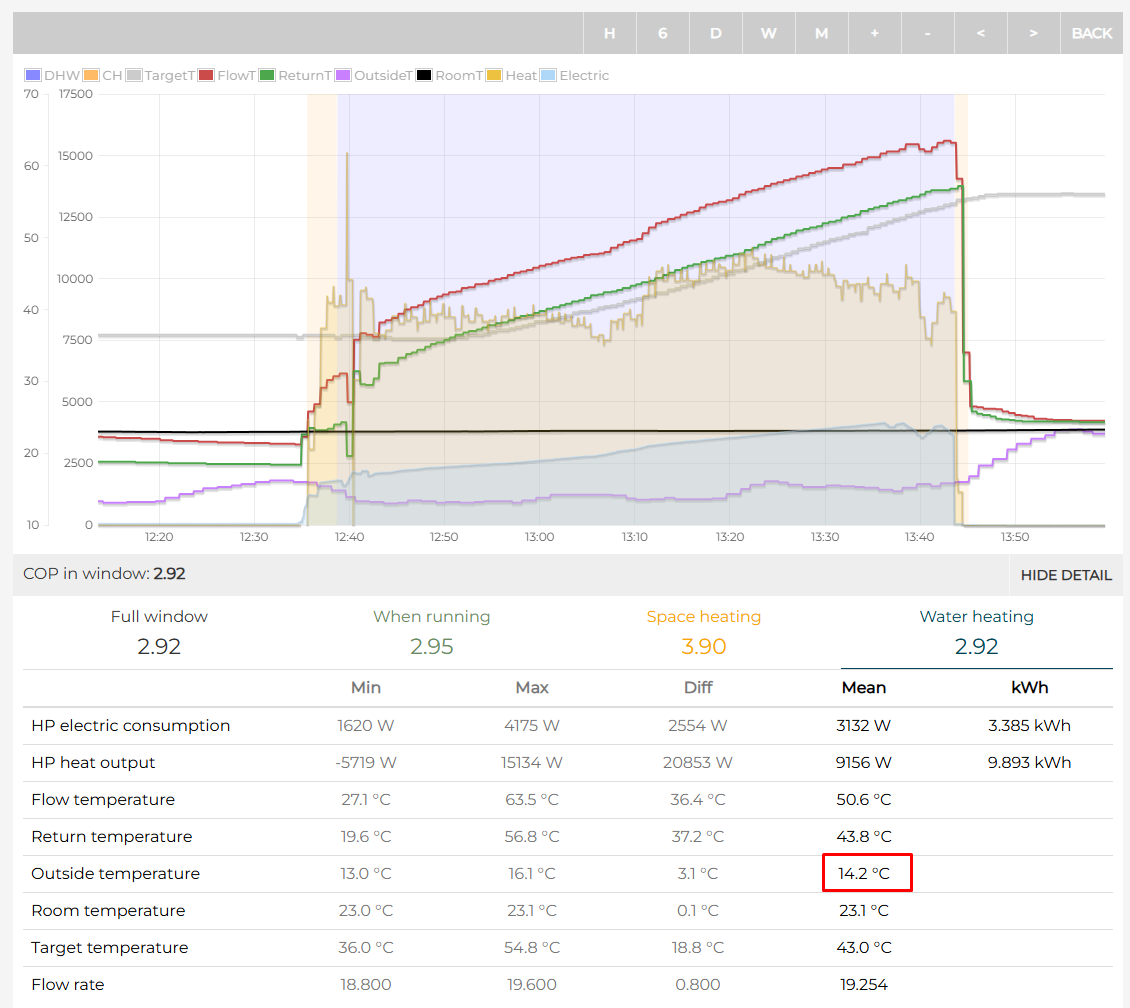
This is one of the run before and the modulation is pretty horrible… After 15 minutes it starts this zig-zag pattern all the way. Every compressor frequency change I can hear every minute when I stay next to the pump. These are definitely suboptimal working conditions.
So let’s see how it will behaves in following cycles but it looks pretty promising. With decreasing outside temperature it can be only better. This also gives me an impression that really my main issue is that the water volume in my circuit is pretty low and with such fast ramp up pump can’t keep with it but why it is doing such zig zag patterns is still unknown to me. Let’s see if FRC will have any impact on this modulation, I‘m curious what will happen if I will be approaching target temperature. Still pretty impressive taking a fact I haven’t changed DR via modbus yet. Adding a buffer tank (volumizer) I think it could really help.
Clearly I see the effect of just enabling it are real!
I’m glad that I’m not only one seeing the benefit of trying to tweak every possible bits of the hw haha.
About my 28C, I don’t circulate water at 50C at all, all zones circulate 28C water. period.
About 42F1, the value swing is meant to cap the compressor value at the given percentage. I guessed that 100% is the default. So when 42f1 is not set, maybe it means cap at 100%.
In my config I use 50% as the max compressor frequency.
For my DHW cylinder (120L retrofitted from the gas boiler), it takes 1h30 to fully heat it at 51C.
I’m eager to see your graphs with 42f1 adjusted to observe its effects.
I need to try this! Just going to try turning it on and nothing else. See what happens. My heat pump is 8KW but my heat loss is only 4.5KW. I’m currently using quiet mode which I thought did the same thing. What would a 50% Frequency reduction give as a percentage of heat output?
Can you explain the difference between Quiet Mode and your method of capping the compressor max frequency? Obviously it is easier to apply Quiet Mode if one does not have access to modbus.
Well, that’ a fairly good question, I can see the effects are different, but I couldn’t describe precisely their internal behavior. I’ll dare say the quiet mode is a “dynamic” frequency control. But it definitely is not an accurate description.
I’ve been skimming through docs and couldn’t find a definitive answer to your question
There is one significant difference. I’m using FR control myself. First, I’ve tried it over modbus, but it sometimes seemed as unreliable despite writing the values periodically (I’ve read that the modbus value is valid only for some time). It seemed slow/vague in response despite in status display showing that DR is enabled. I’ve switched to 0-10V control and it looks to provide better response to what I set despite it’s more coarse (only 10 % steps). Anyway, I wanted to use for night time to reduce noise, because I can’t run the pump 70 Hz plus in night, but ±35 Hz as is Quiet Mode limit is way too conservative. So I tried to replace QM with FR control and I’ve noticed one change - when ramping up, HP does not respect FR control settings. Only when it stabilizes, it changes frequency to FR control limit. When in normal mode + FR control, compressor goes up to 70 Hz (0°C outdoor) during start of the cycle. When in Quiet Mode, it goes only to 50 Hz (sometimes only 40 Hz) during start of the cycle.
It looked promising at the beginning but it happened what I’ve feared it will happen
Ramp us is much slower because compressor is capped by 50% or so and the heating process is slower at beginning but with stable COP and heat generation. But as as soon the pump will reach target flow temperature (takes much longer now) the zig-zag pattern and big compressor frequency altering starts again as before.
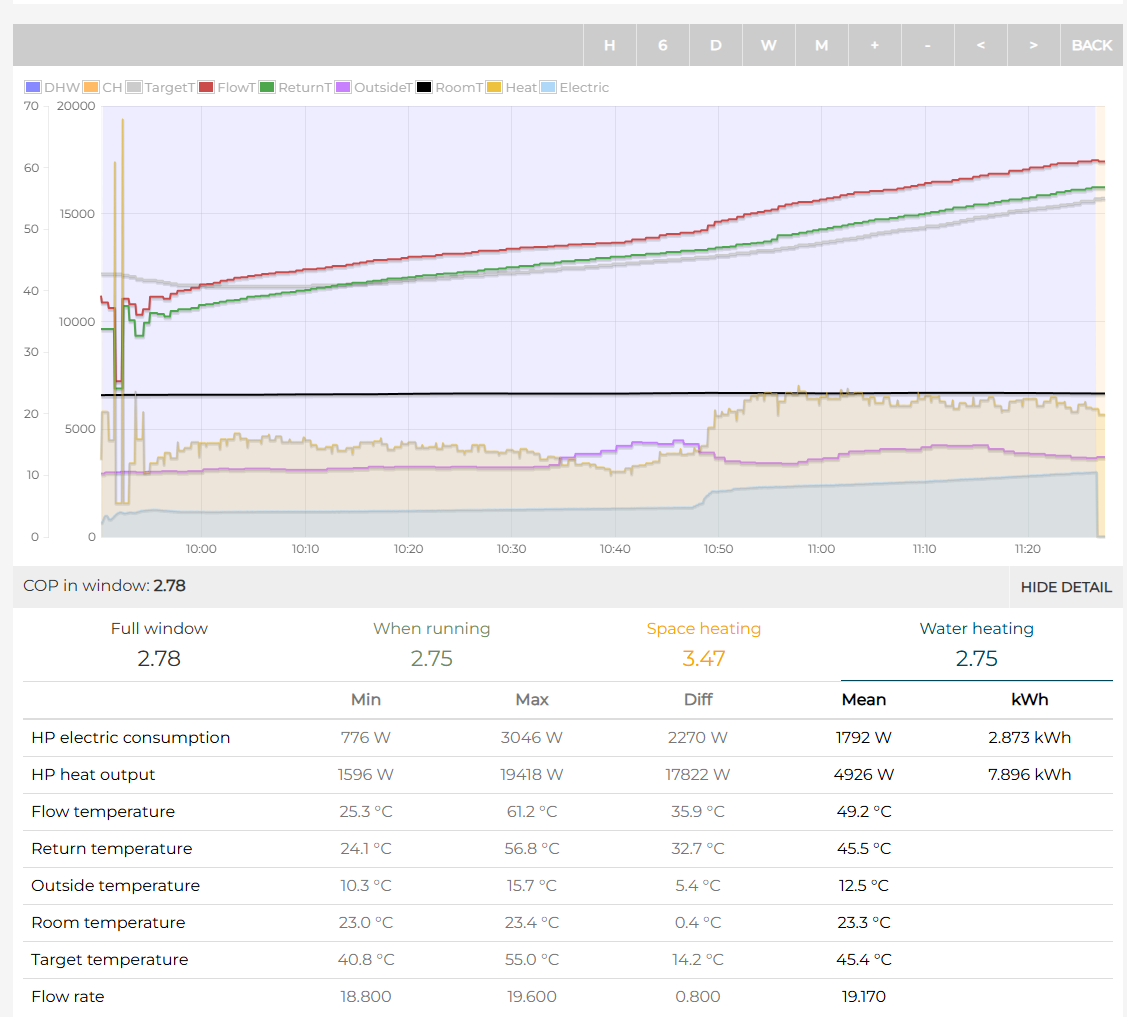
In this run the pump runs stable for 1h:30m but then again zig-zag pattern started again. The previous day with ratio control disabled it run stable only for 30 minutes. So until the target temperature is reached in both cases. I would really want to know why the the compression frequency is alternating so dramatically. It must have been connected to low water volume but still can’t understand why compressor can’t modulated more smoothly when the target is reached. Why jumps from 20Hz to 14Hz then back to 20 ? Why it is not running constantly at 16Hz for example. This is what I don’t understand with this pump. It is simply too harsh to my liking.
COP is not bad but because of zig-zag modulation pump is not able to reach target flow temp which is 40C. Instead it oscillates between 38C - 40C.
This way pump was running for 4h:30 minutes thanks to the ratio control set to 50%. I’m not convinced that this is good for pump because as Sarah said it can’t work in optimal compressor range. Would be probably more silent but in this weather HTQuiet is pretty silent even at 50Hz compressor. You can hear more FAN than compressor. So at the end it takes longer to reach target temperature which could keep a house a bit colder at the beginning.
I will experiment more with this to see if there is some real benefit but I’d assume at freezing outside temperatures this could be a bit problematic. Would take too long to get into target temp I’m afraid.
I think to stabilize the pump a 120L buffer tank would give a bigger benefit. Don’t know.
So you have 28C water in your radiators upstairs ?
Seems not because I haven’t touched this value and the compressor is running 50% max.
From what temperature ? Mine is around 40 minutes I guess from 35C to 50C. I will try run dhw in this mode and let’s see what numbers I get.
Exactly. the power of each radiator is largely decreased, as they were computed with dT 50K or dT 35K sometimes. But it didn’t matter, the house is warm and the ASHP is performing correctly.
That is definitely possible. Finding the right setting seems to be a bit tedious in order to take into account all variables
Considering that I had 2 zones, that was my go-to, even if not mandatory, but radiators don’t have that much power capacity with their small volumes. So yes I think a buffer or at least a volumizer, would make quite the difference on the modulation you’re observing. I’m sorry that I don’t want to repipe without the buffer to see the effect
@mihlit, your observations on the QM <> FR differences are very interesting, but in my case there was another effect leading to poorer CoP.
Yes, exactly my thoughts. But as long as you have warm in your upstairs rooms then it’s fine. I have T21 rads - two desks with 1 convection fin so these are not the best for HP. T22 would be tad better but…. At 28C and your room let’s say 20C there is dT=8C so the heat transfer must be very low. But depends on type of radiators you have and how big. I guess you must have a pretty good insulation at roof and the heat transfers from basement to upstairs by convection naturally.
I have only rads so I can’t afford 28C in them
You have UFH so this has massive amount of water in comparison with radiators only so you don’t need buffer maybe at all but we don’t find now At least I could install one on mine system, piping needs a bit rework because I can’t connect it to common return for space and DHW circuits, need to plumb it to space hating return only. And it’s a bit complicated there but I’m quite adventurous guy
This is probably not relevant, but Quiet mode is not just “off” or “on” - there are 4 levels as shown in section 2-10 of the EHS Technical Data Book (but these can only be set using the K-buttons on the Outdoor Unit panel, per p121/2 of the EHS Installer Reference Guide Book). So probably of no value to you…
@Michal_S AFAIK this compressor can’t actually run for a very long time at less than 20 Hz. Not sure if it is caused by compressor construction or resetting/fixing improper EEV regulation, but from what I’ve seen if it runs at 18 Hz or 14 Hz, after a while it jumps to 20 Hz and back.
@Topaz it’s probably related to what temperatures you need, but I need quite high temperature 40C (I use FCU. It is temporary until we finish isolating our house.) When I run QM with 35Hz during night, it has terrible performance (COP ±2) when outdoor temp is < 5C. That was the reason why I want to replace QM with FR control.
@SarahH I use just quiet mode switch as available from remote controller / modbus. I know that there is 4 level quiet mode in outdoor unit configurable with k-buttons, but as I understand it that’s like overall limit when installed too close to your neighbors. Something like current restriction. Unrelated to indoor controller quiet mode. Whether on or off it won’t go above that limit. BUT this is just my understanding of all the manuals, I did not actually test this.
Yeah vety small diff but that is sufficient. I have not yet external insulation. only internal. 35cm glasswool on the roof, the house has full room height, the roof is completely on top of story 1 (as if the roof was story 2). walls are ibsulated with 15cm of polystyren foam. And all rads (but for the coldest room.. hum hum hints) are t22. 70cm x 70cm versions.
Yes the ufh has a massive volume and i tweaked the temps so that the ufh is always on when radiator are on to ensure the best cop (5.3 instead of 4.4ish)
About the buffer i advise you do and yes you should take care of the piping. but ain’t that funny to play mario the plumber ?
Yes, seems this is the case exactly. It can work lower than 20Hz but only for a short period of time, then it needs to jump back to 20Hz. Sadly as mentioned lot of times here it’s in a fact a 14kW compressor only restricted to 8kW in firmware.
That’s very good COP. Envy I think I will try to lower hysteresis for my thermostat from 0.5C to 0.3C. This could improve the comfort and pump will have more cycles with shorter intervals so this could improve a COP a bit. This could help in warmer weather.
Definitely - until you will find that after finishing the work some of your welds starts to leak
cop is also lower because of higher outside temp without frc.You could compute the carnot cop from the raw vlue and then the percentage of carnot cop you reached.
Hi @Michal_S
I’ve always suspected that the cause of the zig zag pattern is more likely going to be down to low flow rates. Your particular HP, as you know, is 14KW and can only modulate down to around 800w electricity input right and you have a flow rate of 19-20lpm.? For comparison, mine (8KW R290) modulates down to 350w input and I have a fixed flow rate of around 13lpm.
My theory is that the outlet temperature rises and falls too quickly which causes the compressor to have to adjust regularly, and you end up in a feedback loop.
I recently removed my volumiser (only 35L) but I do have a much larger water volume than you. Mine is around 200L. I have some large 3KW column radiators that are 42L each. But I don’t think the volumiser should affect things too much as your return temperature will already likely be quite stable.
Mine, if anything, seems more stable (less zig-zag compressor patterns) since removing the volumiser and balancing the radiators correctly using FRVs, but that is likely not causation.
The point of the volumiser, in my mind, is to increase the thermal store volume for defrost cycles.
The reason I removed mine was because was on the main return from the CH and DHW in the loft (attic) with the cylinder, so when doing a DHW cycle in the summer, I was also heating up 35L of additional water that would be wasted. In winter, in meant that the return temperature stayed too high for too long after a DHW cycle so the compressor wouldn’t start for several hours after. I have thought about reinstalling it on the central heating return only, but we’ll see if I get round to it.
My flow rate is variable. Max. is about 19l/m and Min. around 9l/m. Yeah, I wish I have bought R290 real 8KW unit but this was Samsung’s shady marketing. 350W would work much better for me.
As you said, it’s about compressor frequency. Minimum compressor frequency where pump can run stable is 20Hz but if this is not possible to hold any longer - because your flow temp reach the target and you can’t make the flow faster then the compressor needs to step down. Why to 14Hz I don’t know but what I know it can’t hold it for long so after a minute it has to jump back to 20Hz. And all over again until thermostat temperature is reached.
It would be better if it can modulate from 20Hz to 18Hz rather to 14Hz, it’s too big jump and then the flow temp oscillates as well never can reach the target properly.
It’s truth that volumizer would not probably help me. But if you had zigzag even with such big water volume then I would think the volumizer really would not help. It should help to prolong the cycles because it takes longer until the water get to the temp but once it will the zigzag starts again I’m afraid. But since bigger volume zigzag would start much later and until then the room temperature could be satisfied so thermostat would turn off the pump before zigzag started. Just theory.
Yes, volumizer on common return is really not a good idea so good you’ve removed it. 35L is not that bad as if someone would add 120L on common return
Have you tried disabling the PWM control and running at a fixed speed? I’ve found that this has helped stabilise things more than anything. The PWM control and compressor controls are completely independent of each other, and could lead to PWM and compressor speed chasing each other around in circles as each impacts the other.
In that regard, it might help. Time is always an important factor when trying to stabilise things and find an equilibrium.
 You pump 28C water to UFH and then you switch valve and pump 50C to radiators ? Sorry for my ignorance but still not fully understand it