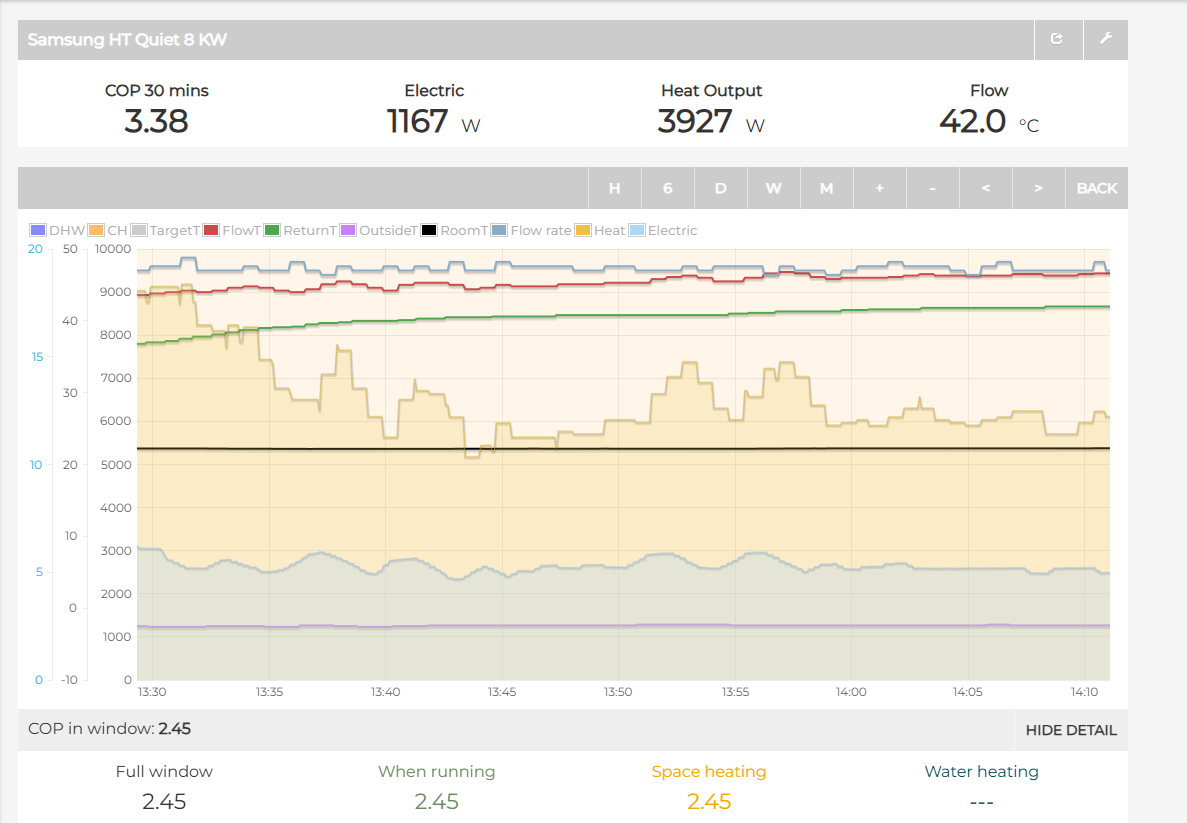
From memory
40** Heat → Inverter use → set to not use.
From memory
40** Heat → Inverter use → set to not use.
FSV #4051 (or 0x40C2 if you are using code).
Honestly I didn’t but I could try for a test, thanks for the tip. But for long term use it’s maybe not a good idea to operate pump at a full speed because first it has consumption around 90W or so at full speed (maybe less don’t remember), it’s noisier and I’m afraid that dT won’t be able to keep with set value. It could be very low so the efficiency would suffer ?
Don’t know will try it just for a test.
@SarahH what’s your opinion on that ?
A lot of heat pumps run on fixed flow rate, like Vaillant, and they’re some of the best performing heat pumps.
I use a separate PWM controller to be able to set a fixed speed that I need. (12.6lpm). I’ve calculated that this will give me a DT of 5.6 at 38C flow temp & -3C outside temp. When the flow temperature is lower, the DT is lower, but COP has, if anything, increased because of the improved stability.
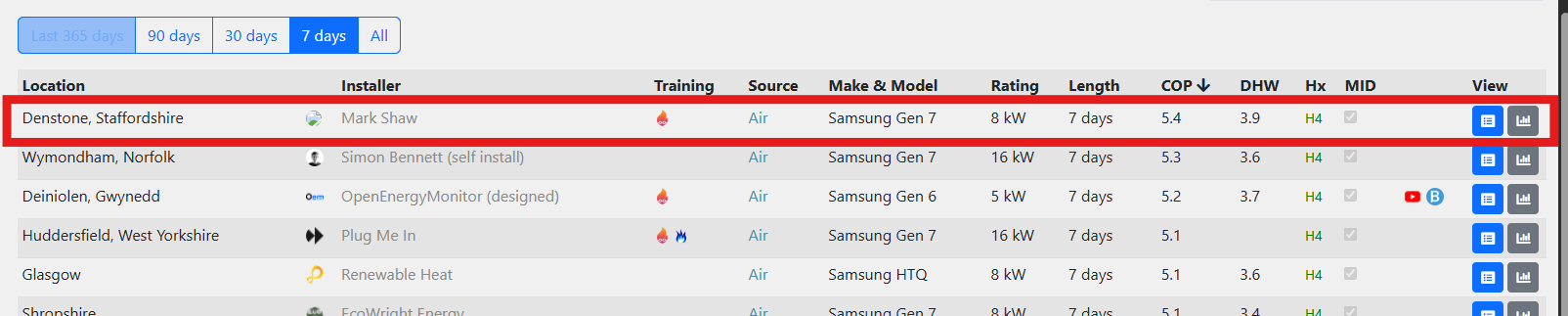
Check out the last couple of weeks on here: HeatpumpMonitor.org
I am top of the COPS for Samsung heat pumps for the last 7 days.
Your heat loss appears to be much lower than 8KW, so you might be able to get away with a much lower flow rate and not have to suffer the temporary noise & high electricity usage of pumping 19lpm at start up.
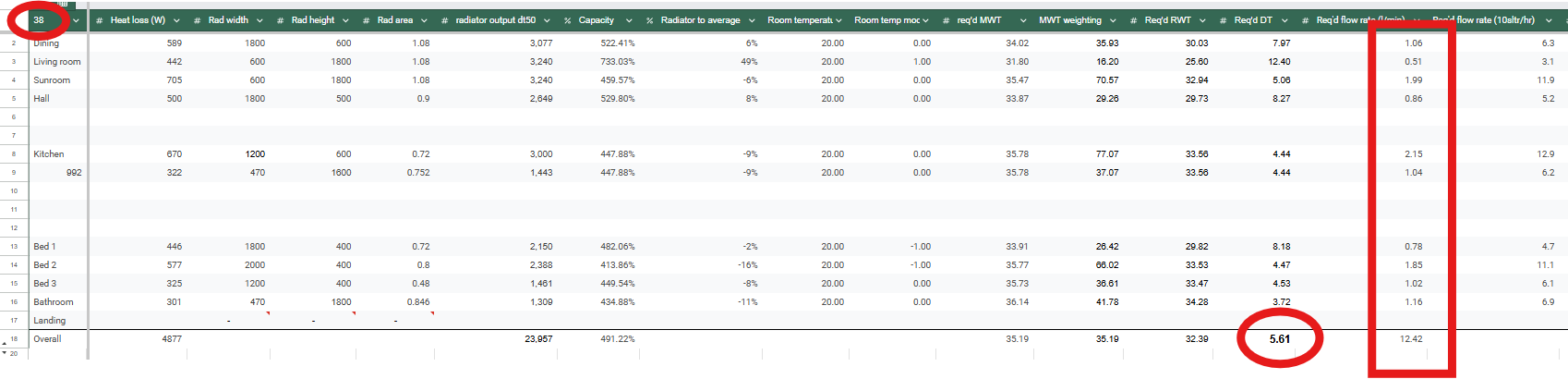
If you know your room-by-room heat loss & radiator specs, you could use this spreadsheet I created to work out the required flow rate to each radiator for a given design flow rate and target DT. The idea, is to adjust the design flow temp in A1 until your overall dt (N18) is close to 5.
You can see in my example, I use a design flow temp of 38 and this gives me a dt of 5.6 and a flow rate of 12.6LPM. I also used this to calculate the ideal dt and flow rate for each radiator and used these values to perfectly balance the system using FRVs. It takes into account the radiator spec and the heat loss of the room. You’ll see, the DT varies a lot from room to room.
Any further questions on this, let me know.
I’m not a big fan of PWM control, @Michal_S, mainly for the reason I gave above (post #86 or thereabouts), but also because of the losses in the PWM electronics (back in the day you could lose up to 10% of the load energy there; maybe things are better nowadays).
That’s you just above me!!
I am going to work on the pwm stuff to see if there is any benefits I can have there
I for the life of me can get FC to work via modbus
Interesting. I will try to disable PWM just for a test and let’s see if it help with this frequency jumps when target temp is achieved.
Really, I didn’t measured it but I hoped consumption at lower rpms is less  I hope when I disable water pump the HP will not complain that there is no flow or there is flow when if there shouldn’t be
What are you going to do ?
If using an external PWM controller, so long as you don’t go below 7lpm you should avoid issues with going under the minimum flow rate, and as long as you change the pump wiring from B1&B6 (permanent live) to B7&B6 (switched live), you won’t get flow when you shouldnt.
Mine has gone back to jumping the frequency up and down again now it is a little bit cooler.
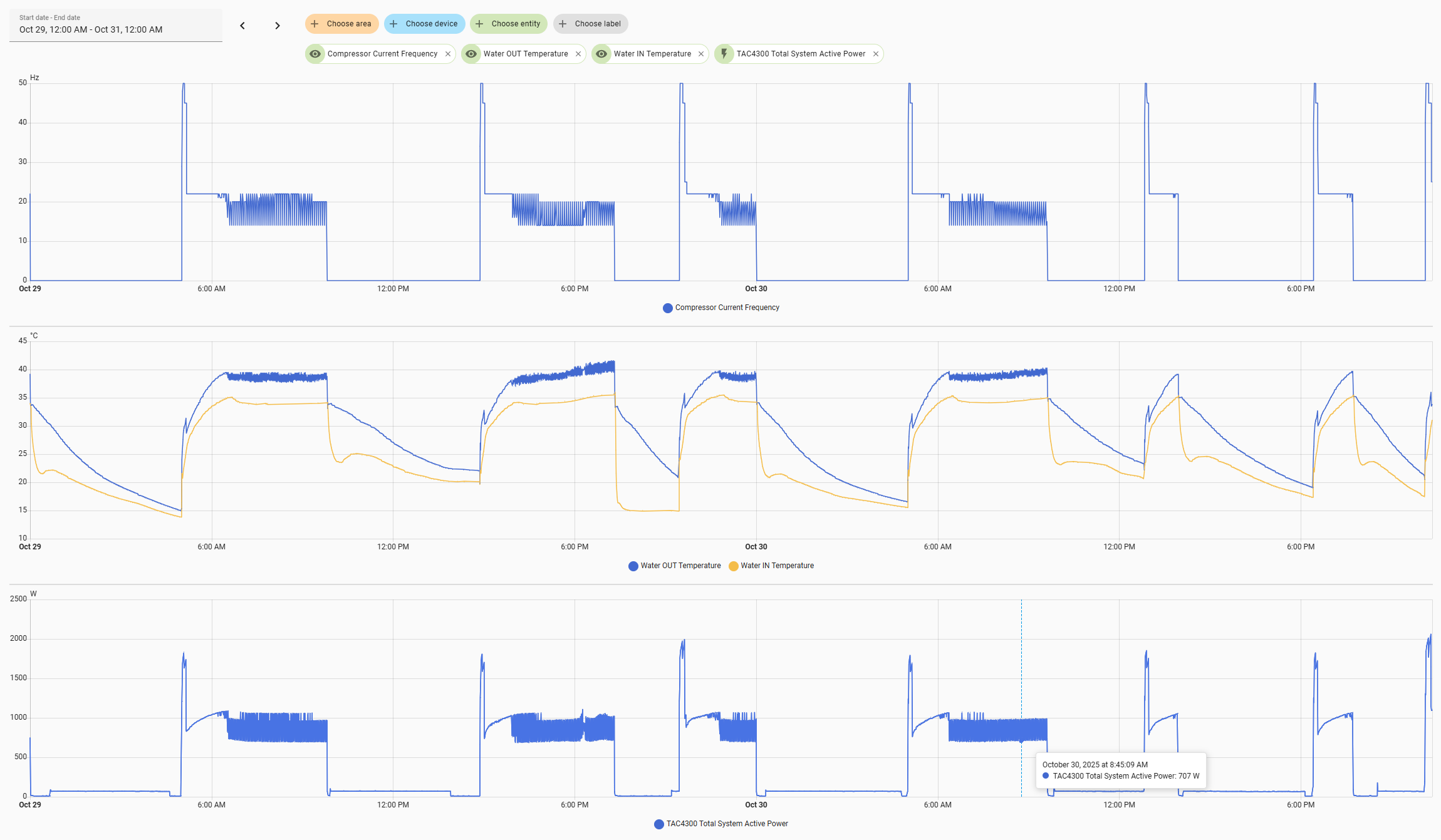
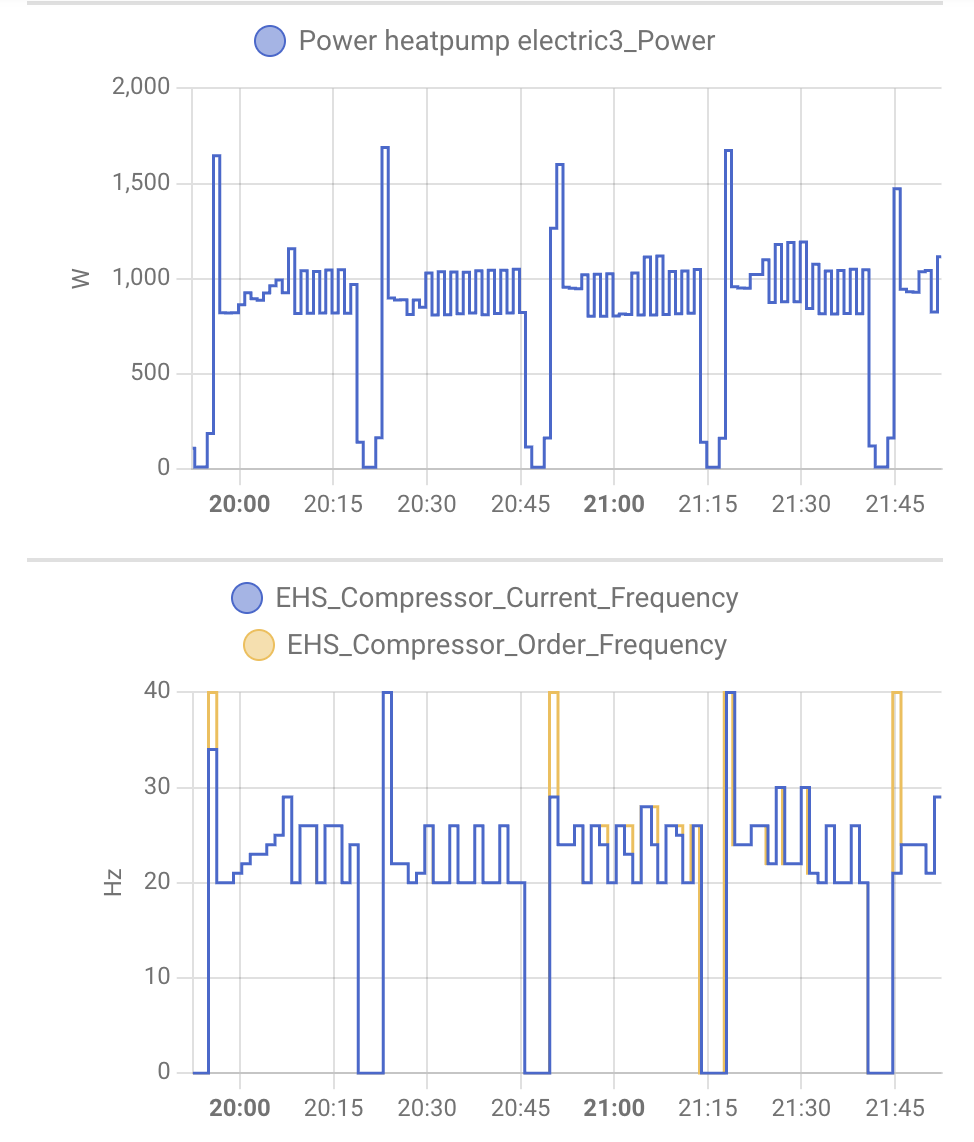
What do you mean it went back to jumping ? Is it doing it again ? Do you have pump on heatpump monitor ? My water pump never goes under 9.6L - this is minimal flow it can achieve. The main problem is that when my target flow temperature is reached and the water pump is running at lowest flow possible which is 9.6l/m then this huge compressor freq oscillation will start. Like the pump is not able to modulate in lower increments, instead it oscillates from 20Hz to 14Hz and then back to 20Hz every minute. It’s really pain to watch especially when I don’t have rational explanation for that. At that drastic compressor change my flow temp will jump from like 40C to 38C then back to 40C… But why ? Why it can’t modulate from 20Hz to 19Hz or 18Hz.. then wait how system reacts and then back to 20Hz… That jumps are simply too big but why ?
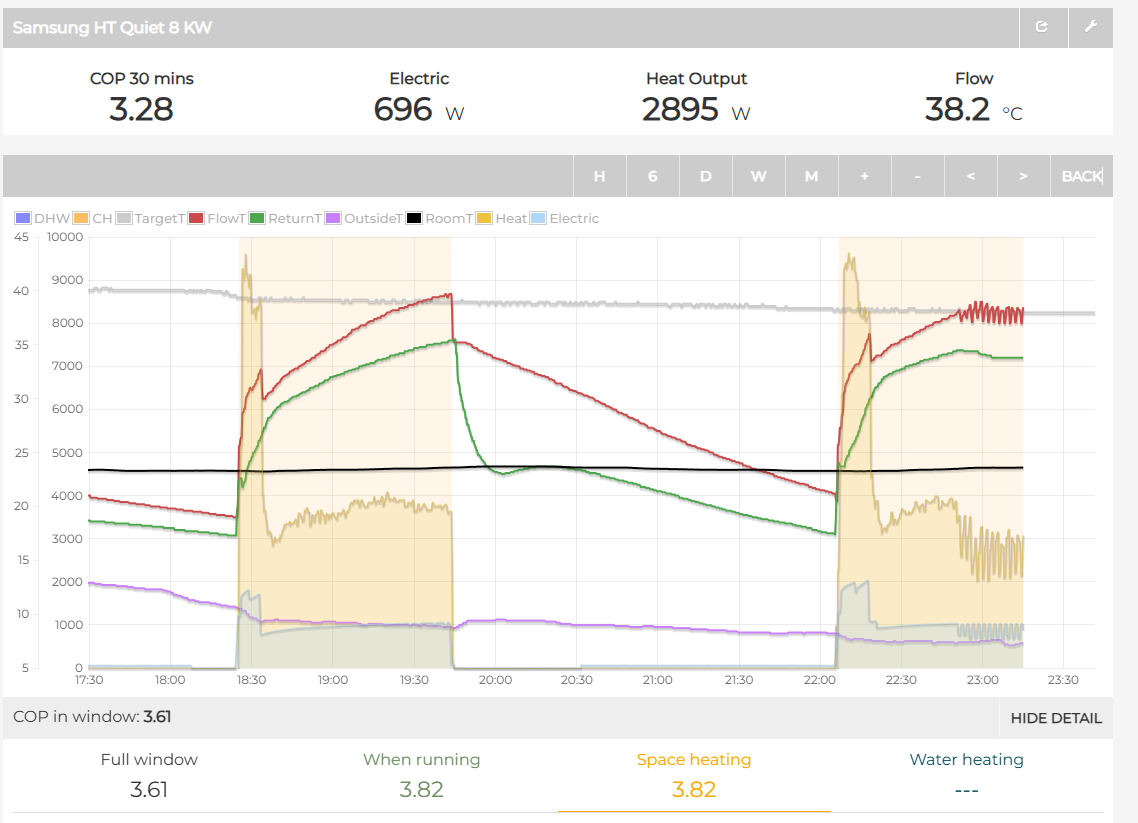
Here you can see few last runs… It’s clear that until desired flow temp is reached (in my case 40C) all is fine but as soon the temp is reached it start to oscillates dramatically. I really don’t call this smooth modulation, instead of decreasing compressor frequency smoothly by 1Hz from 20..19..18..17..16.. and then back up it is doing this. The only explanation could be that probably the compressor can’t run below 20Hz for longer time period but I don’t know if it’s the case.
I am going to try running the pump at a fixed, higher speed. I set up a speed controller with an ESP32 so I can set it and forget. (I moved it to a switched live in the controller)
Before I had it on inverter control with a max 70%.
Thus far, I have not seen any improvements. Still doing what you say with the frequency control/flow temp jumping once at target temp.
Interesting too, going from 30lpm to 40lpm has cost me from 90w of pump power to 194w.
So there is a cop hit just there. dt 2.8 to 1.6
Ive emailed Samsung tech to find out if there is a way to smooth the oscillations out, but I doubt they know
Hmm, interesting. Can you post whole graph from emoncms with numbers ? Do you have it online on heatpumpmonitor.org ? It looks like your fluctuates at higher frequency but still the same pattern. Really can’t get it.
What system do you exactly have ? Sorry if you wrote it already but I’m loosing track Is it HT Quiet ? Do you have floor heating or radiators ? We should find what’s common for our systems and maybe we will find the clue. I’ve tried to change dT to 8C (max) to see if it makes any difference but I guess it only will slow down the pump faster. Once LWT reached it will start to fluctuate again.
70% max pump speed won’t help you much because it’s a lowest speed where the issue starts to occur. It only causes that dT will decrease slowly but from my experience won’t help much. With frequency ratio control it really made the compressor not running at high speed from the beginning so heat up phase is slower making COP better but pump is running longer of course and when the room temperature is not reached withing an hour or so it starts to fluctuate.
UPDATE: or maybe I don’t understand it at all Two subsequent runs. First - No fluctuation and the pump was running for 1h:20min. Second run it started fluctuate after 45 minutes but what I did was that I’ve changed pump dT to 8C. Immediately the pump has decreased flow speed aggressively and it started to fluctuate. Next time I guess will disable PWM and let the pump run at 100% to see what happen.
So still I’m not sure what dT for the LWT/RTW shall I use. 8C 3C 5C ? I don’t know.
16kw samsung r290. Prob a heat loss of 11kw (still waiting on that :/)
Just rads. I have the same crank heater issue as you have in the summer.
I have Home Assistant, but I can’t get the FC to work, beyond turning it on and having a 50% limit in place.
Hmm, I thought R290 units are not doing this. But it’s really a big unit with big compressor. So maybe that’s why. My 8kW R32 is also big because in fact it has 14kW scroll compressor. Seems your heat losses are not high at the moment so the pump is very big and it can’t modulate low enough causing these spikes. I also thought R290 units don’t have that phantom idle consumption. Well, seems it’s all screwed
BTW, you are using very low flow temp for radiators. Maybe that’s a reason your is doing this pretty bad. For a test you could try to increase flow temp to 40C and check how it behaves. However, your COP is much better than mine. I have roughly 3.7 - 3.8 at 10C outside and 40C flow temp. You have 5.3 at 8C that’s great even thought it fluctuates like crazy.
I might have oversized everything a little bit
it did it when it was 4c outside too
Yeah, but with heat pumps lower is better
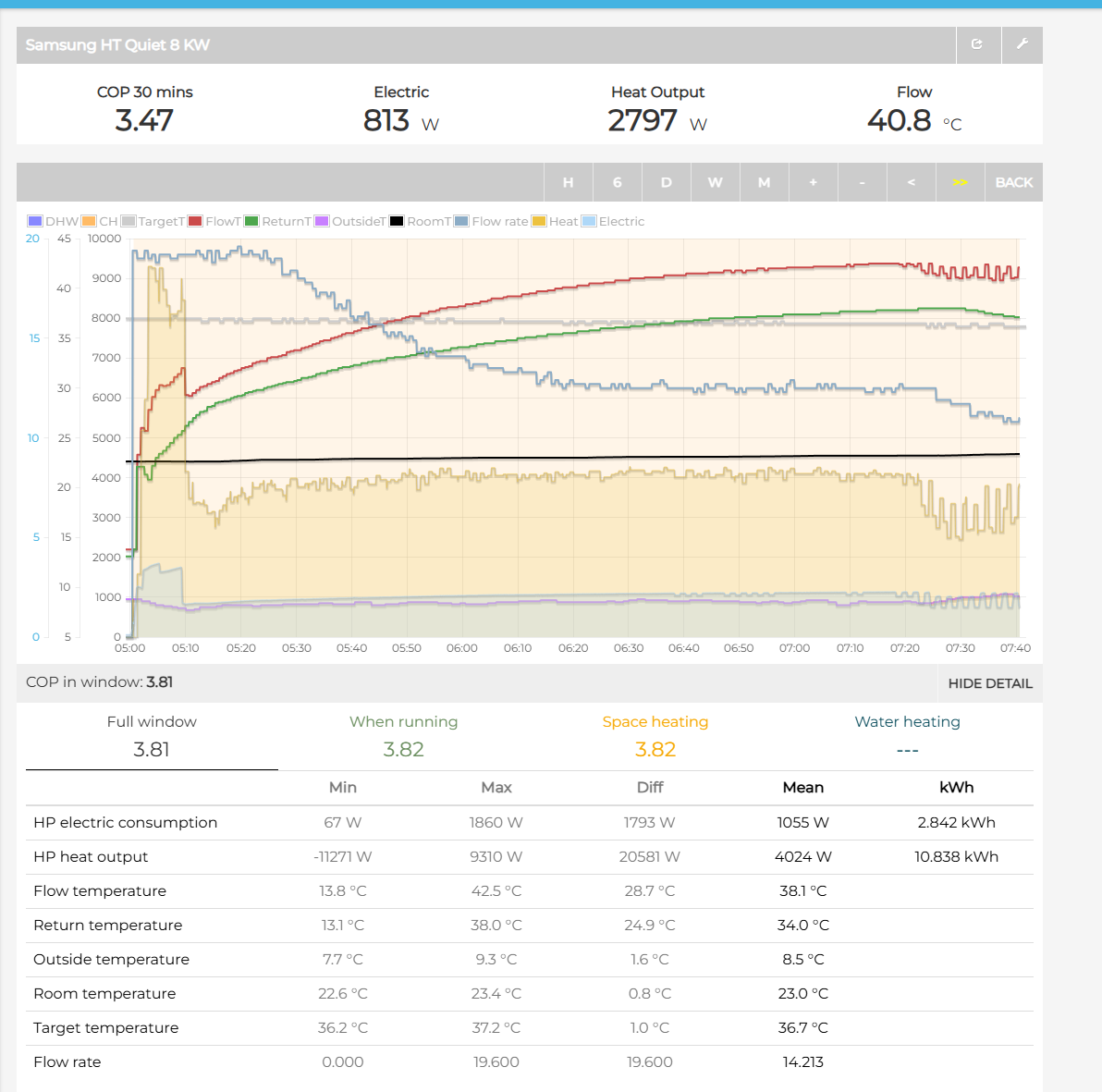
I’ve increased flow temp to 43C for this night and you can see the pump run stable for 2h:20m this time and then again fluctuation started. There were smal dips from 22Hz to 21Hz but after 2h it gave up and again started to modulate erratically changing compressor frequecy by 8Hz from 22Hz to 14Hz which is minimum compressor frequency. I really don’t know why Samsung is doing this. Why doesn’t it modulate smoothly like there is nothing between 22Hz and 14Hz? No explanation for this.
I think the programing logic is simply bad or something and the pump is always chasing LWT very aggressively. Wish I can say do it in more relaxed way.
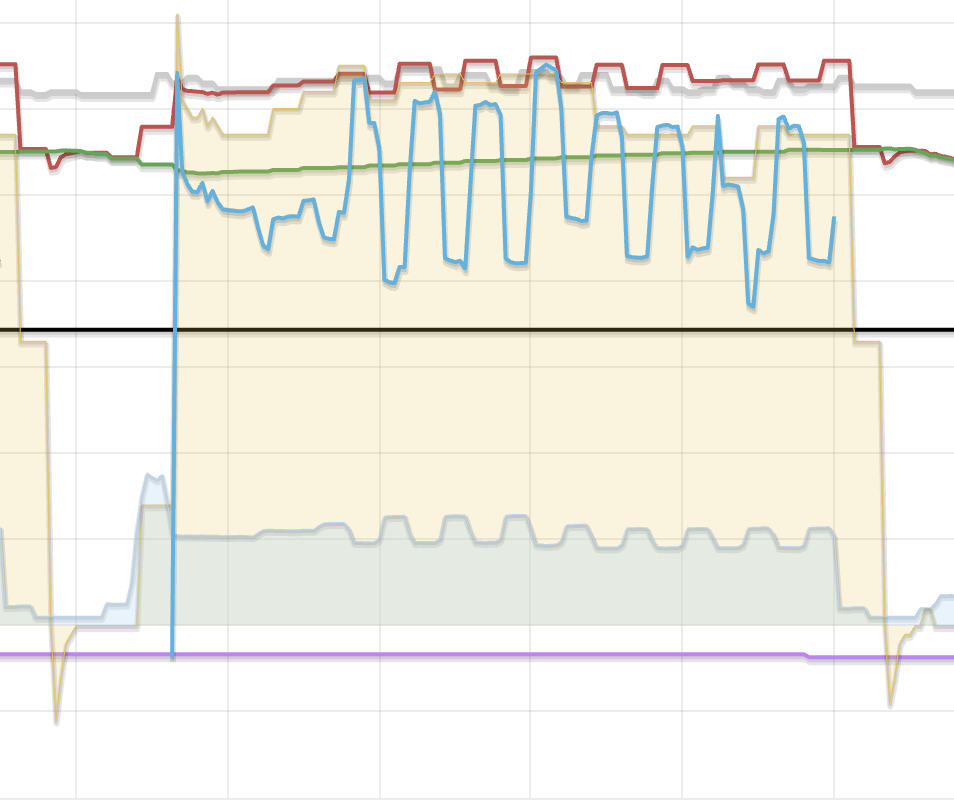
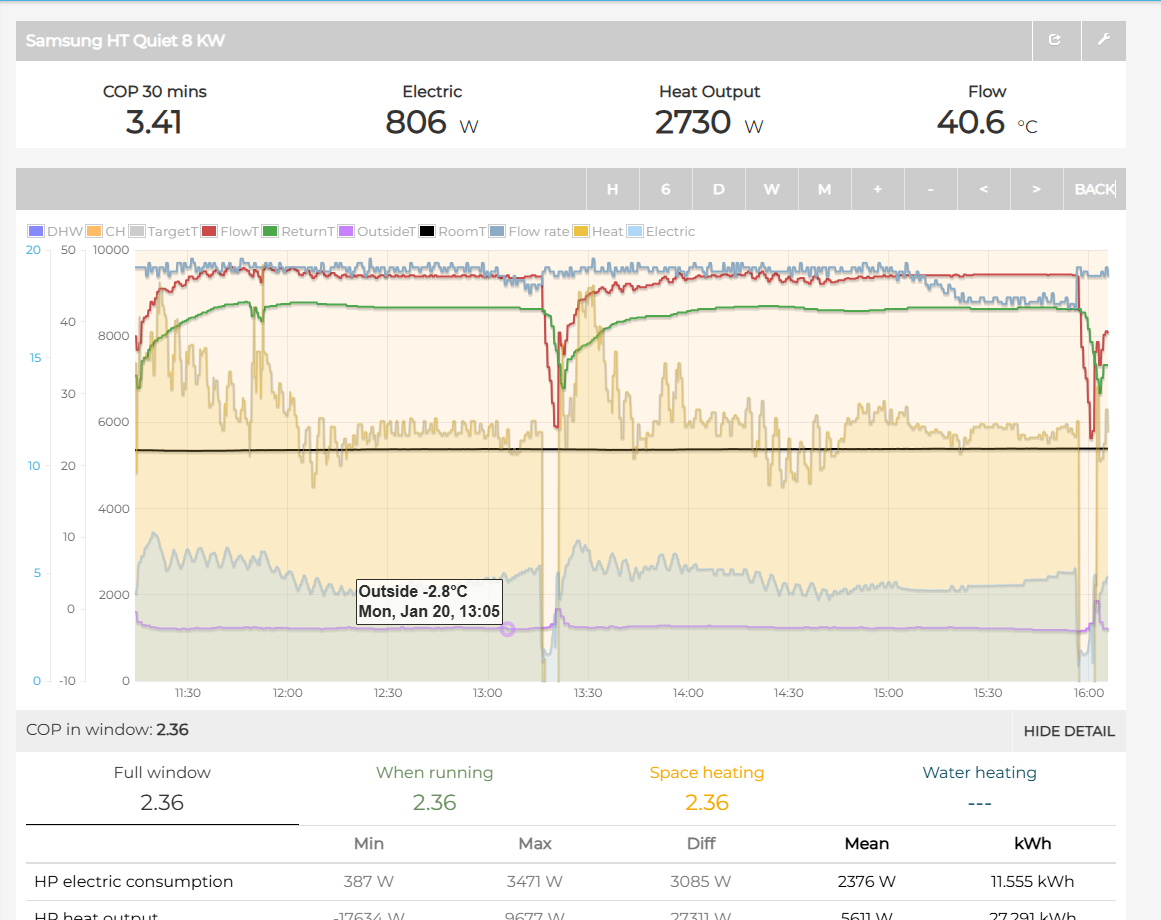
I’ve checked some old records from beginning of the year where it was freezing and the modulation still suck so I guess nothing help this pump. Here you can see it’s stable -2.5C outside and flow is at max. Still, compressor power changes in waves but it’s not that steep. So don’t know think I just give up. Last test I will let the pump run at max. RPMs to see if there is any change how stable the pump is running.
Its intresting how your COP drops when it starts doing this, even though the outside temp is warmer.
I was trying to look at the fireware versions to see if they have patch
Yes, but somehow it is expectable. You are running really very low water temperature like 30C for radiators. How does it work ? If I use 30C in my rads I couldn’t even feel they are warm. Do you have fan coils or how it is possible you can run such low water temperature in your rads ? This temperature is more used for UFH.
Did you find something about firmware ? I don’t know where to look but would also like to update it because it was not done since installation.
I got kicked out of samsung business so need to reapply to look.
If the rad is above room temp its going to output heat, granted it will get pretty low. Your hand will be between 33 and 36c so you don’t even feel they are on, the only way I notice is it I put my face over them as you can then feel the heat. I have to trust the heat meter, 5kw must be going somewhere!
Its lovely, 0 risk of the children getting burnt, When we moved in it was a gas boiler that tried to get to 70c. You could tell when you where in line of sight of a rad from the radiant heating.
”There is no way to adjust the compressor frequency change step I’m afraid, this is built into the software in the heat pump.”
Ive asked for the logic behind the stepping in frequency to see if we can reverse cal it.
Is it possible to reapply ? Would be good! I would definitely upgrade my unit but have some feeling it won’t help 
It’s strange it behaves for us like that. I think it is simply that either you use low water temperature for your radiators or in my case the system could be small like low water volume and with radiators combined.
That’s right but I wonder about efficiency. The heat transfer must be really low at that temperature. But it is really interesting. But your COP is great anyway.
I could try experiment to set fixed flow at max which is around 20L/m and try to set flow temp as low as you have to 30C to see if I will have similar COP. What’s your target temp ?
In any case seems you have pretty big house if you can accommodate 5kW of heat at outside temperatures above 10C. Or you must have big loses My heat loses at 10C are maybe 2kW or even less. But I heat to 23C room temperature. What radiator types do you have exactly and how many ?
Yes, compressor step is driven by firmware, you only can limit the frequency with frequency ratio control but still it will modulating in it’s own way.
@Topaz I don’t use Modbus, but I believe that if I set FSV 5051 (Frequency Ratio Control) to 1 (use), this will have the same effect that you are describing via Modbus. Have I got that correct? I have the impression that it has improved COP since I made the change, mainly because of COP improvement over the first 30-40 minutes. Previously the instantaneous COP would sometimes drop to 1.5 before recovering - now it rarely goes below 3 and sometimes there is no dip at all.
Do you know if there is any benefit in adding Quiet mode when using FRC for DHW heating? I saw a post by @mrsimonbennett about this, but didn’t understand his conclusion.