One conclusion from that thread is that having the BT25 sensor located upstream of the Diverter valve (rather than on the Central Heating leg downstream of the valve) will definitely be misleading the Degree Minutes algorithm. Sam commented on that before although it’s tough to be sure of the location from the photos, given the insulation. If your BT25 sensor is strapped to the pipe immediately above your Heat Meter that’s not right; it wants to be on the Central Heating Flow pipe downstream of the Diverter valve.
If you want to try the Python scripting, I’ve written up a procedure on my blog site. It looks a bit long-winded and complicated but really it boils down to just a few steps:
The catch is you’ll also need somewhere to store the data that comes back from the API, which might make for a steep learning curve in the short term - unless you already have that in hand.
@etchelsa May I suggest you send Dave your myUplink email address in a private message, so he can add you to his system.
Thanks for the instructions - I’ll given them a bash but it probably wont be until Tuesday before I can do that.
I’ll get the temperature probe moved today. It makes sense what you both say about the position of it but it didn’t occur to me tbh (something I would have thought the installer should be aware of).
Presumably the return sensor is ok where it is - just after the circulation pump?
Sam - I’ve granted you access to my uplink. Let me know if there are any problems.
In the meantime I’ve set the curve to 7 with no offset. The flow temp is now reduced slightly but reaching the ‘cap’ but it isn’t maintaining this flow rate and still defrosting.
all up and running, all the parameters have changed ID on your heatpump which broke all my scripts - I wonder if this is newer software versions at your end or if your S40 controller is different to my SMO40 controller. Either way, it looks like we have your data coming through so will let it run for the day and post here for David to also have a look through.
The is absolutely something the installer should have been aware of! The diagrams in the NIBE manuals are somewhat cryptic but in my view they’re clear that these sensors should be on the Heating pipework, ‘downstream’ of the Diverter valve. (There are already factory-fitted sensors within the Outdoor unit on the main Flow and Return so there’s no point duplicating those.)
This is BT71 presumably? (I don’t have that on my system.) Like BT25 it wants to be on the Heating-specific pipework, not on any pipe that is shared with the DHW circuit.
I can’t seem to add photos from my phone. But it seems your system is now recovering and slowly moving your house from significant heat deficit (-900 degree minutes). We are currrbtly around -450 so it’s heading the right way, unfortunately it is slow due to defrosts but they are now happening less. Maybe because of increased outdoor temp, maybe the heat pump is working less hard at the reduced curve or a combination of both.
I’ll post later with images but from what I’ve seen I recommend leaving it running today and no further changes to settings until we can see the system has stabilised.
did you happen to move BT71? Around 1030? Something odd is happening with that sensor now and it seemed to happen around 1030.
That’s good news! The house is definitely beginning to feel a bit warmer.
Yes, I did move the sensor at 10:30 and I’m wondering if maybe the connection has come loose (I didn’t undo the cover for that one as I had to do it quickly before heading out with the kids). I’ll check it again this evening when I’m back.
Thanks again for keeping an eye on things, it’s very appreciated,
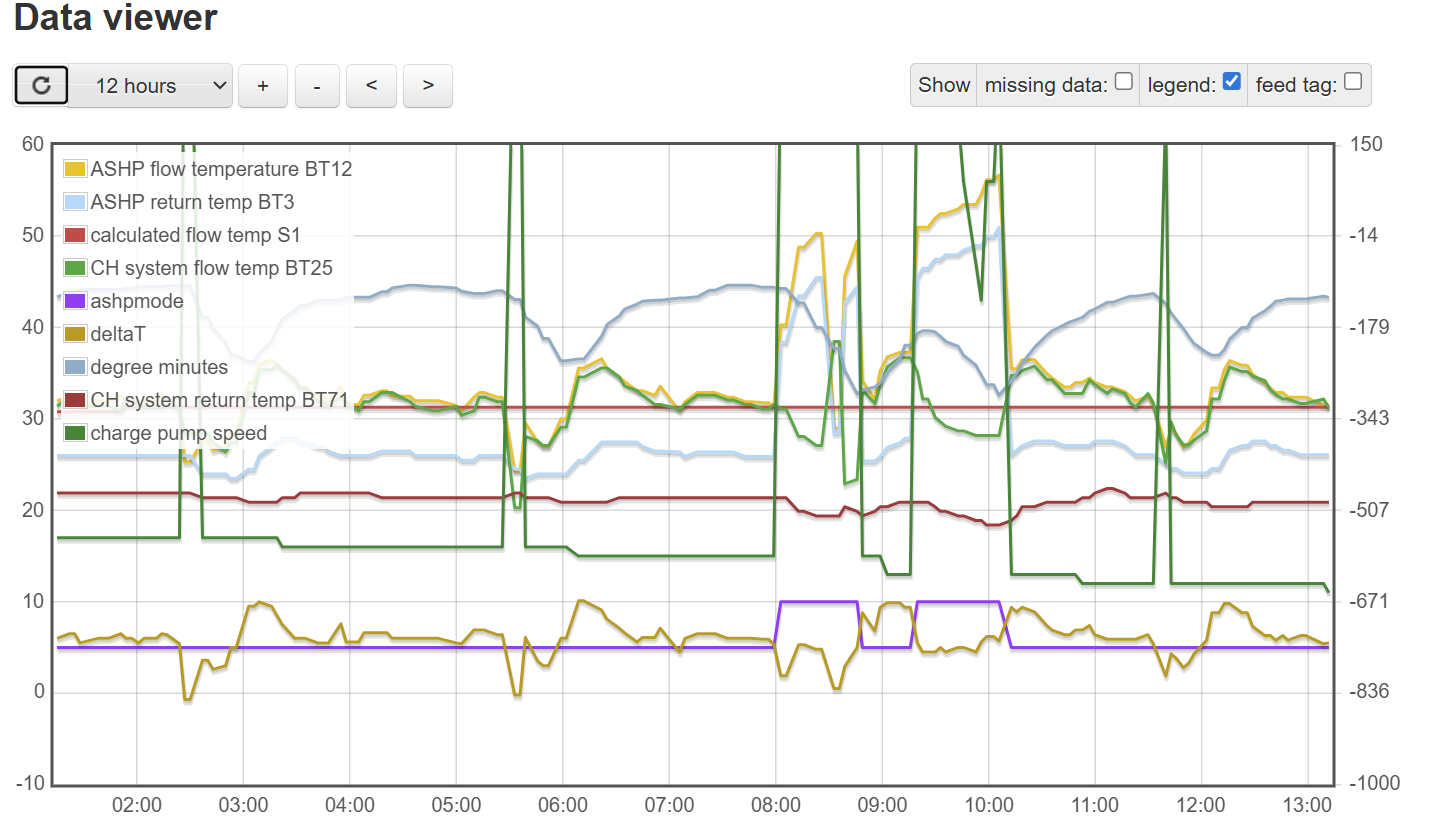
The graph above is from a day of running. I’ve not looked in detail but some observations and things to look at going forward:
the system started the day with significant negative degree minutes, likely due to a high S1 target temperature over recent days and the cold weather with lots of defrosts
Since you adjusted the curve to a lower target, the system has begun to recover as the degree minutes have steadily climbed through the day
The system has not yet managed to get the degree minutes to 0 so the heat pump has run all day (shown by ashpmode = 5)
The system defrosts regularly and when this happens the flow temperature at BT25 takes a big dive. This is likely because you have no buffer tank to act as a “thermal battery” so the only source of heat to help the heat pump defrost is directly from your hot water in the CH loops which is then rapidly cooled and seen by BT25. This further decreases your already negative degree minutes value.
At 1500, your S1 target temperature suddenly steps up, I guess you have a schedule with an offset programmed in to around +4 or +5? We should look to remove this for now.
Your BT71 return temperature suddenly changes at 1030 and is consistently below the return temperature as seen by the heatpump, this suggests it might not be installed correctly so is reading low or is now in a location that reads something differently - this is definitely something to explore further
From around 1500 the flow temperature and BT25 track your target S1 temperature well, this causes the degree minutes to flat line. This is behaviour I’ve not seen before, normally the NIBE will overshoot S1 until degree minutes reach 0. Maybe this is a change in the F2050 logic or something you have configured in settings, I’ve seen other F2050 systems on heat pump monitor run like this and it is something to keep an eye on.
You’re still running your charge pump at 100% - we should probably put this back to auto now the system is stabilising
Your delta T (as seen at the heat pump) is looking much more normal at around 6-7 degrees, compared to the large dT we saw earlier in the thread - it is much more as expected. The delta T as seen by the controller (difference between CH BT25 flow and CH BT71 return will still be large and might warrant investigation as to the impact of this)
Sorry nothing overly helpful at this point but I wanted to post the graph and also let David take a look.
I think next steps could be:
Monitor for another 24 hours and feedback how the house is feeling - Nibe uplink doesn’t have internal temp data so we can only see this from your OEM plots, maybe you can post one for today so we can see how the internal temperature has reacted. you said it has felt warmer and that’s expected based on how the heat pump has run today.
Later on tomorrow, reset the charge pump control to auto and
Remove any schedule offsets you have configured (I think you can just disable them)
Thanks Sam, this is really really helpful and things are definitely moving in the right direction.
Firstly, I’ve removed the schedule and reset the pump speed to auto.
Secondly, the house is beginning to warm up (due in part to the outside weather I’m sure). We are still a bit of a WIP so there are some parts that are temporarily boarded / poorly insulated so I don’t expect it to be roasting by any means (but the rooms we can shut off are warmer for sure - the bedroom is approaching 16 degrees and climbing steadily).
BT71 Return Flow Temp - so I moved this at 1030 which is why there is the sudden change. Essentially we have ‘3’ returns lines that join together before going through the circulation pump and back to the heat pump:
Return from the upstairs radiators
Return from the HW
Return from the downstairs manifold which does the UFH etc. it is worth noting that our UFH heating is a mix of an overlay system and solid in screed system. There is a significant thermal mass to heat here (albeit well insulated) so it will take a long time to get up to temperature.
The return from the upstairs radiators (1) joins the return of the HW (2) before joining the return from the UFH (3) i.e.:
I put the probe on return line 3 (from the UFH manifold) as this is a ‘heating return’ and the probe reached here easily with re-wiring etc. however, if you think it is better placed elsewhere i can change it no problem. Therefore the reason for the low return temps is the UFH is soaking up a lot of heat!
Can I ask what is delta T - is this difference between flow and return (i.e. the same as in radiator terminology)? What’s the ideal here for heat pumps compared to gas boilers (I know for gas boilers a high delta T is beneficial for condensing etc).
Buffer Tank - is this something we should consider having installed or do you think the system can cope long term without this?
I’ll continue to keep you posted on things (and I hope to hear from the installer tomorrow so it’ll be interesting to hear what they have to say.
Thanks again - I’m learning a lot of valuable information here and more importantly the heat pump is performing a lot better!
Thanks for picking up the task of collecting and graphing the data from Dave’s system Sam (and posting here for my visibility); that’s really useful.
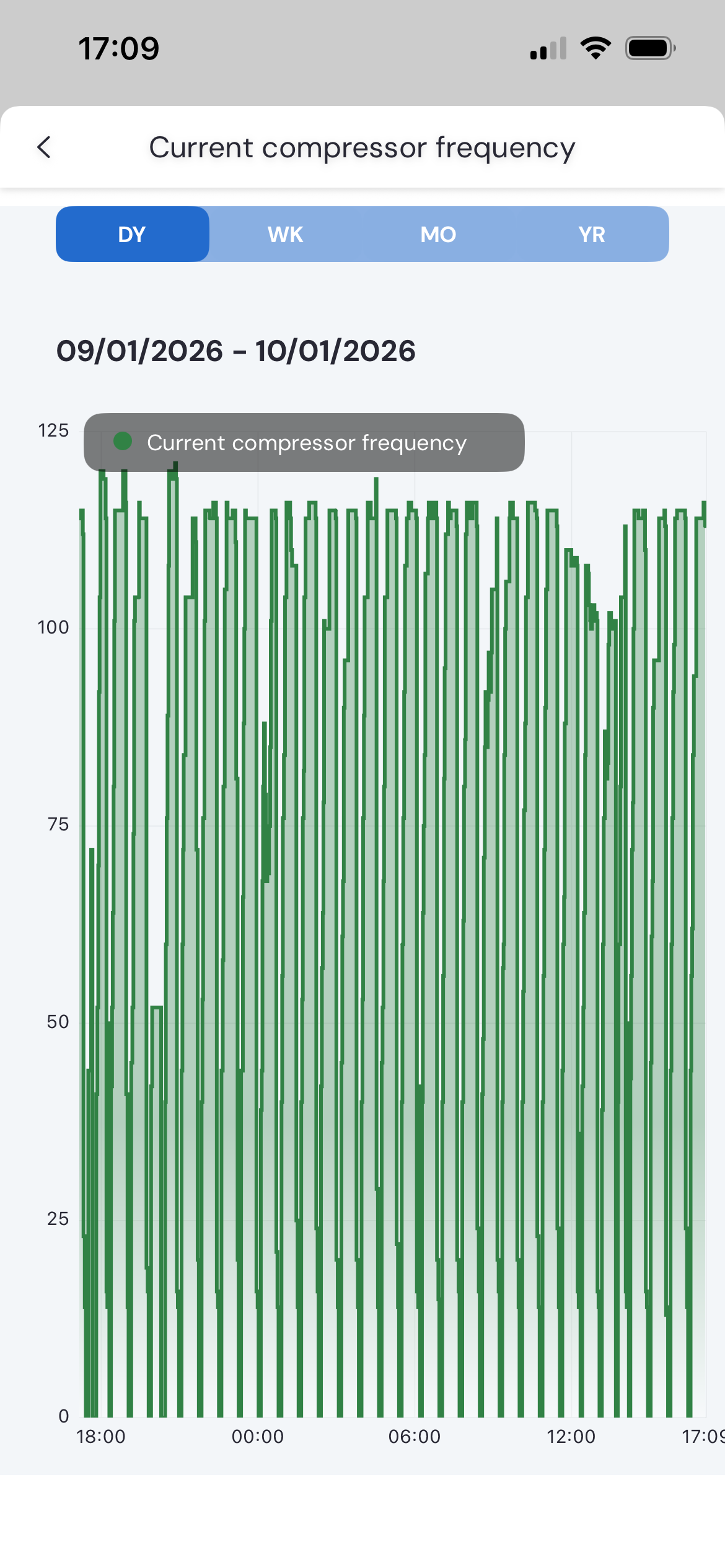
Would it be possible to include Compressor Frequency in the graph? My hunch is that the ‘flatlining’ is the controller modulating the compressor speed and so avoiding the on-off cycling which would happen when the DMs reach or exceed 0.
The defrosts can be inferred from the Flow temperatures but could we add the Defrost status to the graph too, for extra clarity? (It looks like the ‘ashpmode’ isn’t changing to reflect defrosting.)
Adding some more volume to the system would definitely help here, providing a reserve of warm water for use during defrosts without taking (as much) heat from the house. I like to use the term “Volumiser tank” for what some people call a 2-pipe Buffer tank, to distinguish it from a 3- or 4-pipe Buffer tank (which would mostly be playing a different role and would need additional circulation pumps). Adding something like a 100 litre NIBE UKV to act as a Volumiser would be something to propose to the installer.
Since the ‘heating’ return pipes don’t come together before being joined by the ‘hot water’ return that complicates the placement of the BT71 sensor. I’m not sure how (or even if) BT71 gets used by the control algorithm though, and whether it would be less-bad to have that back where it was (where it also ‘sees’ the DHW Return).
Once the floor slab comes up to temperature, BT71 in its current location will better align with BT3 so I’d say leave it where it is for now.
Yep - exactly the same. With heat pumps, you want to minimise the Flow temperature to maximise efficiency, so a smaller DeltaT is generally better - as long as you’re able to dump enough heat into the property (which depends on the sizing of radiators etc.)
So there’s no BT50 indoor temperature sensor and the heat pump is running on ‘pure’ Weather Compensation control? I suspect that’s going to prove problematic - especially with your ongoing renovation works Dave. My preference is always to give the controller some feedback from the indoor temperature, to take account of passive solar gain (or extra cooling due to high winds etc.) I’d recommending adding that; you can always disconnect it again if it proves problematic. The placement of the sensor needs some consideration though - it doesn’t want to be near draughts or direct sunlight.
The last 12 hours with compressor frequency added (dark green line). I omitted it on the first post to make it easier to read.
There is some odd behavior being seen during a hot water cycle, I will post a new picture in a new reply slightly zoomed in for the end of this graph
it does look that way, this is different to my behavior (and what I have seen on other Nibe). This F2050 modulates around the target very well, mine just overshoots it and stays like this until degree minutes go to 0 then it shuts off until -60.
I cannot find a way to do this, the aspmode signal is derived from the operating priority in NibeUplink, the manual suggests defrosting is effectively putting the ASHP into “cooling” priority but this never changes on MyUplink in the received data. I will try and log the data for a while to see if there is anything during a defrost cycle - inferred from the flow temperature.
No problems, it wasnt a big job and seeing this data for more Nibe systems will really help those that own Nibe units to understand how they work and how they are best set up - even if the graphs can be a little complicated to read at times…
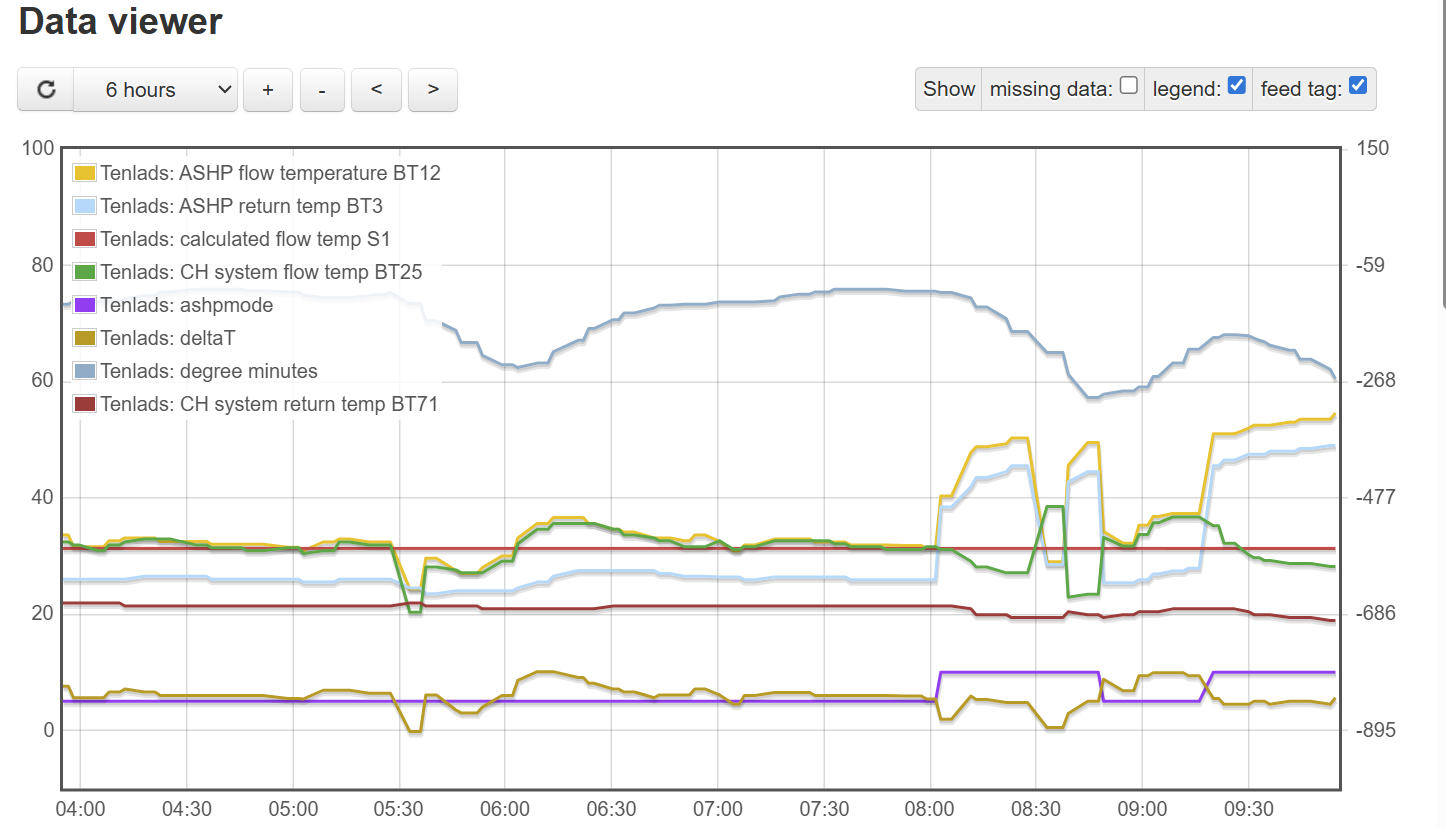
This is the first time we have seen a hot water cycle since capturing data - I cannot understand this one:
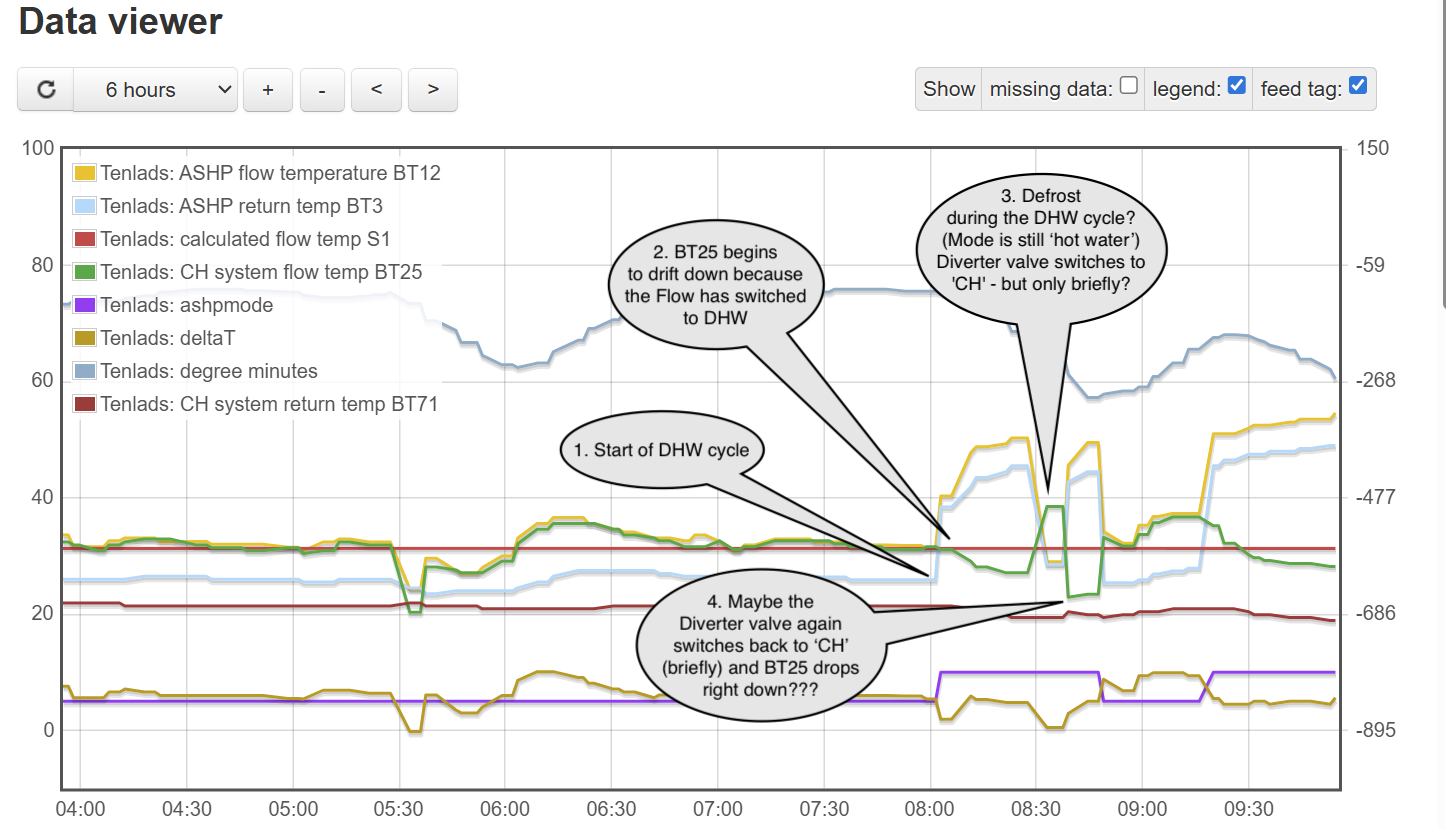
at 0800 the hot water cycle commences (seen by ashpmode = 10)
The BT25 temperature immediately drops which I would not expect as this should sense the flow on the CH pipes (if it was seeing DHW flow it should increase)
The BT25 temperature does a sudden jump up and back down around 0830 and stabalizes when the ASHP goes back to heating mode
At 0915, another hot water cycle starts and BT25 begins to decrease again,
The result of a decreasing BT25 during DHW is to push the system further into negative degree minutes
I think we could benefit from a plumbing schematic if at all possible and specifically some more information about where BT25 is located. Is there anything showing the plumbing layout that the installer provided? Sometimes they leave a schematic with the homeowner but in most cases the homeowner has to trace pipes and draw it up.
Thanks Sam. No worries if the Defrost indicator isn’t easily available. Some NIBE units report a specific Defrost Status as parameter 44703 but if nothing like that is coming through for Dave’s system we can manage without it.
I agree it looks like these newer NIBE systems are doing a much better job of modulating the compressor frequency than the older ones, keeping the DMs at about -100 rather than letting them rise to 0 and turning the compressor off.
Here’s my attempt at interpreting your latest graph, showing the DHW cycles:
It’s become clear from this other NIBE thread that the controller is making a decision about whether to defrost using heat from the CH circuit or using heat from the DHW tank (what is sometimes called a ‘tank defrost’). It seems to do that by checking the temperature of the ‘heating’ water - and it does a ‘tank defrost’ if the heating water is considered ‘too cold’.
So my thinking is that - when needing to do a defrost during a DHW cycle - the controller is ‘testing’ the temperature of the heating water by briefly moving the diverter valve. Those valve movements could explain the sudden changes in the value for BT25 (which Dave has moved to the Heating pipework).
I’m sure that’s very much intentional and it’s what tells the controller how much of a ‘Degree Minutes Deficit’ has built up while in DHW mode (or while Defrosting), so it knows what deficit it needs to ‘recover’ on the next heating cycle.
this is not there on the returned data from the S40 controller and I cant see anything similar that would match - I have also noticed on myuplink that no text events or notifications are being logged about defrosting either.
Based on this data, we might be concluding it is all working as expected? it is operating very consistently now.
The return BT71 still looks odd to me but as we dont know what this actually does it is probably not something to worry about. Looking at the data the BT25 sensor decays quite quickly, 5-6 degrees in 5 minutes when doing DHW. Maybe this is normal.
I also note the charge pump speed sits around 12% which is similar to how mine used to work, I believe this is back on the auto setting so might benefit from setting a higher minimum PWM value (it is the only pump to circulate through the whole house).
@Tenlads it would be useful to know how the house temperature is now. the heat pump has been running constantly for 28 hours and only interrupted by a few defrost cycles. It can take a long time to bring a cold house up to temperature at low flow temperatures so it would be interesting to know if your internal temperatures (ignoring renovation holes) is increasing. Once the system and indoor temperature is stable then the correct curve needs to be found for your property to achieve your desired comfort level
I’d say so - but looking at the Return temperatures I’m sure the house is still cold. With it being much warmer outside and with the stats showing stable operation it can go on a higher Curve to bump up the Flow temperature. Maybe increase that in stages; if it’s on Curve 7 then move it to 9 for a day, then 11 etc.
I agree. So leave it on Auto but set a minimum (for Space Heating) of 50%, for now? (I’d be inclined to put it higher but it might be prudent to do that in stages.)
Again, many thanks for your help. It really has been great and has made a huge difference!
So the house is definitely getting warmer, gradually. This is no doubt helped by the increased outdoor temps as we won’t be fully insulated etc until towards the end of March (the delights of glazing)!
I have installed the BT50 sensor in our snug for the time being. This room is insulated and pretty much finished (but it will take a dip whenever we open the door or leave it open). In the long term I will probably move this to the main living area but that shouldn’t make too much difference. Can I ask, in the room sensor settings (1.3.3) I have selected the option below:
Is this correct? Are there any other settings i need to take a look at / update? It’s this automatically adjust the curve etc as required?
I’ve also set the pump speed minimum to 50%.
Again, I can’t thank you both enough. I think things are operating well (some tweaks will not doubt be required along the way but I’ll leave it for a while just now). I’ve not heard from the installer today but I’ll discuss the tank with them in due course.
It’s great that things are continuing to improve. I think we need to give the warmer weather a lot of the credit but as long as things remain stable that’s all good.
Excellent. I’m pretty sure that’s all you need to do with the BT50. It won’t completely get you off the hook from choosing a suitable Curve but effectively it will auto-adjust the Offset based on the indoor temperature.
On my older SMO 20 controller there are some configurable ‘factor’ settings related to this but those aren’t available with your SMO S40 and you basically only get to tick the box (or not).
We’ll need to keep a watch on how S1 (the Calculated Target Flow temperature) reacts based on the BT50 input. NIBE warn that using BT50 to control the heating can be problematic with UFH (especially slow-reacting UFH) and NIBE F2040 12kW with SMO S40 controls not following WC? describes some unexpected behaviour that could happen. (You can always un-tick that box in 1.3.3 and myUplink will continue to report the BT50 value but it will stop using it to control S1.)
That’s good. At some point we should explore the DeltaT settings to see if we can make it automatically run the pump faster, since it’s your only circulation pump, but 50% is much better than 12%. That might also help us understand if BT71 is being used as an input for the DeltaT control.
It will be interesting to see how your system performs during the next cold snap - assuming the house is up to temperature by then.
It does look like the room sensor is having some effect on the S1 target temperature - it has shifted it around since around 2100 last night. Although it is hard to determine if the increase this morning is actually due to lower outdoor temperature or BT50 room sensor influence.
I have added two new signals to the logging, one for indoor temperature (BT50) and one signal that appeared in the data called room sensor set point - this is 20 degrees. It looks like this might be configured in the controller and set at 20. The BT50 room temperature since I started recording the signal has sat steady at 18.5 degrees.