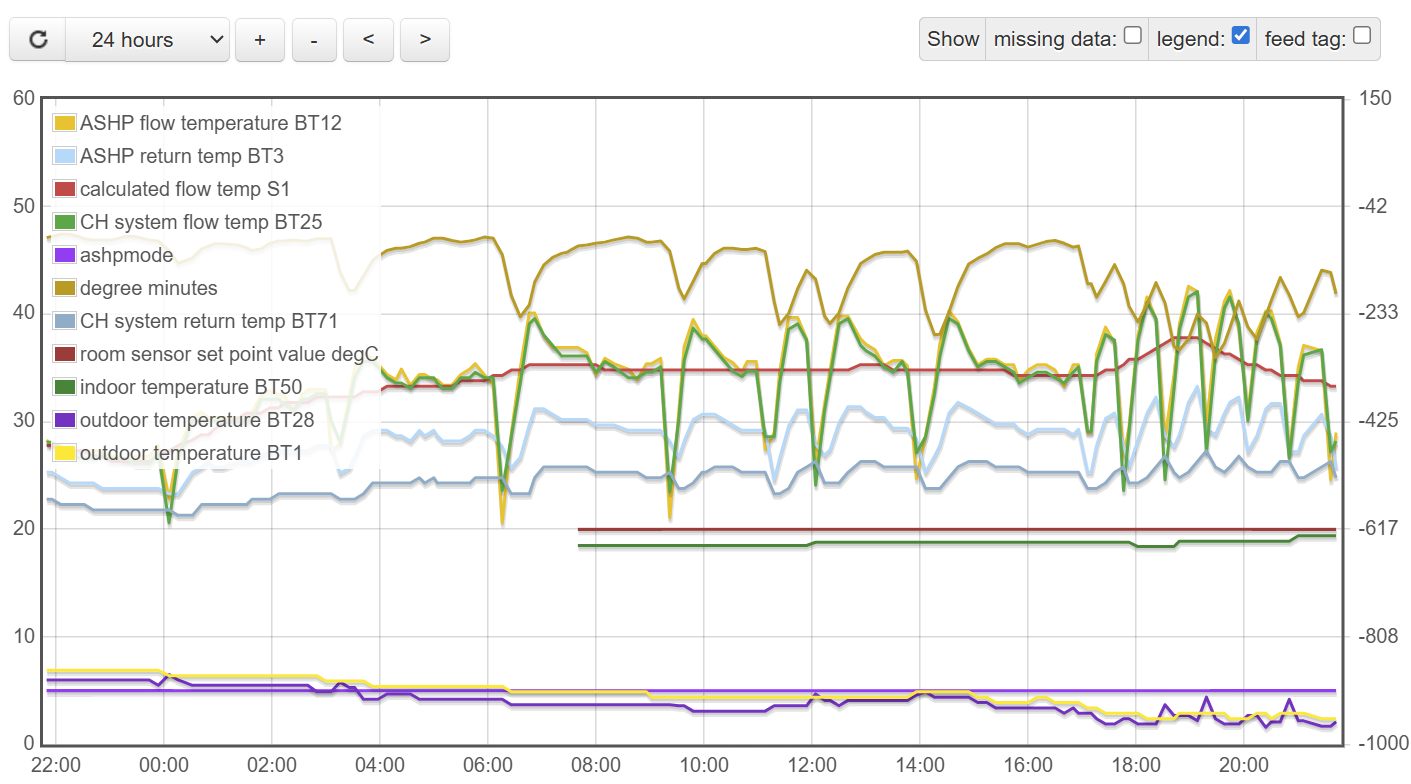
Just for a quick update : The room temperature is showing a slow increase and is getting close to target of 20 (assuming that is what the set value means)
Thanks Sam. The ‘20’ will indeed be the indoor temperature thermostat set-point (i.e. the target for the indoor temperature, adjustable on the controller in 0.5C increments). It’s good to see BT50 converging on that.
The last-but-one graph was looking very good, with BT25 closely following S1 as that moved up and down (with the occasional dip for a defrost, followed by a peak as the DMs recovered).
There’s clearly a lot more defrosting happening towards the end of the latest graph, as the Outdoor temperature dropped closer to 0 - although the DMs are still just trending upwards (following the ‘blip’ in S1). It will be interesting to see how it performed overnight, with (presumably) even lower outdoor temperatures but with BT50 close to the set-point.
I agree a simple schematic diagram would help, if Dave is able to sketch something when he gets chance. I’m still of the view that additional system volume would help by holding a reserve of heat for use when defrosting. That would probably work best installed on the Return from the heating circuits (rather than on the Flow side).
David
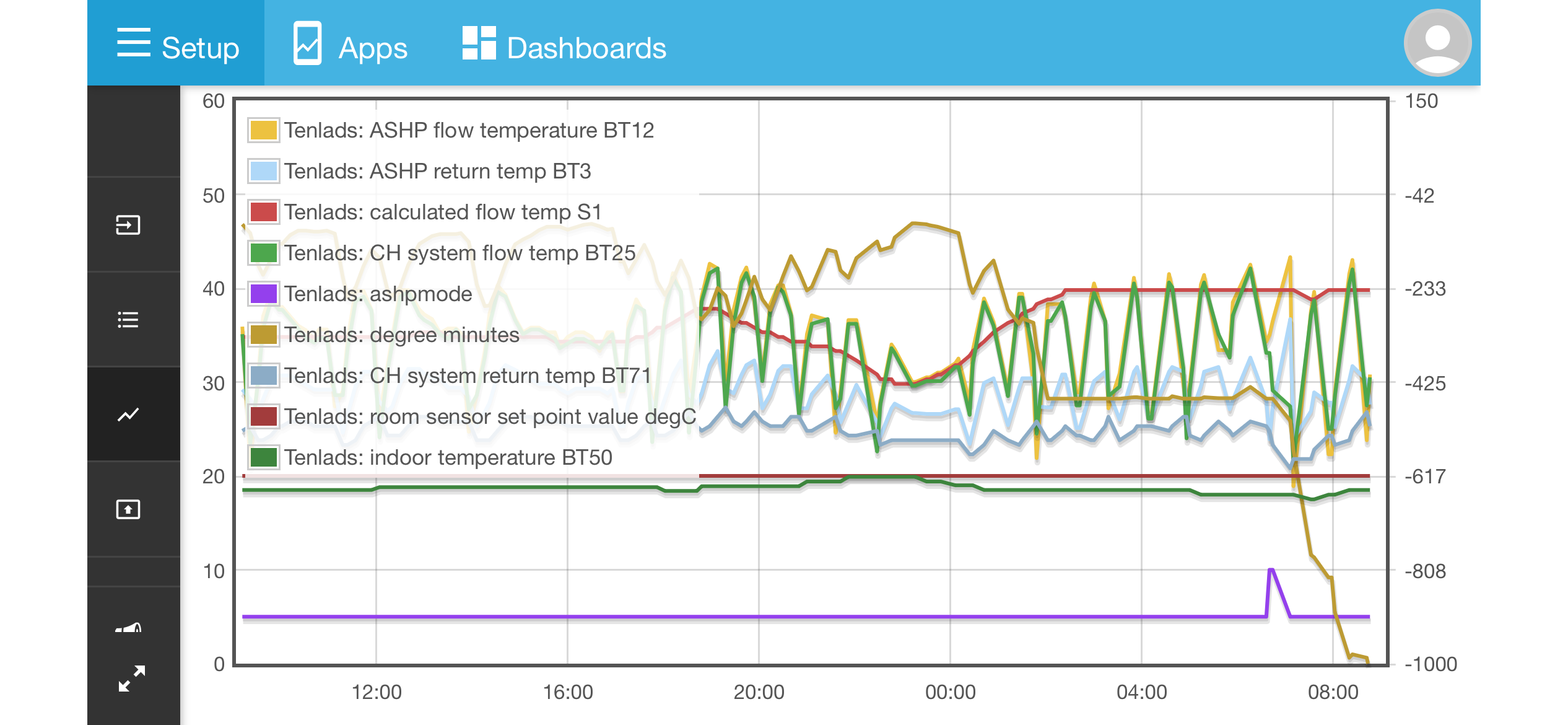
I think the graph supports the theory.
it doesn’t look like the ASHP is able to defrost effectively in colder weather. The flow temperature rarely gets up to the S1 target before a defrost (I assume) takes it right back down again.
The degree minutes have taken a big dive and the room temperature has reduced.
I suspect this is now the same situation as what occurred when Dave started this topic.
Thanks Sam. I agree with that assessment and it’s great that your latest graph catches it changing from ‘doing fine’ at about 23:00 to ‘definitely not coping’ at 08:00.
Interesting that it managed to hold steady at about -450 DMs from around 01:30 until around 07:00 when a DHW cycle (and the resulting defrost) pushed it ‘over the edge’.
@tenlads: This would be a good graph to review with your Installer. If things don’t improve with slightly warmer weather during the daytime you might want to temporarily reduce the indoor target temperature a degree or so, to stop it trying quite so hard and attempting 40C flow. You could also consider using the immersion heater on the DHW tank so the heatpump can focus on the central heating instead.
David
Hi Both,
Thanks again - this is really helpful and as you say @dMb a great graph to show the installer.
I’ve got a few more questions if that’s ok:
- We’ve still got a bit more volume to add to our system (some more UFH to install and two more radiators). This will add around 40l volume by my calcs. Would this negate the need at all for the volumiser tank?
- Radiator Balancing - should I make any attempt to do this to achieve any delta t across the upstairs radiators (as you would with a conventional gas central heating system) or just let them flow freely. They are all heating up sufficiently and equally.
- Volumiser tank - I’ve had a quick look at the Nibe install manual and from my understanding they recommend putting the tank on the flow side. @dMb you said to install it on the return side - what’s the reason for this? Also, volume - is there a rule of thumb for tank size? What are the pros / cons of going bigger or smaller?
- Defrost cycle - when this runs does this put the pump in reverse and effectively reverse the flow in the system?
Sorry for all the questions - still on the steep learning curve here.
I’ll also try and get the schematic sketch done in the next couple of days. Apologies for the delay!
Thanks again,
Dave
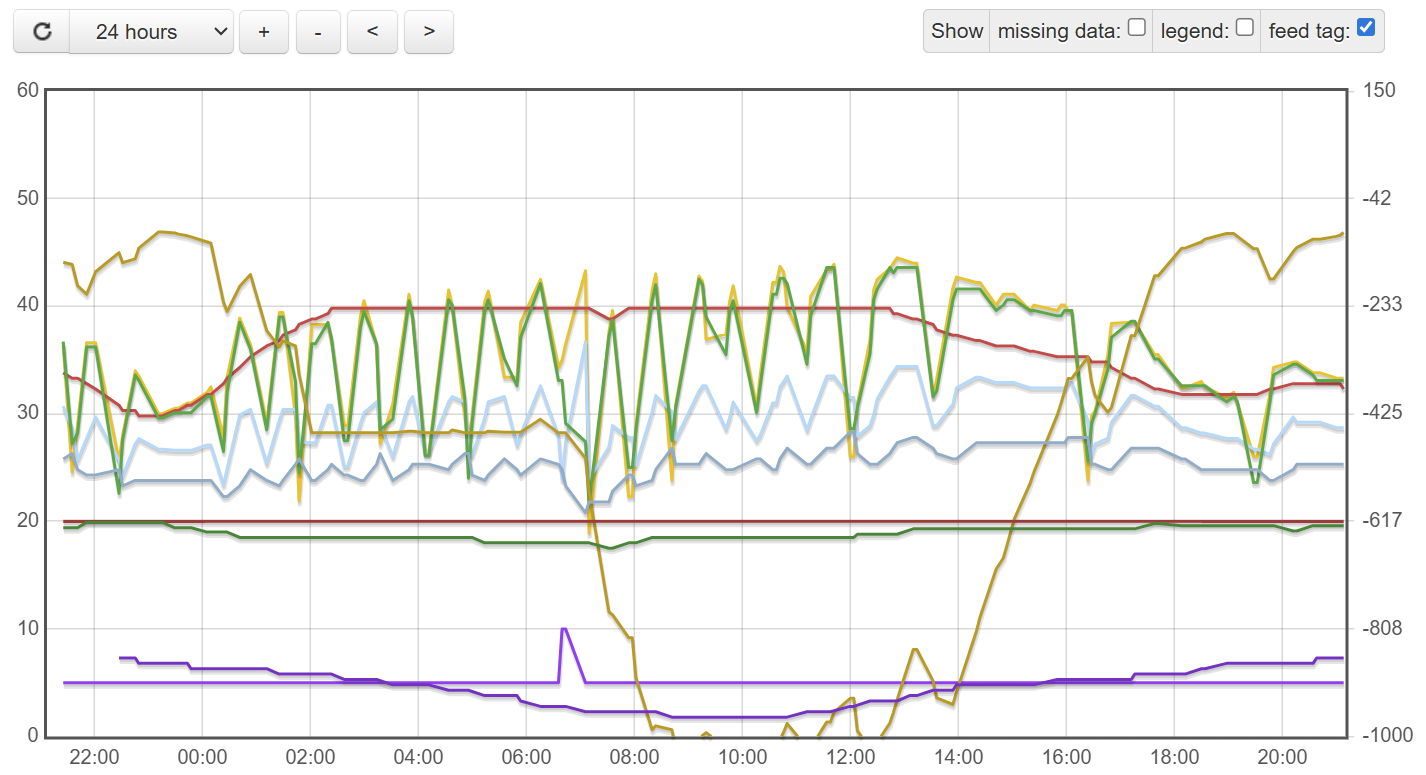
Your system did indeed recover once the outside temperature begin to rise around 1300. It is back to what we think is “normal” for your current set up - we can of course, and should you wish, help you keep eyes on how your ASHP performs as you add more volume.
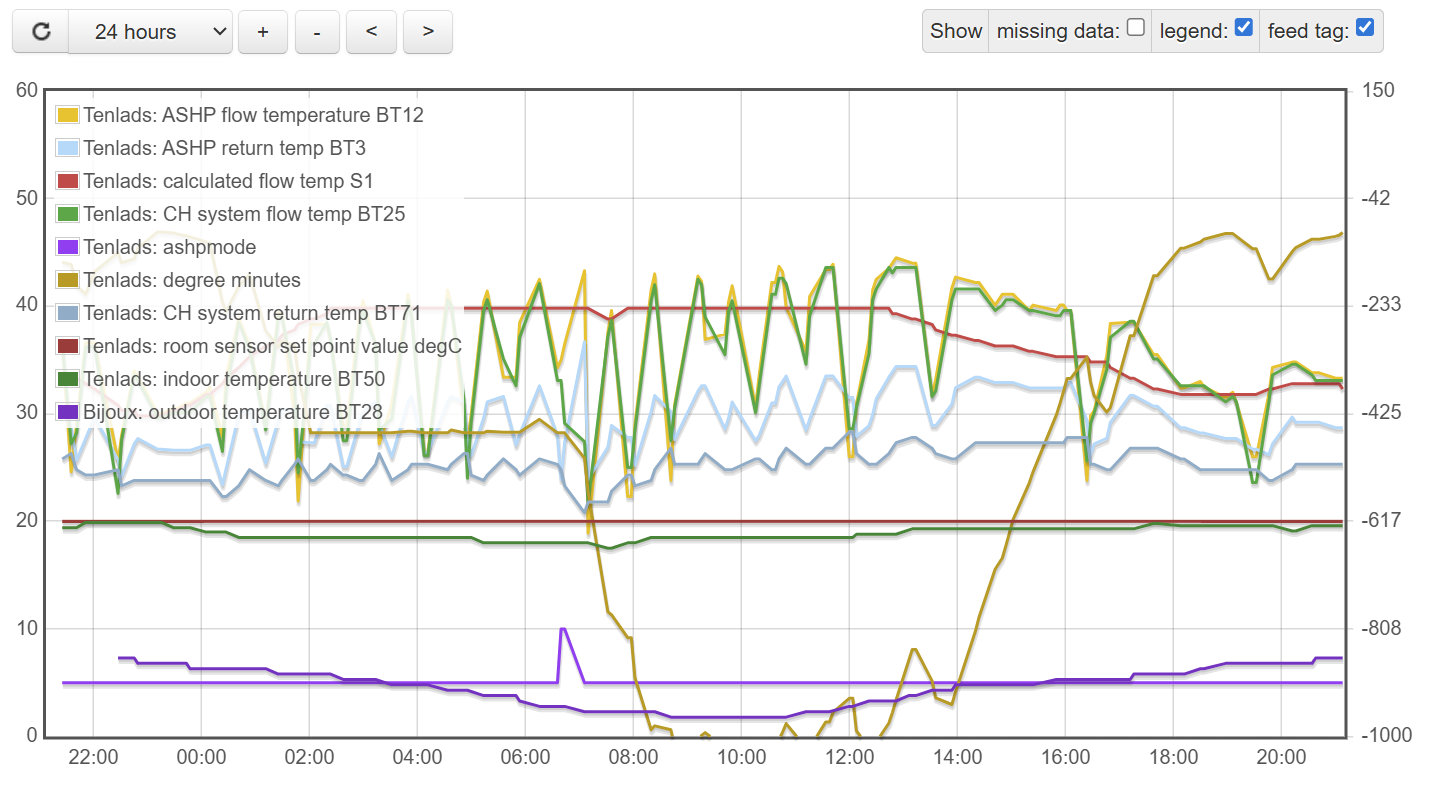
and same view but with the legend (omitted for clarity above as it covered up the end to end view)
Hi Dave,
Questions are always good; keep them coming. I’ll answer them slightly out of order:
During a Defrost cycle, the circulation pump still runs in the ‘normal’ direction. (These are centrifugal pumps which only work one way around and I don’t believe there’s any way to get them to run ‘backwards’.) However the outdoor unit goes into cooling mode, where it’s taking heat from the Return leg of the heating circuit and putting it into the evaporator, to melt the ice. As a consequence, the Flow leg of the heating circuit is temporarily colder than the Return (hence the big swings in BT25 on the graphs).
That’s right; the schematics in the NIBE controller installer manuals show it on the Flow side, although the manual for the NIBE UKV 100 shows other options. Several other non-NIBE threads on these forums have advocated placing the Volumiser on the Return to help with Defrosts, which had influenced my thinking - the logic being to provide a reserve of water for the heat pump to draw upon during a Defrost.
However, I’ve just been doing some further research and Volumisers in Heat Pump Systems: Does Placement Matter? | Renewable Heating Hub makes a compelling case for always placing a Volumiser on the Flow side, since it then ‘dilutes’ the slug of cold Flow water before that reaches the Radiators and UFH (so those continue to heat the house).
So ignore my previous suggestion; a Volumiser should go on the Flow side.
I’ve seen rough guidelines of 10 litres per kW of heat pump capacity (and I’ve got a 100 litre Volumiser for an 8kW heatpump) - but it depends on how much existing volume you’ve got and whether your system is prone to short-cycling. (If it was, a larger Volumiser would help to ‘soak up’ some of the output and lengthen the cycles, but your system hasn’t been cycling at all so that’s not a particular concern). It also depends on how much physical space is available. The NIBE UKV size options are: 40, 100, 200, 300 and 500 litres but in practice you’re probably looking at either the 40 or the 100.
If you go too big - especially with the Volumiser on the Flow side - there will be a lag before your Radiators and UFH see a Flow temperature change (and it would cost more to purchase and install). If you go too small your system will still be struggling during Defrosts.
Maybe, but I still think you would benefit from some extra volume that is separate from the UFH and Radiators. While there would be a cost to purchase the Volumiser tank and a cost to install it, there’s no risk of it reducing the efficiency of the system.
If you’re adding about another 40 litres anyway, perhaps go with a 40 litre UKV (i.e. an extra 80 litres total)?
If they’re all heating up I’d say leave them be. You want the valves as wide open as possible and sometimes you need to partially close valves on some rads to get heat to the others, but if they’re all warm already that sounds like they’re already pretty well balanced.
David
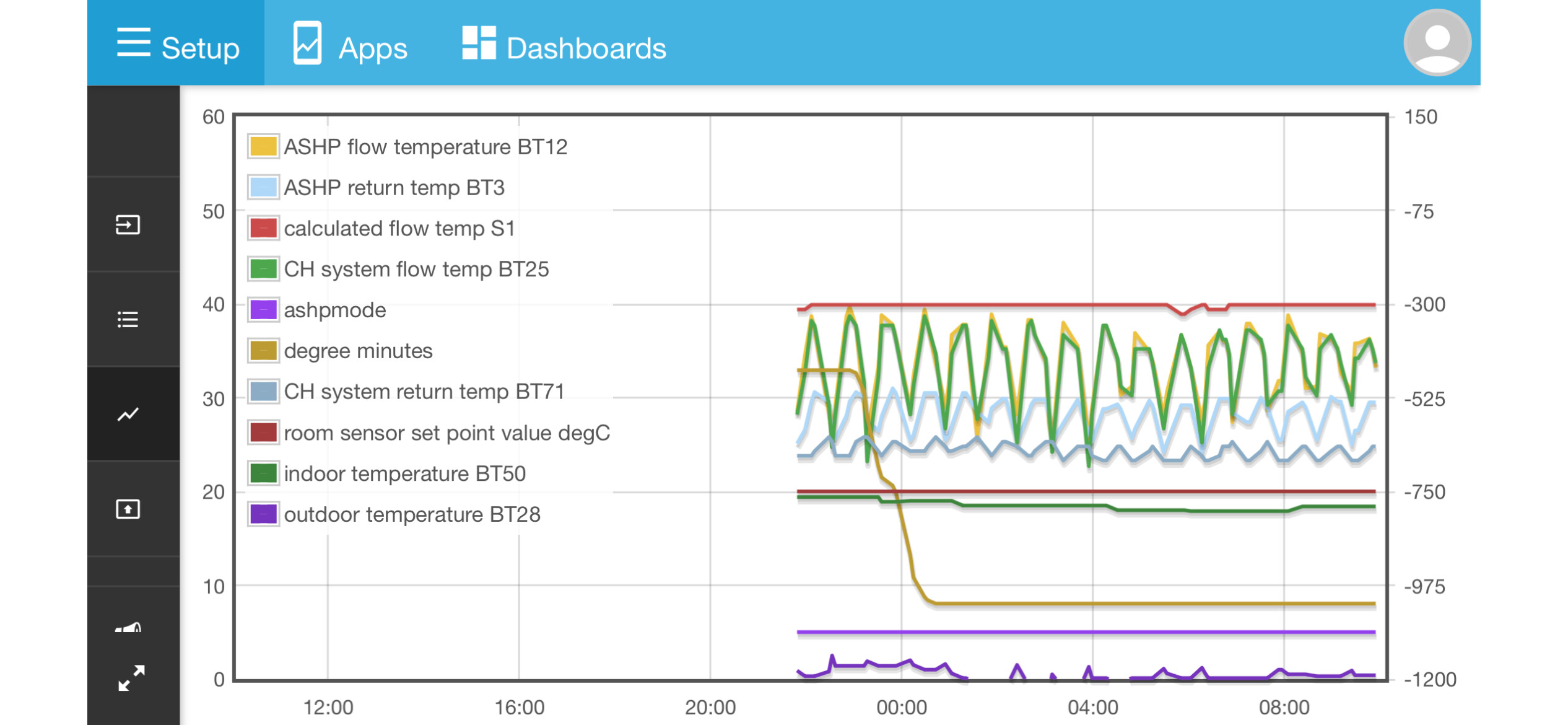
Hi Dave - Just a quick update for you. The temperature has dropped and the heat pump is struggling to defrost. The flow temperature is never getting to the target before a defrost is required. The temperature of your CH water is slowly declining which will further exacerbate the defrost problem if the outdoor temperature remains around 0 degrees.
This is another example of the defrost problem to talk through with your installer
Hi Sam,
Thanks for the update. Yes indeed the DM’s are stuck at -1020 and the house is beginning to cool down.
Unfortunately the installer is still elusive. Hopefully the outside temperature creeps up over the weekend to help us out.
Dave
Hi Sam / David,
Just a quick update. We had the installer round yesterday to take a look.
Essentially they were of the opinion that the ‘Power demand at Dot’ was set to ‘auto’. They claimed this was limiting the system to 8kw rather than the maximum 10kw which meant the system isn’t heating up quickly enough and therefore getting stuck in a defrost loop.
Firstly, I don’t understand enough about the ‘auto’ function of this setting - is this static or dynamic over time? How does the system determine what to set this at?
Secondly, I don’t see how this can have much of an impact on the defrost cycles. Unless it dramatically changes the COP (reducing it so it doesn’t freeze up as much) I would have through the system will still frost up a similar amount and will need to defrost.
I don’t see how the defrost problem can be solved without increasing the heat storing capacity of the system to give it more of a heat store to call upon for the defrosts? Or am I missing something here?
Sorry - I’ve also still not got the plumbing schematic drawn yet. I’ll get that done over the weekend when we’ve got a bit more time (or this afternoon hopefully).
Thanks,
Dave.
Hi Dave,
Thanks for the update. I don’t have any insight into how the automatically-derived ‘Power at DoT’ works (Sam might know more) but my system is working perfectly happily on the Auto setting and typically delivering more than its rated power output (as measured by a third-party heat meter). So I share your scepticism about this setting being the cause of your defrosting issues and I agree with your other assessments.
From an engineering and thermodynamics standpoint, the Evaporator in your outdoor unit (i.e. the part that frosts up) was designed to cope with the nominal heat output under typical operating conditions. Asking that Evaporator to work ‘harder’ (e.g. extracting 10kW rather than 8kW) is only going to make it frost up faster. (You’ll have noticed that larger-capacity heat pumps tend to have much bigger outdoor units - often with two fans - and the main reason for that is the need for physically larger Evaporators to maintain efficiency when extracting more heat.)
Ideally you’d want your system to frost up less - but that either means reducing the heat demand or swapping the outdoor unit for a larger model:
- If I understand your ongoing works correctly, you will reduce the heat demand once your renovation works are fully complete and you get the additional radiators and UFH circuits working, so that will help in the longer term.
- I’m not seriously suggesting you swap to a larger outdoor unit. That would be expensive and will probably leave you with an over-sized system once the renovation works are complete.
Unless or until you can stop your system frosting up so much, the next best thing is to make the defrost cycles more effective - which brings us back to adding a Volumiser tank to provide a larger reserve of warm water to be used when defrosting, reducing the chilling effect on your heating circuit.
Regards,
David
I’m also not familiar with the setting. Mine is at auto and whilst I have regular defrosts I don’t get into a program. I do run one of those double fan big units though (16kw).
I would also concur with you both about the effectiveness of this setting to assist defrosting.
I’m not sure when you changed the setting but if it was before today it didn’t make much difference. Your heat pump seemed stuck in a defrost cycle most of the night, just a little less severe than seen before
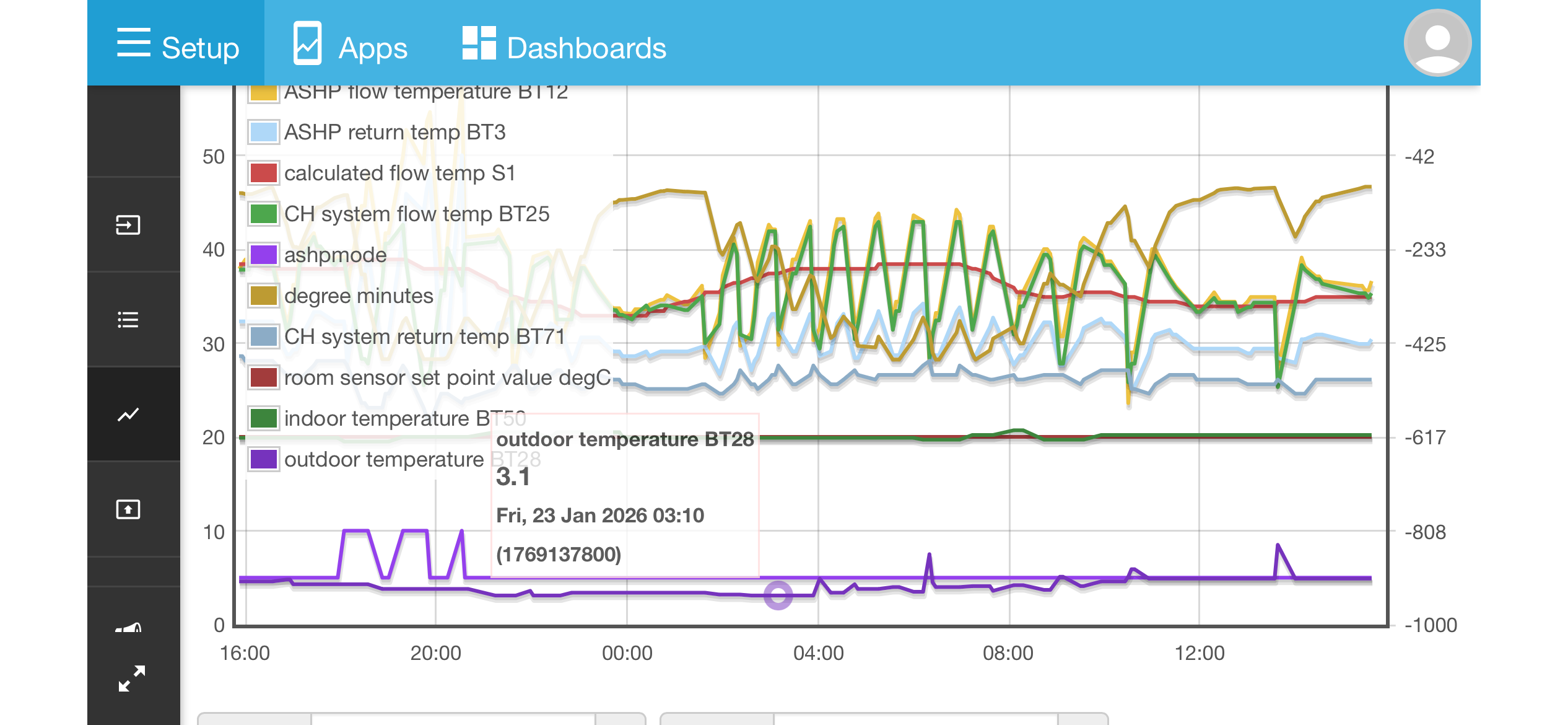
I’ll keep an eye going forward on any changes to performance or defrost