A relative newbie / clueless novice here looking for some help and advice.
We have had a NIBE heat pump systems installed for around 10 months now whilst renovations have been ongoing in house. Essentially I’ve not paid too much attention to things given a) the house has been in a state of transition with big holes to the outside, no insulation etc and b) up until now we’ve been warm enough / accepting of the temperature given the state of things. However, now the house is sealed up and the insulation is about there I’ve started looking at things a bit more closely (and the house is cold).
Setup:
Upstairs is heated by radiators (4 bedrooms and a bathroom) total area of c. 80m2.
Downstairs is open plan living space with a small snug, and utility room separate. This is all UFH (Ambiente) with a radiator in the snug and hall. However, the UFH is still to be fitted in the snug and utility room. Total areas of c. 90m2.
Heatpump: NIBE F2050
Controller: SMO S40
Issues:
The flow temp rarely gets above 40 degrees despite the max temp being set at 50 degrees
The heat pump looks like it is short cycling
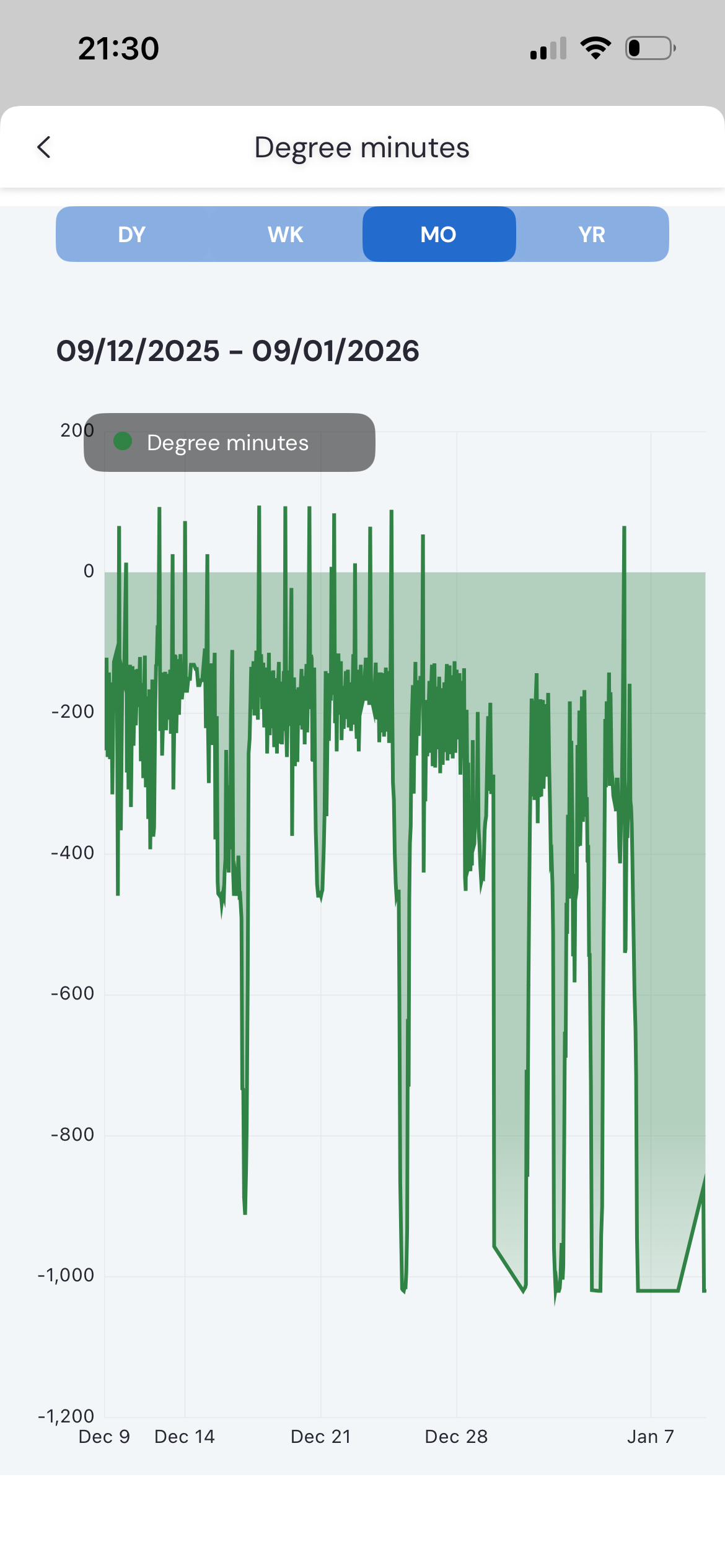
Degree minutes are currently at -1020
I’ve tried altering the curve (currently at 12) but this made no difference.
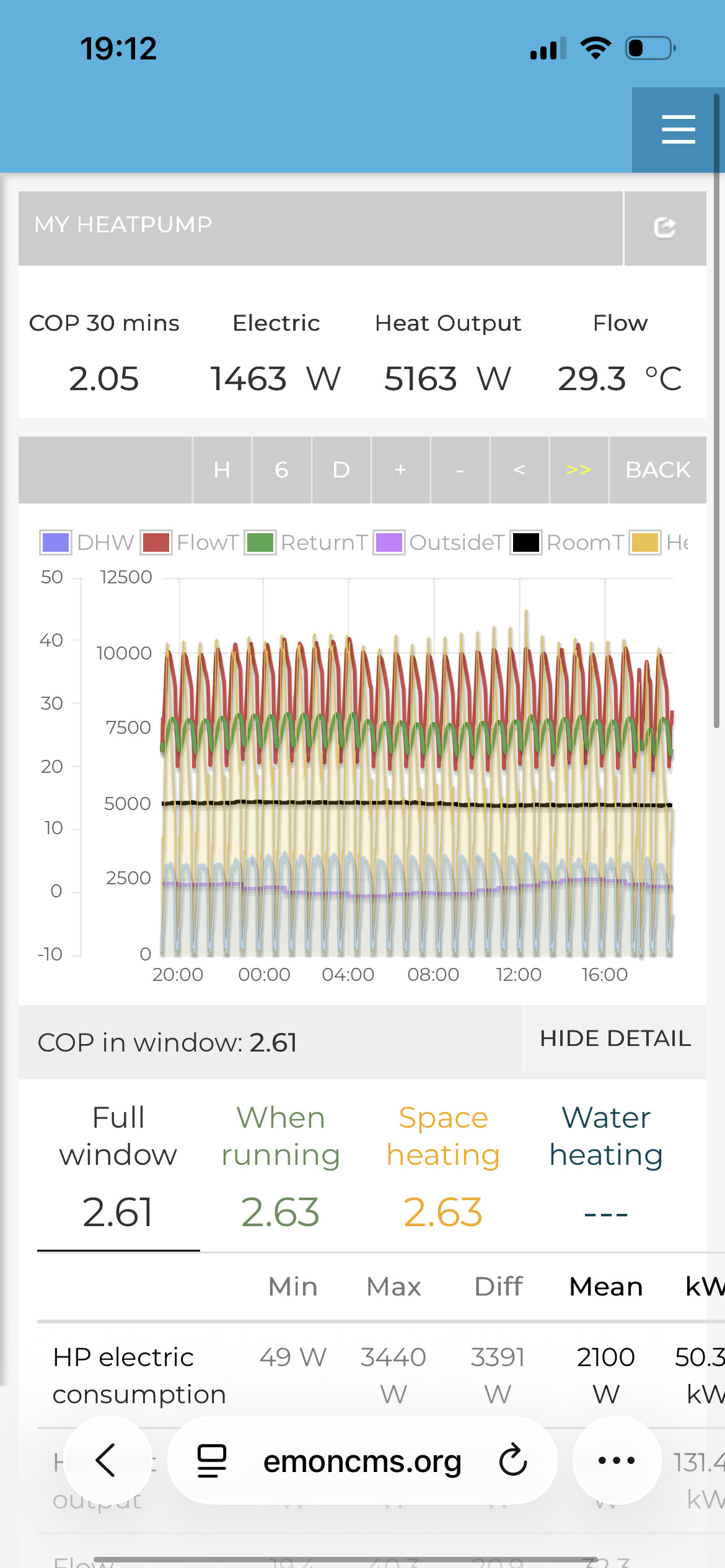
Here is a snapshot of what today’s OEM graph looks like:
Is this as expected or am I missing something obvious here? It seems to me strange that the supply temp will never go above 40 - could this be because the supply temp is rising too quickly (I’ve not balanced the radiators but the UFH heating had the ‘auto-balancing’ actuators).
It’s always good to see another NIBE owner on here. While there aren’t too many people who tend to participate in the NIBE discussions, those that do have some good knowledge about the systems - and the NIBE hardware seems pretty solid.
While that doesn’t look like crazy short-cycling (slightly more than one cycle per hour, by the look of things) and it’s similar to this other F2050 it’s definitely worth investigating.
The first thing that stands out to me is that -1020 Degree Minutes is much more highly-negative than I’d expect to ever see. That’s in the sort of territory when the controller would try to bring in the auxiliary resistive heating (though I’m not sure if the F2050 has that) and it’s an indication that the heat pump controller knows it’s failing to meet the heat demand.
As you may already know, the DMs typically range from about -60 (or a different, configured negative value which triggers the compressor to start), to 0 (when the compressor stops) - with a bit of ‘overshoot’ above zero being common (and the reported DM value being capped at +100).
Are your DMs going up above zero every cycle or remaining around -1000?
Presumably you have your system hooked up to myUplink so you’re able to access additional parameter values from the controller?
We’ve learned that the “External supply line” temperature sensor known as “BT25” is critical to the successful operation of the Degree Minutes control algorithm.
Are you seeing sensible values for BT25, generally matching the Flow temperature?
Are you able to check where your BT25 sensor is physically located?
Usually on the end of a thin black wire leading from the SMO S40
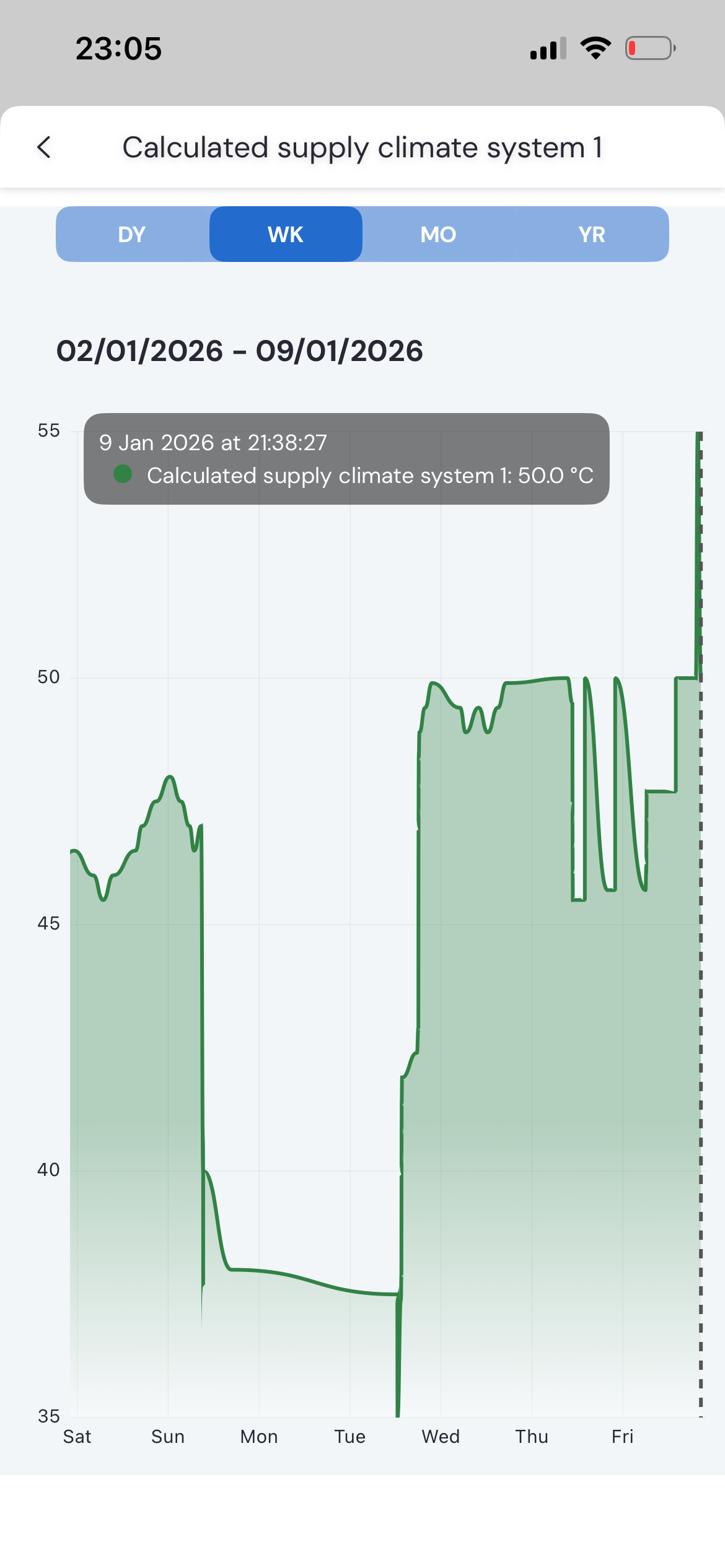
The other parameter that is helpful in understanding how the control algorithm is performing is “Calculated supply climate system 1”, also known as “S1” . Ignore the somewhat cryptic name; this is the Target value for the Flow temperature, taken from the WC curve. The Degree Minutes are a running total of how much (and for how long) the BT25 reading is more or less than S1.
How does the S1 value compare to your expectation of Flow temp above 40C?
How does the S1 value compare to the sort of values you’re seeing for BT25?
A litte more info on your plumbing setup would also be helpful:
Separate pump on the UFH manifold(s), presumably?
Any sort of ‘Volumiser’ tank (might be a NIBE UKV)? If so, what capacity?
If you have one, and there’s a thin black wire going into to top, that’s probably your BT25 sensor
Any sort of Buffer tank or Low-Loss Header?
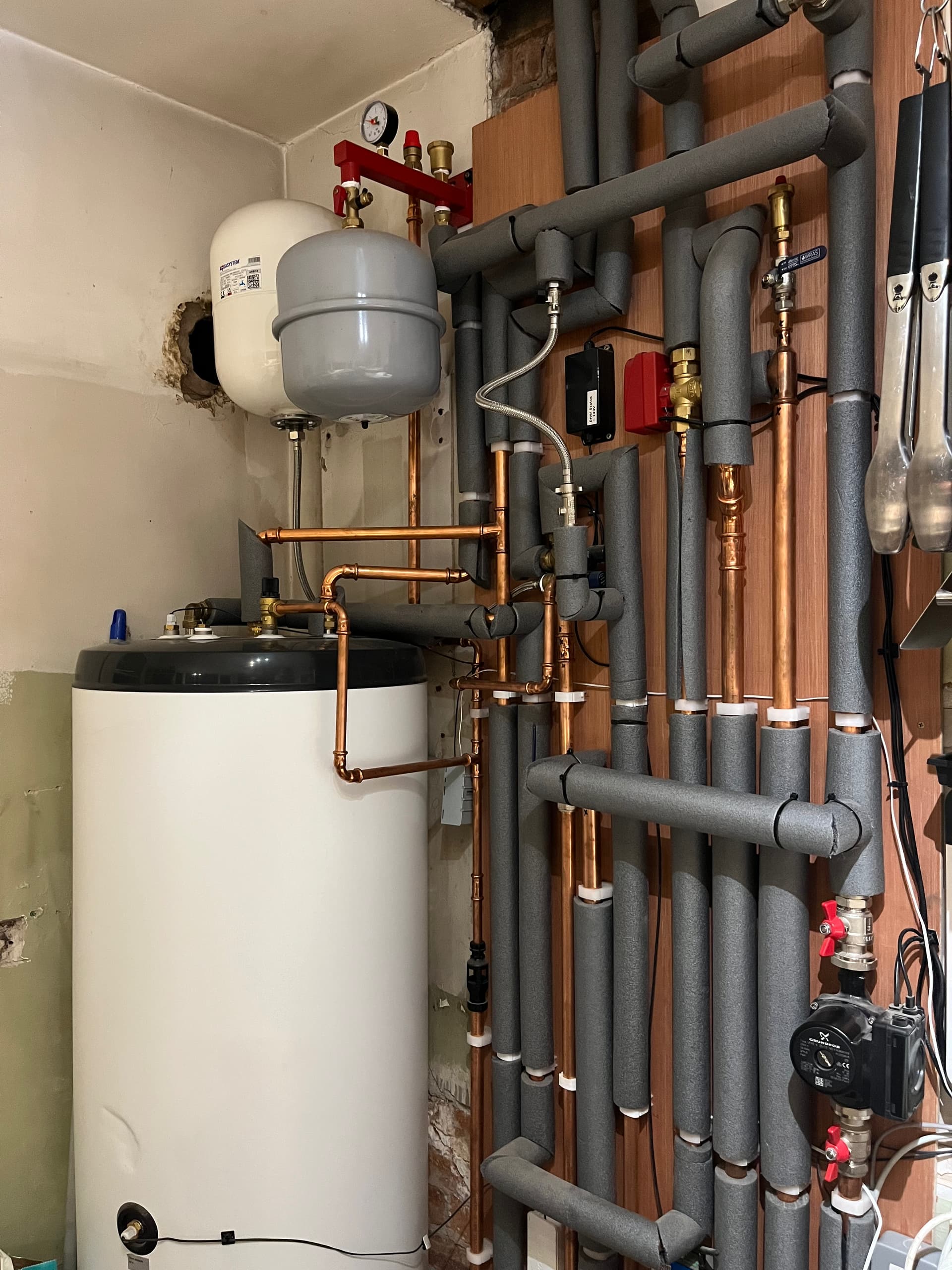
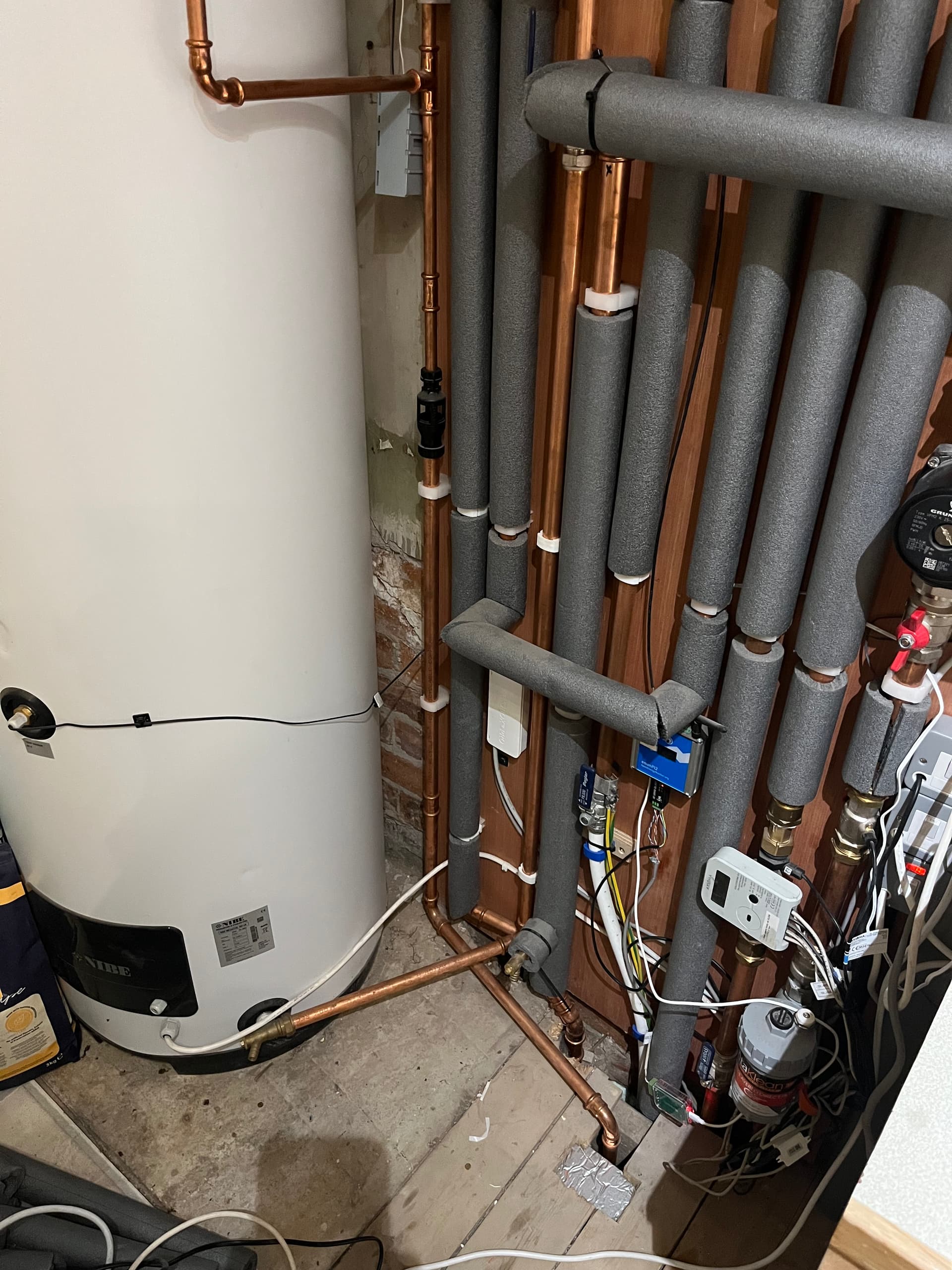
A photo of the indoor pipework would be ideal, if you have one.
Welcome! As David says, not too many who talk about Nibe on here but I’m also one of them and learned most of what I now know from here.
I’ve not managed to keep up with the recent flurry of Nibe posts but I’ll jump on here to see how we can help
to have such a negative degree minute value suggests your flow temperature into your heating system (measured by BT25) is never exceeding the weather curve calculated / requested temperature for significant periods of time, as a result your NIBE should keep running rather than cycle - it will try to keep increasing the flow temperature until it satisfies the degree minutes. So it’s odd it cycles and we need to determine why.
Nibe uplink will be most helpful here. Understanding why the Nibe does things is usually only possible by seeing a number of internal parameters all together.
as David said, another key step is some plumbing details.
Also what size is your unit? 12kw?
I’m also a little confused by your maximum 50 degree flow comment, the target flow temperature is usually set by the weather curve and it would need to be very cold and a high curve to target 50 degrees, so maybe you could explain a little more what you mean by this?
Yea, I’m not too concerned about the cycling per se - it’s more the fact that the supply temperature never gets above 35/40 degrees.
So, to tackle your questions.
DM - Yes, this seems extreme to me also (I’ve found some helpful explanations about DM’s and it shouldn’t be getting to -1000). I’ve attached a pic of DMs over the last month.
BT25 - yes, this is located just above the OEM meter and everything seems fine here (uplink and OEM match almost exactly).
S1 - This sits at 50 (I’ve tried upping this but it makes no difference and I’d prefer not to leave it above 50 due to the UFH).
Plumbing setup - There is not a separate pump for the UFH manifold (the installer explained that it shouldn’t be required and they would prefer the one pump to control everything) flow around all of the loops is 1l/min which I think is acceptable. I’m not 100% sure if I have a volumiser tank / buffer tank / low loss header… I have two small tanks hanging above the setup. I don’t think either is a volumiser tank, both seem to be expansion vessels of some description (one the HW and one for CH).
Sorry, I mean the highest supply heat is set to 50 degrees (1.30.6).
The curve is set to 12 with an offset of 10 so with the current outdoor temps (pretty much hovering around 0 day and night) it should be at the maximum (50 degrees).
I believe the heat pump itself is the 10kw version (F2050\AMS20 -10).
I hope this helps but let me know if there is any other information I can provide.
This is odd. They rarely go above zero, I would expect you to have positive degree minutes (which is what cycles the heat pump off) - and your OEM graph shows it cycling off so something is turning your heat pump off and it doesn’t doesn’t look like it’s degree minutes
you say S1 sits at 50 and you have tried upping it. S1 is usually dynamically calculated based on the weather curve and not set by user. Are you definitely running weather compensation? do you have a historical graph of S1? This should be variable based on outside temperature.
A few other observations but I’m not sure if they mean anything as yet. It’s sometimes useful to put them down and build a picture from all relevant pieces.
your delta T is rather large, from your OEM graph it seems to be 12-15 degrees so you’re losing heat somewhere but you’re noticing the house isn’t warm.
Your BT25 sensor looks like it’s on the flow from the heat pump rather than the flow to the Central Heating circuits, which looks to be the upwards pipe from the red 3 way shuttle valve. It’s not likely to make any difference but it’s not something I’ve seen before on a Nibe installation
Your room temperature on the graph seems low, which backs up the house feels cold. Do you have any indoor nibe sensors in a room? They are normally a small white square box
Do you have any indoor nibe outdoor nibe sensor? Again a small white box. This outdoor one is key for the S40 to know the temperature and pick an appropriate S1 target from the weather curve (see point above re are you running weather compensation)
Curve 12 and an offset of 10 is a significant flow temperature, and you’re still feeling cold. Something is definitely a miss here..
Just as a useful piece of further information, how are your UFH loops / zones controlled? Do you have room stats connected to the actuators on a manifold? How are your radiators controlled? Do your radiators and UFH heating feel warm? With 40+ degree water going to them I would expect them to feel quite warm to the touch
sorry lots of questions. It always starts with a bit of fact finding! I’m sure David will have even more
No problem about the questions - more than happy to answer them!
Yes, sorry S1 is dynamic but it is capped at 50. However, due to the weather curve and the outside temp this has been at the ‘cap’ pretty consistently over the last few days with actual supply temp never reaching it (ignore the blip to 55, this is where I was checking that the highest supply heat setting did limit this). I also have to confess with altering the heating curve earlier in the week to try and see if this kept the heat pump on more consistently (at a lower temp) to supply more heat to the house (I did warn you I was a newbie)…
I don’t have the NIBe indoor temp sensor installed (the installer was very light with the sensors they installed which I have rectified but I haven’t got round to the room temp due to the renovations). There is an outdoor sensor installed which aligns pretty closely with the other (netatmo) outdoor temp sensor we have.
Yes, the house is cold, significantly colder than it has been in the past. The radiators get mildly warm but never hot or as warm as they used to.
Heating set-up - the flow from the heat pump comes into the house and basically splits into 2. One goes upstairs to the radiators and the other to the mainfold for the downstairs (for the UFH but the radiators are also ‘loops’ on the manifold since there is only a couple). Each underfloor heating loop is controlled by a programmable thermostat but this is effectively set to ‘always on’ at the moment. I do have the auto balancing Ambiente ego actuators but these are always open since the loops never get warm (the flow of each loop is consistent at around 1l/min).
I can hear the heat pump switching on and it is working hard but it always seems to switch off as it approaches a flow temp of 40.
the installer was supposed to be out before Christmas as the periodic increase has never worked since it has been installed. However, we’re still waiting on them. I will chase them up again and have them look at this issue. However, despite their reputation I have little confidence they’ll fix it.
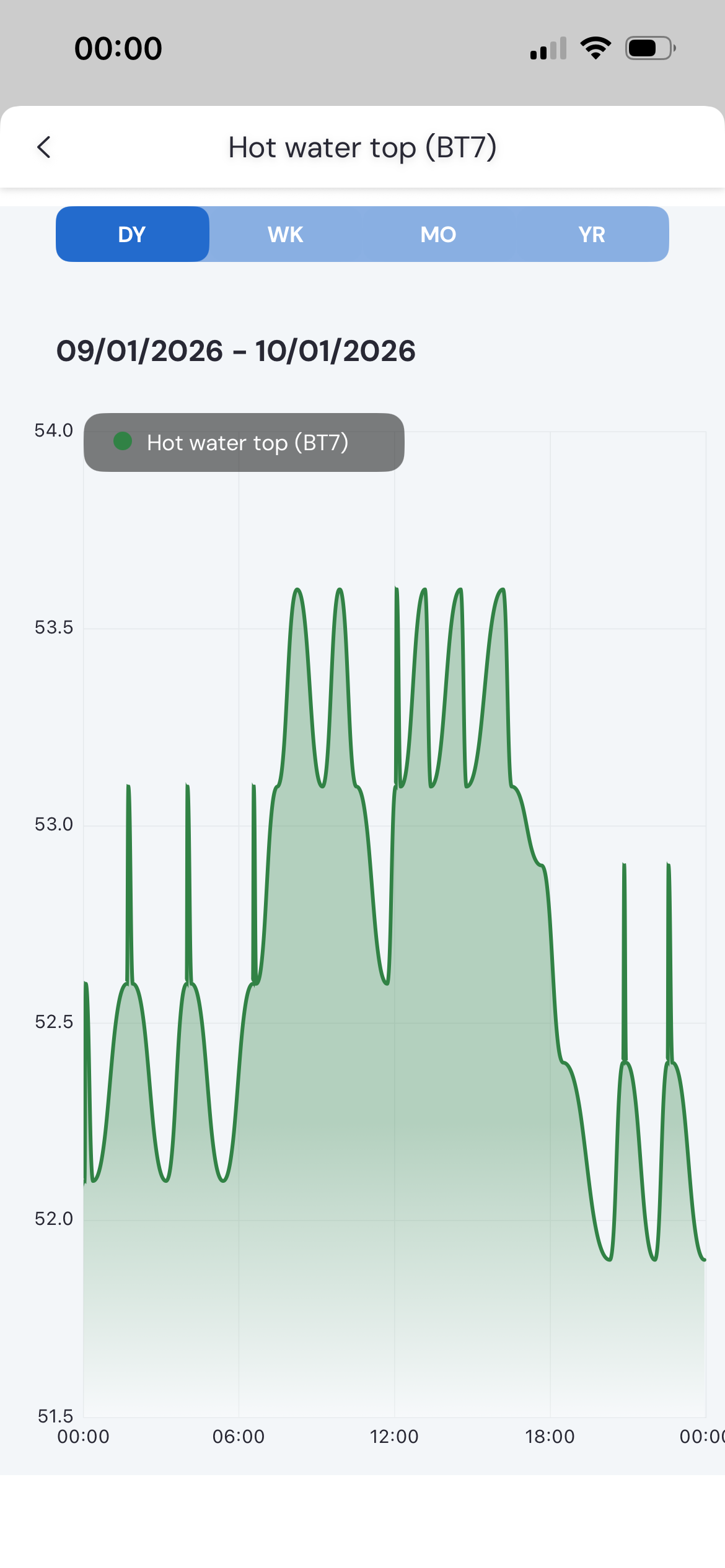
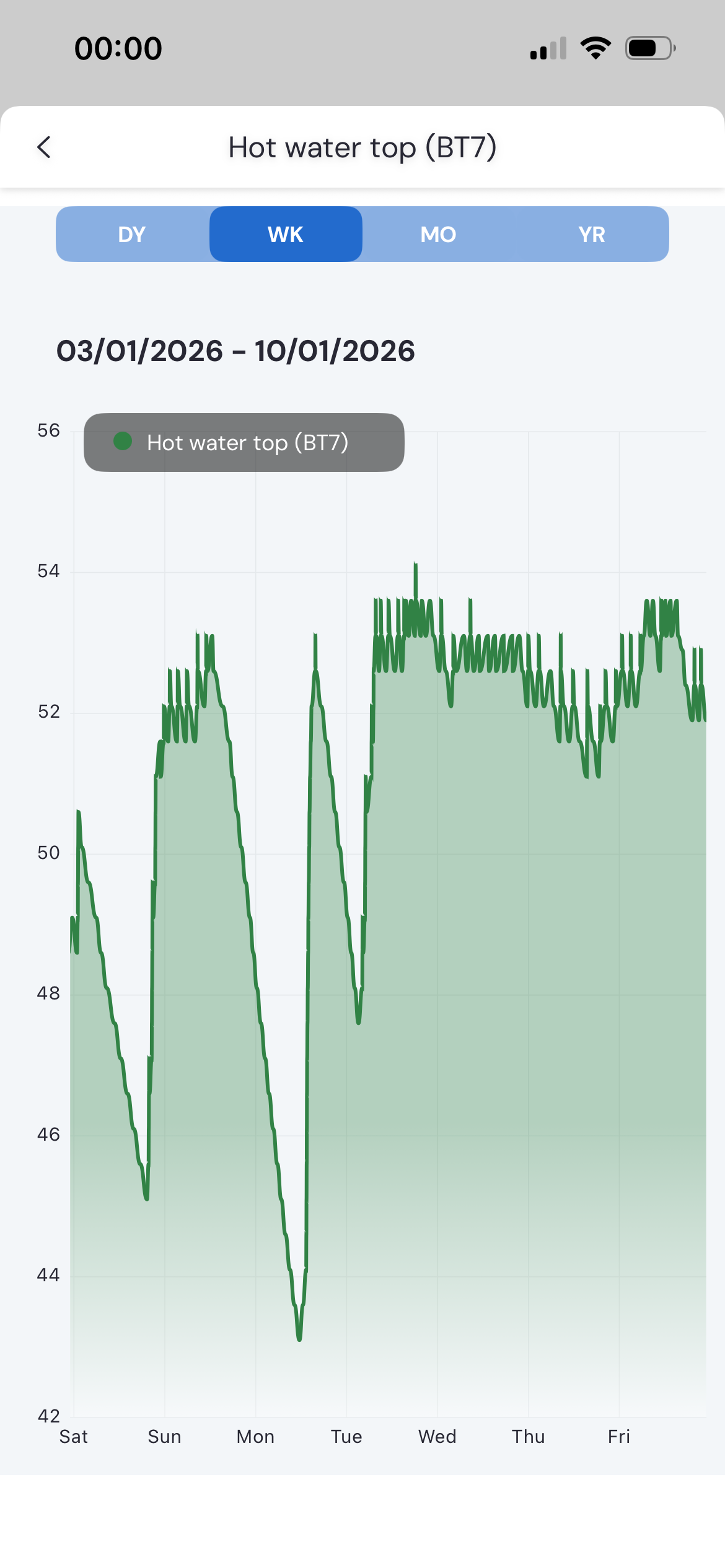
I wouldn’t expect the hot water temp to fluctuate like that - am I correct?
Could it be an issue with the valve where the hw is being heated at the same time as the heating? Still not sure why this explains why the supply temp isn’t getting above 35-40 but I’ll check the valve in the morning.
Thank you, it’s starting to become clearer how you’re set up.
with your target at 50 but your flow never getting there, this explains why you spend a lot of time in significant negative degree minutes. If your flow (which is the same as BT25 for you) is below S1 degree minutes keep counting down more negatively.
It seems your curve isnt helping you because something else is going on which prevents you meeting the flow temperature specified by the curve - I think your curve is too high but we likely need to look elsewhere before fine tuning the curve
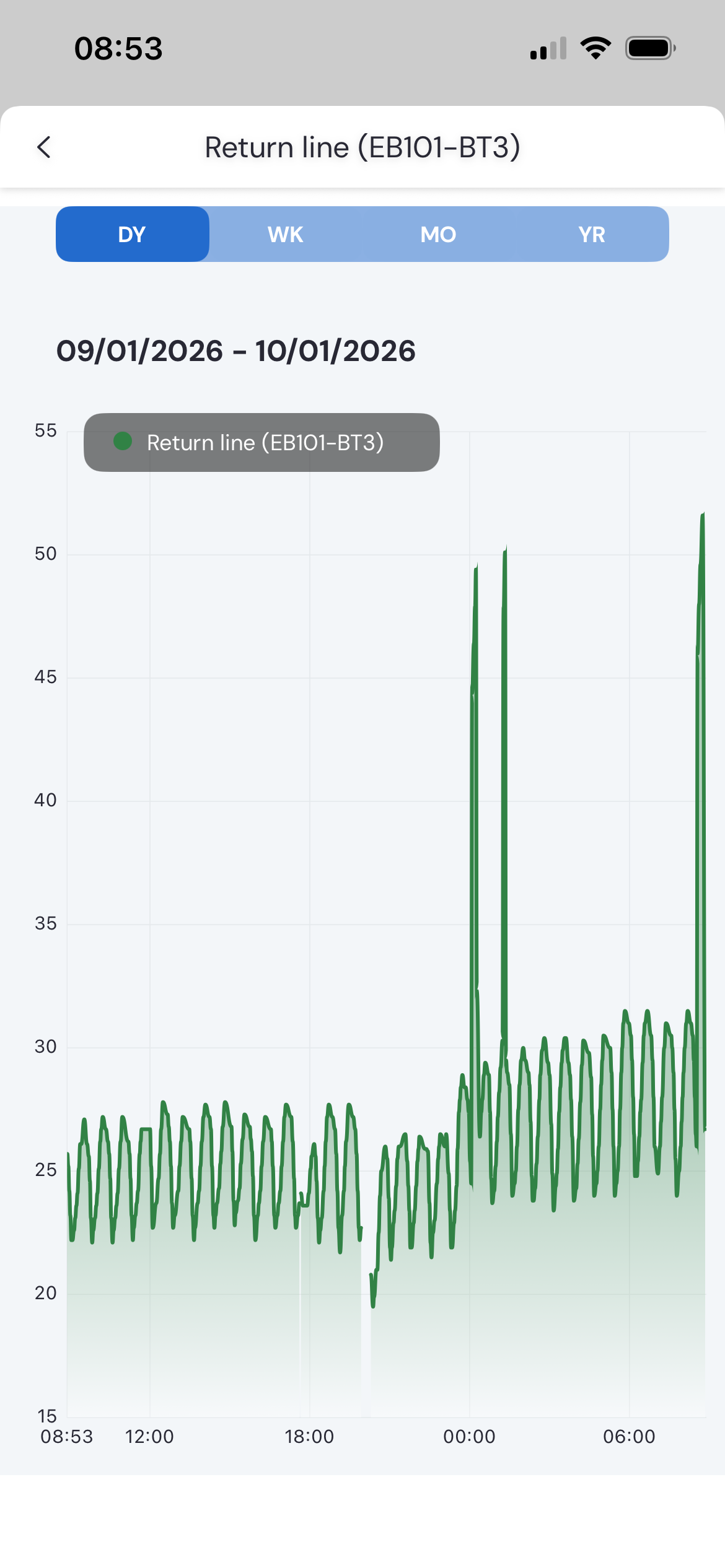
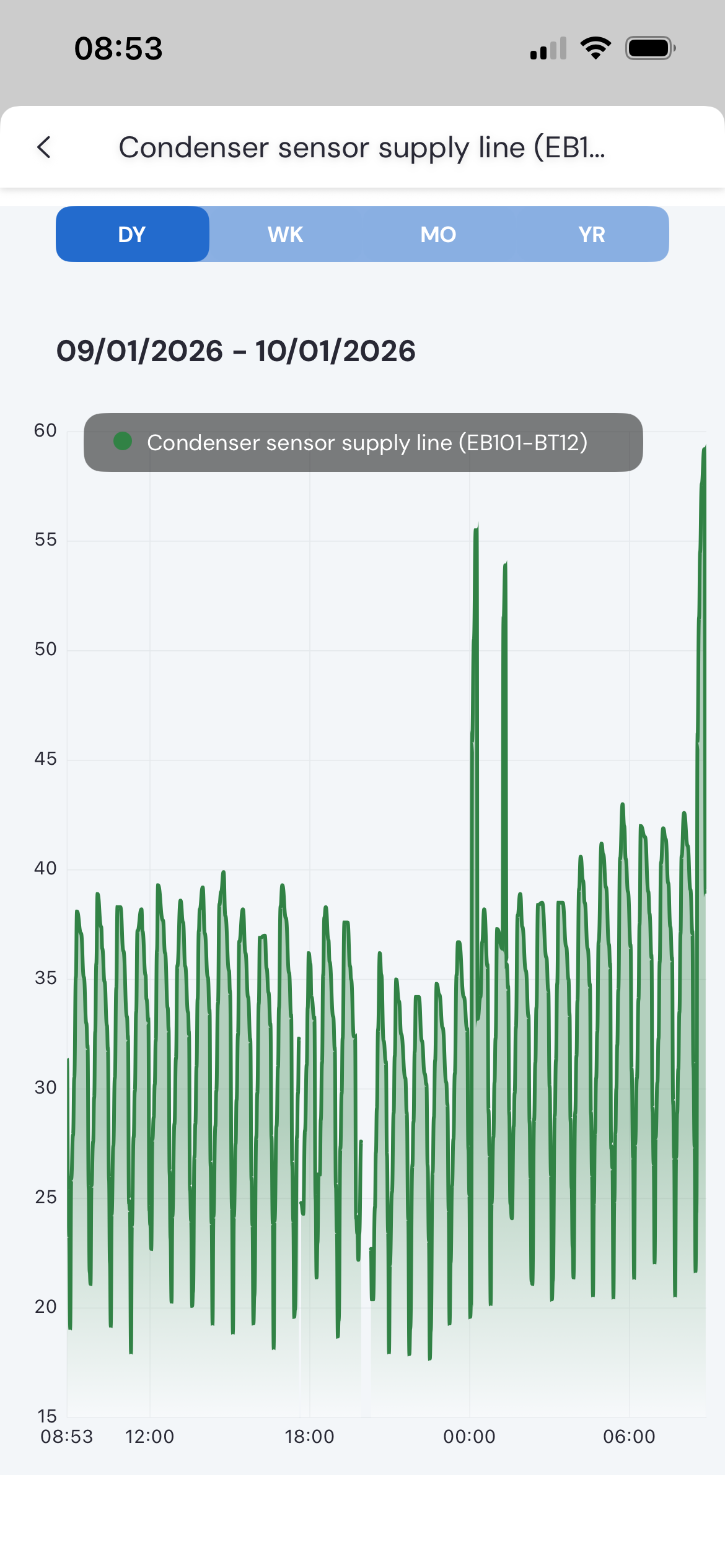
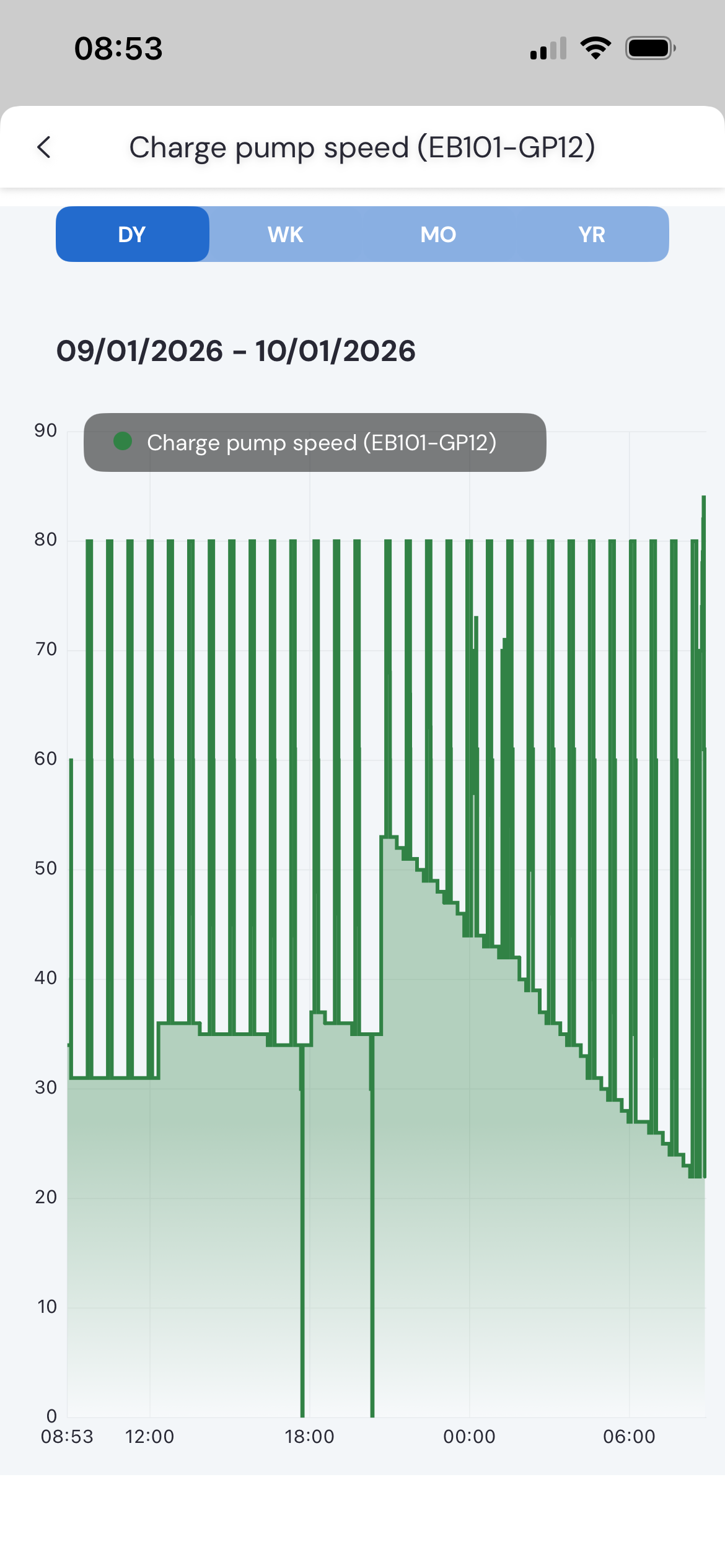
can you drop in some graphs of your charge pump speed (this seems to be the only circulating pump you have on your system) and also your flow and return as seen by the NIBE heat pump (BT3 and BT12) - I can see it from the OEM kit but it’s useful to see what the NIBE thinks.
Thanks for all the extra info. A lot of it confirms the behaviour we’d expect to see:
S1 is high but seems eminently sensible for the Curve and Offset you’ve got configured
The highly-negative DMs are a natural consequence of BT25 being consistently lower than S1 for hours on end (rather than alternately above and below S1 on each cycle)
As Sam noted already, it’s odd that the Compressor stops before the DMs rise to 0, so ‘something else’ must be making it do that.
The Hot Water temperature changes reported by BT7 do seem odd and an issue with the diverter valve is a possibility. There should be some sort of indicator arrow on the valve head. Can you see that indicator and does the valve move as you’d expect when switching from Central Heating to Hot Water?
Do Hot Water cycles generally work OK? Do you get higher flow temps when heating DHW (which would confirm the heat pump is happy to deliver higher temperatures in some circumstances)?
Since the NIBE Charge Pump is the only circulation pump in your system that’s going to be working fairly hard to push the flow through all the radiators and UFH loops. As Sam noted, some graphs of the “Heating medium pump speed” would be great, to see what that’s doing.
Sure - not a problem. I’ve attached the graphs below.
On a side note I’ve been trying to check the hot water diverted valve (by asking for a temp increase in hot water) and it seems fine. It also shows the heat pump is capable of supplying temperature above 50 so it doesn’t look like a catastrophic issue with the heating period pump itself. I’m still slightly confused why the hot water has stayed at a high temp despite showers / baths.
Yes, the Hot Water cycles work ok (high supply temps etc) although I did notice that there hadn’t been one for over a day yet the hot water remainder hot. I’ll do some more diagnostics on the valve itself to check it’s moving correctly.
We do have another pump for the UFH loop we can install if required (it’s still in the box) but from the flow meters in the manifold the flow doesn’t seem unreasonable* (1l/min).
Thanks Dave. It’s good to know DHW cycles work OK.
I’m surprised the Charge Pump isn’t being driven harder - seems it’s only briefly peaking at 80% whereas I’d expect it to be closer to 100% whenever the compressor is running.
Could you check the settings in Menu 7.1.2.4 please, for the Charge Pump Speed. If the maximum is set to 80% that can go higher; 100% wouldn’t hurt. You might also want to try temporarily changing it to Manual speed control and forcing it to 90% or 100%, to see if that improves matters.
As Sam noted before, your DeltaT seems a bit high so maybe there’s something odd happening with the automated charge pump speed control (which aims for a specified DeltaT). The settings for that are in menus 7.1.6.n.
I’m no UFH expert but I believe 2 litres/min is a better flow for UFH loops with a heat pump - but I agree that if you can get an ‘adequate’ UFH flow with just the NIBE Charge Pump that’s preferable to adding the complication of a second circulation pump.
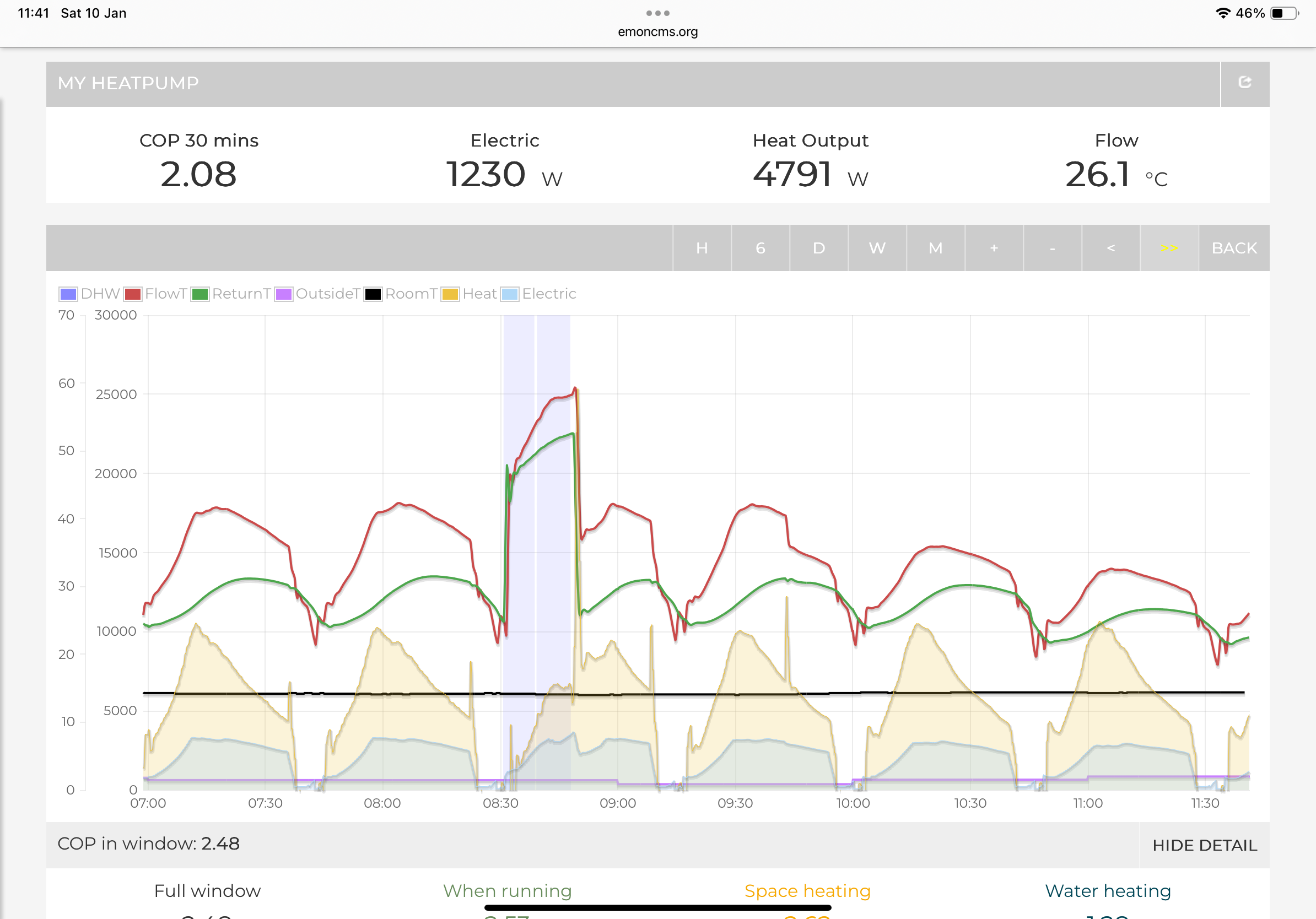
In an act of desperation I have emptied the hot water tank. I’m going to set it to heat as I want to check the heat pump is capable of heating it back up to temperature in a reasonable amount of time.
Interesting. That DHW cycle 08:30 - 08:45 looks ‘normal’ and it will be good to confirm you can reproduce that again. Both Flow and Return temperatures are high, and steadily rising (more or less) together.
Presumably it was 09:45 when you forced the Charge Pump to 100%, corresponding to the step-down in the flow temperature. That does makes sense: for a given heat output from the compressor, a higher flow rate through the heat exchanger means a lower flow temperature. However that higher flow isn’t giving you any more heat transfer to the house…
It’s the Return temperature profile that looking the most strange to me. I’d have expected the Return temperature to rise more quickly from the start of a cycle, more in line with the Flow temperature as that increases. I don’t think you’re ever going to see a Flow temperature of 50C when the Return is down below 30C. So maybe we should approach this from ‘the other end’ - why is the Return temperature so low?
My other thought is about Defrosts. Are you able to tell how often those are happening?
It would be interesting to know if your heat pump is cycling off or just defrosting. The flow temperature is dipping below the return temperature, this only happens on my system when it defrosts. In your system you don’t seem to have a large buffer tank (or other store of heat) so a defrost will take heat straight out your CH circuits and perhaps explains the flow dropping so low so quickly. Nibe uplink has a messages / error section which usually lists defrost events so if you can find that it could be useful information to tie up with the above graph.
For the time period shown above (when you changed the setting) can you post a graph of compressor frequency, this should indicate what the heat pump is trying to do
We still need to figure out why it gets to 40 (or thereabouts) and decreases flow temp, I think we can assume it’s deliberately doing this and I wonder if it’s something to do with the large delta T? Does the nibe control algorithm do something if the delta T gets way too big. Maybe it thinks you’re pushing way too much heat into the house and ramps down flow temp irrespective of degree minutes? This is then counter intuitive to try and get degree minutes under control. This is a guess and not a behaviour I’ve observed before. David might have a view on this.
I wonder if another experiment might help us. What would happen if you set a S1 temperature that the flow rate (under current circumstances) can achieve, maybe something like 38 degrees for the current outdoor temperature. This might get you out of negative degree minutes. This would mean picking a curve somewhere near 7 or 8 and letting it run. This could lead to a cold(er) house for a while but I’m keen to see how it behaves when it can regularly satisfy degree minutes. It’s a bit of a test to see if we can get your installation to operate “normally” based on everything we know about how the NIBE system controls itself. This wouldn’t solve the low return / large delta T but it’s all useful information. However let’s do one thing at a time so report back on your hot water experiment first. I expect this to work, you can see in hot water cycles your delta T is around 5-8 degrees which is much more normal and the nibe continues to ramp up the flow to 55-60 degrees
Experimenting when it’s so cold outside and defrosts are common is less than ideal.
I’m also wondering if some of our detailed graphs of all parameters will help us see something. The data all comes from Nibe uplink but it is quite advanced to log and visualise data. David and I have both done this for others but it requires granting access to us for your Nibe uplink data - in read only mode. We can just graph them up and have a review of all parameters ourselves which might unlock some more thinking. I’m sure we would be happy to help if you want to go this way.
I’m equally puzzled by this behaviour Sam; it’s not something I’ve seen before. I have the older SMO 20 controller - and on a Ground Source system (so no Defrosts ) - so your experience is likely to be more relevant than mine. Thanks for stepping in to help Dave out.
It’s possible that with such a highly-negative DM value (and such a high S1) the controller is ‘trying too hard’ and quickly frosting up in the current weather, entering a vicious cycle. I do think it’s worth trying a test on a lower Curve, maybe after a power-cycle to reset the DMs to 0, to check what happens under more gentle load.
I also think getting a more complete picture from myUplink would help - in particular the ‘Operating Mode’ / ‘Status’ / ‘Priority’ parameter you and I have discussed before, which I don’t think is available as a Custom Tile in the myUplink App. If Dave is happy to grant one (or both) of us remote ‘Viewer’ access to his myUplink data (which he can revoke at any time) it would be easier to see a more complete picture, viewing multiple parameters side-by-side.
Alternatively Dave - if you’re up for a bit of Python scripting - Sam or I can help you to pull back more data from the myUplink API, for you to add into emonCMS alongside your heat meter data.
Just as a comparator. I run a F2040 16kw unit with a SMO40 controller. I have 8 radiators downstairs and UFH open plan upstairs. Everything is open loop, no thermostats or zone valves with a circulation pump on the UFH manifold and a second one for the radiators, these are separated from the NIBE charge pump by a 3 port buffer tank.
The upstairs is new, lots of glazing but insulated well with SIPs. The downstairs is brick and old, cavity walls with no insulation and suspended timber floors with no insulation and lots of air bricks to keep it nice and cold under the floor.
I have regular defrosts but I’m not linked up to NIBE uplink so I can’t tell you how many.
I run curve 7 and right now my S1 is 36 degrees for a 1.5 degree outdoor temperature. My house maintains a very steady balanced 21 degrees on this curve and flow temperature.
Assuming your house is better insulated than mine you should be able to drop the target flow temp right down to below 40 using curve 7 or 8 and maintain a comfortable indoor temperature. This won’t solve the big delta T you are seeing on flow and return but it will definitely help stabilise things whilst we continue to understand exactly what your unit is trying to do.

 ) - so your experience is likely to be more relevant than mine. Thanks for stepping in to help Dave out.