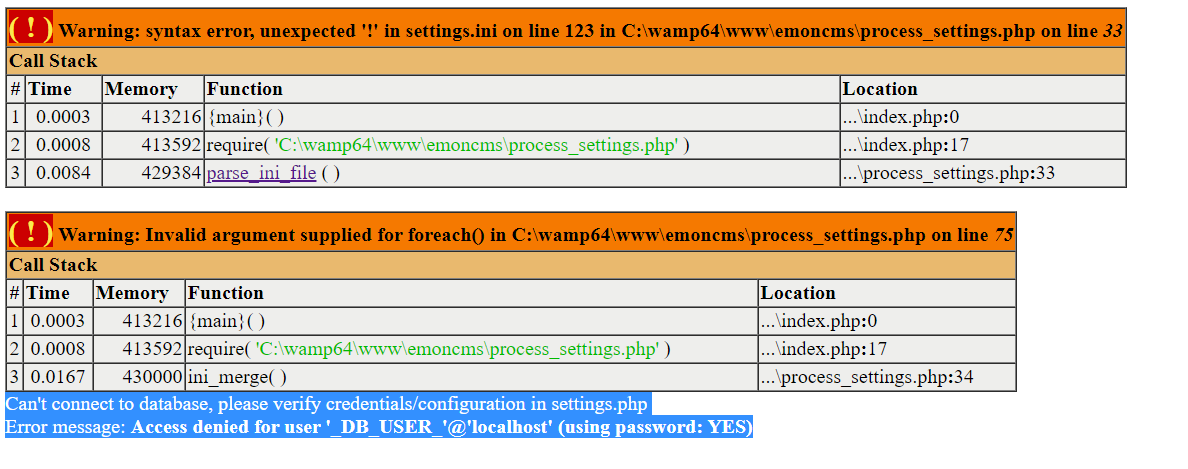
Hello everyone. I would like to create a WAMP local server for my emoncms. Unfortunately I have a problem with the settings.ini file created from the example settings.ini file. On loading localhost/emoncms the following error is returned.
This unfortunately does not work. it still retruns the same error as before. May be I should point out that I am following the guidance provided by this link in creating this settings file from the default settings file. I have attached the default setting file as well. defaul_settings.txt (5.8 KB)
Have you tried deleting the ! in the settings file (I know that in theory it is commented out but…)?
From the docs;
Note: The following reserved words must not be used as keys for ini files: null, yes, no, true, false, on, off, none. Furthermore, the following reserved characters must not be used in the key: {}|&~!()^".
You are probably the first person to try the newer settings process (by ini file) on a WAMP setup. EmonCMS is largely run on a LAMP machine, and is designed for such.
You need 2 ini files, one is the default settings, and a second to override settings as required and is thus a subset of the default settings. Do you have both? The structure and the [headings] must be identical.
@Lui if you have any way to run on Linux (VM, docker, spare RPI perhaps?) you should have a better experience as we dont develop and test on WAMP, just in case it saves you a lot of hassle?..
Each element of the ini file should be on a single line. If the Win machine opens it and it does not have the correct line breaks, it may be the issue.
The first thing that springs to mind is the text editor is going to handle the file differently
than the WAMP server. I recall running a WAMP server and seeing the same thing,
i.e. the file didn’t display correctly in Windows Notepad, yet the WAMP server had no issues with it.
Sounds like it may be a WAMP server issue vice a Windows issue.
Well I instead opted to get a raspberry pi v4 for the same task. I followed the instructions on how to install the emonScripts as it is discussed here. Unfortunately on rebooting, I can no longer access the pi. I keep getting the error message “Cannot open access to console, the root account is locked.” I have seen possible pathways to resolving this. Is there any explanation for this? And how easily can I resolve it.
Is that the first reboot after install? Did you wait for it to finish all the resizing etc (does take a while)? You might get that message initially while it is busy doing things.
I don’t think the scripts had been tested on a Pi4. Any reason not to use the EmonSD image?
I edited the the cmdline.txt by adding init=/bin/sh using a card reader. The console indicates bin/sh: can’t access tty; job control turned off. Then I followed the instructions as explained here. The OS indicates that it has panicked but sync fails. What did I miss?
Hello @borpin.
I installed the emonSD image onto a flashDrive and logged into the emonpi thereafter.
I would like to access have a user interface to use which would enable me to access my emoncms account locally from this point on. Is there a way to proceed from here? How do I transit from the terminal to the EmonCMS GUI interface? Any resources and guide from here will be appreciated.