Accurate flow measurement is typically a lot harder to achieve than temperature measurement, but if you just want to look at relative performance over time, or with different settings ‘close enough for government work’ works for me. 
It appears the newer-gen Arotherm devices have a built-in compensation for the sensors. There is an automatic air-bleeding program which detects sensor offsets and sets a delta internally to compensate. The older arotherms also have this program - maybe it would be worth a shot to try whether the compensation is an undocumented feature on them
Very interesting! Where have you gleaned this info about the new-gen Arotherms?
I read that there is an air bleeding mode and temperature calibration on a german heat pump subreddit. Looking at the manual of the latest Vaillant indoor unit for the newer models confirms this:
The service instructions mention running the air bleeding program (“Entlüftungsprogramm”) to calibrate the sensors once a year.
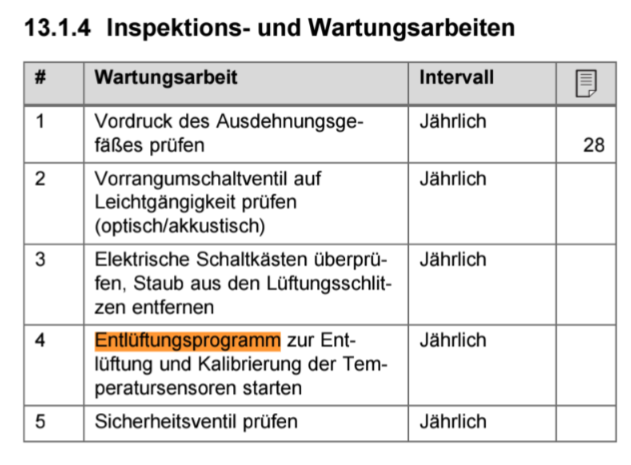
More details in the document (German only, unfortunately)
Nice, I just picked a pair up off eBay for £12, brand new.
Any chance of a translation of the instructions to try this with an existing Arotherm+?
Please excuse my use of Claude to try and pick out from this thread the main examples of Vaillant Arotherm+ in-built metering vs MID meters. Im posting here as I think it’s a useful summary. I’ve been going through each of these post references and I think it’s done a decent job - will go through them again now and correct/refine if needed.
Claude response:
I’ve read the whole thread (206 posts across 11 pages). Here’s what I extracted, split into the long-period comparisons you’re most interested in and then the shorter/single-run ones for completeness. Post URLs use the format
.../24230/{post number}.Long-period comparisons (a month or more)
Post 1 — TrystanLea (opening post) — link
Summarises two monthly figures from Mick Wall’s (Zarch’s) blog: December 2022 showed under-reporting (heat meter COP 3.35 vs Sensocomfort 3.26 vs controller working figure ~3.0), while April 2023 showed over-reporting (Sensocomfort combined ~4.4 vs heat meter 4.14). Also cites Michael de Podesta’s result of 2.83 from the Vaillant app vs 3.33 from his MMSP metering.Post 18 — PjH (Peter Heyes) — link
The strongest long-term example. A full two years compared against a Sontex Superstatic 440 / Supercal 531 heat meter plus a dedicated electricity meter. Jul 2021–Jun 2022: Vaillant reported 16,064 kWh heat / COP 4.5 vs metered 13,219 kWh / COP 3.7. Jul 2022–Jun 2023: Vaillant 21,045 kWh / COP 5.0 vs metered 17,780 kWh / COP 4.2. Electricity readings agreed closely; heat was over-reported by ~20%.Post 25 — PjH (Peter Heyes) — link
Month-to-date (August) for the same system: controller working figure 4.1, myVaillant app 3.7 (3.5 corrected) vs Superstatic 440/Supercal 531 reference of 3.0 — app ~20% high, working figure ~37% high.Post 55 — Timbones (Tim) — link
30-day COP close to 6.0 from myVaillant on a monitored system, judged too high; heat generated over-estimated by roughly a third.Post 71 — TrystanLea (Trystan Lea) — link
A daily table over five consecutive days (29 Mar–2 Apr 2024) comparing the Vaillant app against a Class 1 electric + Class 2 heat meter on a remedial install. Electricity matched within ~1%, but heat was consistently ~24–27% high (app COP ~6 vs metered ~4.8). Not a full month, but a clean systematic multi-day comparison against proper meters.Post 73 — Timbones (Tim) — link
30-day COP of 6.55 flagged as not believable, with myVaillant over-estimating heat by about a third (this system had no heat meter, so compared against expectation/Carnot).Post 79 — glyn.hudson (Glyn Hudson) — link
The best “good agreement” example. A 5 kW Arotherm+ (his parents’ system, on heatpumpmonitor.org) where onboard heat and electricity matched the MID meter within about 3–4% — attributed to correctly clipped sensors. Also notes the app’s “Energy efficiency” figure averaged 7.3% error vs MID (Trystan edit: 4.05 app, 4.37 MID but vaillant controller 4.23?).Post 141 — Nando.Tolboom (Nando Tolboom) — link
A VWL55 with OpenEnergyMonitor (OEM) metering showing differences of over 50% between OEM and Vaillant, attributed to under-reported supply temperature. Ongoing installer observation rather than a single defined period.Post 145 — Timbones (Tim) — link
Since-install SCOP of 6.0 claimed by the Vaillant vs a more realistic Carnot-derived 4.45.Shorter-period / single-run comparisons
These compare inbuilt vs meter/reference over a day or a single cycle rather than a month:
- Post 6 — Zarch — link: app DHW COP 4.0 for the day vs heat meter 2.9 for a morning run.
- Post 7 — fluppie007 — link: calculated heat vs Vaillant eBUS-reported heat (graphs) showing large divergence.
- Post 31 — fluppie007 — link: single-day figures — calculated heat 36.8 kWh vs eBUS-reported 12.9 kWh, with electricity matching the SDM120 within ~0.03 kWh. (Trystan edit: I think 36 is a typo here in the original post - should read 16.8 kWh vs 12.9 kWh which would make more sense from the graph - this is not a MID metering comparison for heat)
- Post 37 — LeiChat — link: five days of daily electricity deltas, emoncms vs MyVaillant (very close).
- Post 51 — Andre_K — link: flow/return offset comparison across three systems (his own ~1.2 K over, dfeist ~0.3 K under, Zarch ~0.1–0.2 K).
- Post 97 — Andre_K — link: after sensor fixes, single-day DHW 6.3 kWh (app) vs 6.05 kWh (own sensors), <5% error; heating within <2%.
- Post 194 — CH_18 (Craig) — link: before/after sensor swap, COP ~3.4 vs ~5.48 at matched outdoor temperature (self-reported, no MID meter).
A couple of practical notes from the thread that affect how you read all of the above: the electricity measurement in Vaillant units is reported to be MID-approved and is consistently accurate, so nearly all the discrepancy sits in the heat measurement, driven by clip-on flow/return temperature sensors that are often poorly matched or badly seated (posts 40, 49, 79, 91). That’s why some systems over-report and others under-report. The most directly comparable long-term, meter-against-inbuilt datasets are posts 18, 71 and 79.
I’ve gone through these all again and the figures and references do match well. I’ve added a few in-line comments (Trystan edit)
We now have two related threads for other brands here:
and our own testing of the accuracy of the MID heat meters that we use using an in-line electric element: Heat meter accuracy testing.