I’m not seeing any photo or attachment on your last post - maybe that got lost along the way?
Information on the Compressor Curve is patchy to say the least. There’s a paragraph in the SMO 20 Installer Manual but I don’t find it especially helpful. Since my own system doesn’t have a variable-speed compressor I don’t have the option available myself.
One of the parameters reported by myUplink is Requested Compressor Frequency, which is the result of applying the Compressor Curve to adjust the compressor speed setting based on outdoor temperature. I believe the Frequency is reported as a Percentage, i.e. 0% is ‘Off’’ and 100% is ‘Full Speed’. The first step would be to check how high that’s going when your system is running a heating cycle (rather than a DHW cycle). If it’s more than 50% there should be scope to reduce it.
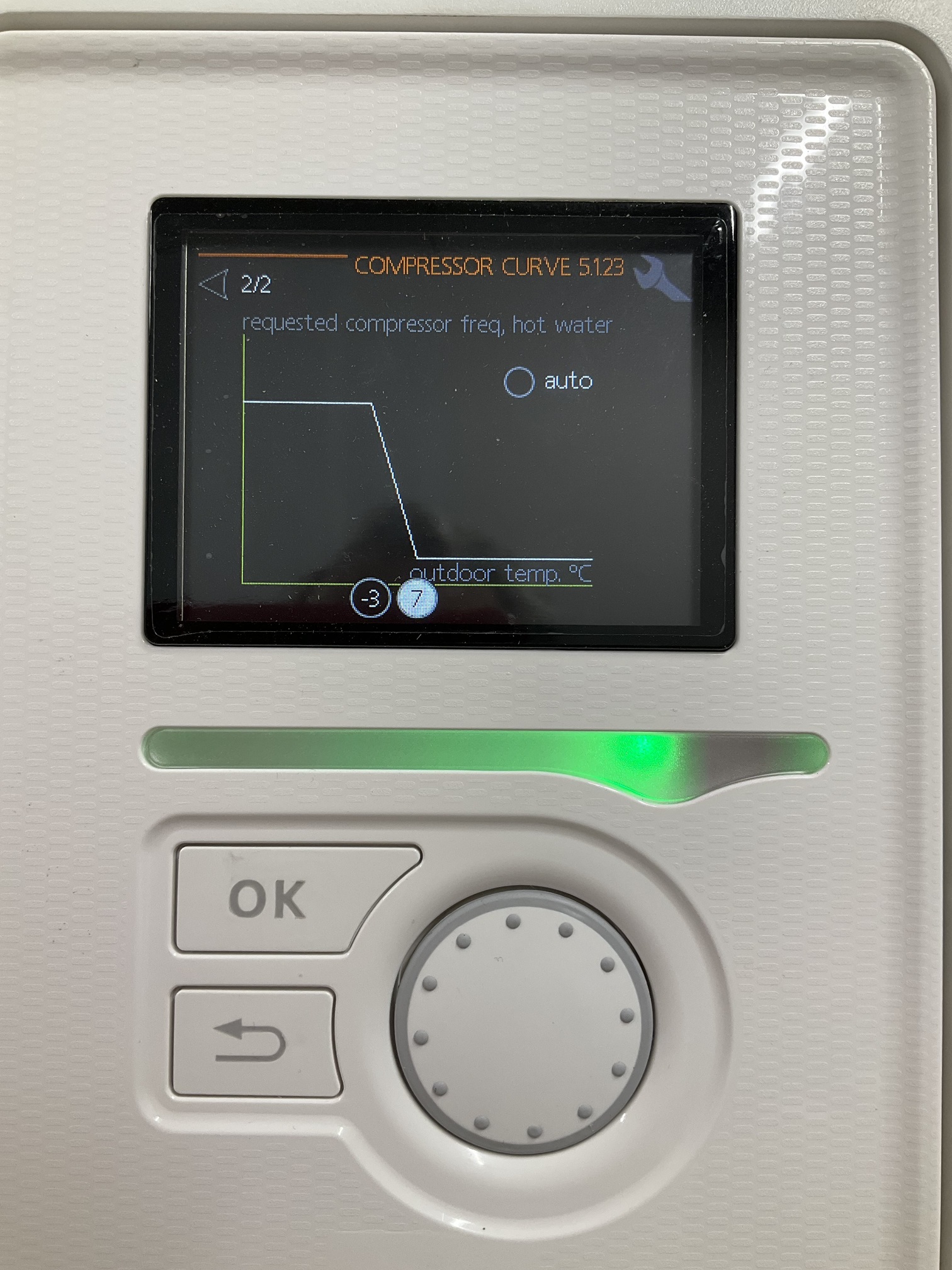
My default with AMS-10-12 (which under the hood appears identical to yours also in the menu settings) is “auto”. Did you deselect auto before taking the picture?
My status:
I get cycles from 1 hour to 2 hours and off times from 1 to 2 hours in the coldest days, the number of starts includes the defrost cycles too and with the “statistics” change integration of HA it says I get max 20 starts per day
In the summer with cooling mode I get about 24 starts per day. I had to lower the lowest target flow temp to 9C and increasing the start of the compressor at 50DM, initially I was getting 60 cycles with 12-13C as lowest flow temp.
Average run time of the heat pump per day is 12h in the winter and 8h in the summer.
Last winter: peak heating production reached 88 kWh/day
This winter so far, it’s peaking at 84 kWh/day
Curve 2 offset 2 seem to be sufficient here to keep ambient temp at 21C, it occasionally drops to 20C in the coldest days during the night only which is fine
For cooling I use curve 1 offset -4 (I was told curve isn’t useful in the summer with splitter so it’s almost flat)
BT25 with heating ranges from 24 to 33 with target temp around 28 in the coldest days
My opinion is my unit is oversized (I pointed it out to the installer last year and I was told the smaller unit cannot handle my load). So my only objective to avoid its peak energy consumption of 3.8KW that seems unnecessary near the end of each cycle at 16A (it ramps up gradually and finally peaks for a few minutes with an extra kw power and >85hz frequency when BT25 is already above target), but the current limiter doesn’t work. They didn’t install the energy current meter, and I wonder if it can’t work without it.. I was told it’s only needed on three phase systems. So B1/2/3 reads 0.1.
When I deselect auto I also get the curve -3 7. I tried to tune it down to -13 7 and then BT25 rose too slowly, barely keeping up with demand. System ran continuously for hours without cycling, triggered more frequent defrost cycles, deltaT between supply and return also was reduced. GP12 (charge pump) slowed down to around 50%, didn’t reach 100% anymore. The HZ also were greatly reduced. The energy consumption was greatly reduced too.
I also wonder how the info section show the Ampere of EB101 and how the Energy log show a energy consumption if there’s no current sensor installed? Both seems underestimated in fact, maybe by 15%.
-13 7 was too relaxed but after the test I selected “auto” again because my worry is the “auto” compressor curve is smarter than the “manual curve defaults -3 7” and changes frequency in response not only to outside temperature, so I’m uncertain if it’s good idea to try again to go manual with a less relaxed setting.
I also tried blocking frequencies above 85hz keeping the compressor curve to “auto”, because I’m really after removing the last kw of electric energy consumption, but that caused GP12 charge pump speed to drop to 15% when the compressor started, I never seen GP12 droppping below 30% before. Supply temperature rose 10°C above return — (usually deltaT is in the range 5–7°C tops). So I quickly disabled the block frequencies feature. However the 15% charge pump speed happened again at the start of the next cycle and then never again, so I wonder if it was an unrelated fluke.
Does the COP and/or longevity of the heat pump increase by allowing the HZ above 85 at the peak power of the heat pump? I thought the answer is no to both… and because I don’t think I need it I thought it was worth a try, mostly to reduce the risk I hit the circuit breaker during the coldest winter days, but the fluke in the charge pump speed dropping to 15% didn’t look good. Chances it’s a bug in the firmware and nobody tested the block frequencies from 86 to 120 so I’m not inclined to try it again.
Thanks for all useful info provided by this project and forums.