“An ASHP won’t work in your house.”
Solid stone, rural Scotland. Two levels and rooms in the roof, 420 m² habitable space. No wall or floor insulation. Built in 1874. Heated with a 37 kW LPG combi boiler. You’d better keep a boiler.
That was the first answer, and it was unanimous. When I pushed, the answer shifted but not in my favour: “You’d need a heat pump the size of your current boiler. 37 kW. And you’d have to rip out the pipework. And replace every radiator.” Which, translated, meant don’t bother.
I found I couldn’t quite accept that. Not out of stubbornness, but because nobody telling me this had actually properly surveyed the house. The 37 kW figure wasn’t derived from our walls, our windows, our air changes, our house geometry and location. It was derived from our existing boiler — which had itself been sized by someone doing the same thing a decade earlier. A chain of assumptions, each one rounding up for safety, ending in a number nobody had ever checked against reality.
So I started doing the sums myself. I had to learn and understand from scratch about house heating engineering and search for old Victorian houses.
The first assumption worth questioning was the U-value. Industry guidance for solid stone walls lands somewhere around 2.1 W/m²K — a figure generous enough to make any heat loss calculation look terrifying. But our walls aren’t generic solid stone. They’re whinstone rubble with sandstone dressings, roughly 600 mm thick, with lime plaster on lath on the inside. That construction behaves differently from the textbook assumption. Working through it properly — thermal conductivity of the stone, the decoupling effect of the plaster-on-lath cavity, the actual wall thickness — I got to 1.2 W/m²K. Not insulated-standard by any stretch, but not the disaster the rule of thumb suggested either.
The second assumption was air changes. Old houses leak — that’s true. But how much they leak is a measurable property, not a folk belief, and the default of 1.0 ACH or higher gets applied to buildings it has no business being applied to. Our house has had its windows done, its chimneys sealed where they’re not in use, and isn’t drafty in the way a Victorian tenement might be. Measured and cross-checked, it sits closer to 0.5 ACH.
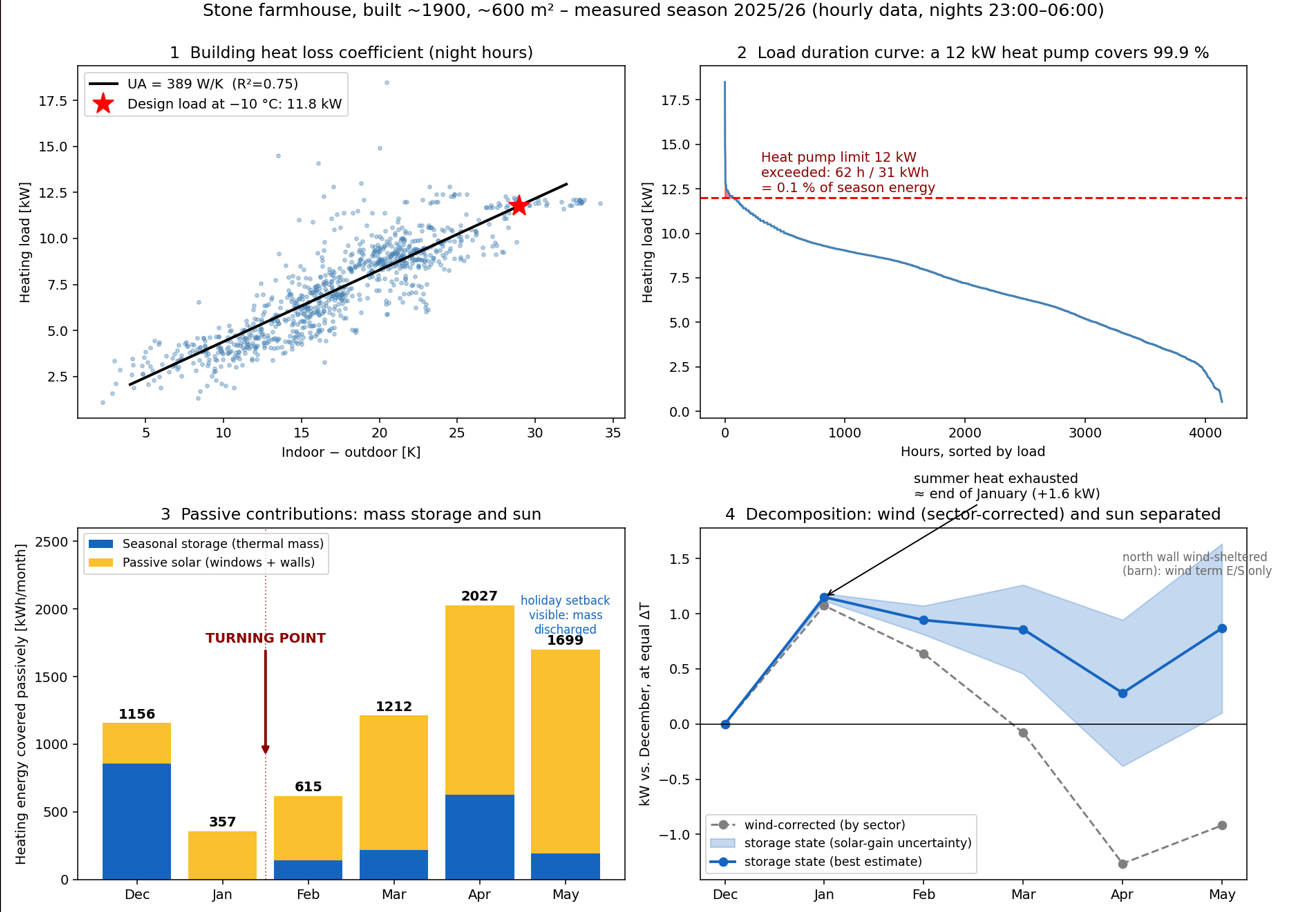
Two assumptions corrected, the heat demand calculation fell out differently. Not 37 kW. Not anywhere near it. 11.94 kW at design conditions. I specified a 12 kW Vaillant aroTHERM Plus. Measured peak demand a year later: 11.6 kW, inside 3% of the paper calculation.
That was the first answer to the first “no”.
The main runs pipework did need upgrading — heat pumps move twice the flow for the same heat — so I replaced the arteries with 28 mm copper myself before the installer arrived. The capillaries were fine. The radiators didn’t need replacing either; they needed to be used properly at low flow temperatures. That’s a control problem, not a hardware problem. ESP32 fan boosters on the lukewarm rooms, seventeen smart TRVs calibrated and held to a minimum opening to protect the design flow rate (~2,014 L/h), one TRV repurposed as a compensating valve.
Two “no”s down. The third one was the one the industry was least prepared to lose.
After a full heating season, measured against the same house under LPG: 68% less energy, 46% cost reduction, 57% more heat delivered, sCOP 4.21 — the numbers that tell the full story. These are meter totals, from a monitoring stack — Home Assistant, ebusd on the Vaillant’s internal bus, InfluxDB, EmonCMS — built to surface bad news as readily as good. A two-layer control architecture (coarse heat-curve adjustment plus cycle-by-cycle flow-temperature trim, derived by reverse-engineering the manufacturer’s own sensitivity formula) is what delivered those numbers.
Along the way the house became a laboratory. Heat loss coefficient: 0.540 kW/K. Fabric–ventilation split: 0.496 / 0.037 — internal insulation matters, draught-chasing does not. Air changes per hour: 0.167–0.174, derived unexpectedly from CO₂ decay curves on the upstairs air-quality monitor. Thermal mass: ~8 kWh/K, matching first-principles physics for whinstone of this thickness and density. Three numbers, three methods, cross-checked.
The three “no”s that opened this story were not the product of bad faith. The installers I spoke with were not lying, and most of them were competent. They were answering a different question than the one I was asking, which was what does our house actually need?
The house I live in now is the same house I moved into — same stones, same lath-and-plaster, same 1874 floor plan. Nothing about the fabric has fundamentally changed. What has changed is what I know about it. That accumulated knowledge is the real project. The 12 kW Vaillant is almost incidental — it’s the machine that made the investigation necessary. The investigation is what made the house tractable.
If the opening of this story was a wall of received wisdom, the end of it is the quieter observation that received wisdom is what you get when nobody has bothered to measure. You have to keep score. Eventually the score speaks for itself.
The heat pump works. The house works. The monitoring works. The laboratory is open, and it will stay open.
PS: Thank you for open energy monitor forum and the emoncms team, you have been a great source of learning.
Next: