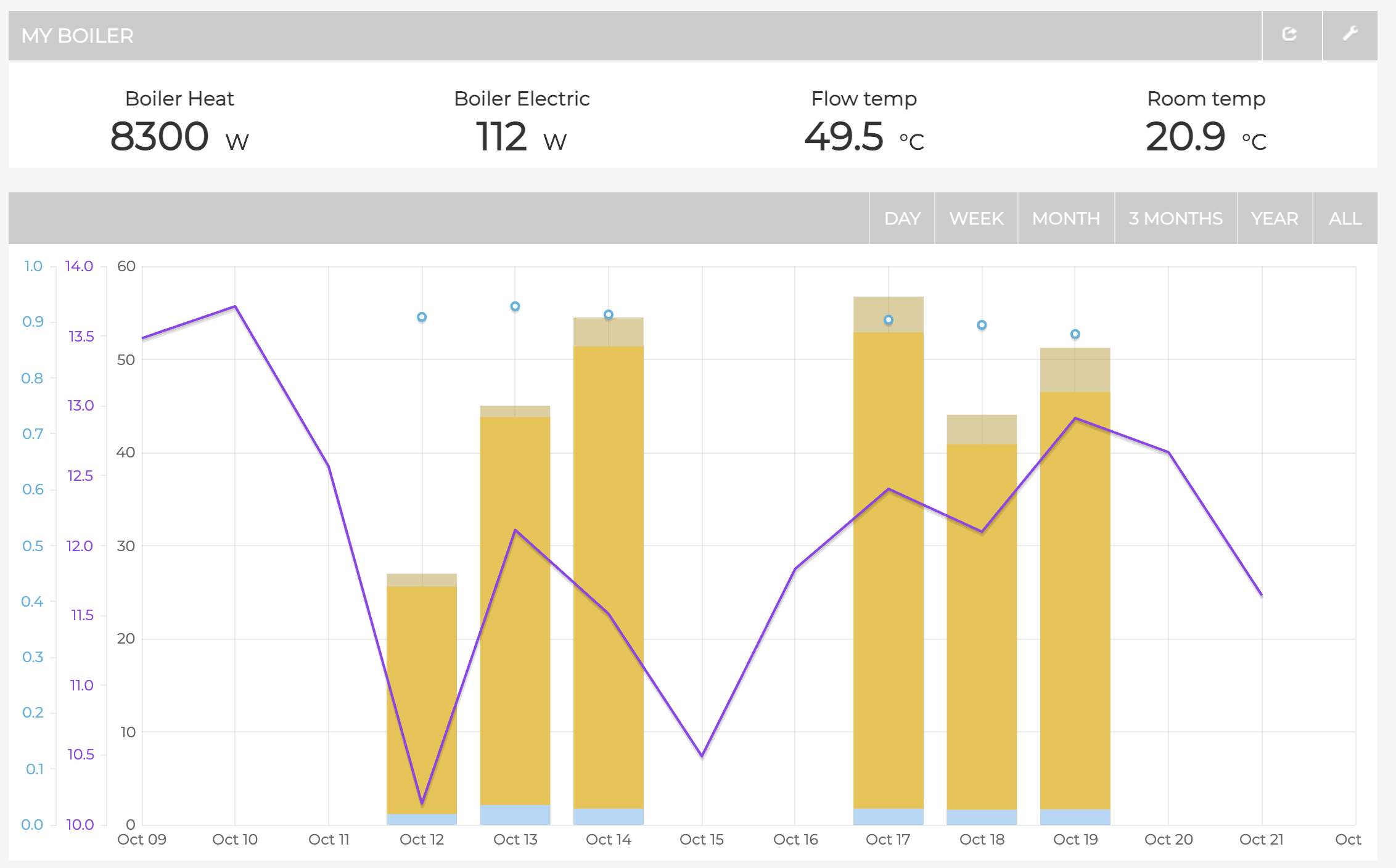
I’ve been uploading my gas boiler data from Home Assistant for a while and I can see all of the data arriving in Emoncms - app view . However, on a few days I’m missing the summary bar graph. e.g. below. What is causing the gaps? I’ve checked and can’t see any missing info on the uploaded data graphs. Any advice would be very welcome. Cheers.
Hello @gr0mit I’ve just fixed the energy feeds for you, they needed recording using “log to feed (join)”, this joins across small gaps in the data. The missing bars result from null values in the kWh data at midnight, log to feed join removes these
Hi Trystan - Amazing! Thanks so much. How does my gas boiler performance compare with others? I am currently running it with a home-built weather compensation curve controlled by Home Assistant. Found a way to programatically set the flow temp of my Vaillant system boiler, and I’ve also reconfigured to PDHW (you can see the higher temp setting when CH is not called for, where DHW heating the tank.
Hi - Thanks for your observations. Can you explain what you mean by misfires?
Just FYI my control system is using ebusd and Home Assistant to set the flow temp of the CH water to match a heat curve that I’ve implemented based on external temperature and required internal setpoint of 21 Celsius. The heat curve is based on Michael dePodesta’s Vaillant Ecotherm equation.
I looked a while back at buying the Dutch Vaillant Opentherm board but it was nearly €200 after import duties (stupid stupid Brexit) so I opted for the ebusd interface instead, and implemented everything in HA. Because why not re-invent it?!
Also, part of the problem is that the boiler, a Vaillant 24kW beast of a thing, doesn’t modulate down low enough, so it’s always cycling. Any way around this?
And then you’d need to buy the OpenTherm gateway from the Nodo Shop
For information about what low load is
Low load - in simple terms - max cycles per hour (3 or 4 for a boiler) where the duration of each cycle is calculated and controlled with precision (like PWM). Uncontrolled / normal cycling is when they are not restricted on how many per hour and duration is not precisely controlled.
I have a Glowworm Ultracom 18hxi (was 30hxi). This is basically the same boiler as your Ecotec, both based on a Saunier-Duval design, and had much the same problems as you. I also have it under eBUS control. It has some “interesting” features
It has a very aggressive over temperature trip. If the flow exceeds the flow set point by a couple of degrees, then it shuts down until it is happy everything has settled down. It wouldn’t be so bad if this was only active on the maximum flow temperature, but it is active on the current flow set point, and is exacerbated by the next point ……
It always starts up at full bore, so if the flow set point is anywhere near the current flow temperature it will overshoot and the over temperature trip mentioned above activates and it stays in this cycling hell for hours.
There are a few things you can do
You can range rate it if you don’t need the full 24kW. In the installer menu the first option (d.0 I seem to remember) allows you to limit the maximum output to any value down to its’ minimum modulation (8kW-ish). This means it is less likely to go unstable on part loads. It also means that the house will take longer to warm up. A side benefit of this is it will reduce any ticking pipe noises on start from cold.
Divide the control algorithm into 2 distinct strategies ………..
When the house load is sufficiently high that the boiler can modulate smoothly then just use your weather compensated flow set point as you are now.
When the house load is not sufficiently high then alternate between max flow temperature and boiler off, but using your weather compensated temperature as a simple ON/OFF control (like the simple old bi-metallic room thermostats). Also enforce a boiler minimum on time, I use 5 minutes. I tried more complicated energy integral control for this, but the simple thermostat is good enough to not warrant the extra complexity. You should be able to do that with HA.
My boiler graphs are here
You will see periods where it is modulating fine, and other periods where it is cycling, but in a controlled manner. It is in tandem with a heatpump, hence the apparently “odd” behaviour (the HEMS decides which to use based on current fuel cost)
Thanks so much for your reply. I’ve already set d.0 to 15kW in order to reduce wear and tear on the system as it never seems to be able to dump more than 8kW into the house at sensible flow temps.
One thing I’ve noticed is that to get a dT of 12C on the rads, i only have to crack the lockshield valves open 1/8 to 1/4 of a turn. It’s sooo sensitive.
As the heat loss I’ve calculated for the house is approx 7.5kW (outside -3, inside 21) I will never have the boiler in a properly modulating mode, I’m guessing. Basically the boiler is too big! So I need to ensure it cycles in a ‘sensible’ fashion. I’ve currently got d.2 set to 10 mins and d.3 to 15 mins. But the docs are a bit thin on how this affects operation. Do you have any thoughts on suitalbe settings for these?
This is the burner anti-cycling time, when the burner turns off, it should not be turned on again for at least d.2 minutes. However, this is the value for a 20 degC flow temperature. To find out what the actual delay is at the flow temperature you are using you have to consult this table …….
The row across the top is the value set in the d.2 register, you then go down the column until you reach the flow temperature, that gives you the actual delay being used. So for a d.2 of 10 and a flow of 60 degC the actual delay is 3.5 mins, so very little effect. If you wanted an actual delay of 10 mins @ 60 degC you would need to put 35 into d.2.
However, looking at the graphs for your system, there are periods where it looks OK. For instance, from 6:30am to 8:00am today it burns for 10 minutes at a time, and then is off for 5 minutes, so 4 cycles an hour. It then goes potty until 9:10am with many short burns, then recovers. So I think your guess of 10 mins looks like a reasonable starting point, so you should put 35 in d.2
d.3 is a measurement and not a setting?
Given the minimum output is 8kW-ish, absolutely correct.
I shouldn’t get too hung up on a dT of 12 degC. In fact, you may be making things worse. By restricting the flow through the boiler the flow temperature will rise more rapidly so you are more likely to trip an over temperature burner shutdown. Assuming the radiators are correctly sized then you are only interested in getting the same dT across all of them. I am running with a typical dT of 5 degC between boiler flow and return.
It would help if you could add boiler flow setpoint to your graph (TargetT). At the moment it is not possible to tell if the cycling is due to setpoint being reached or an over temperature trip.
I’ve replaced room temp for boiler target temp. Does this help with your analysis?
Sadly my rads are in places quite undersized as they were designed for dT50. In the kitchen our installer put in 2 ‘designer’ rads with 10mm plastic pipe, buried under the tiled floor. Knowing what I now know, this is extremely annoying as the flow through the rads is very slow, and for low temp flow the rads are grossly underpowered. Grrrr!
Re d.1 and d.2 I ‘ve mislead you..sorry
d.1 is 15, d.2 is 10
d.3 is read-only for a combi, which mine isn’t.
As regards the potty burn from 0800 to 0910, that is where there is call to heat DHW after our showers, and the target temp goes up to 65, to heat the water tank. You can see this on the graph as it’s filled in as ‘white’ rather than ‘yellow’.
If you have any more wisdom I’d be keen to learn as you’ve clearly already been down this rabbit hole!
Yes, can see that is not doing anything crazy. First a general point about the flow rate. From the installation manual the flow for 24kW at a dT of 20 degC is given as 1049l/h. So for the minimum 8kW and dT of 20 degC would be 1049/3 = 349l/h. During the stable cycling periods your dT is 12 degC and flow rate is 612l/h, and 12/20ths of 612 = 367l/h, so about right.
Looking at graphs for Sat 25th Oct ……..
From 9:07am to 10:01am it is doing DHW. Flow rate looks fine. The start of this looks reasonable, but after 9:35am it goes unstable. The strange thing is it isn’t even reaching your set point of 65 degC. That looks like it is a safety shutdown due to the flow temperature increasing too rapidly OR it could be that the real set point is still 54 degC OR some d.X value is limiting the max flow temperature. I am inclined to believe the flow set point is being set correctly in the boiler because you can see adjustments during CH periods having an effect.
From 10:01am to 11:10am it looks fine with stable cycling pattern. Then the flow rate plummets to 144l/h and it enters cycling hell, definitely safety shutdowns as the flow temperature overshoots violently. This flow rate is well below the 349l/h for 8kW calculated at the start, so there is no way the boiler can run stably like this. If it has been doing this since 2011 then it is a testament to the build quality of Vaillant, since each one of those overshoots will be stressing the heat exchanger. Can you hear ticking and bubbling standing next to the boiler when it is in this state? Question is, why did the flow rate plummet? Do you have TRVs on the radiators? The fact that it goes back to stable cycling about 15:20 suggests you do, and solar gain caused most of the TRVs to shut down during the low flow period.
It does have very stable burn periods after a period of DHW, 20 mins, where the CH water has dropped in temperature while it was doing DHW. So I would repeat my suggestion of setting d.2 to 35 to try and get more of these long burns. If you could get it down to 2 or 3 cycles per hour that’s probably the best you can do given the gross over-sizing.
Today Mon 27th so far it has looked very stable all day. I wouldn’t be too upset if it looked like that all the time, but I would still try to reduce cycling as suggested in the previous point.
Thanks for your observations. A few comments below:
From 9:07am to 10:01am it is doing DHW. Flow rate looks fine. The start of this looks reasonable, but after 9:35am it goes unstable. The strange thing is it isn’t even reaching your set point of 65 degC. That looks like it is a safety shutdown due to the flow temperature increasing too rapidly OR it could be that the real set point is still 54 degC OR some d.X value is limiting the max flow temperature.
I discovered that the controls on the boiler actually act as a temp limiter. I’ve whacked both CH and DHW knobs up to 70C and the boiler temp is now making it to 65degC now. Thanks for your pointers here.
From 10:01am to 11:10am it looks fine with stable cycling pattern. Then the flow rate plummets to 144l/h and it enters cycling hell, definitely safety shutdowns as the flow temperature overshoots violently.
This was me. I was trying to get more flow into the distant rads so had shut all the rads off except the ‘index’ kitchen rad. Then gradually opened up the lockshields on all the other rads to get them warm, without starving the kitchen rads of too much. So ignore most of Saturday as I was heavily fiddling.
I would repeat my suggestion of setting d.2 to 35 to try and get more of these long burns. If you could get it down to 2 or 3 cycles per hour that’s probably the best you can do given the gross over-sizing.
I’ve just changed d.2 to 35 mins. I’m not entirely convinced it will have the required effect but let’s see!
Today Mon 27th so far it has looked very stable all day.
no-one was at home to fiddle! The system was just doing its thing.
I’m going to eek the lockshields open a tad more in the hope of increasing flow. I’m still not quite sure if I should be tweaking for good flow or a deltaT of x degC - where x seems to be a variable number depending on who you talk to!
I can see it is having the predicted effect. However, the d.2 delay depends on the flow temperature set-point. The value of 35 was based on a flow set-point of 60-ish, I can see your set-point is 40-ish, so you are getting an actual anti-cycling delay of 20 mins, rather than the predicted 10 mins. But you are getting about 2 cycles an hour, which is good. The question now arises has this affected your comfort with large temperature swings? Your house has a time constant between hours and days, so it can’t see this slow cycling, it just integrates it out. Humans have a much shorter thermal time constant, so may perceive temperature fluctuations. So time to experiment and find a setting for d.2 that is the best compromise between human comfort and reduced cycling.
I can see that with the new slow cycling the pump is shutting off too soon. This means the boiler has no idea of your house load. When you have found your d.2 sweet-spot, I would be inclined to increase your pump run-on time so the pump is running continuously while the boiler is cycling (where it started up at the beginning of the day is as it should look).
You will only get the dT quoted on the data sheet at maximum output, unless the boiler is one of those that tries to control dT by fiddling with pump speed (not many of them). As the boiler reduces power so dT will fall anyway. If your boiler was right sized then it might be worth chasing dT, but with your current system you are more likely to provoke cycling hell by chasing dT.
Ooo, you even got a perfect DHW burn at 11:40am today. Oh, and by the way, d.2 is not active during DHW cycles.
I’m not sure how the boiler knows whether it’s doing DHW or CH. It is a system boiler it was wired for Y-plan, with no input to the boiler for DHW/CH. So the boiler has no clue what it’s doing?