Monitoring Your Samsung ASHP Controller

@SarahH Interesting thought. Now that you have a room stat that allows you fine control of hysteresis, I’d be interested to see the outcome of such an experiment.

However, I recall a slide at the end of one of John Cantor’s YouTube videos (@20:30min):

that indicates maximum efficiency at around 40% compressor speed, with a sharp roll off below 25-30% (hence why OEMs only allow their units to modulate down so far), and a more gentle roll off in efficiency above 50% (relevant to this discussion). To this end, I’m currently running with #5051 set to USE to limit compressor speed to 50% max, which hopefully helps with DHW runs but does little to help me with continuous heating runs although may benefit shorter runs (oversized heat pump, so I’m able to do this in anything other than the very coldest of days). Whether this is correct for all compressors, I do not know, but it kind of made sense to me based on the analogy that my car is most efficient with running at ~50mph even though it is capable of running at 0-100mph.

I have previously tried to minimise the number of cycles by extending the off time as long as comfortably possible. I also figured that the heat pump is going to be more efficient reheating water that has cooled to 20C back to 32C LWT than reheating from 25C back to 32C LWT (more time working at lower temperatures). But maybe your suggestion of shorter cycles to spend more time operating in the 40-50% range may be more efficient.

Morning @hank31980.

Correct. Any setting on #2093 will be ignored when a 3rd party roomstat is connected. And your description of the #2091 action completely matches my understanding :slightly_smiling_face:.

Don’t be surprised if your LWT goes some way above the WL target. The controller still uses the latter to reduce the inverter frequency down to its minimum, but then it should just stay there until the roomstat is satisfied (as you correctly infer).

That should be phase 1 of optimisation done - avoiding excessive cycling. For phase 2, the trick seems to be to set the WL target (via #2021/2) such that at minimum compressor speed (typically 20Hz for an EHS, though as low as 14Hz in some circumstances - high OAT it appears) the HP is delivering roughly as much heat as your house heat loss.

This is the problem that I am currently wrestling with. I want a hot LWT each morning to re-warm the house quickly after the end of overnight setback, but a cool LWT for the rest of the day to meet the above heat balance target. Doing this reset manually twice a day (at the WRC or firing up SNET) is a pain, but @pantherale0’s excellent HA integration offers the prospect of doing this for me if I invest in a Micom such as RPi (work in progress :wink:).

Finally, don’t worry if this all seems overwhelming to you - I think you’re making great progress (much faster than I did two years ago).

Im not sure about progress?

I set my system at the moment to Quiet mode, hopefully to limit output a little bit maybe?

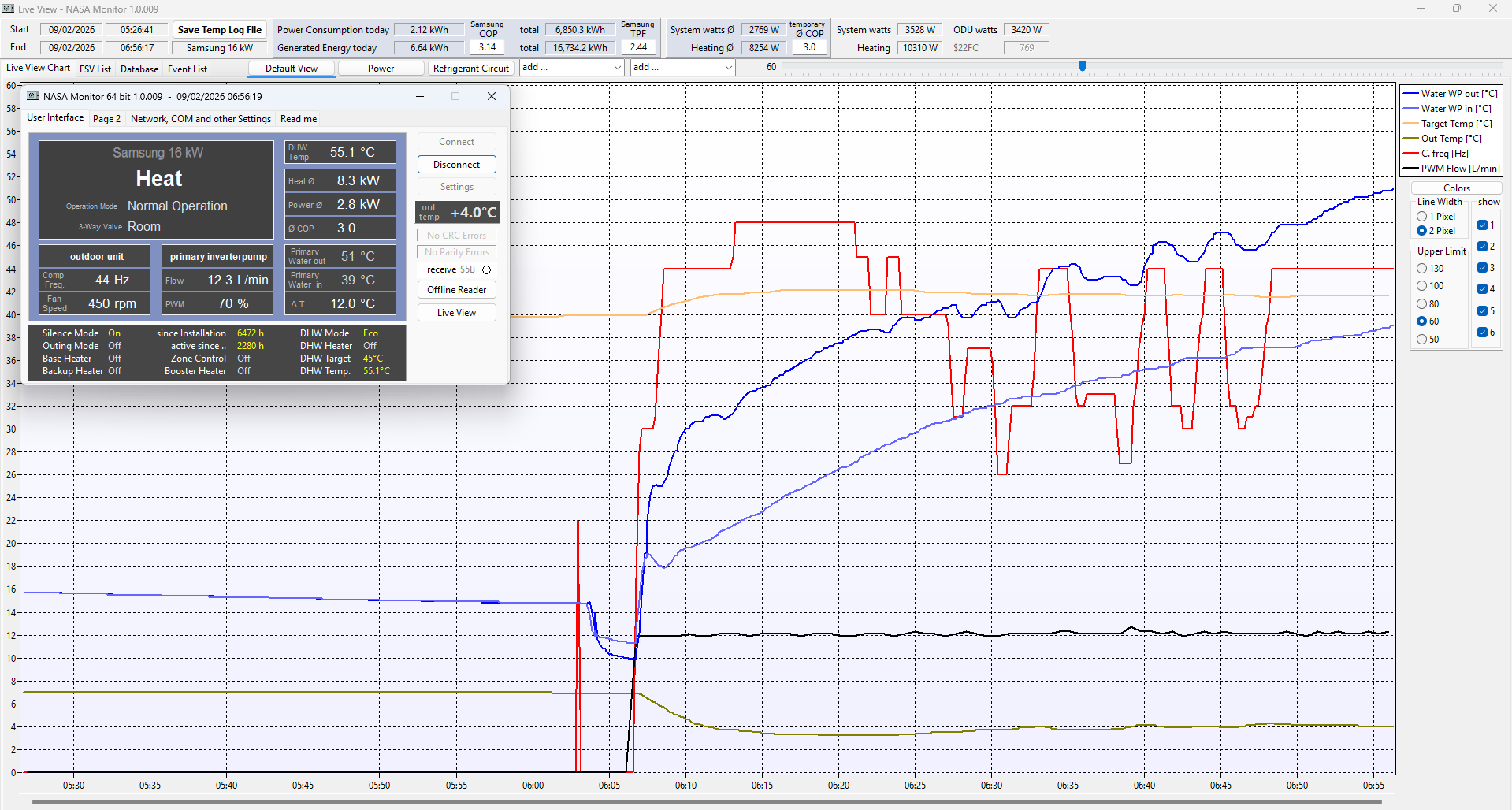
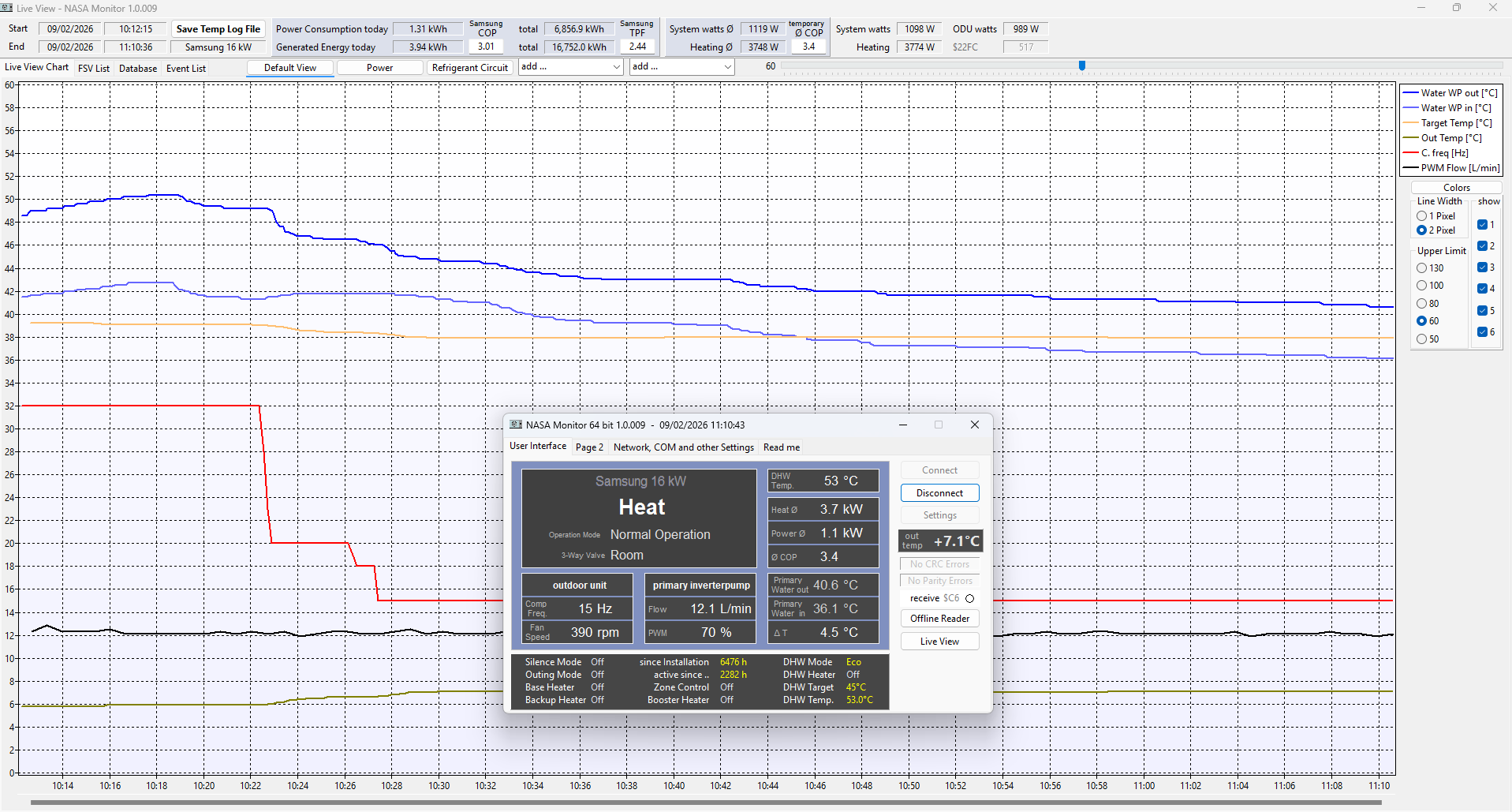
The system kicked back in this morning at 6am, but what seemed to happen was that the Compressor ended up running up to 44Hz and then eventually just seemed to stay there, even though Water Outlet Target was around 42 degC, the Flow and Return temps just seemed to keep rising well above this threshold.

I thought the Frequency of the Compressor would have modulated, to keep Water temps close to setpoint?

So that confused me to start with.

As an interim measure I changed 5051 to 1 to try and limit Compressor Freq, not sure if this will help.

I really don’t understand why Compressor frequency isn’t modulating to control Water Outlet temp?

Hmm that’s odd. I’d give it a bit more time than your display covers.
I haven’t used #5051, though I know some brave users have. (I don’t think that just setting it to 1 will do anything - you either need to apply a DC voltage somewhere (?) or send a Modbus command.)
Also I don’t use Quiet mode, but perhaps this is affecting the speed reduction algorithm.
A quick look at the FSVs you posted doesn’t reveal any howlers…

My strategy at the moment for Temp setback from 22:00 to 06:00 every night is to set a lower the Bedroom temps down from daytime 22 DegC to 19 DegC via my Shelly TRV’s but leave all downstairs Shelly TRV’s set to 22 DegC.

I was hoping with this strategy, the system would just tick-over keeping downstairs nice and warm and bedrooms no more than 19 through the night.

…it might well do, but this isn’t changing your LWT, which I suspect had been causing the rapid cycling you had previously. (And absence of cycling is some progress, for a start.)

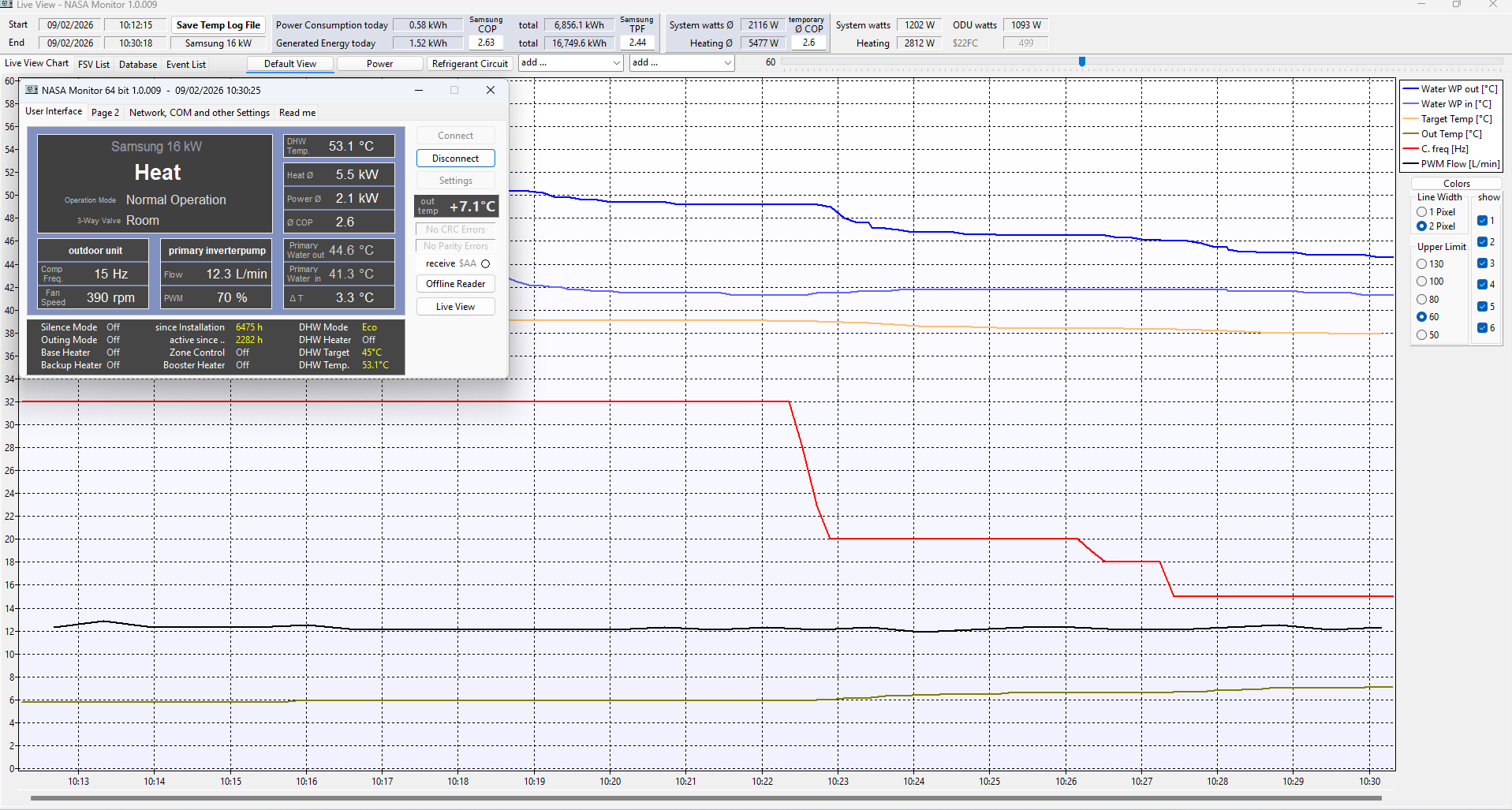
I still believe that reducing your LWT target might help. A quick and easy experiment would be to use the +/-5degC target offset available on your WRC. Set it to -5degC and watch your NASAmonitor display. You should see the yellow trace drop, and your compressor speed should also start to fall. Does it?

So I’ve turned off Quite mode now.

I set the parameters for Water Law to be more like default, ie for Outside Temps of -5 and +15 = Water Outlet temps of 50 and 30.

Things have started settling down a bit.

Brilliant :clap: :slightly_smiling_face:.
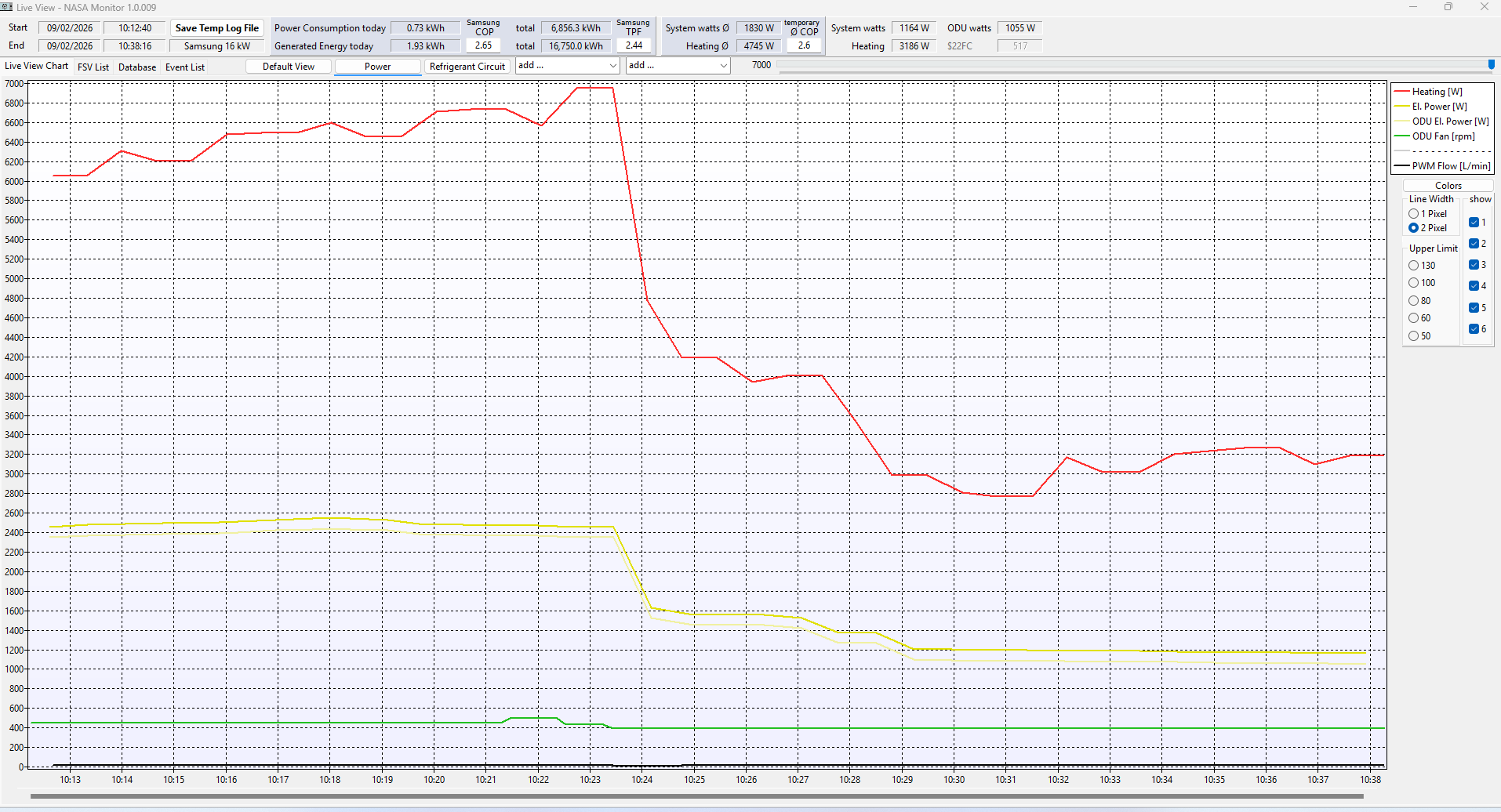
Have a look at the Power tab. You may find that your instantaneous CoP has reduced a little, but your power consumption should be satisfyingly low.
Interesting that your (LWT - RWT) deltaT is also reducing. Can you explain that?

Wow…………so that seems to have dropped from 2.5 kW (El.Power) to 1.2 kW (El.Power)

Delta T seems to have steadied now at around 4 DegC.

I did look at my Bedroom TRV’s and I had mistakenly put in there 10am for the Temp setback, so all upstairs TRV’s were closed from 10am this morning, so I’ve changed that to 10pm now and they have all opened back up. Maybe this explains the Delta T anomaly?

Maybe not enough heat emitters available to shift the heat generated? Im just guessing here as Im a complete novice at this.

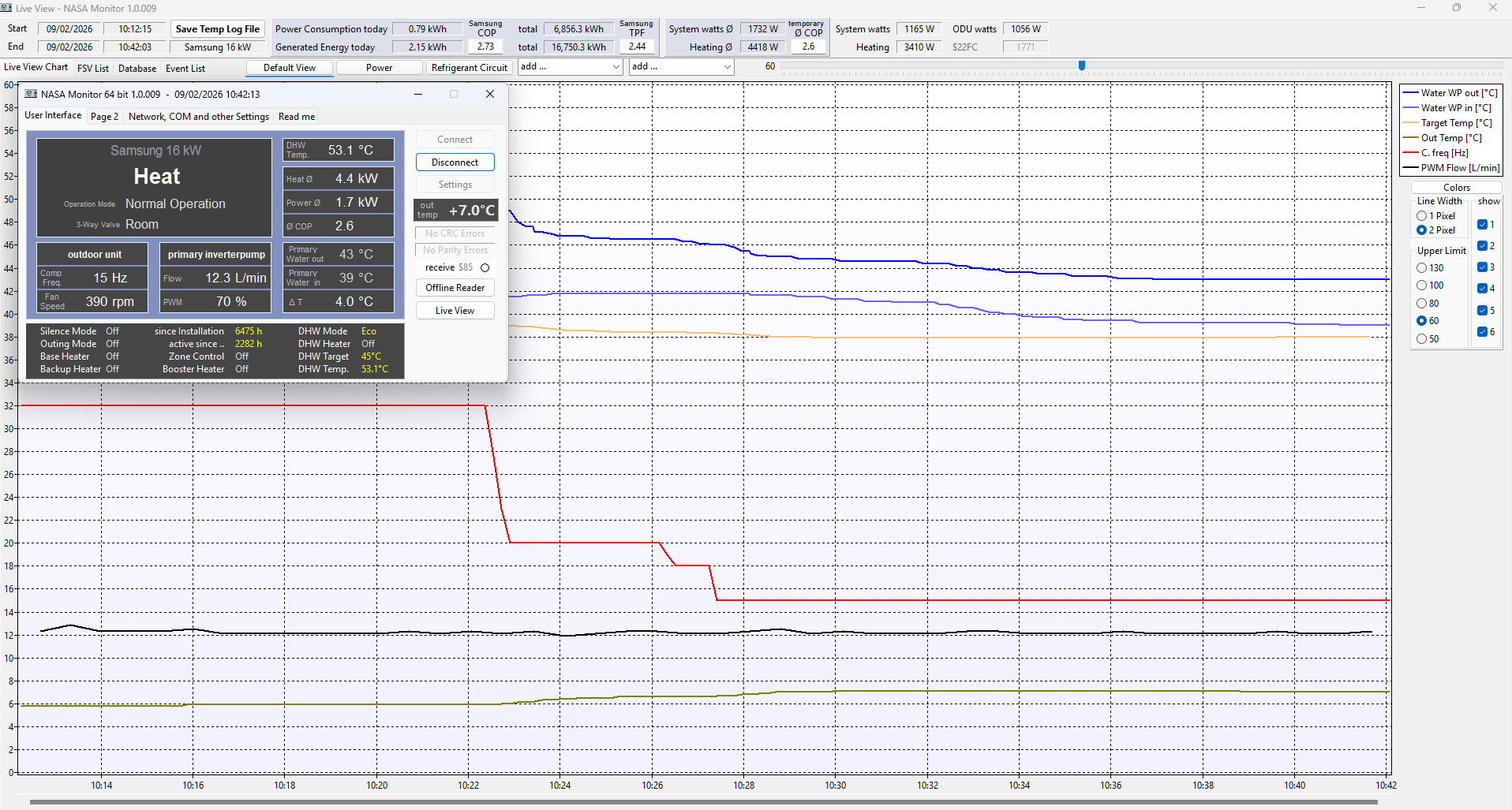
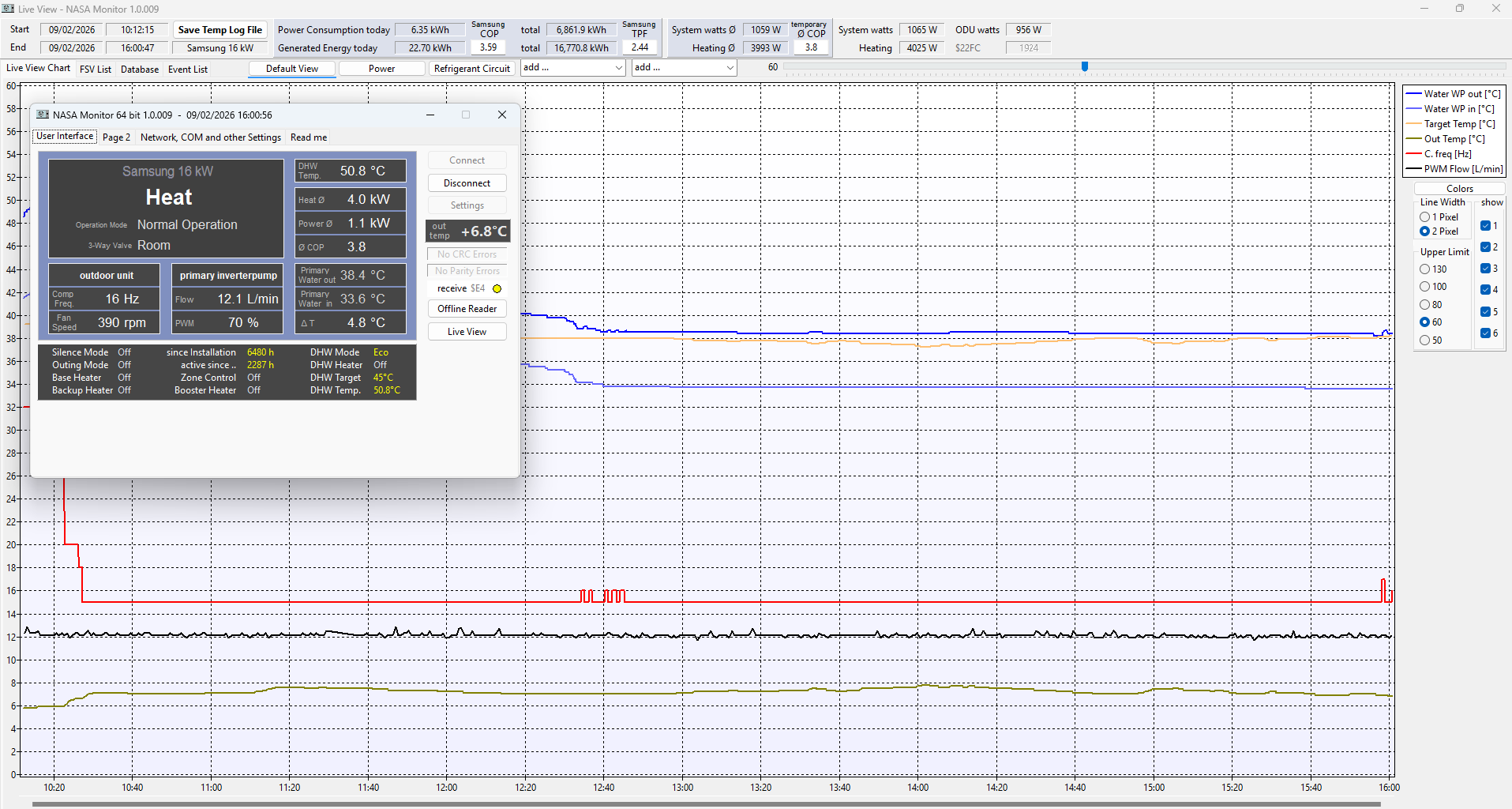
There’s a useful data point for you there. Assuming that your house temperatures are reasonably constant, your house heat loss is roughly what the HP is producing, i.e. about 3.2kW, for a (house-to-OAT) deltaT of (22 - 7) = 15degC. So you can pro-rate this for other deltaTs. At 0degC OAT you’ll lose about (22-0) /(22-7) * 3.2 = 4.7kW. You can use this to estimate what LWT you would need to supply this, and hence what #2021/2 settings you should set.

Hopefully, you are now finally into “tweak” mode…

You’ve lost me know, if you can be patient enough to bear with me, as I’m new to this and therefore the terminology and jargon.

(house-to-OAT) deltaT of (22 - 7) = 15degC………where do you get the 22 and 7 from?

In the meantime, Im just so happy I now have some control going on with the Samsung ASHP and its all very steady at the moment, Elec Output of 1.1kW and Heat Output of 3.8kW………….COP of over 3……………

Maybe I misunderstood, but you said that you’d set your TRVs to 22degC (daytime) so I assumed that that was your indoor temp, and I took the outdoor temp of ~7degC from your NASAmonitor display (brown line, near the bottom of the Default view).

You certainly have. You earned yourself a glass of something :slightly_smiling_face:. Just take your time, and all will come clear(er)…

Ok, so applying some common sense I assume the 22 is an example of my desired internal setpoint in the house and 7 is the current outside ambient temp….hence OAT, hopefully that’s where these numbers are from

Oh I see you already answered that……sorry, behind the curve as usual.

Anyway many thanks for your suggestions so far :+1: with the Parameter changes, it feel like a weight is lifted off my shoulders already, and just to achieve a more benign steady state with this Samsung ASHP is fantastic.:grin:

The next steps will be as you say, optimising/fine tuning the Weather Compensation.

For now I’m keen to see if the current Parameter configuration gets me through the next 24 hours without anymore cycling and remains stable and delivers steady heat output to the house.

So far so good though, you are a star :star:

Unbelievable…………….still steady as she goes, using about 1kW of Elec power and producing 4 kW of heating power. Cant believe that a couple of Parameter changes can be so critical.

1 Like

Yup looks like you’re safely on the island now :ok_hand:.
My parting suggestion is that from here on you only change settings one at a time before observing the consequences, and keep a hand-written log of any tweaks, so you can recover the situation if things go pear-shaped.
Happy journey…
Sarah

Yeah, couldn’t agree more about being able to record the changes and monitor the results etc.

For now I used S-NET to Export the settings as are in place today, so hopefully if I cock it up later in the week, I can just re-import the working values from today.

Thanks so much for your help and hopefully going forward I can contribute rather than just asking dumb questions etc.

Your advice so far has put me in a totally happy place with the 16kW Samsung ASHP, but now im trying to refine the setup or maybe understand further what might be the limits of what I have.

So at the moment I have my Water Law set to OAT -5 to 10 DegC corresponding to Water Outlet Temp of 47 down to 37 DegC.

To be fair, this seems roughly about right for my house, because all heating Zones are 100% open and most of the house is reading between 20 & 21 DegC, so no one is complaining about lack of heat, which is a great first step for me.

The only Zones I dial back at night are the Bedrooms, which I drop back from Target of 22 DegC to 19 DegC, just to be comfortable at night, but everything else stays on at 22 DegC target temp which never quite gets satisfied, so the call for heat is at the moment always there for the ASHP, hence 24/7 running.

Generally the ASHP seems to pull around 1kW, so pretty much I know it will use around 24kW/day give or take.

PS - I don’t use it for DHW, just heating.

It produces at the moment a COP of around 4 as I can see from 1kW electric power it seems to produce about 4kW of Heating power.

Today we have OAT of 10 DegC, which is the top end of my Water Law.

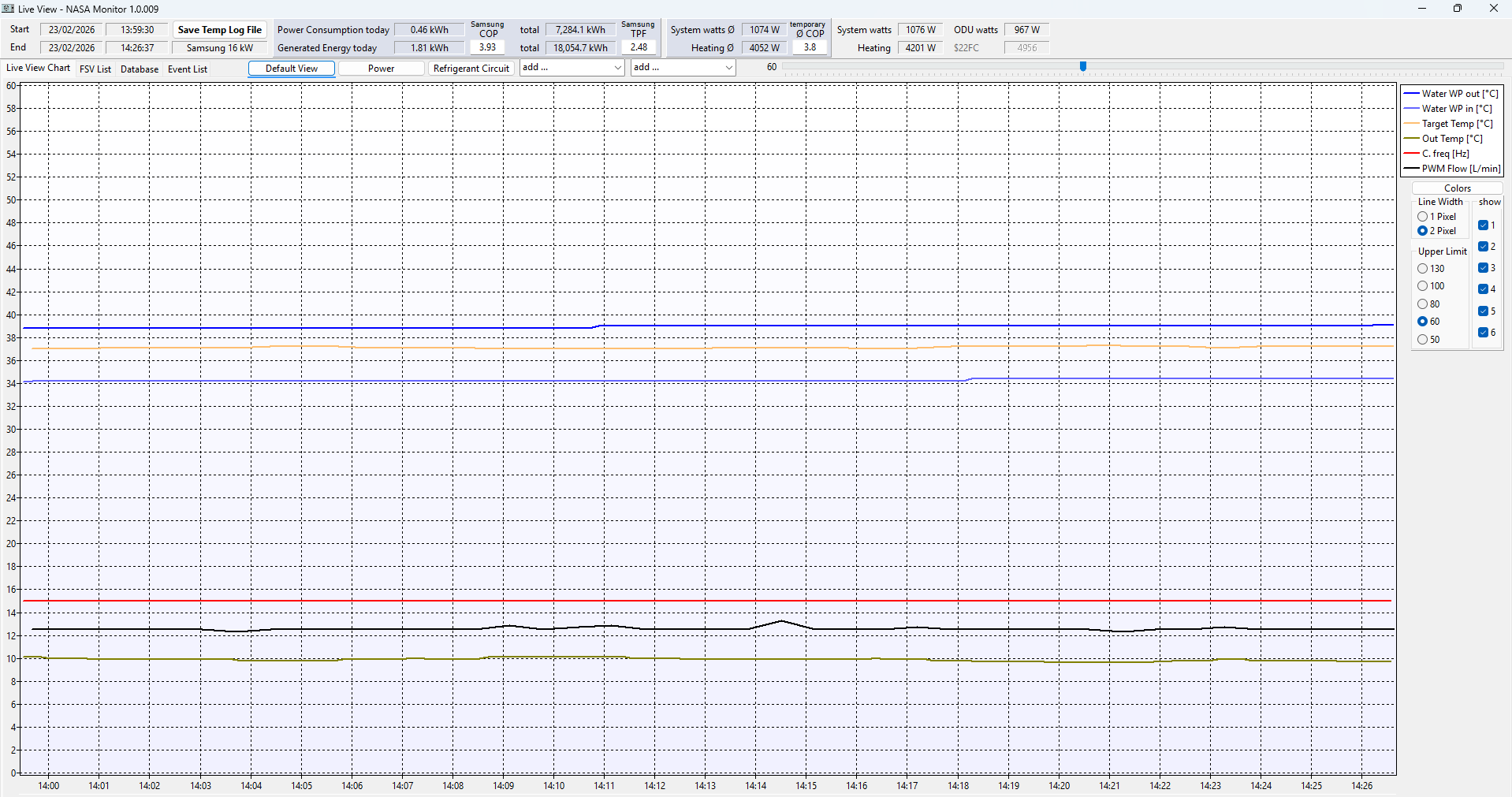
The setpoint is sitting at 37 DegC, but my Water Outlet Temp sits a couple degrees above that at 39 DegC and seems to be just flat lining.

I notice the Compressor frequency is also flatlining at 15Hz and the Fan speed is doing the same at 390 rpm.

Have I actually bottomed out here, ie is this 16kW ASHP just running now on its minimum and therefore I wouldn’t get any lower temps from it with OAT of 10 DegC?

Does this point towards too big an ASHP and/or too small the installed emitters (radiators) or can I derate the ASHP somehow to lower its heating output further?

I have a Gen 6 16kW Samsung AE160RXYDEG.

If the outside temperature is > 9.5c it won’t output less than 30c.

Ok, well good to know and I think I have the same model Samsung ASHP as yours AE160RXYDEG..

I guess if I could get it to go down to 30c then that would be great, but maybe other things in my system are preventing that from happening?

I am not sure whether the issue here is simply my Emitters are not large enough to drop the Water temp any further than current outlet temperature of around 39c or whether it is to do with Pump speed/Flow rates etc?

The Compressor seems to have “bottomed out” to 15Hz and Fan speed to to be “bottomed out” to 390rpm, which I am assuming is minimum running levels for both devices?

I just didn’t know whether I could change a parameter to “de-rate” the ASHP down to act more like a 12kW, 8kW unit?