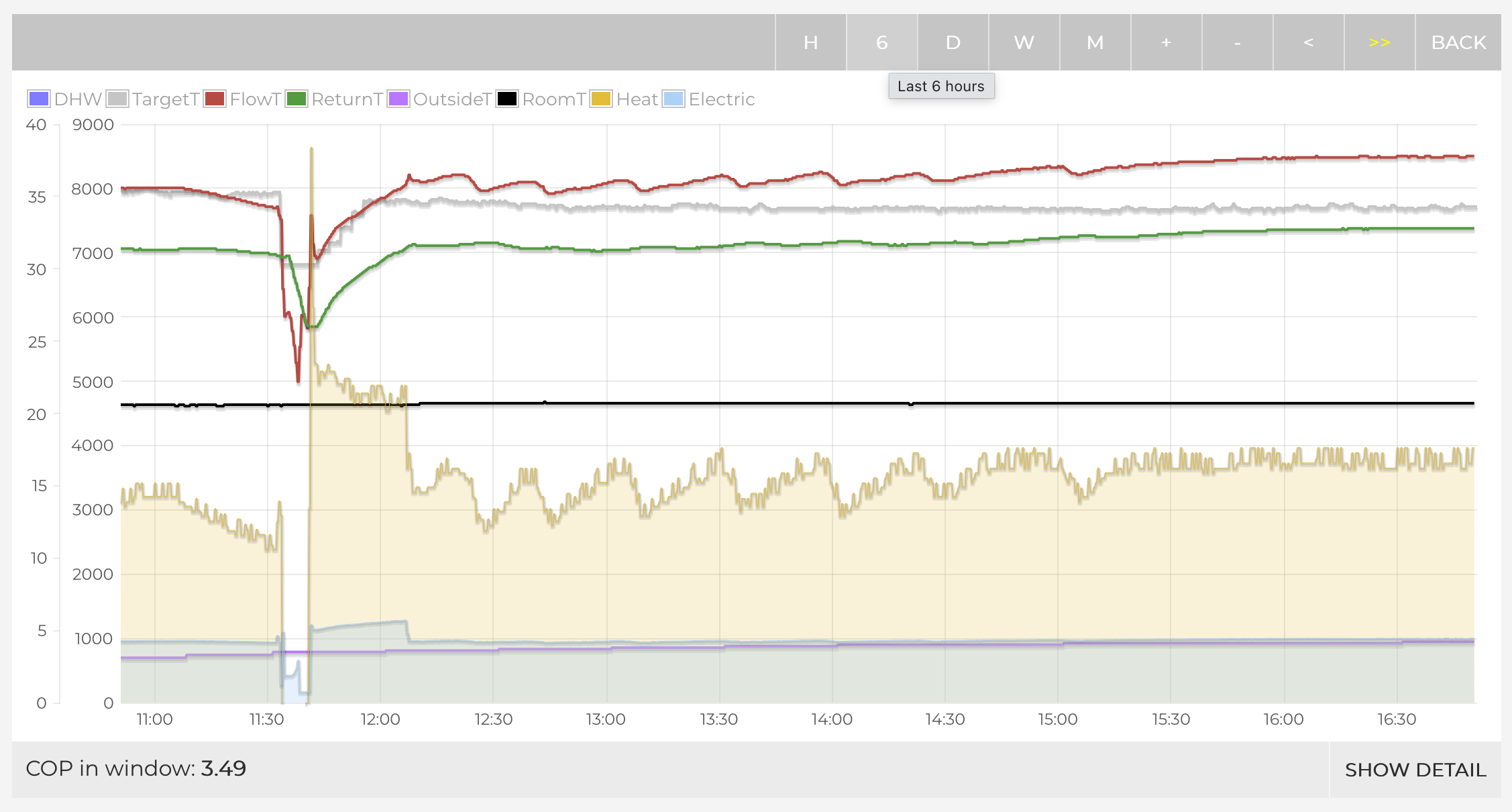
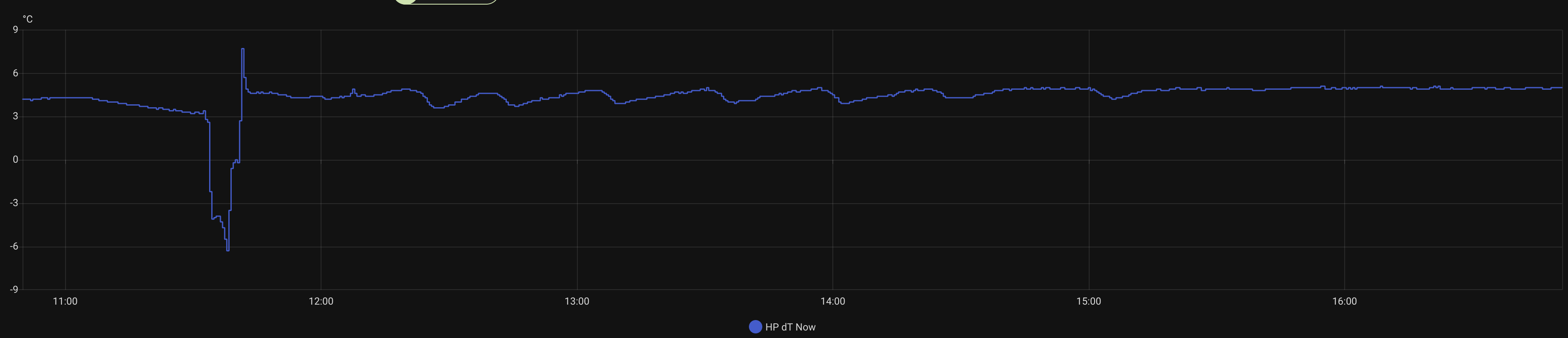
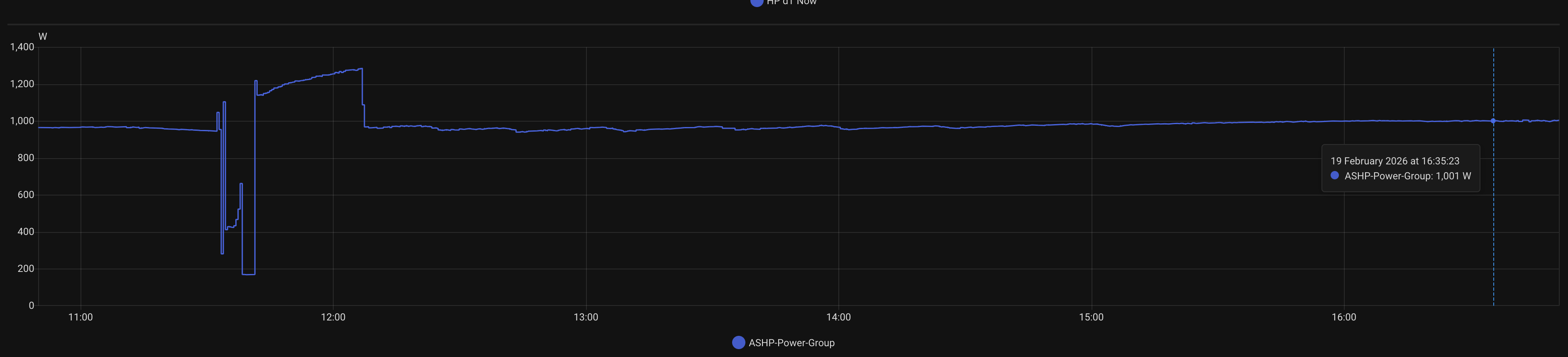
For those of you who have had Daikin attend and update the monobloc firmware on 9-16kw units, have you noticed any change in power consumption/efficiency etc? I haven’t and have not been contacted either.
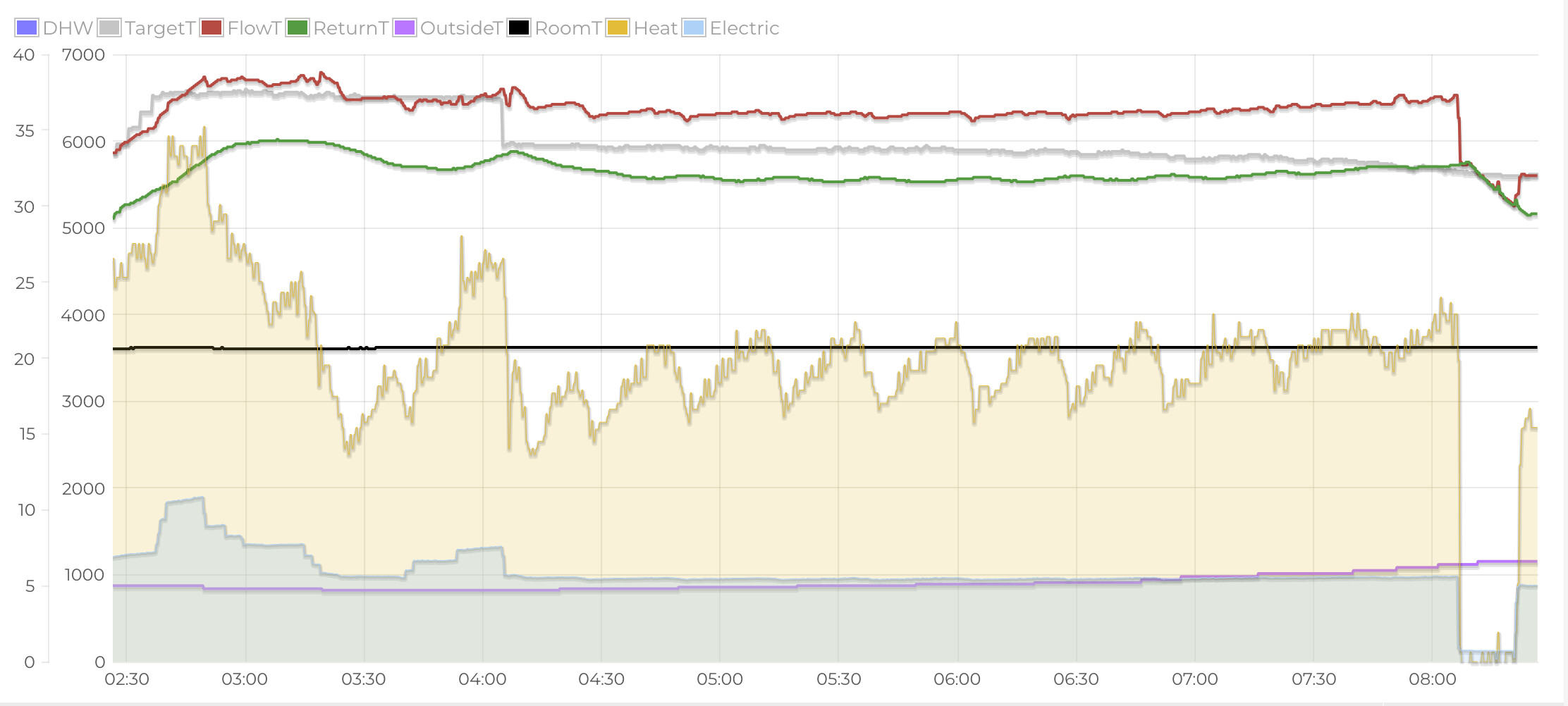
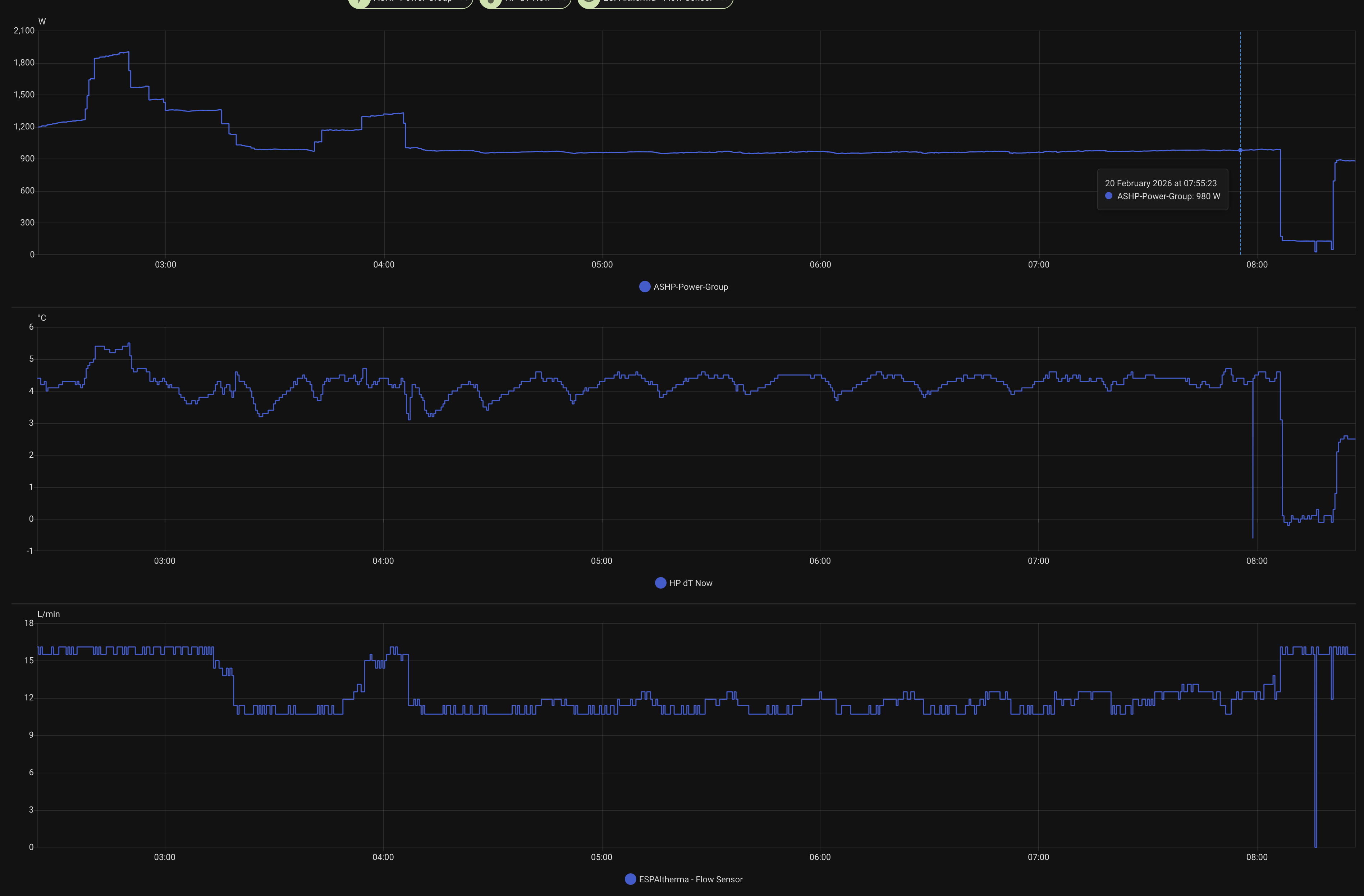
I’m curious since my unit will ramp down as low as 700w or so if its mild outside (10c out, target LWT 25c). Right now, it’s 4c outside, target LWT is 34c but it’s gradually risen and risen to 38c whilst consuming 1000w input power. I just wonder why it wouldn’t ramp down a bit instead since I know it can run lower than 1000w and if since the engineer firmware update if your unit is now able to do that and if any other changes you’ve noticed since.
It seems to be doing what it is supposed to be doing.
Your return is rising so the flow is rising within the overshoot allowed to maintain your requested dT of 5c.
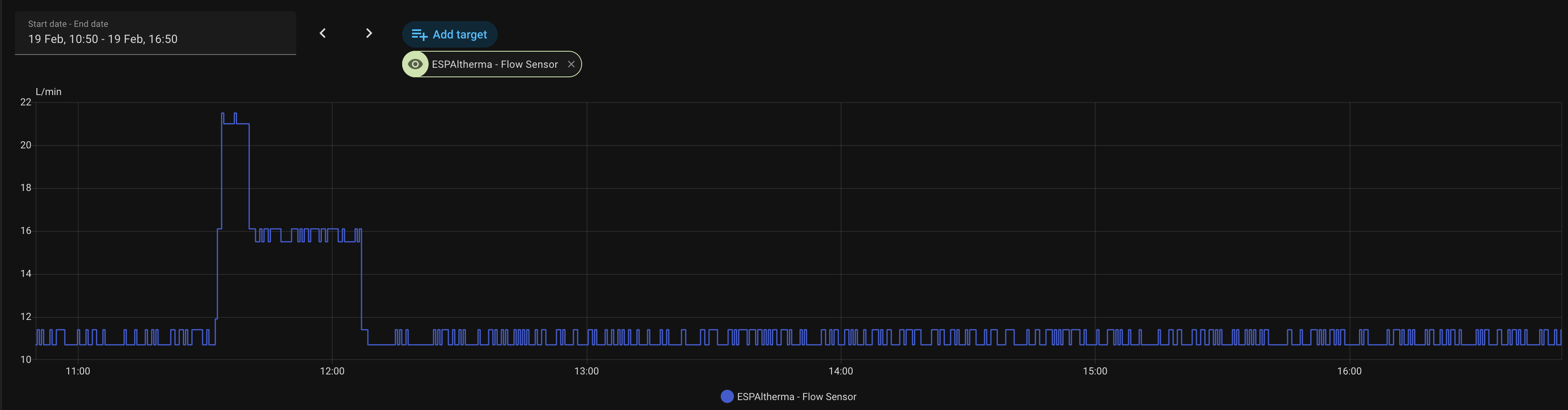
What is going on with the flow rate?
The same data showing the flow rate would be useful, I would guess it is on the floor at around 10lpm, otherwise it could have reduced the flow rate to keep the dT at 5c.
It’s all to do with return temperature with Daikin heat pumps.
I would assume you have hit the limit of your emitters and flow rate so the flow has to go up to keep running.
Overshoot does kick in, so it’s working in that regard. I just wonder why it doesn’t back off the input power consumption since it’s running above it’s minimum by some way and whether the firmware updates that Daikin has been installing for some here have changed this behaviour.
It’s 4c outside and it is heating the water to 38c, 1,000W of input seems reasonable to raise the temperature of 11l of water by 5c at that outside temperature.
If you want less power input then you will need a lower flow temperature which means either bigger emitters, a lower internal temperature or a smaller dT.
Reducing the dT to 4c should allow it to run a lower input as you should be able to get closer to the requested flow temperature at the minimum flow rate.
If only that range of heat pumps had a smaller circulation pump on the `smaller’ units.
The monster circulation pump is actually one of the biggest problems with the 9 and 11
So it’s the same symptoms. The compressor could run lower to not overshoot but it doesn’t.
The question remains, has anyone who is doing this level of monitoring seen this behaviour and if so, did it change after the Daikin engineer attended firmware update?
I don’t know about firmware updates as I don’t have that heat pump anymore as you know.
But, you are not understanding how your heat pump works.
The flow temperature is not being increased by the heat pump as a result of anything in the programming or settings relating to flow temperature.
The flow temperature is initially set by you via wdc or a fixed setting and then allowed to fluctuate within defined parameters such as overshoot and modulation.
The primary influencers of the flow temperature with these Daikin heat pumps is the return temperature and the requested dT
Your return temperature is increasing and so the heat pump follows its instructions to maintain the set dT by first reducing the flow rate and once it cannot go any lower it increases the flow temperature within its allowed limits.
Once an increase in flow temperature outside of the set limits are required the heat pump will stop and restart.
The `issue’ you have is your heat pump cannot run at the flow temperatures you are attempting to run at without exceeding the set flow temperature due to insufficient emitter capacity to deliver the heat generated.
But that’s just the point. It could. It’s being told to consume 980w of input power but the flow temp keep rising and rising. Maybe there isn’t enough emitter power, maybe it’s oversized. It doesn’t matter. We know it could consume as little as 700w input power so it’s programming could reduce input power a bit. It feels like it has a window of operation depending on target LWT.
I know you’ve said before that it’s governed by return temp, but how does the Overshoot 4c parameter come in then? From the charts, it looks like overshoot is governed by the LWT, not the return.
I guess I could try DT3 but I think it’ll be the same. There is too much energy being input into a system that can’t emit it and for whatever reason, the compressor isn’t being run at a lower input power even though there is scope for it to do so.
For what it’s worth, the 8kW and lower range of Altherma 3’s behave in a very similar way at the bottom of their modulation range - power will consistently stay above what I know it can do as a minimum (350W+ Vs ~270W) as flow temperature stays above target or even climbs.
At the extreme end (sustained 14c+ outdoors), it’ll drop into ~hourly cycles instead of dropping power consumption.
Given that I get crazy good efficiency that I’m extremely happy with, I’ve not found the motivation to dig deeper into this behaviour but I would guess there’s some fundamentally good reason it behaves like this. Same logic I use to hand wave away the slightly inconsistent flow temperature control it displays all over the modulation range.
The return is rising as your emitters cannot pass all of the energy into your house at the selected flow temperature.
If the flow temperature remained as you set it the dT would decrease.
Daikin heat pumps don’t work like that.
They maintain a requested dT using the return temperature as the reference point (it could not be referenced to the flow temperature and be maintained)
As the return temperature rises the heat pump has to increase the flow temperature to maintain the dT. It does this within defined limits.
That is the Daikin control logic, a dT based on return temperature maintained by adjusting flow rate and when flow rate is at the minimum it increases flow temperature by up to 4c until the dT is too low and it shuts down and tries again.
Think of it it this way
Requesting a flow temperature of 35c with a dT of 5c is actually asking for a return of 30c
Your heat pump cannot do that in your example above so the flow temperature has to rise.
If you removed the overshoot then it would shut down and restart a few minutes later and carry on doing this.
This is not really affecting your input power, that is being determined by the amount of heat being delivered and the outside temperature. A few degrees higher flow temperature won’t make that much difference.
From my experience the 9kW was happiest and most efficient around 35c flow anyway, a few degrees up or down made very little difference.
I get the “Daikin logic” now, thanks for the explanation.
I think there is so much wrong with my installation that it will never perform optimally. Maybe DT3 will work better, gives the pump more wiggle room to operate? I’ll give it a try. It’s milder now so I won’t notice any difference until the first weekend in March by the looks of it.
Gemini’s thoughts:
Why DT3 is your next logical step
The “Delta T” setting on a Daikin isn’t a fixed pump speed; it’s a target. By setting a lower DT (like DT3), you are instructing the pump to work harder to maintain a narrower gap between the Flow and Return temperatures.
Current State (DT5 @ 11 L/min): The water stays in the heat exchanger longer, picks up more heat, and hits that +4°C overshoot quickly.
Proposed State (DT3): The pump will ramp up (likely to 15–18 L/min) to keep the Flow and Return temperatures closer together.
The benefit: Faster flow increases the “turbulent flow” in your radiators, making them more efficient at dumping heat into the room. This might allow the unit to stabilize the LWT for longer before it drifts into the overshoot zone.
Here’s an interesting point from Gemini I hadn’t realised which adds more clarity to the behaviour I’m seeing:
The “Minimum Modulation” Floor
Every compressor has a physical limit on how slow it can spin. While you’ve seen it hit 700W when it’s 10∘C outside, the compressor efficiency and physical work required change as the Delta T (the difference between outside air and target water) increases.
At 10∘C ambient: It’s easy to move heat; the compressor can “idle” lower.
At 4∘C ambient: The refrigerant cycle requires higher pressure/work to extract heat from the colder air. Your “floor” has likely shifted up to that 1000W mark. It physically cannot run any lower without stopping.
Yes, that is what I said in my first reply to you.
1,000W seems reasonable to raise the temperature of 11l of water by 5c at that outside temperature.
My 8kW unit takes about 500W to do the same to 6.5l of water.
Once you take out the circulation pump power (yours will be more than mine) then they aren’t too dissimilar
Daikin controls are based on continuous operation at higher flow temperatures and the Madoka needs higher flow temperatures to give room for modulation to control room temperature.
None of it is designed with optimum efficiency as the primary element.
Couple that with 16kW heat pumps badged as 9kW units and this is what you get.
They don’t want to run at low flow temperatures, flow rate is variable and continuous operation is desirable, none of it makes for headline grabbing efficiency (of the right sort!)
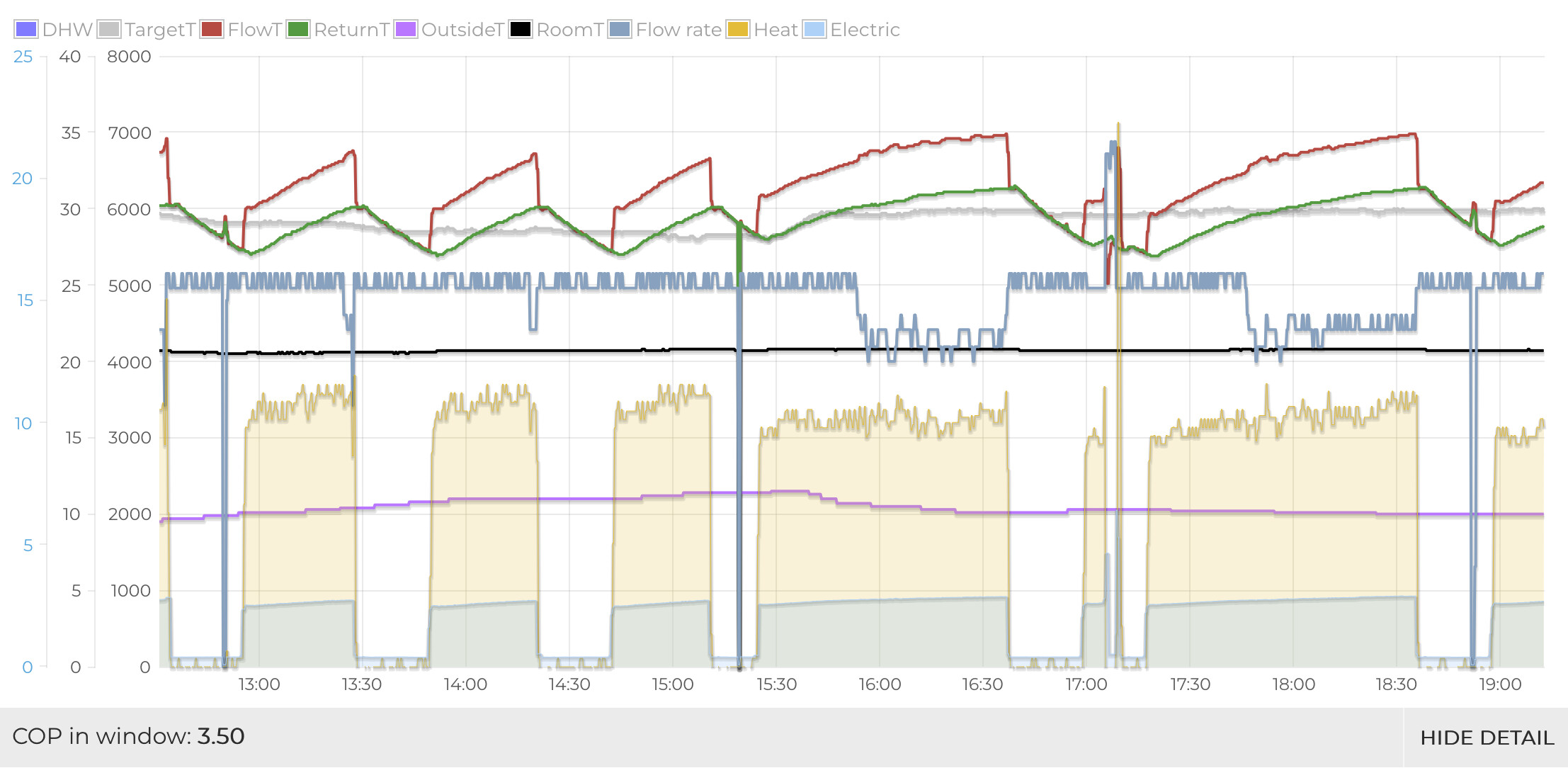
@chrisg your COP at such a low flow temp is very poor because the emitters/ rads cannot output the minimum heat produced. The tell tale for this is the saw tooth wave form for your flow temp. The excess heat = input - output, first goes into an increase in flow temp until the overshoot level is reached and the compressor and fan stop. This is always bad news for efficiency. You will find if you increase the flow temp minimum set point ( or wd set point) to around 35 or even 40 c as Matt suggests, that the saw tooth changes to a square wave form and, as your rad output matches the min input, your % of Carnot and hence cop increase to about 5 or more at 10c compared to 3.5 now.
One other comment on the discussion above: the compressor and fan ramp up and down to achieve the target flow temp, they do not automatically change when you change the dt target. Flow temp is the primary target. Let’s say the energy input is Q
The pump speed goes up and down to achieve the target dt. As Q= flowrate x dt x specific heat capacity, then doubling the flow will halve the dt and vice versa. So pump speed alone controls dt.
Of course if your rad output is too low because the flow temp is too low then, even at min flow rate the dt target will be unattainable. I do not believe that the HP automatically raises its flow temp to achieve the dt but you will see the unavoidable rise in flow temp due to excess heat production mentioned above.