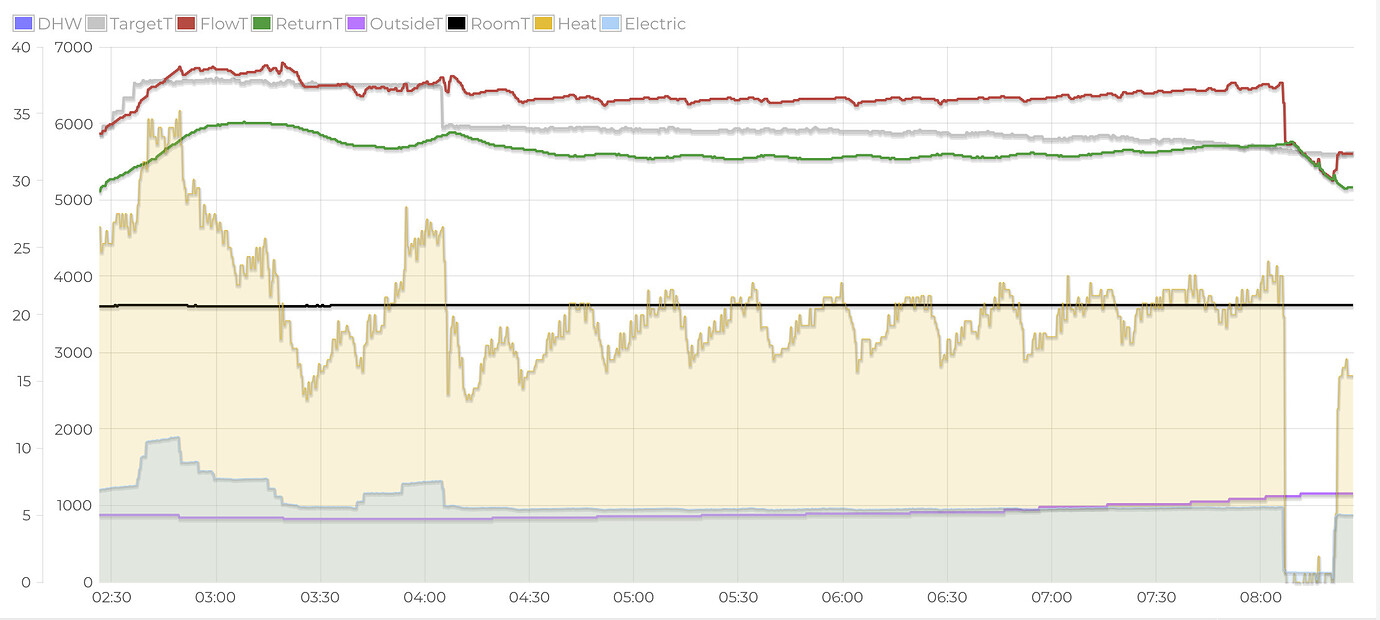
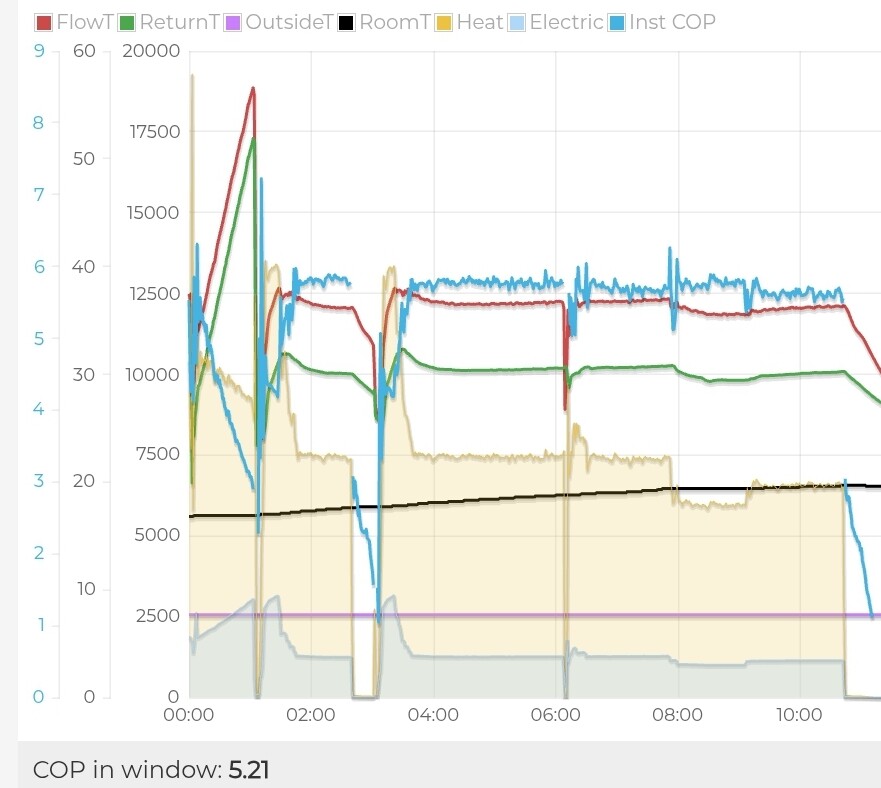
I have to say I’m puzzled by the 25 minute ripple in your flow temp and power, especially as the flow temp ripple in the first example above is not mirrored in the return temp. Then the opposite is true in the second example. There isn’t a trv somewhere ‘hunting’ and turning a rad on and off is there? It either this or some hunting by the compressor or pump at their minimum control levels OR do you have an auto bypass set to maintain minimum flow rates?
In any case it would be best to lower your dt target so the flow isn’t jammed on minimum. Raising the flow temp and rad output will also help raise dt.
If I raise the flow temp, the house overheats. Should I just raise it on the WD curve anyway and let the Heatmiser (ext. thermostat) shut off the heat pump?
Btw, a LWT of 35c sits around 4c OAT whilst 40c equates to -1c OAT on the weather curve. These flow temps maintains the ground floor at ~20.5c with very little other input (modulation).
The ripples are there in the return, they’re just more muted - I suspect because the rads output smoothed them somewhat. I can see them more clearly in the HA graphs.
All TRVs are fully open. Daikin set the ABV some time ago.
I would raise the flow temp and let the room stat switch it on and off. As you are not using a madoka just make sure that the hysteresis, the difference between on and off temps, is about 1 degree, any smaller and you will see too frequent cycling. The madoka has a 1.5c hysteresis for comparison.
Re the ripples, I ve looked again at your dt4 example:
So you do get stable flow temps at 35c which i hadn’t spotted before. I had meant that the ripples are in the return here. The puzzle is that with a stable flow temp you should be seeing a much better cop in these conditions. As the rads here are coping with the output I’m wondering if the lower than expected cop and maybe the ripples are due to how and where you are measuring the flow and return temps? I’ll send a sample from my unit under similar conditions to show how I suspect your unit is really performing..either there is a fault in your unit or in your measurement.
I’m using the onboard sensors in Altherma via ESPAltherma.
Flow temp monitoring comes from: Leaving water temp. before BUH (R1T)
Return monitoring is: ‘sensor.althermasensors’,‘Inlet water temp.(R4T)’) | float(0) + 0.6
0.6c is added to the return temperature to match it up with the R1T sensor, this was done during a period when the water pump was active but the compressor was not.
I’ve never seen the kinds of COP values a lot of you report but I’m not chasing it either. I was always under the impression that heat pumps ran low and slow for best performance. Mine doesn’t do that unless it’s between 2c and 4c outside.
I guess it makes sense to push up the minimum flow temp since when it’s milder, the pump sits there pushing around water for extended periods for no real benefit.
Btw, Madoka’s hysteresis is 2c which is far too wide. The heatmiser is set to 0.5c which is perfect for our home. In the hall where it is located, that 0.5c can be as much as 1c in other parts of the house.
0.6c seems like a big error but I can’t argue with your correction. I’ve three pairs of temp measurements, Daikin, like you, thermocouples taped to the pipes and in line jobs which come with the flowmeter. I’m using the last of these now as they are most accurate. The other two generally have slightly lower dts so lower heat generated. The daikin flowmeter isn’t bad but is also likely to introduce an error.
That said it mainly the ripples in your readings that is hardest to explain.
While a low temp usually equates to higher COP, it does seem, as Matt has said, that the Daikins seem to be optimal around 35c and not always lower. I also think that unless you have emitter capacity higher than your minimum heat production capacity for a given flow temp you will see a lower % of Carnot efficiency which outweighs the higher Carnot usually seen at lower temp. In other words 55% of Carnot at 35c flow is better than 45% Carnot at 30c flow.
So it’s counter productive to have a too low flow temp if that destroys your radiator capacity.
I’m seeing better behaviour but only at mild outside temperatures, post update. I’m at just over a COP of 4 for this winter. Previously I didn’t see any running below 900W, now it’s below 800W at flow 31C and 12C outside. A small improvement but still not as useful as an 8kW model would have been (I’ve tried to get a swap without success).