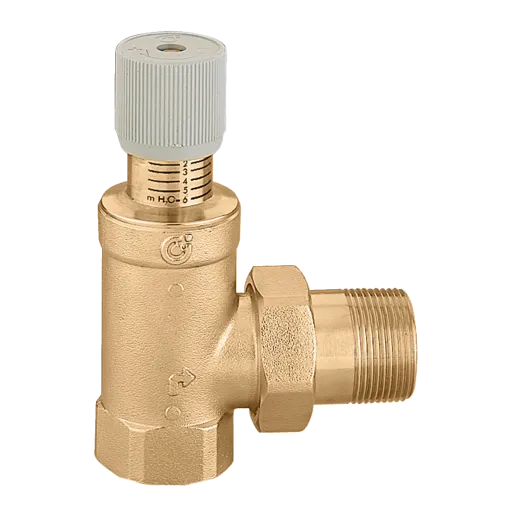
Problem is: my underfloor heating can’t take a lot of flow. It has a max of 12 liters per minute. I verified this by opening up all underfloor zones and running the Daikin pump test.
Now, what happens is this. When it gets colder, delta t increases, pumpspeed increases, pressure increases. Then the bypass opens and a lot of warm water flows directly back to the heatpump.
I’ve noticed the bypass opening above 14 L/min.
Now my question is, to prevent water going through the bypass, is it a good idea to set pump limitation at 60%? I read the max is 20 L/min, so that would max the pump to around 12-15 L/min.
The pump limitation only works during the initial 20-30 minutes after the compressor starts. After that, pump speed is governed by deltaT. You can influence the steady state flow rate by increasing the deltaT value, that will force it to run the pump more slowly.
What’s your bypass valve set to? I wonder if it’s bypassing too easily.
Thanks. Are you sure the pump limitation only applies to the first 20-30 minutes after startup? I can’t find this in the manual.
Delta t is set to 5. Roughly, with temperatures above zero, bypass won’t open and thus all heat goes through the underfloor heating.
However, when it’s below 0 bypass opens because flow increases due to the delta t 5 not being reached. It increases from 14 to 16 and eventually 19 liters per minute. A lot of flow in this situation goes through the bypass obviously.
Bypass is set to 2 (1 = open and 6 = closed). See attachment.
Why 2? Because per Daikin manual instructions, I closed it, ran pumptest (12 L/min), then opened it until the flow was 14 L/min because that appears to be the minimum. It still said 12 L/min at bypass setting 3, but reached 14 L/min at bypass setting 2.
I tried 3 and 4 but with 4, the compressor started to make a lot of noise. Maybe because the bypass opened and closed continuously at that pressure point?
Actually, no I’m not sure because when my system gets to steady state, only on the coldest days does it deviate from running at the lowest flow rate 11lpm in my case. It may be that the limit applies at all times for space heating.
Your bypass is different to mine so I can’t comment on that. I would suggest, though, that testing it with the loop fully closed may not be a fair comparison since usually you would never expect that to be a real world condition. My bypass valve isn’t binary; I can hear it bypassing as it is adjusted with greater or lesser amplitude of flow noise. You may want to try it more towards the closed side for normal operation? Just an idea. I’m by far an expert in these matters. I hope others come along soon to offer help.
Either you run a higher flow rate and a lower DT, or a lower flow rate and a higher DT. They’re two sides of the same coin, and if a higher flow rate is an issue for your setup then the obvious answer is to increase DT instead.
I can tell you from direct personal experience with the same model of heat pump that you have that heating up to DT10 is still plenty efficient - I averaged a 4.2 COP over the course of Jan this year, even with radiators up to 46c flow.
As far as I know, there’s no way to force a limit of 12L/min, as mentioned above the setting you’re talking about is only effective for the beginning of a cycle.
Setting a higher DT could still help with restricting pump speed, you just need to find the point where it won’t go over 12L/min to keep to target or below. Higher DT will not noticeably change your efficiency one way or another.
A higher temperature drop across an emitter is not the same thing as running a 5c higher flow temperature. Here’s an analysis of DT Vs COP on HPM data if you want to see how little impact it actually has: