I know that in an ideal world, I would be installing an emonPi2 and be fully compliant, but I’ve run into an issue with my installer and want to know if there are alternative routes?
My system was installed by Aira, offering a great deal and a 15-year performance guarantee. I am really happy with the system (despite it having a buffer), and the installation quality was first class. However, as part of the guarantee, I’m not allowed to modify the system. I asked them before installation if they would be happy to fit the heat meter, and they said they wouldn’t. To make matters worse, they also don’t share a huge amount of data (at the moment), which has led me to this point.
I want to know how my system is performing and not rely on the Aira App saying everything is fine. Is there a way of using an ultrasonic flow meter (such as the TUF-2000M Water Flow Meter) connected to Home Assistant to collect data and for this data to be added to the database? Is there a minimum tolerance on the data collected before it becomes unreliable?
At the moment I have one CT on the supply to the outdoor unit (compressor, fan and primary pump) and also another CT on the feed to the indoor unit (cylinder, backup heater and secondary pump). I also have surface-mounted temperature sensors on the primary flow and returns.
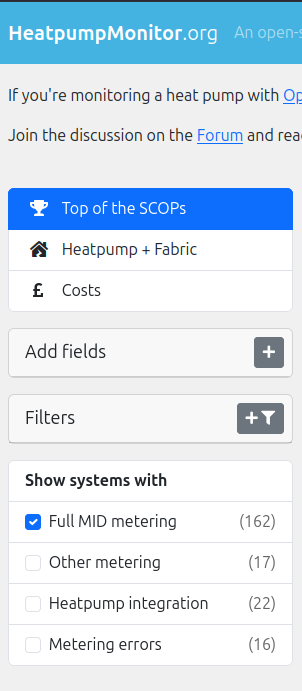
While we require MID approved class 1 electric metering and class 2 heat metering to list a system on the standard public leader-board on HeatpumpMonitor.org, there are plenty of people contributing data with other approaches e.g pulling data directly from a heat pumps own monitoring. You can explore these systems by enabling them on the site e.g:
I did actually try a TUF-2000M but struggled to get it to work well, though the pipework was old steel pipe which may have contributed to the difficulty getting a reading, I have not tried it on new copper yet.
CT monitoring, flow and return temperature and outside temperature will give you a lot of insight into what it’s doing and you can estimate COP using the carnot COP calculation (see Simulated Carnot - how to use? ).
I’d keep nagging at your installer about fitting some MID metering.
I started off with a refusal from Octopus office staff but kept nagging at them and then the on-site installation team.
If they can’t justify to you a reason why the heat meter will degrade your system’s efficiency performance, then nag a bit more. Exactly how much head will be lost in the heat meter and why is that amount of loss critical to the performance of the system?
The real value of heatpumpmonitor.org comes from it being certified accurate and entirely independent of the heat pump machinery. The onboard sensors on the heatpump may not be certified and small errors multiplied many times give results that are at best, indicative.
problem is the nagging didnt work and the system is installed and running. I doubt they will be willing to retrofit it.
Im not looking to use their sensors - even if they eventually give us access - but use my own surface mounted ones. yes accuracy will suffer but at least it will be my data!
My installer came back on two occasions when I “complained” about
1. excessive length of pipe run between DHW cylinder and kitchen tap (I proposed a shortcut)
Fitting a Spirovent deaerator in the primary flow pipe when the OEM heat meter that they fitted was diagnosing bubbles. If they hadn’t fitted the heat meter in the first place I wouldn’t have known about the air-in-the-system problems and my HP system would be running at lower efficiency and causing more wear and tear to the HP and pipework. Potentially we have avoided a future warranty claim
So, even though your system is commissioned, a responsive installer can still be persuaded to improve it
If you consider the installation to be your property (rather than still belonging to the installer) then you are free to make changes to it. For example, in the future you may want to change a radiator, or add a solar diverter to the immersion heater. In the event of a disputed warranty claim, the installer will need to demonstrate that your changes caused the failure.