By my calculations it’s about even, taking the current rates:
IO Go: 0.08
Standard rate with cop 3.75: 0.2738/3.75=0.073
I’d argue that a heatpump is a much nicer heating system, but even taking dhw into account there is not much payback to be had. Very annoying personally.
Email through this morning that flexible IOG night time rates are dropping to 5.2p/kWh from 1st April which swings the maths even further in favour of storage heater.
I agree with @adriandorr though that a heatpump provides a better and more controlled heating than a storage heater.
We have battery storage which generally covers the heatpump usage. 95% of our grid usage is therefore in the off-peak period so electricity cost will be dropping by about 25% with the new rates.
I expect the extremely low overnight rates will very much be temporary (since they are in part due to govt policy anyway). Octopus must be losing money on those tariffs (and have been for some time) and if more users start piling on heating usage (which coincides with their highest cost times), then I suspect that will make them re-evaluate the offering. If you want to get an idea of the true cost of electricity to Octopus overnight, then compare what Octopus charge on the Agile tariff to Octopus Go (don’t just look at tonight! Look at an average of the past few weeks).
Many properties would need a (potentially very expensive) supply capacity upgrade to be able to pull in all of their daily heating at a CoP of 1 within 6 hour period, and be able to charge their car and DHW at the same time. e.g. heat load of 10 kW would need 40 kW electrical supply to storage heaters (plus another 7 kW for the car, and maybe 3 to the DHW) total 50 kW which requires 200 amps at 240 volts single phase.
On a cold winter day my heat pump delivers in excess of 100kWh/day of heat output. For storage heaters to absorb that much heat over a 5/6/7 hour off-peak electricity period implies a current around 60-80 Amps. My main fuse is 60A, so irrespective of a price comparison, we need to consider the practicalities of this approach being taken by an individual property as well as implications to the grid of mass adoption locally or nationwide.
I’m not so sure this is true. The intelligent part of Octopus allows them to move the charge window around. In part this allows them to select the cheapest times for charging. It also gives them the ability to move demand around, and shed demand. Those are both services which have value to the grid and undoubtably Octopus is being paid to provide them.
The last figure I saw was that Octopus had over 1GW of controllable demand in the UK on their Kraken platform.
I occasionally see IOG choose slots in the 4-7pm peak, on days with high CO2 intensity. Those must be expensive slots, so the only logical explanation is that Octopus is receiving payment for some other service (for example being able to shed load in the case of a sudden power station outage) that means it makes sense.
This is a very good point.
There is friction between what makes sense for an individual vs what makes sense at a population level. When sizing a heat pump it makes sense for an individual to slightly undersize it so that the capacity is more appropriate for 99% of the running and avoids inefficient cycling. Supplemental COP 1 heating (fan heater, oil heater, etc) can be used if necessary. Makes perfect sense.
However at a population level, the nightmare scenario for the grid is that on a really cold day, when demand is already high, people start adding COP 1 additional load. From a grid perspective accepting the cycling inefficiencies is preferably to creating even higher load at peak moments.
The answer is obviously heat pumps rather than storage heaters. Decreasing our primary energy requirement has to be the way forwards. I think over the next decade we’ll see considerable change to TOU tariffs. I suspect the overnight period will get more expensive as increasing numbers of people make use of it. Conversely I think we’ll see the emergence of a mid-day off-peak, especially in summer, as the installed solar capacity grows. Ultimately I think we will see significant cost increases at the times of peak demand. Having the ability to move your grid consumption, even by a few hours, will be hugely beneficial.
I would take Octopus Agile as an indicator of wholesale prices. It now rarely gets below mid teens (pence per kWh) even in the supposedly high supply/low demand early morning period. Also TOU prices like Cosy are creeping up - I calculate around 24p average for a heat pump compared with low 20’s last year.
So conclusions are that EV tariffs are being subsidised through other users and as more EV’s are coming on stream the night time wind is not keeping up. Whether the low EV tariffs will continue in the medium term is uncertain. Perhaps they are a short term subsidy - like FITs and the BUS grants - to encourage EV take up but eventually the government will need to fill the financial hole from loss of fuel duty by either a charge per mile or maybe an EV electrical tariff premium.
Hopefully the expansion of wind and solar is bringing on more low cost production but, currently, this is only just keeping up, at best, with increased overnight demand.
Furthermore the uncertainty in TOU tariffs means that heat pumps and home batteries from a financial payback view - I know there are other environmental and comfort benefits - are less attractive. The plummeting cost of grid level batteries also undermine individual ones. The latter help avoid local grid stress but this does not seem to be recognised through TOU pricing.
Clearly no sensible person will install new storage heaters rather then a heatpump for a complete home.
But seems to be no economics case to replace working storage heaters with a A2W heatpump. Personally I would just add a A2A to the living room.
As the grant does not allow hybred system, I expect many oil users with boiler that are in a good condition will get the fastest payback by DIY installing a small number of 2nd hand storage heaters. (One per ring main)
The fully installed price of full new storage heater system is now close to the price of Fogstar batteries!
The x 3 assumption is flawed - particularly at daytime in spring. If the heat pump is running at all it is more likely to be x 5 COP. My system has a sCOP of 5 and that is despite loading it to use more energy at night - hot water is heated at night and a higher temperature demanded in the cheap IOG times.
A further consideration is that the current very cheap rates for car charging is unlikely to be maintained as more batteries and EVs come in to use. Think more than a year ahead - heat pumps will always be around x4 times the efficiency of a storage heater.
COP5 during spring is just as flawed. You’re only consuming a few kWh to make up the difference between spring ambient outside temps and the indoor setpoint. COP is much more relevant in the depths of winter when it’s closer to 3 and you need to consume much more energy. COP isn’t the be all and end all.
sCOP takes this into account - my sCOP is 5 - this includes winter.. I’m not sure where you are in the country but round here it is still feeling pretty wintery! Over the last week our average temperature has been under 8 deg and over 100kWh consumed by the heat pump at an average COP of 5. Storage heaters - if they could have maintained the steady 21 deg that I have would have cost significantly more. With the batteries I have it would have cost me about 5 times as much.. Anyone running an EV on OIG without batteries is missing a trick - payback is only a few years.
I have a weird house with rather low heat demand. For the past ten years I’ve heated it using electrical duct heater in the MVHR which is only ever on for the seven hours of cheap rate E7. It uses the structure of the house itself as a storage heater. It works, and it’s very difficult to justify investing in a heat pump instead. So it’s not a totally crazy idea to use storage heaters, but it does depend on the particular house, I think.
Having had a full house on storage radiators it was not a comfortable solution. The heat is gone by the evening. There was an afternoon boost but even that was not enough, it just did not make the home comfortable for the whole day. On the other hand a correctly installed HP on the Octopus cosy TOU tariff does the job without batteries with modest temperature setbacks providing whole house heating at an average rate of around 22p kWh, 7.3p even with CoP of just 3 , so cheaper than storage radiators at 8p for example. In most cases the SCoP will be much better than this. Add some battery storage like I have this year and the average rate is 17p/kWh this winter (2025/6). So unit of heat is 5.6kWh and over the season will be well below normal EV rates at COP1.
TOU tariffs are a sustainable feature of energy rates so can be used for future costings for a Heat Pump.
Last winter, I achieved an average import price of ~20p running Octopus Cosy with no battery but avoiding the peak period and running an overnight setback.
This year, having added battery storage, we only ever import at the Cosy cheap rate. Due to the 3 cheap rate periods, a battery size of around 1/4 of max daily usage seems about right (as a fair amount of daily usage can occur directly from the grid during the 8h/day of cheap rate)
If we are trying to show the true cost of ASHP versus other forms of heating then the analysis needs to be accurate and comprehensive.
For instance Cosy TOU applies to all electricity used so, for instance, cooking the evening meal may fall within the high cost price period. Also TOU rates, such as Cosy have increased over the last year.
If you install a battery then you should account for the payback. A 16kwh battery costs around £6k installed if you shop around. So you need at most 7-8 year payback to recoup battery cost and interest foregone. Also do you charge the battery between the widely recommended 20 and 80% to maximize it’s lifetime, meaning available low cost electricity is less than the label capacity. Further does the battery meet all house demand or just the heat pump.
I realise that people make investment decisions based on other factors, such as cutting their carbon, but if we are quoting costs then they need to reflect all factors and be up-to-date.
Accurate analysis also puts pressure on government and energy providers to make electricity rates more attractive/accelerate sustainable production to encourage the switch. This is currently done for EV users since the overnight rates are far below the Octopus Agile rates, especially in winter, suggesting that these are being subsidized and even these are becoming more restricted or pushing upwards.
Agree that EV rates are certainly subsidised this has been admitted by Octopus and that is why it has been withdrawn for heavy multiple users like taxi operators.
It is not a bad thing really to encourage initial take up but no doubt will be withdrawn when the majority have an EV and it may be replaced with V2G tariffs that help the grid.
The cosy tariff has been and still is 8 hours at 50% below the standard rate in three sessions over the day and 3 hours at 50% above in early evening. The differential rates have not changed over the past few years. This simply reflects the average wholesale price of electricity over the duration of the day and is predictable. This type of TOU tariff has now become established and is likely stay like this and so can safely be used for costing heat pump installations going forward.
For the consumer the extra cost of using say 2kWh to say cook a meal on 50% above rate between 4 and 7pm is easily outweighed by the heating and hot water at 50% below during the three dip sessions in winter. (not the case in summer so best to switch to an EV tariff or similar). Looking around on line most find that it is cheaper without significant reductions in comfort.
But with a modest battery storage the savings are truly impressive…
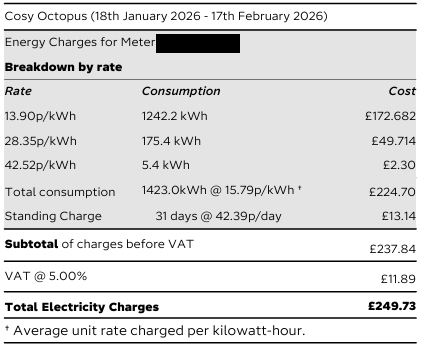
Take a look at my heaviest heating month of January this year:
The average rate of electricity is as it appears on the bill is 44% below standard rate with my 5kWh usable storage fitted.
With current standard rates at 27p/kWh that saves the average heat pump consumer around £750 pa. on the entire energy bill. Or £7,500 over the ten year life of the LFP battery pack*.
The current cost of a fully installed 5KWh rated system it is in the region of £4 to £5k. If part of a solar array it can be as low as £3k. (ref Octopus energy)
Therefore the pay back is currently around 6 years which is typical for home energy investments. LFP is particularly suited as it uses iron and phosphate rather than cobalt and nickel and therefore much greener.
What happens if many users fit battery storage? The differential rates will likely not change much because the cost of balancing the grid will always be present especially as we all electrify.
It crucially means there will be less imported gas for peak demand electricity required in the near future.
*NB This allows for recommended charging for LFP from 20% to 100% (LFP does not degrade like Li-ion) to give a life up to 10,000 cycles. Round trip charging efficiency is 92% on my system and is included in costing. At 3 full cycles per day in winter the life is expected to be ten years. The ageing effect is gradual and the LFP battery will likely continue at a lesser capacity for much longer than ten years continuing to save money. (caution we do not know the average life of LFP in a domestic situation just yet but after two years of hard use mine has not changed). If you have the cash and already have solar I would definitely recommend it - but always check what savings can be made by scheduling usage and the current fixed rates on offer before making a significant investment.
PS We have an old victorian detached house with a family turning everything on when they want - and we keep the entire house at 19C for 20 hours a day in depth of winter - it does all work. So glad I did this.
Your figures are impressive and I cannot argue with the real data performance you have achieved. My point is that given what ASHP owners can achieve without a battery (I e. not the standard rate) then the TOU tariffs are not as attractive as they were. I was getting the 20% you’ve seen on line but more recently:
The fixed 15p heat pump plus tariff was withdrawn.
I am now on a 19p fixed until mid-27
Even with your great figures that means a £5k battery gives around 4-5p saving which applied to say 8k kWh total use over the year gives around £350 per year or at least 15year payback ignoring interest lost.
EV tariffs for just home battery owners with no car are hard to come by. The nighttime Agile rates show that they have to be subsidised
Local grid scale batteries are becoming far cheaper and a standard add on to solar farms so generators may prefer to use these to smooth demand rather than paying home owners or gas fired power stations - perhaps not this year but the technology and scale are changing quickly and a home battery is a 10 year invest decision.
So I’d like to be convinced especially as I have the battery base built and the cables in place with plans for a sodium battery but uncertainty is the killer of investment decisions. Energy suppliers can help by programmes to guarantee low/zero bills like Octopus. In the meantime, perhaps I should spend the money to help build a local solar farm or similar or buy an EV for v2h when I need the next car.
Thanks again for your figures. Discussion and data helps make better decisions.
You raise a very good point about fixed flat rates and how we can take them into account in the investment decision. A 19p fixed discount is a great deal (for me eon has a 22p for 15 months but only if I switch, my existing provider it is a 25p fix). If we expect flat rates to stay relatively low then battery storage just for the ASHP is not an economic investment. But if you intend to use it for solar capture as well then it is certainly worth considering.
Interesting that you mention the National Grid may solve demand and distribution with large scale battery storage. If that happens everyones bills will go up to pay for it and maybe the purpose of TOU billing will eventually become superfluous. Only time will tell I guess.
Thanks for the useful discussion - lets hope electricity prices come down relative to fossil fuels for all our heat pump investments!
A couple other factors that came into our decision to buy a battery:
Entering into retirement, we are cash/asset rich but income poor, so we were happy to spend capital now to reduce bills in future. We are now net zero with no bills (Octopus pay us!)
I believe we are now as resilient as we can be against future (financial) shocks at a time we have less capacity to respond (see #1). This is bourne out by current events whereby our heat pump consumed £43 last month for heating and hot water, whereas the oil boiler it replaced would have consumed a shocking £225 of oil for the same heat output.
Will we see the £7k cost of a Tesla PW3 back in 10 years - maybe, just. But that £7k sat in the bank at 4% only earns £280/year towards paying our bills whereas the PW3 saves/earns us double that.