On the LFP ‘reserve’ percentages: there is no need to set any kind of manual reserve, over and above the factory-set depth of discharge limits. There is no advantage to longevity.
With our 19kWh GivEnergy battery array, we run it down to 4%, which is the lowest that can be set.
My Dyness/Solis battery came already set with a shutdown SOC of 20% and I never changed it thinking it was good for the LFP battery life but as you say it seems the only reason for it to be this high is to have a reserve. I have now reduced the shutdown SOC to 10% and may go lower if I do not intend to use it for power outages.
Thanks @ectoplasmosis for your suggestion it will save me money!
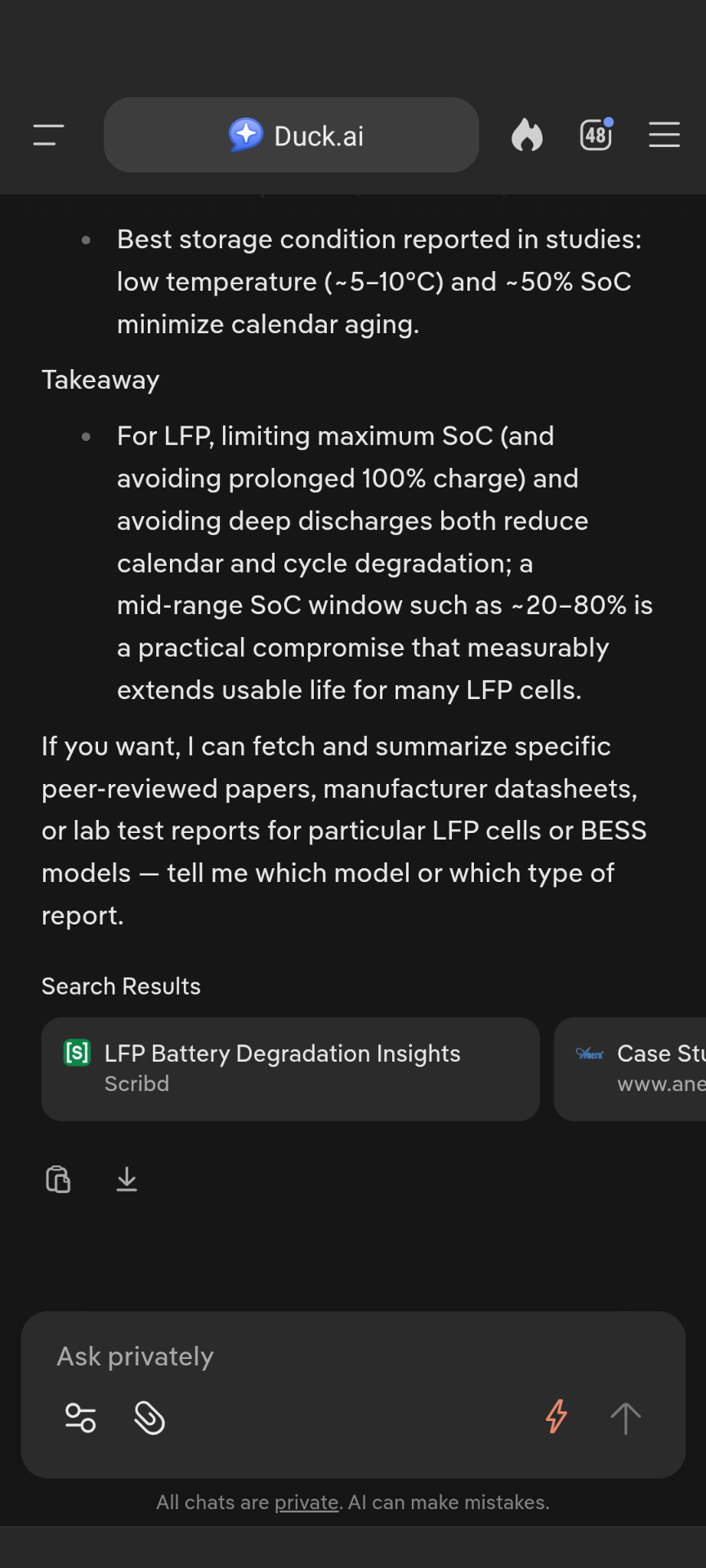
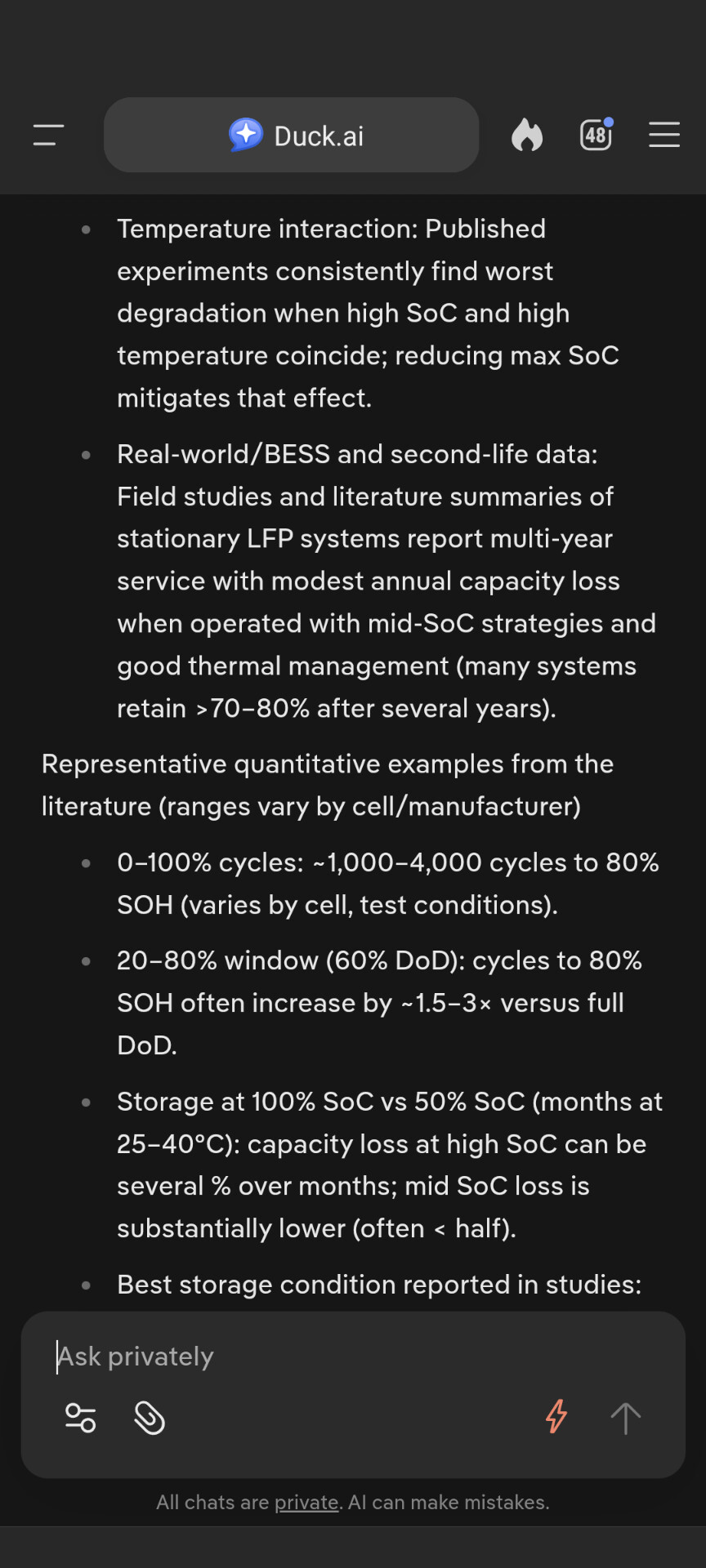
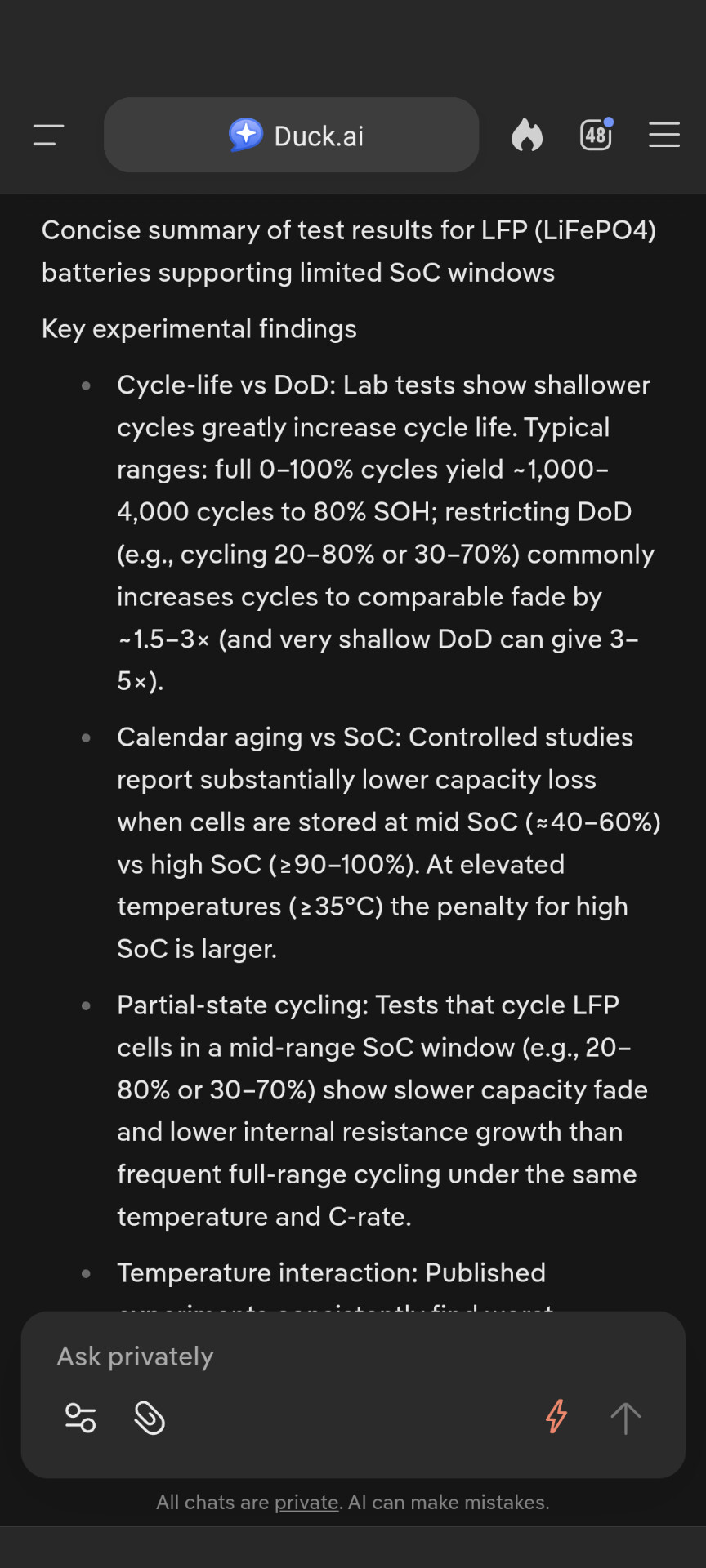
I’ve no axe to grind on this but if you research data from actual tests it supports the recommendation of keeping the discharge range between 20-80% to extend longevity/available capacity.
Of course, you should weigh this against your financial longevity expectation for the battery. If you are OK it lasting say less than 8-10 years, after which you may replace it with new technology, then run it hard and maximize the benefit during that period.
Hi Martin, I am bit confused. I thought that the 20% to 80% cycle test data was for Li-ion. Can anyone find a reference that LFP home storage can be cycled from 5% to 100% without too much degradation other than aging? Certainly that is what is claimed in the link above but maybe they are wrong. Lots of conflicting information out there.
PS I think the main reason for confusion is that with home LFP batteries manufacturers already enforce safe depth‑of‑discharge limits, so you’re not actually hitting the “true” 0% or 100%. For example on my battery you cannot change from “100%” so I think that is what is happening here.
Thanks for that. In the case of my home storage it seems that that the real SOC values are not visible to the user. My batteries can only be set in a range that supports the warranty. I cannot change the 100% only the reserve value which can be set to down to 5%. They are just user settings.
My Dyness user manual says SoC shutoff on inverter should be set to 20%. Compare that with the latest DL5 series which says set to 10%. In both cases the cycle life is quoted at >6000. So best consult your manual for the correct inverter settings for your particular home storage battery.
The recommendation is the battery is not left for a long time below 20% or above 80%, it not an issue to discharge to 5% and charge to 100% if charging every night and discharging below 80% every day.
I can tell you a little about how my Tesla PW3 behaves. Presumably Tesla know a thing or two about batteries.
The PW3 is LFP chemistry. It is a 15kWh battery, sold as 13.5kWh capacity, so has ~10% spare capacity hidden from user.
The Tesla App uses it’s own AI to control things. It recommends setting a 20% reserve, but can be overridden by user and discharged down to 0%. I think the recommended reserve is a combination of still providing some backup capacity with longevity.
A recent update to the Tesla App has also ‘optimised’ charging so that the battery does not sit at 100% charged for long time periods (see @Ringi comment above), so the battery is supposed to slow down or stop charging at 80% where it can, and only fully charge to 100% when required. Again, presumably this can only be for longevity reason.
If Tesla feel the need to encourage users to stay in the 20-80% range, they presumably feel it is beneficial to battery health / longevity, and ultimately will help minimise warranty replacements.
In winter I have no issues fully utilising my battery. I will fully charge to 100% and discharge as required, down to 0% if needed. In reality, I don’t think I’ve ever needed to go below 10% in winter - we turn stuff down/off first to manage rather than run out of battery.
In summer we use far less battery. It fully recharges each day on solar and discharges overnight as required, maybe only down to 70-80%. There is no way to tell it to only charge to 80% and the App (AI) seems fine with it fully recharging despite recent ‘optimisations’ to the App.
Thanks, @Old_Scientist that is very informative. I certainly will not worry too much about the cycling levels. My battery storage is working well. In summer I buy virtually no energy in and in winter I use almost entirely half price electricity to heat our home. It is a result and I will try not to sweat the small stuff.
In ten years we can all assess how it has worked out but I am confident I made the right decision.
The OP asked whether a battery-less heat pump could be as cheap to operate as storage heaters using IOG overnight pricing. The answer isn’t yes/no, but what SCoP the heat pump needs to perform at to achieve cost parity with storage heaters. Somewhere in the high 3s seems likely to be sufficient. But several replies pointed out that storage heaters don’t deliver the same comfort level as a heat pump, so a heat pump is still the preferred way forwards.
I’d like to point out that heat batteries can deliver the comfort levels (or better) of a heat pump, with the operating costs of storage heaters. For smaller homes, e.g. where there isn’t the outdoor space for a heat pump, a heat battery can hit the sweet spot for high comfort levels, low operating costs, and low carbon emissions. Especially if retrofitting an existing hydronic heating system away from a combustion boiler.
(Disclaimer: I’m almost contractually obliged to point this out, as I work at tepeo, making heat batteries for residential heating. )
Storage Heaters deliver their heat to the house by heating the air around them, as soon as they’re hot enough to do so. This tends to be during and soon after they’ve been charged up. The defining features in this context are the low level of control over the timing of heat delivery, and the localised means of heat delivery.
Heat Batteries deliver their heat to the house by heating water that is pumped around the emitters, in exactly the same way a combustion boiler would do so, or an air-to-water heat pump. And the heat is available on demand, for many hours after they’ve been charged up. Heat batteries work with any hydronic emitter, including radiators, underfloor heating, plinth and skirting board heaters, and forced air systems.
So while storage heaters and heat batteries both access cheap overnight electricity, that’s where the similarities end. Storage heaters have low levels of control over delivering localised heat. Heat batteries have high levels of control over delivering centralised heat. Hence they’re ideal for retrofitting an existing hydronic heating system away from a combustion boiler.
 )
)