I should add, I have Arduino demi running my home heat on a 1500 gal water tank since 2014 ish… I have Beagle bone Black running VenusOS receiving Mqtt updates from my SolarAssitant node. etc IE I can code for most of the SOC platforms C++ or python or Go … I have a python based AC charge controller that charges based on actual PV amps over AC … etc
Where do you start with the Mk2 PV Router - it’s a very good question because it was not designed for your voltage or frequency, so you might find some small changes are needed.
I presume you are here because you’ve seen the copy of Robin Emley’s website and possibly seen the Arduino version in the Docs section.
What were you thinking in terms of the hardware? Robin might still have a few pcb’s available, I don’t think he ever published a CAD file for any of the boards.
So I think the question you ask yourself might be - do you replicate Robin’s kit design as closely as possible, given the components available to you now, or do you follow the hardware design only in principle, and use a more modern processor you’re familiar with and write the software from scratch again only following the principles. What will be critical for you is the performance of the ADC, especially regarding the sampling rate - rather surprisingly, the ATMega 328P still takes a lot of beating.
Robin still keeps an eye on this forum, so he may well see this within a few days. I still know how to contact him, if there are any specific things you need to know. Meanwhile, I did help him with parts of the design and programming, so I’ll help as much as I can.
As it happens, I have today removed a Mk2 router from my UK house where it has been working faultlessly for many years. Since installing it we have come a long way and now have a battery and a heat pump. In many ways these new equipments replace the need for the router, which is why I have uninstalled it.
I learned so much from Robin in our correspondence and have every confidence in the project. My system has 4 outputs that cascade in turn as each one stops drawing power.
If you or anyone else is interested to buy it, please DM me and I’m sure we can work something out.
@FredM67 has been developing a new version of the router with, I believe, the blessing of the new “owners” of the project. He might be able to chime in here, too
Yes. Ironically I was well down the path of using a Beaglebone Black ( embedded PRU’s ) and running VenusOS (Victron). Alas the PRU support is not part of VenusOS and adding it would be quite the “one off” , so the default Debian OS for BBB also seems to have lost decent support for the PRU’s ( I have the C++ code for the basic rms and switching written ) … So I was looking for other microcontrollers suitable as a sanity check and ran into Robin’s website and had to laugh a bit. I had used an aruino in 2012??? ish that still runs today to control a wood gassifier/heat exchanger/circulator pump. (dallas one wire temp sensors, logic to start/stop the circulator when the boiler is hotter than the tank.
So reading his site I was feeling quite a bit like reinventing the wheel …
All that to say a modbus TCP running on an arduino that is a highly accurate meter + ssr relay 50A controller with decent support would let me replace the Programmable Realtime Unit in the BBB with something more reliable. I am not looking for custom boards but the basic knowledge what needs to be included for a safe durable system.
Since I already have a 1500 gal heat reservoir tank up and running is seems like a great place for a dump load. That said - the primary goal was to create a consistent load for the PV inverters. I have a zero export setup. My pole barn has 4 strings of 12 = 4500w x 4 = 18Kw 2 Fronius inverters master/slave each manage 2 strings. I use the Dynamic output feature of these to set 0 watts hard limit, -185 watts soft ( always using 185 watts from utility ) . So Smartmeter 1 sec polls and ~ 2sec response. These are AC coupled to a Sol-Ark 15K with 4x16Kwh LiFePO4 banks at the house basement about 250ft from barn.
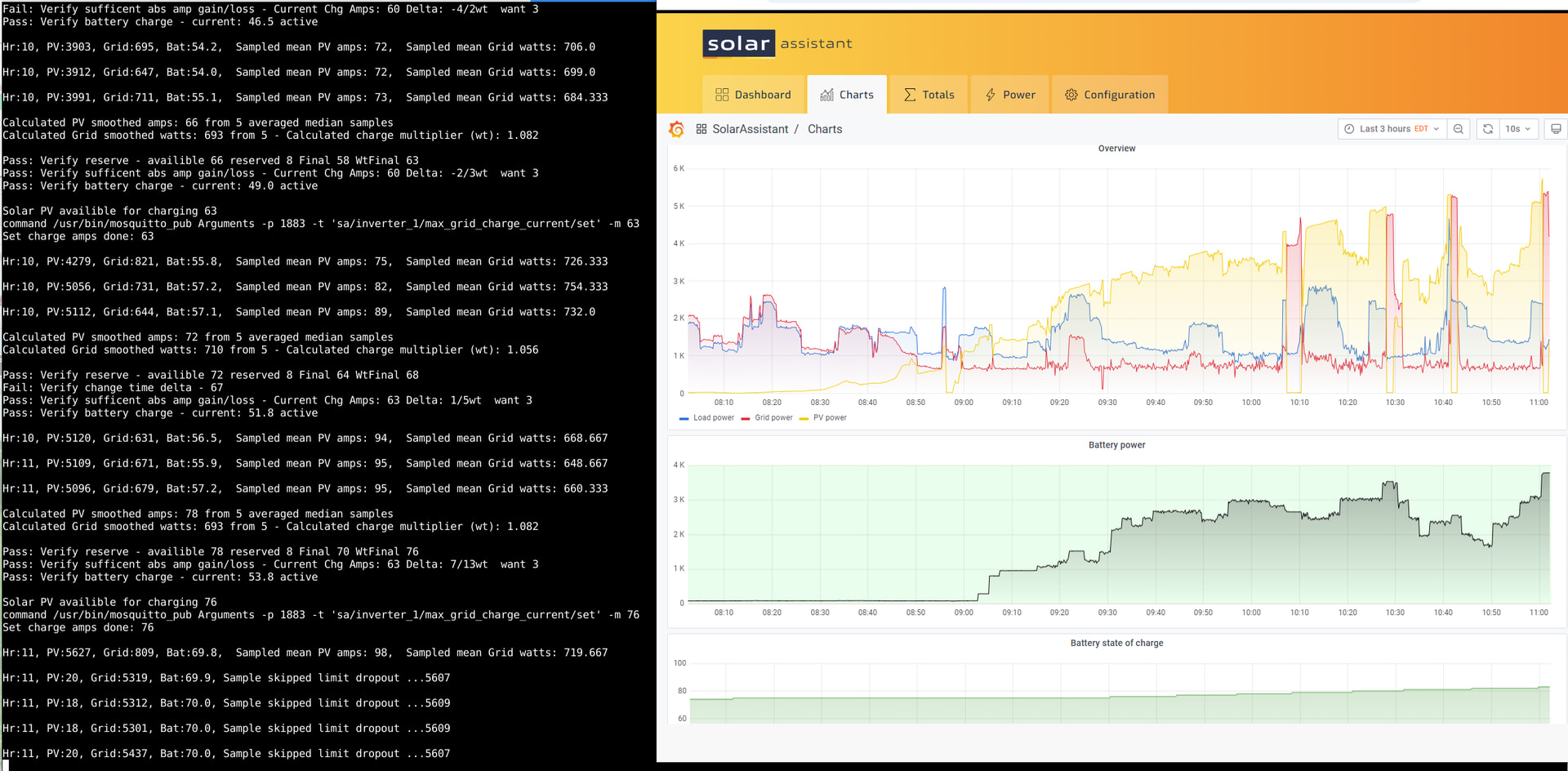
This creates from 2 - 12 hard PV shutdowns during a day charge cycle as loads drop and the PV sends the grid close to 0 or past 0 for brief moments. My design was to “catch” the instant drops and open the dump load relay and switch the load difference to the dump load making the net utility use smooth and the PV production also smooth. Then slowly decay the dump load back to zero.
In addition to this when the batteries are full I would quite happily let it heat the tank. 1500 gal is around a million BTU’s of energy usable so replacing the grid as the “buffer” plus some extra heat. Replacing the grid as a buffer is a strong point in my plan to make the utility entirely optional.
Today it is very close but having this capability would let me keep the PV inverters running without a hiccup by replacing the smartmeter with my own smarter meter… The Sol-Ark runs everything or passes thru the PV but keeps the AC coupled segment “alive - in sync” all the time but the meter state will drop PV production. This brings me to full off-grid capable.
Here is a sample of the drops ( and my custom charge controller dealing with them ) the red/grid spikes backfilling the PV during charging when a blue/load drop triggered the limit stop
ps. The charge controller does a good job of following a smoothed out PV production and sending all available excess to the batteries during the charge window. When grid watts go up charging backs down. I altered the code to let the grid pick up the short drops - more efficient than ramping down as the sun is present a large load drop was the root cause.
I ran one of Robin’s PV Routers for about a year. Had no issues with it.
Voltage shouldn’t be a problem. Given the power levels involved, his system
is running at 240 Volts. Frequency shouldn’t be a problem. I had no issues WRT frequency. That said, Robin may have changed things to the point where
frequency is a problem. I don’t know. After I stopped running my router,
I didn’t stay up to speed on what Robin was doing with the project.
The last bit I can remember was something about a 3-phase version that
would work on this side of the pond by using 2 of the 3-ph inputs and
ignoring the 3rd one. Next thing I knew, the project was taken over by someone in France.
That’s all correct. The mk2 business is now driven from South of France by Amandine and Quentin. https://mk2pvrouter.com/
I’m not selling anything, I’m “only” on the design part, hardware and software, with the help from time to time of @Robert.Wall and @awjlogan.
The new Mainboard is still in test and validating process. A lot has been reworked/changed, but still based on an Atmega328p.
In a near future, hopefully, I’ll redesign it on the same way as emontx6/pi3, using a new microcontroller.