What SCOP can you expect from a system that runs at 55C and 50C flow temperatures on the coldest days?

I was watching this video https://youtu.be/zPhlm8afr9o?si=K1_HLTAJZcRfV7Je&t=982 by Mars of Renewable Heating Hub the other day, where he is questioning a claim that it is possible to achieve a system efficiency / SCOP / SPF of 340% from a system that needs to run at 55C on the coldest days.

It got me thinking, what can we say about this from the data on HeatpumpMonitor?


1) Weighted average flow temperatures on the coldest day vs SPF:

At a high level we could look at the following chart that plots weighted average flow temperature on the coldest day vs SPF: https://heatpumpmonitor.org/?chart=1&filter=query:cooling_heat_kwh:1:lte:t,hp_type:Air:eq:t,boundary:H4:eq:t&period=custom&selected_xaxis=measured_mean_flow_temp_coldest_day
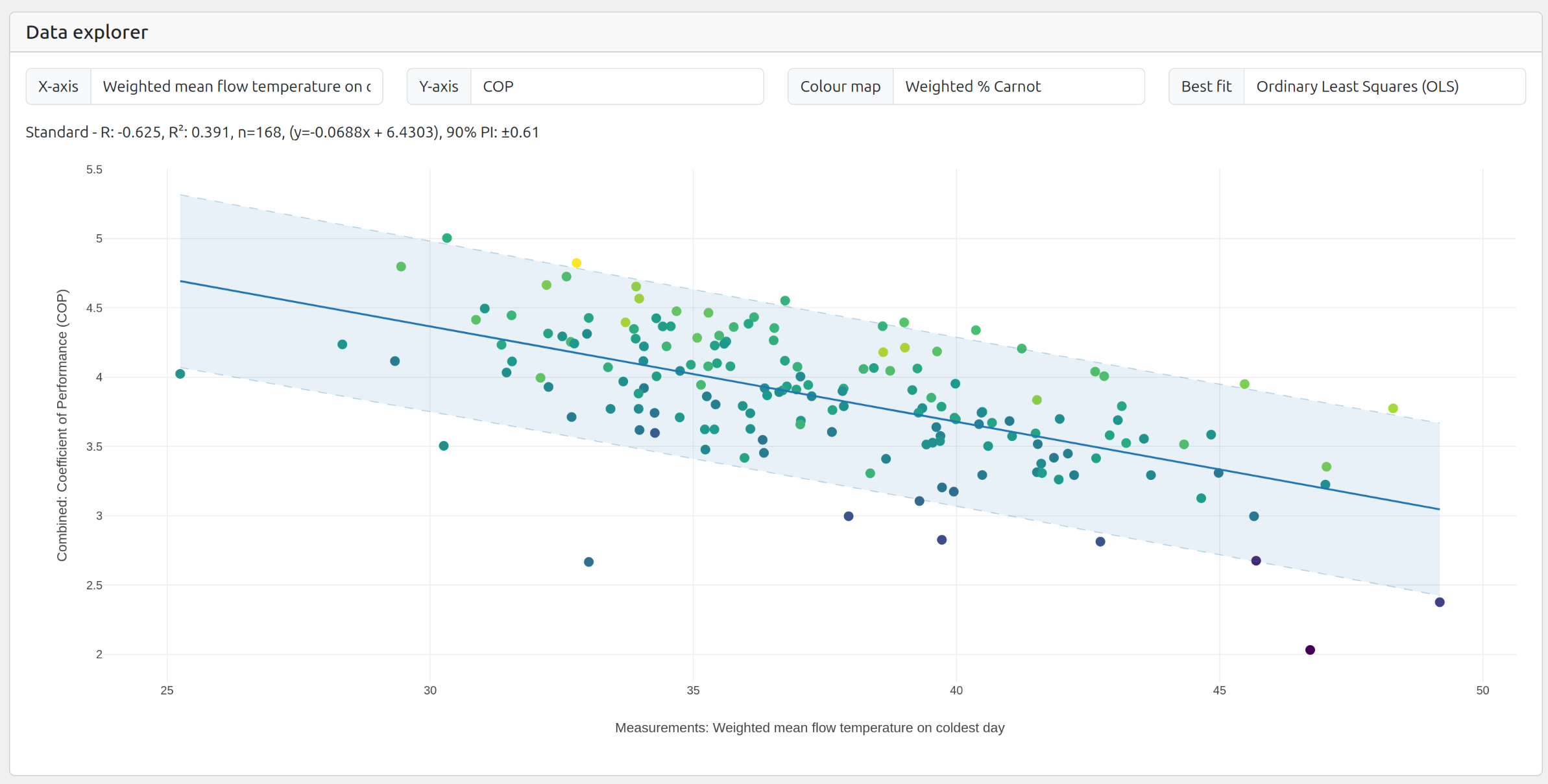
First we can see we don’t actually have any systems that run at a weighted average flow temperature of 55C on the coldest day (weighted average meaning that most heat is delivered at that flow temperature), the highest we actually have is system 444 in London with a weighted average flow temperature of 49C and a SPF of 2.4. System 170 in Devon meanwhile has a weighted average flow temp of 48C and achieves an SPF of 3.8, highlighting how wide the range of performance can be!

The central line of best fit gives the following equation:

SPF = -0.0688 x Weighted average flow temp + 6.4303 +- 0.61 

We would therefore expect the average system that actually delivers most of it’s heat at 55C in practice on the coldest days to achieve:

-0.0688 × 55 + 6.4303 = 2.6 +- 0.6

The higher end 90% PI performance systems at 55C might achieve around SPF 3.2 and the lower end 2.0.

2) Simulated results using our Dynamic Heat Pump Simulator

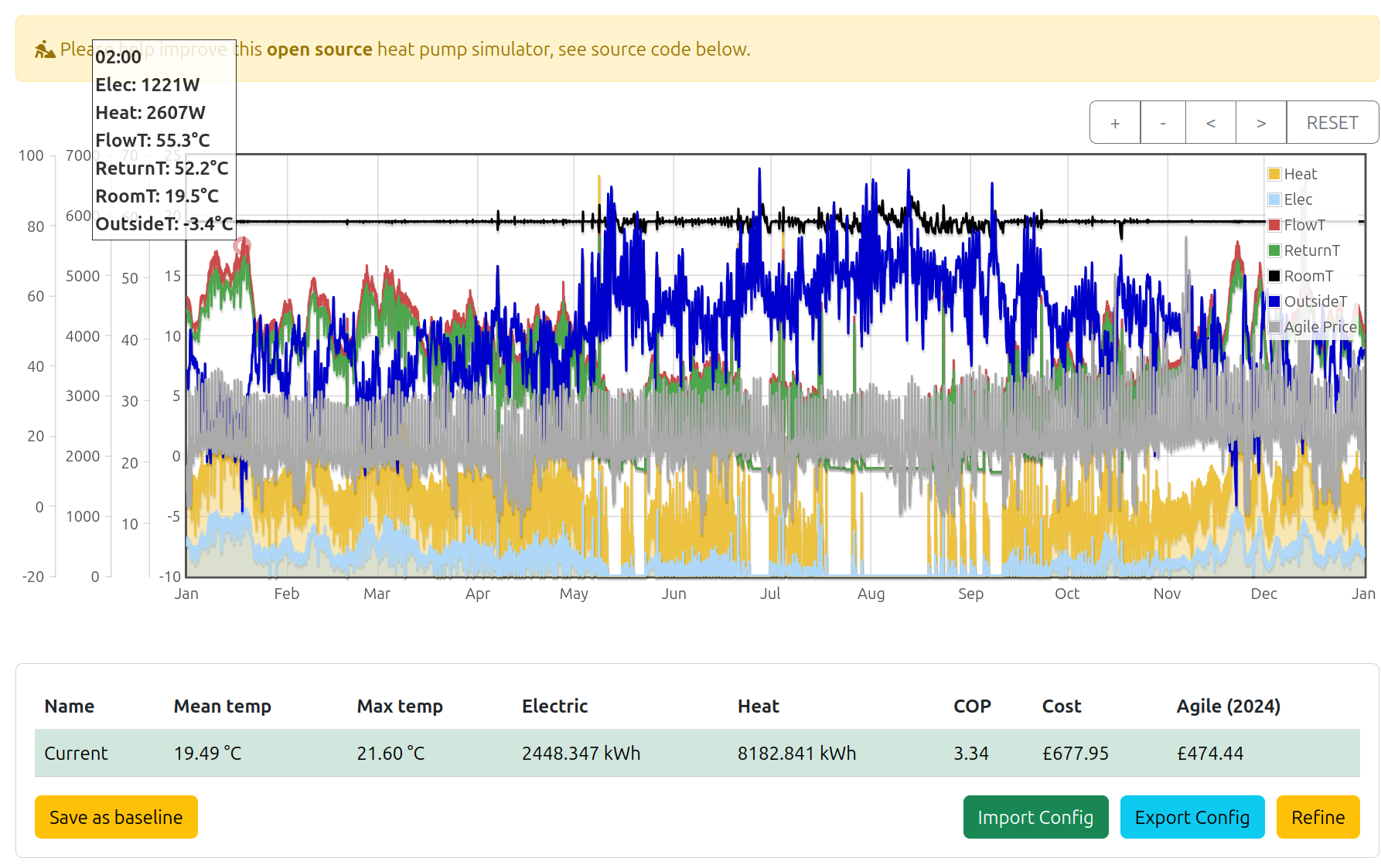
I’ve been slowly improving our dynamic heat pump simulator over the last year, the latest versions includes the ability to simulate space heating performance over a full year and interpolated COP model based on the detailed Vaillant datasheets. Here’s an example run with a 5 kW vaillant continuously heating a house to 19.5C, running at near 55C on the coldest day achieving an SPF of 3.34 over the year (space heating only). This is without modelling defrosts and so I would expect perhaps a further 0.1-0.2 reduction in COP in reality which could bring us to a result that might be quite close to the top 90% PI of the HeatpumpMonitor data above. Note that this is space heating only, I would again expect a reduction in the combined SPF once DHW demand is included - unless of course a well optimised heat pump cylinder is added to a high temperature emitter system - perhaps not that unlikely?

The Ecodan COP model suggests 3.44 is possible, the simple carnot with variable offsets 3.53. Interestingly if you double the heat loss, switch to a 12 kW Vaillant COP model with it’s higher datasheet performance and adjust the emitters accordingly to again target 55C the simulated performance rises to 4.2 on space heating! The on paper performance for the 12 kW Vaillant really is a class above!
3) Steady state design flow temperature vs actual required flow temperatures

Playing around with a number of simulation runs I noticed something that makes a lot of sense conceptually but is really quite interesting to quantify!

  • First: steady state heat loss calculations and design flow temperature calculations do not take into account internal gains such as body heat and heat given off by electrical appliances in a house. Internal gains in a typical house may be around 300-400W. For a house with a real world heat loss of 3.4 kW and a low temperature radiator system with a design flow temperature of 40C, this makes the difference between needing to run at 40C without gains and only needing 38.3C with 330W of gains included.. For a high temperature system with a design temperature of 50C including 330W of gains drops the required flow temperature 47.4C. The impact of gains increases as the design flow temperature increases, in our example here the difference increases from 1.7K @ 40C to 2.6K @ 50C.

    Modelling a system that requires 55C not including gains results in 52C after including 330W of gains (same 3.4 kW heat loss above).

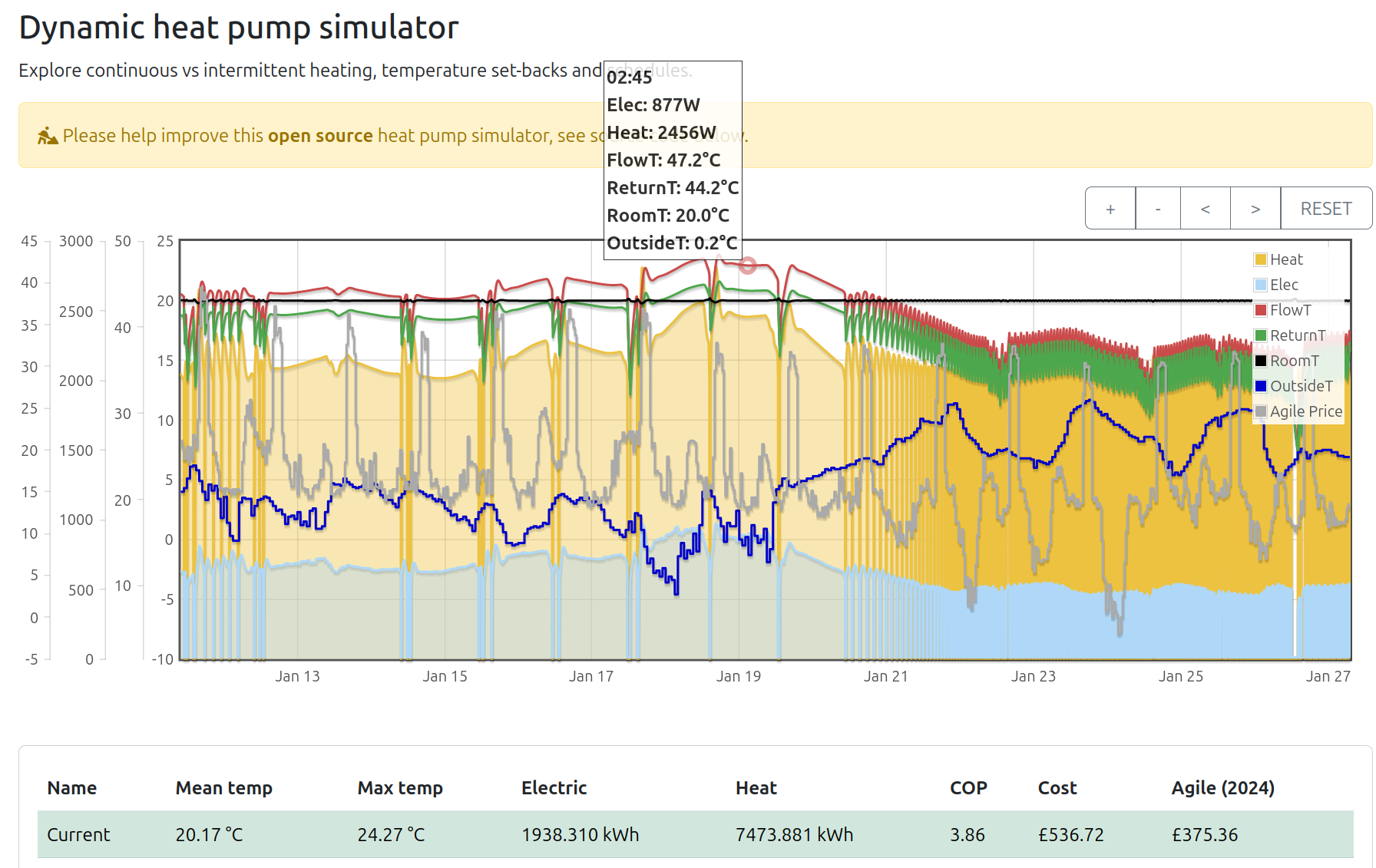
  • Second: Taking this same 55C without gains 52C with gains steady state system and simulating it in the dynamic model we only see sustained periods at ~49.8C (max 50.5C). The design temperature of ~-1.1C (calculated based on the 99.6% percentile of the outside temperature dataset used for the simulation - important!) was not quite experienced for long enough, the warmer outside temperatures either side results in average heat demands that are lower than what we would experience if we had multiple days in a row at design temperature.

The result of this example is that a system with a design temperature of 55C on paper based on an accurate heat loss calculation and steady state assumptions may well result in significantly lower flow temperatures in practice due to: internal gains, short duration of design temperatures and also higher 99.6% actual experienced design temperatures than assumed. The performance of this simulated steady state 55C system, ~50C when dynamically simulated results in a space heating SPF of 3.62. If this simulation is realistic we could feasibly imagine an SPF of 3.4 being achieved once defrosts and DHW demand are included - assuming a high performance heat pump cylinder. Allocating 2x 1 hour DHW periods from which the space heating needs to recover by running at slightly warmer flow temperatures only has a marginal effect reducing SPF from 3.62 to 3.59.

Conclusions

As ever it’s a bit of a complex picture.

  • It’s probably the case that if we monitored 100s of systems that actually needed to run at 55C all day, on the coldest days, we would find average SPF’s that center around 2.6±0.6 (90% PI)

  • It’s likely that the better designed, installed and optimised systems, especially those with heat pump hot water tanks and optimised heat up DHW schedules might come in around SPF 3.0-3.2.

  • The 12 kW vaillant simulation suggests higher SPF’s could be possible for larger systems perhaps these could even hit SPF’s of as high as 3.6-3.8?

  • Systems with accurate heat loss calculations and steady state design temps of 55C may well do a better as they may run as low as 50C in practice with gains and dynamic effects taken into account. (-0.0688 × 50 + 6.4303 = 3.0±0.6).

  • Systems with oversized heat loss calculations and 55C design temperatures could do even better of course!

  • It is possible to hit higher SPF’s from systems that run at 55C for short periods in a day e.g to boost temperatures but then fall back to lower temperatures such as 45-50C for longer periods. I will do another post with an example of this another time.

Would love to hear peoples thoughts on the above!
5 Likes

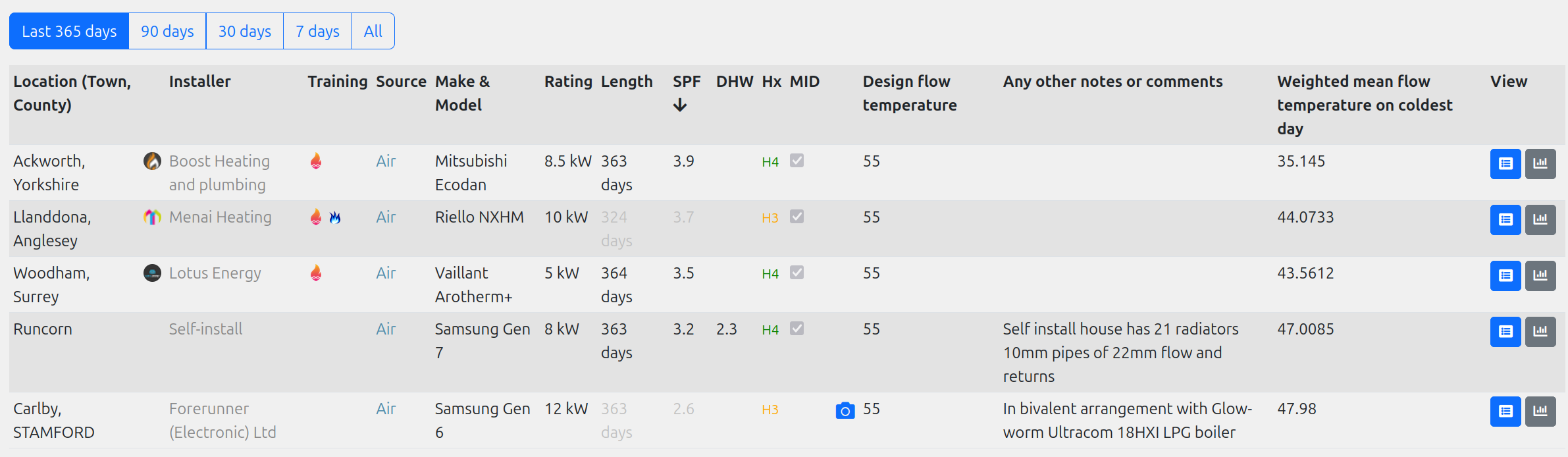
There are 5 systems with design temperatures listed at 55C, these all run at lower weighted average flow temperatures on the coldest day which could result from a combination of factors: gains, dynamic effects and perhaps higher actual outside design temperature as explored above alongside other heat loss over-sizing (air change rates, U-values).

https://heatpumpmonitor.org/?add=flow_temp,notes,measured_mean_flow_temp_coldest_day&other=1&hpint=1&filter=query:flow_temp:55:eq:t&minDays=250

Carbly, Stamford is a hybrid and seems to switch to gas on the coldest days.

The Samsung Gen 7 in Runcorn, system 266 seems to be at max capacity during the coldest days, though the setback does mean it has to work a bit harder that it otherwise might need. It hits 51C max flow temperature. It looks like this system is space heating only as well, it’s SPF 3.2 matches the central figure calculated using (-0.0688 × 47 + 6.4303 = 3.2 ± 0.6).

The higher performing systems have lower weighted average flow temperatures and a quick glance through them suggest that these are either examples of oversized heat loss or perhaps just entering the wrong design temperature on the HeatpumpMonitor form?

Expanding the scope to systems with less total days of data:

The Malton, North Yorkshire system 828 HeatpumpMonitor.org looks like an interesting one to watch, with COP 3.6 so far. One one of the coldest days so far it hit 51C max flow temp and again around 47C average flow temp. Looks like space heating only.

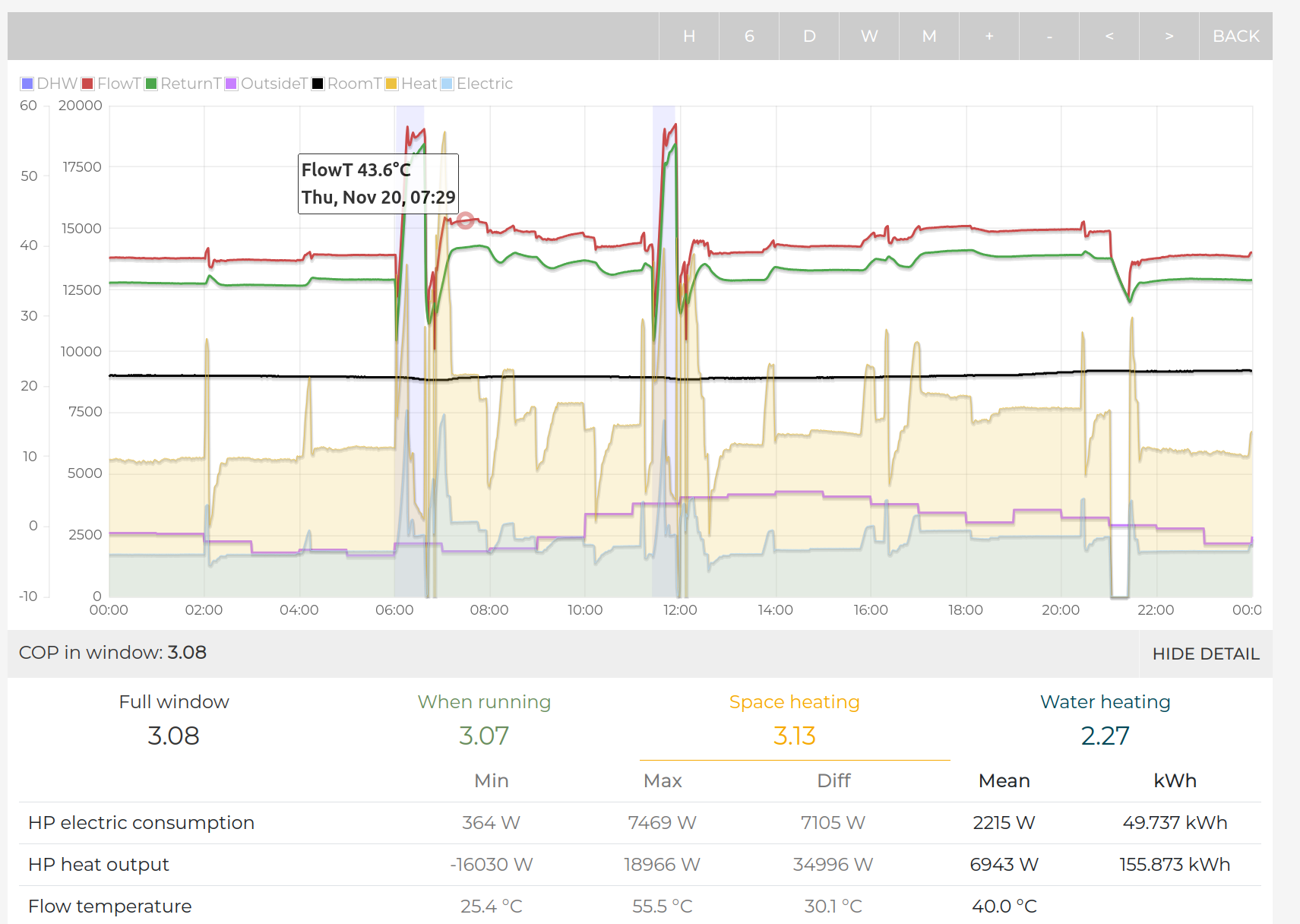
The Ormskirk, Lancashire, system 763 HeatpumpMonitor.org system has only needed to run to a max of 43.6C on space heating on the coldest days, average more like 40C - but this one has a DHW demand at relatively high temperatures.

1 Like

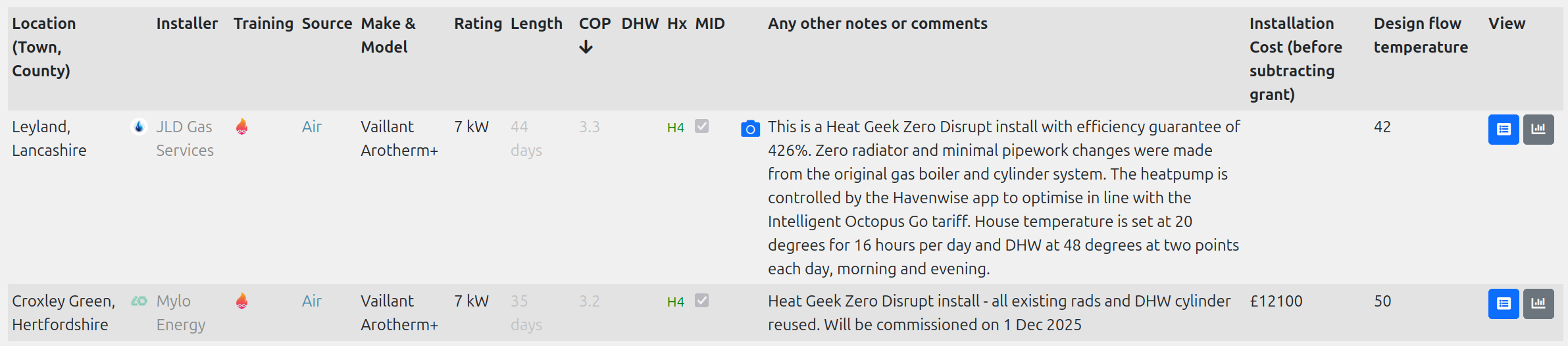
The two public HeatGeek Zero Disrupt systems on HeatpumpMonitor so far have a COP of 3.2 and 3.3 but only over 35 & 44 days: https://heatpumpmonitor.org/?filter=zero+disrupt&period=all&minDays=0&other=1&add=notes,installation_Cost

These have design flow temperatures of 42 and 50C respectively. Both are running average flow temperatures on the coldest days below that.

Leyland, Lancashire, has heat meter air errors so is reporting a COP that’s a bit lower than in reality, I think it would be getting around 3.5 without the heat meter issue.

1 Like

Re-running the numbers at a 50C flow temperature after discussing the above with Mars. Thanks Mars!

  1. Weighted average flow temperature on the coldest day (based on HeatpumpMonitor.org )
-0.0688 × 50 + 6.4303 = 3.0±0.6

This would suggest that systems actually delivering most of their heat at 50C on the coldest day should achieve a central figure of SPF 3.0 but with a wide possible range of 2.4-3.6.

2) Simulated results part 1: Space heating only using vaillant arotherm 5kW COP model with most heat delivered at 50C on the coldest days suggests SPF ~3.6 (space heating only, not taking into account defrosts, perhaps with defrosts 3.4-3.5). The 12 kW vaillant COP model and 2x heat loss etc, suggests a simulated potential of 4.4 (Im a bit skeptical TBH but it’s interesting that the datasheet suggests such high performance).

3) Simulated results part 2: 50C steady state at -1.1C vs dynamic and gains (see above).

  • 3.4 kW accurate heat loss, 0.33 kW internal gains = 3.07 kW actual heat demand, actual flow temperature requirement after including gains of 47.4C.
  • Simulated using the dynamic model with thermal mass results in actual average flow temperatures on the coldest days of ~45.6C and a SPF of 3.9, blocking off 2x 1hour periods for DHW increases this to 46C, vaillant 5kW model not including defrosts, space heating only!. Perhaps closer to SPF 3.7/3.8 in reality for space heating only

4) Weighted average flow temperature on the coldest day of 46C

-0.0688 × 46 + 6.4303 = 3.27±0.6

5) Actual systems on HeatpumpMonitor.org with a design temperature of 50C:
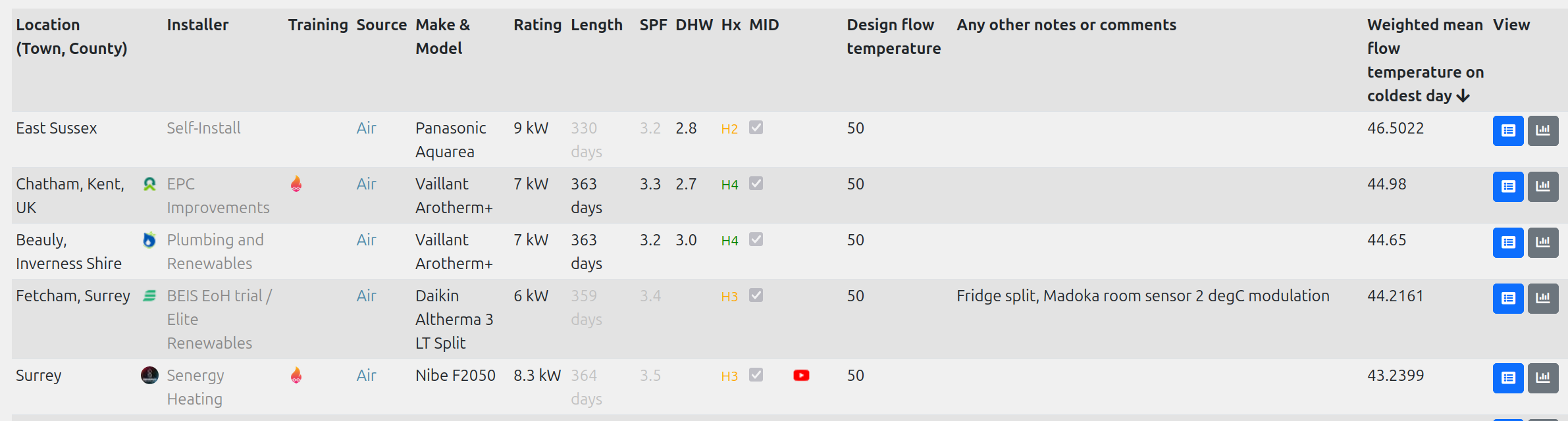
27 systems with MID metering, average SPF of 3.5 (range 2.7 to 4.5). There will be a large mix here of systems with oversized heat loss calcs, there are some systems that are running average flow temperatures in the low 30s on the coldest days.

https://heatpumpmonitor.org/?add=flow_temp,notes,measured_mean_flow_temp_coldest_day&filter=query:flow_temp:50:eq:t&minDays=250

Looking at the top 5 highest weighted average flow temperatures on the coldest days we see SPF’s of 3.2, 3.3, 3.2, 3.4 & 3.5

These results suggest that the top end of well installed and optimised systems that are designed to run at 50C should be able to hit 340%. This may be possible even with an accurate heat loss if cold snaps are short enough or there is substantial internal gains. If the heat loss calculation has a bit of a margin on it, it should be easier to hit 340% after optimising weather comp. This will be easier on systems with a lot of space heating demand (less time spent on standby) and a lot depends on DHW performance and DHW % of demand of course.

2 Likes

I’m thinking more about the simulation results that suggest e.g 44C actual average running temperatures from a 50C design flow temp and I’m wondering if it’s overstating how much lower the flow temperature could be, the simulator really needs to include defrosts and hot water demand, both should result in higher space heating flow temperature requirements as the system has to recover from the energy lost to defrosts and the time away from space heating spent when doing a hot water cycle..

Perhaps the jury is still out on how much of the difference between weighted average flow temperatures on the coldest days and design flow temperatures is down to heat loss calculation oversizing vs these other potential factors..

3 Likes

Correction

I realise I made a mistake in my original set of simulations. In the first post I had sized the emitter system for 55C based on a design outside temperature of -3C. Whereas the actual outside temperature dataset used in the dynamic simulation has a 99.6% percentile design outside temperature of only -1.1C. This overstated the impact of the dynamic simulation on reducing the design flow temperatures required. With the emitters sized for the correct design outside temperature the flow temperatures required on the coldest day increased from 47.2C to 49.8C and SPF dropped from 3.86 to 3.62. Interestingly simulating 2x 1 hour periods blocked off for DHW only reduced the space heating SPF from 3.62 to 3.59.

For the 50C design flow temperature example the simulated average flow temperatures on the coldest day increased from 44C to 45.6C (46C with DHW periods blocked off) - only down from 47.4C gains only. Simulated SPF dropped fractionally from 4.0 to 3.9. SPF range based on HeatpumpMonitor weighted average line of best fit reduced from 3.4±0.6 to 3.27±0.6.

Posts above have been edited with these new values, so that it’s easier to follow for new readers.

Overall SPF changes are not that significant but the corrections indicate that including gains has more of an effect than the dynamic simulation / thermal mass effect - once the correct design outside temperature is used (which also shows how much of a difference the assumed outside design can make).

Getting there slowly with the physics! Next to model DHW fully and defrosts! :sweat_smile:

I think overall conclusions so far are:

  • 55C design flow temp systems with accurate heat loss calcs may only need to run at ~50C in practice and so based on the HeatpumpMonitor weighted average line of best fit equation: -0.0688 × 50 + 6.4303 = 3.0±0.6. Gives a wide range from 2.4-3.6 (3.6 being space heating only in the very best case or/and with very efficient heat pump cylinder).

  • 50C design flow temp systems with accurate heat loss calcs may only need to run at ~46C in practice and so based on the HeatpumpMonitor weighted average line of best fit equation: -0.0688 × 46 + 6.4303 = 3.26±0.6. Gives a wide range from 2.7-3.9 (3.9 being space heating only in the very best case or/and with very efficient heat pump cylinder).

1 Like

My system has a design temp of 50C. Which feels right for the downstairs room, but would be way too warm for everywhere else and the upstairs. (It’s 3 stories).

My own heat loss calc had the flow temp at 42c, probably lower now, with the newer ACH advice.

Compounding this, the solar gains upstairs can be enough to heat those rooms with hardly any heating!

I also run a very high 300L 50c hot water charge daily, I have no idea how people live with 35C water.

Basically I would like to say that we assume systems are designed and installed as intended originally, which can be a little off the mark.

I don’t think I’ve ever heard of anyone heating their DHW to 35C?!

I think 45-50C is more like the general norm…

2 Likes

I looked at the best performing on the site and that’s what they were charging it too, I couldn’t believe it :joy:.

Hi Trystan,

In your simulation of a Vaillant you suggest a defrost impact of 0.1 to 0.2 on CoP. A quick look at recent data shows that my Vaillant aroTherm Plus 12kw defrosting reduces CoP between 0.35 and 0.45. It also reduces heating time by over 10%. Defrosting is a significant effect on heat pump performance here in Highland Perthshire where relative humidity can be very high and temperatures quite low.

Last year when I looked at defrosting more carefully, I found defrosting occurring at temperatures up to 3C when relative humidity was over 91% and electrical demand from the heat pump over 1kw. How would the heating rate needed to achieve heating system flow temperatures of 55C affect the likelyhood of defrosting compared to a flow temperature of 35C?

Has any reseach been carried out into the design of ashp fins or superhydrophobic fin surfaces to inhibit frost formation or prevent frost build up?

Peter