There’s lots of discussion around this question, how these different technologies and tariffs can combine to provide greater savings overall, how tariffs, solar and batteries can enable lower cost lower SPF/SCOP heat pump installs or greater savings with high performance installs.
With a lot of help from Claude I’ve built a new tool to explore this question. It integrates earlier work I did manually on the 15minute real world data based solar & demand matching into a new overall user interface which is pretty much all Claude’s doing. I did double check the embodied carbon references and have sanity checked the work at length..
As ever with a tool like this error bars on input assumptions will have a strong impact on the results. E.g one of the aspects of the financial modelling side that I think is hardest to answer is how will time of use tariff pricing evolve over the next 10-20 years. For the heat pump costing math in the model assumptions around lifetimes and how much of a system actually needs to be replaced after 15-20 years is also something that isnt currently captured by the tool.
For me the big take away so far is a reminder of just how large the carbon savings of switching these large ticket items can be, even taking into account embodied carbon. The carbon payback time looks to be very short 1.0-2.0 years. The model suggests the financial savings are more modest at 25-35%, these include capital cost and a 3% discount rate above inflation.
The main co-benefit for heat pumps is the agile tariff - as we probably expect. E.g in the default example adding a £12k install heat pump with SPF 4 on a flat tariff results in £134/year of savings (includes annualised capital costs - so yes there is payback there!). Combining the heat pump and agile increases savings to £475/year (though £160 of that is savings on standard electric demand). The additional benefit of adding 4 kWp of solar on top of that for the heat pump is only £36 out of the £113 that solar saves overall. A 10 kWh home battery on top of that with optimal dispatch agile arbitrage saves another ~£45.
https://openenergymonitor.org/tools/energy-ledger.html

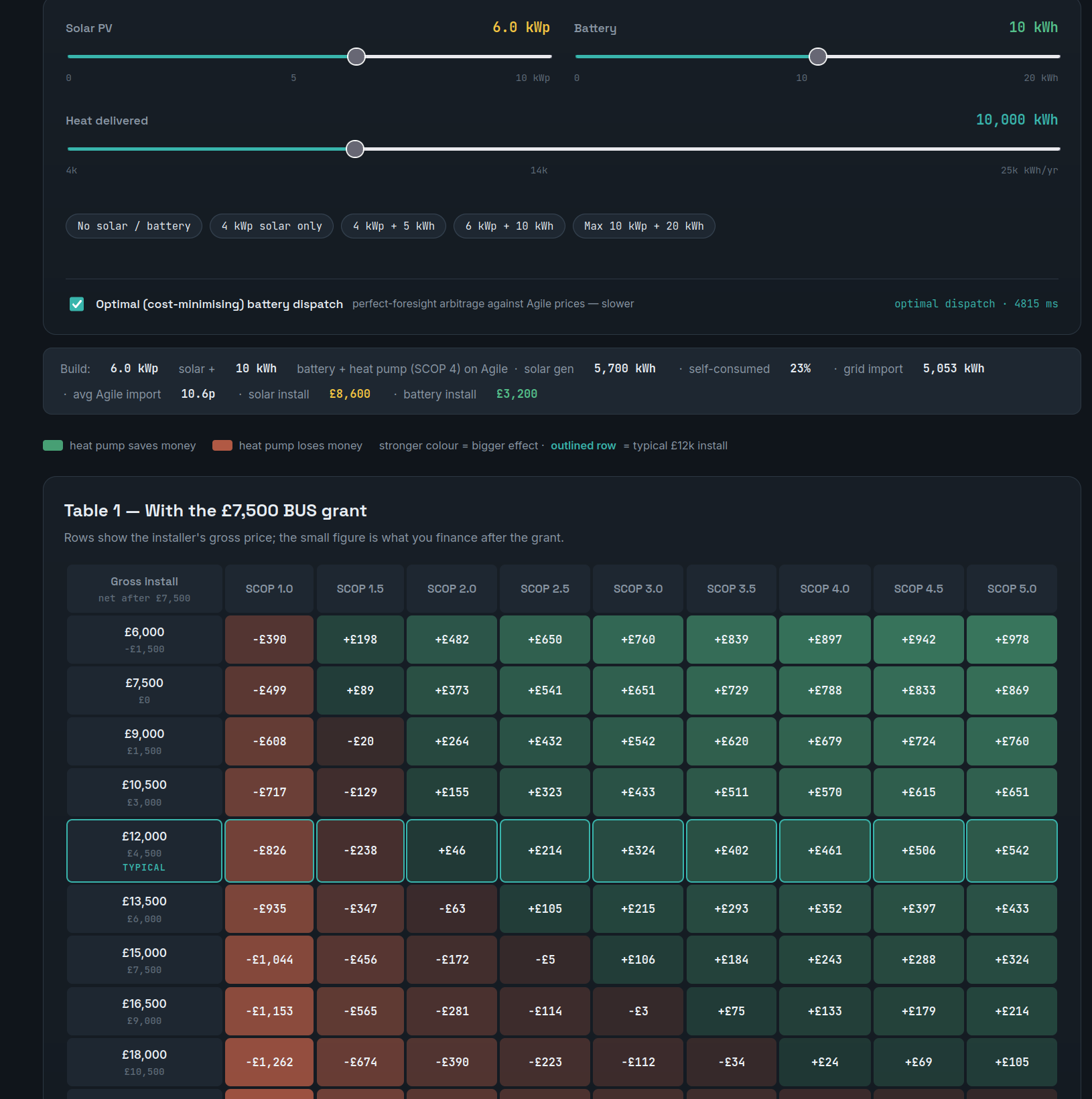
Claude also built this more specific heat pump co-benefit report page which also runs the full model behind the hood. This makes the balance between SCOP and install cost much easier to pick out:
https://openenergymonitor.org/tools/heatpump-cobenefits-live.html


without the grant:

the code for this is all available here: https://github.com/openenergymonitor/tools.
The grant is doing a lot of the heavy lifting as expected - but it looks like post grant - hitting an SCOP of 3.5-4.0 with a £7500-9000 install is probably where we need to be (this is with agile and a 6 kWp solar array and 10 kWh battery doing arbitrage). Another way to look at that chart is to draw a line of equivalent savings, and see if you can push out that much more performance for the extra install cost.
This is all of course running on agile prices over the last 12 months - which is probably the largest source of uncertainty and risk projecting financial savings forward. The balance will of course change if prices go up or down over time. My current thinking is that time of use tariff prices will go up over time as more people adopt them - I think for many of us early adopters the average agile prices we are paying today are actually below or too close to the cost of producing that electricity and maintaining the grid (based on the simple grid modelling tool I built earlier in the year UK Grid Simulator  ). I’m not totally convinced that the prices are scalable to everyone, I also think as heat pump start to really impact national demand those winter time of use prices will rise quite a bit. I could be wrong about this of course - it would be nice if I was!
All in conclusion so far is wow those carbon savings are huge! and being reminded of that has left me feeling more optimistic about this than before. It’s good that that the financials look ok and that there are some savings to be made, it’s also a lot of fun from a technology and playing with nice kit perspective!
Thanks to @John_Ewbank for sharing his battery dispatch solver which helped Claude then develop a different variant of it that gets most of the way in terms of savings performance. And thanks also to John for creating his solar calculator here https://solar.johnewbank.co.uk/ which I have used for validating a few overall results - definitely worth checking out his work on this as well and his write up on balcony solar: Is Balcony Solar Worth It? - John Ewbank





 I’d tend to go with “never” as I guess you just pocket the cash one time, it’s not an ongoing thing but entirely up to you!


 Been that way for a few years now. But the value of solar is far from just the output on rare sunny days.