Or just use the emmerson heater for DHW when very cold outside. (And if on a cheap overnight rate could also get a 2nd hand storage heater to use for a few days once every few years.)
Thanks for the recommendation!
Have come across this thread while researching (as an end user, not installer) various heat pumps for install in the alps (design temp around -12) and obviously concerned about the reports here of lower than stated outputs due to defrosts on Vaillants. Although as mentioned above, high humidity in the UK might play a role. I have however come across something fairly interesting that I thought would be worth sharing here. In the UK (& also Germany), Vaillant markets the nominal outputs as reflected in model numbers as 5,7,10,12. However in Italy (haven’t checked other countries), the unit model numbers differ slightly (S3 instead of S2) and the nominal ratings are 5,6,8,12,15. Looking at the graphs, the units have identical performance. I wonder if this just a regulatory difference or whether due to climate differences they are more confident of hitting the stated outputs.
There is also cooling capacity when using fan convectors.
True, this is potentially the reason for the different model number.
The S2 in Germany come without the coding resistor to enable cooling and I think the S2 stands specifically for that.
Is there any difference in the way the S3 performance data is documented?
Interesting that the nominal output figures are lower. Do they quote any figures based on mean output? Would seem strange to badge an S3 unit with 6kW and then state output figures of 8-9kW!
Nominal output figures on S3 are actually higher. Output Vs temperature graphs seem identical. 4kW S3 = 3.5kW S2 and so on up to 15kW S3 = 12 kW S2. You can see that the data in these documents. Different nominal outputs, different model numbers, same heating output graphs.
UK: https://professional.vaillant.co.uk/downloads/aproducts/renewables-1/arotherm-plus/arotherm-plus-installer-quick-guide-2848532.pdf
Italy: https://www.vaillant.it/downloads/vgoa-vaillant-it-doc/istruzioni-installazione/pompe-di-calore-1/installers-quick-guide-arotherm-plus-versione-esterni-2113706-v2-2282817.pdf
Welcome @Dividing3345
Worth clarifying that this is not a reason to avoid Vaillant, it’s an issue with many heat pump brands, Glyn was showing me some data on a Viessman with a similar issue just yesterday. In a way it’s not really a fault, it’s just that heat pump manufacturers need to provide better data and then we can design systems around that…
Understood, but it is useful to know given the knowledge, or lack thereof of some installers, especially regarding the 7kW SKU.
Reflecting on this whole thing, I wonder if what’s happened here is that Vaillant engineering in Germany provided the UK sales office with max output capacities (not including defrosts) and that it was these that were used to populate the nicely formatted table in the datasheet that we’re all familiar with. No referenced testing standard is given alongside that table for the capacities as far as I know…
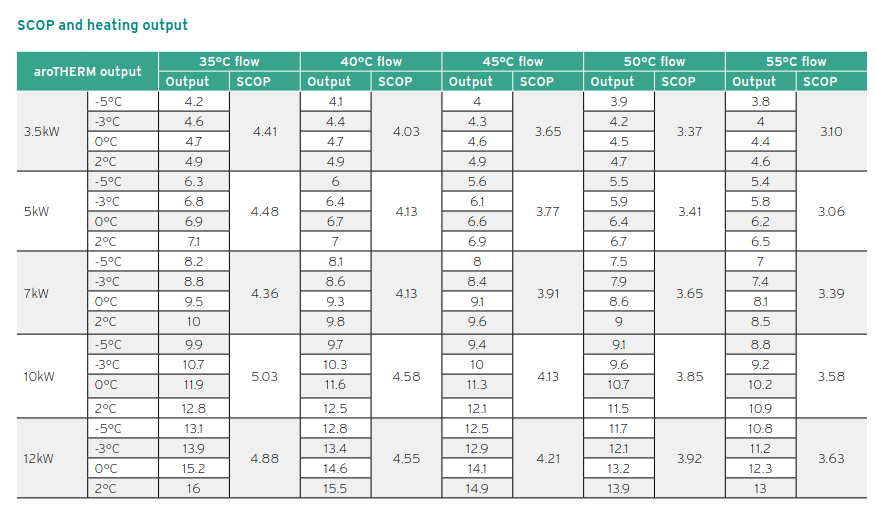
A single referenced EN14511 testing standard full load heat output figure is given in the appendix of the installation manual at A-7/W35 and these figures are much closer to what our tests above indicate, they are still a bit higher, but not nearly as much. Is this whole thing just a unfortunate mistake, not helped by the above table given without context and perhaps given without the UK team realising that it was max output only?
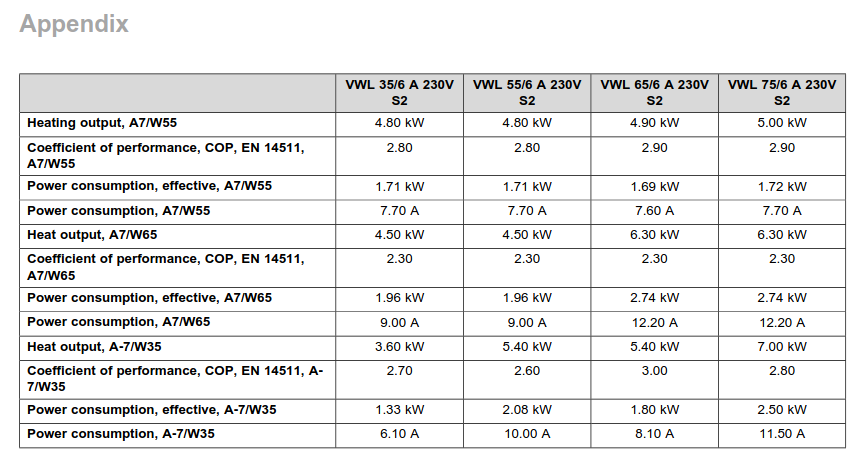
It’s a shame that A-7/W35 is the only full load test, A2/W35 & A7/W35 are partial load outputs. There are also no -7C max output figures in the first table to compare against.
In my opinion, those temperature tables cannot capture this issue because humidity comes into play. We would essentially need output capacity over the 2D parameter space temperature & humidity. I’ve had runs around freezing temperatures with defrosts every 30 minutes or every 2 hours - it’s completely dependent on humidity. At a minimum, there should be multiple tables with e.g. 30%, 60%, 90% RH.
Another unfortunate factor is that this issue does not exist in Germany or many other countries with much lower minimum temperatures compared to the UK. If you have to design for -10°C, there’s plenty of headroom for the defrost dip. As stupid as it sounds - maybe it didn’t occur to them to include design guidance for this “edge case”? They really need to include a big warning to include 25% headroom when the design temperature is around freezing and high humidity is to be expected.
An additional reason can be that vaillant, at least in Belgium and I believe also in Germany, sell arotherms with an indoor unit which always include immersion heaters. The configurations with only the heat pump controller is only used in cascade and bivalent systems. So afaik a vaillant system has never be designed to run only with the outdoor unit from factory.
Do you think a single set of tests at 100% humidity would be sufficient? It would of course be interesting to know how it varies with humidity.
It would be great if the tables were also expressed as continuous equations  to make it easier to integrate in software tools for system design.
Yes good point, I can imagine how this would be the case.
Interesting.
There just needs to be better information on all of this really…
Yes, you always get the indoor unit in Germany.
Sure, for designing the system you just need the worst case. We can point Vaillant to this thread if they don’t have the data available  .
.
Do you get indoor units even for monoblock system ? What the point of “mono” if you end up with an additional box in the house ?
Monoblock means the coolant is contained in the outdoor unit, which makes installation easier as you need no coolant pipes. The indoor unit can be the uniTower that also doubles as a hot water storage, so you have no extra device.
The point is having the electrical backup heater available for defrosts, support at extreme cold and legionella cycles. I haven’t seen a single quote without an indoor unit and appropriate backup heater from any of the companies we asked. It’s standard here.
The uniTower saves a lot of plumbing but that reduces how much labour trades people can charge and needs a corect sized space with good access to install it.
I surprised one of the larger UK installers have not done a deal to buy them in bulk.
The uniTower is the default here. My installer wanted to put in a bigger warm water cylinder, so I got the cylinder and the VWZ MEH 97/6 indoor unit (we’ve got sufficient space). The VWZ contains the 3-way-valve and backup heater and has relais outputs for warm water circulation pumps and other devices. How is the 3-way-valve managed when only an outdoor unit is present?
By the VWZ AI. Basicly the same PCB that is in the unitowers and indoor units, but in a separate case.
The indoor units make for a neat integrated installation, but I personally like the VWZ AI + separate cilinder and 3 way valve more as it gives more flexibility and serviceability.