After two very dull days (my solar system produced nothing) yesterday evening my outside temperature sensor flat-lined all night, even as the temperature dropped. The SensoComfort reported a OT link strength of 0; it’s usually 6. I presume the capacitors discharged; it began waking up again around dawn.
Anyone else seen this before? I would have thought the sensor would stay online for longer…
I’ve read that the wireless solar-powered sensors are nothing but trouble; would it be possible for you to run a 2-core cable to a suitable location and use a wired sensor instead?
I had moved it last Sunday. The installer had put it next to a square plastic down pipe “to shield it from the sun” but the northern wall never sees sun in my heating season, and the sensor was reading a degree or higher than my weather station. So I repositioned it well away from the pipe and, noting that the installation instructions say put it 1/3rd the way up, a fair bit higher.
It worked fine until Thursday. I put it in the sun on Friday morning and then put it back up. Worked fine for a while although link strength was only 4 or 5. Then it dropped to zero again after dark. I took the sensor down and placed it very near the receiver unit (but still outside). Link strength 9!
Its new, higher position was level with or slightly above the floor of the first floor; maybe the extra material was enough that the 868 MHz signal wasn’t reaching the receiver. It shouldn’t vary as much as it was doing though.
So I moved it down half a metre. I taped it in place first and link strength was 6. After screwing it in place link strength has been 6 or 7. Weird, but seems to be fixed…
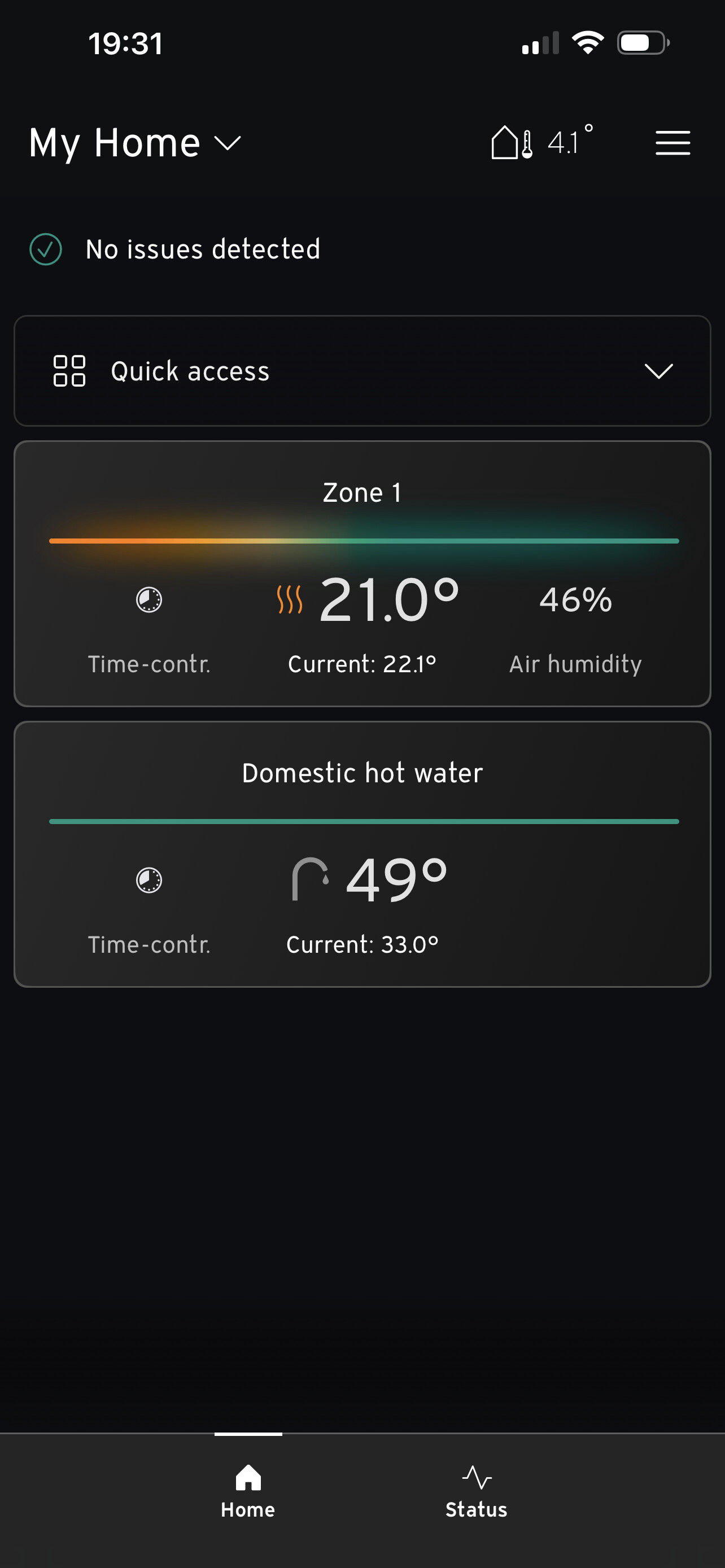
My myvaillantapp, has done something weird today. It’s showing my data from before my internal PCB was changed and the serial number changed. It’s also showing incorrect current power use figures. Logging out and in hasn’t fixed it, very weird.
I always get nervous when stuff like this happens, that I am going to get electrical issue again with it and the machine stop working.
The vaillantconnet box has a blue light, I hard reset this but it went solid blue again, but the data shown in app is incorrect. Really vaillant software in unacceptably shit for the cost. I’ve unplugged it for now, thankfully the heatpump is working fine.
Just to follow up, the app has now returned to normal. Energy data is all correct. So I presume a backhaul issue. @JamesH I hope your issue has resolved.
Good Evening Everyone, first post here so please be kind. We’re about to put a deposit in for an install of a Vaillant 5kW Aerotherm heat pump to be done in conjunction with a soon (3 weeks away) to start extension/renovation of our house.
For background, its a 1978 build 4 bed detached house, cavity wall/loft insulation. Will be upgrading to UFH (JK floorheating) and triple glazing during the build.
We already have 16.4kwh batteries and solar pV along with a myenergy eddi solar diverter which has given good service over the last couple of years (no gas at all during summer last year which was a nice feeling).
The reason I’m posting, is we are going with a partially zero disrupt install by a local heat geek, including retention of our existing HW cylinder (pressurized, ~ 0.7m2 coil). Its only a few years old, and after a lot of discussion HG suggested keeping it as it would be ~2K to change the cylinder, and would only save ~£60/year estimate. Figure we can always change it down the line if it doesn’t perform as we would hope.
Anyway, I currently have my Eddi solar diverter hooked up with a destratification pump to maximize hot water from solar (previously would only achieve ~1/2 a tank, now get a full one), and reading through the manual I noted that the Eddi can hook up to an ASHP like this
where the eddi heats the water up to a given amount of solar level (i.e. enough to run the heat pump), then kicks the heatpump to life to take advantage of the efficiency advantage. The heat pump then triggers the eddi for legionella cycles and runs its normal timed DHW periods. This way, I figure i could gain a little shorter reheat cycle?
I read the Vaillant is apparently smart grid ready but having read through a lot of wiring diagrams etc, i’m finding it hard to find where the e-sense and relay connections from the eddi relay board plug in as its hard to identify the S.G connection points? I’ve seen similar setups posted about for mitsubishi ecodans/nibe etc. Has anyone done this for a vaillant HP and if so - which connections are needed?
Not strictly what you are asking, but I use an Eddi in combination with a (Daikin) heat pump. The Eddi does diversion (and boosts from mains in winter when the grid carbon intensity is low as needed) to do pasteurisation cycles. There is no interaction/connection between the Eddi and the heat pump at all. The Eddi is managed from a some RPi scripts to be kind to the grid.
I have not used my Eddi in over 3 years since my heat pump went in.
Why would you divert energy and only get 100% efficiency from the Eddi / immersion when you can get 300-400% efficiency (COP) doing hot water via the heat pump?
And in most cases, quicker than the 3kW immersion.
As you have batteries too, I think you’re in a much better position to fill the batteries with the surplus then get 300% from the heat pump.
If you have the VWZ indoor unit with a backup heater it will be used for legionella cycles. They are actually targeting 70°C and even though your flow temperature might reach this for some time, the hot water in the cylinder doesn’t. The way it looks for me is that the heatpump is used until the flow temperature is at its max and then use the backup to reach 70°C in the cylinder.
So I notice that people say that they sometimes need a different curve when it’s mild vs when it’s deeply cold, and I’ve been wondering about that too. I plan to gather data on this at home, because I have a theory…
New here. First I want to thank @Andre_K for the heat curve equation. Second I want to thank @ectoplasmosis for the psimonkey heat curve visualisation, which is lovely.
The psimonkey interactive curve tool is what I thought I wanted. I didn’t find that at first, so I did a spreadsheet instead, and excel is probably the right tool for my question.
I wonder whether perhaps “target temperature” in the heat curve equation is a misnomer. It describes the convergence of the possible heat curves, but in reality we’re targeting flow temps given the system that our house is.
So I’m gathering data. Lowest functional flow temp for milder conditions, and lowest functional flow temp for harsher conditions. With excel, find the curves that pass through both points and try them. Could be around 18 degrees at 0.55, could be 17 degrees at 0.65, could be 16 degrees at 0.7…
Etc. If you see what I mean. The “T set” is just describing the origin of the line. It’s a strong assumption that that is the best line for your building. So I’m going to look into it, I want to thank the people who gave us the lovely tools and guidance so far, and I’ll get back to you with my findings when I have enough data/experience.
Which is why the manufacturers of heat pumps need to be investing in systems that monitor every relevant data point and learn so that you don’t have to mess around with curves. Heat pumps will never hit mass acceptance if it requires the householder to tweak obscure values when all they had to do with a gas boiler was set a thermostat. A system that doesn’t respond dynamically to both internal AND external temperature will never work on a mass scale.
I use Mitsubishi’s AA on my two zone system and have TRVs on everything other than the emitters where the remote sensors live. The house is comfortably warm, we never run out of DHW, nobody complains and it’s better and cheaper than the gas boiler. It could be more intelligent/efficient I’m sure and no doubt it will be so in successive iterations of the firmware but we’re content in not having to tweak anything to stay warm.
@greentangerine I partially agree, but it’s worth saying that an end user can probably treat this like a classic thermostat if they want to. I’m talking about and assuming running off weather compensation, which is totally optional. I could just run this off room temperature just like it was left at installation, and I’d have a pretty simple ‘gas boiler’ like experience that’s totally fine.
I don’t HAVE to mess with curves, but I do have the option to optimise, in a way that I find useful and interesting.
Say that you drive a ford focus. It works out of the box, as it were. It could be tweaked, you can get involved to make it faster, but it’s also fine. The arotherm plus seems fine in that regard, and that’s likely true of most units. You can just use it, and it’s not clear to me that Vaillant need to provide AI driven F1 performance out of the thing that already works for most use cases.
But if I want to get involved under the hood, it’s lovely that I have that option, and that we can talk about it on the internet together.
Further baseline optimisation from the manufacturer by default would also be nice though. Tricky, given how different every building is, but more efficiency for everyone would be delightful in due course.