Vaillant Arotherm hmu_setmode_flowtemp_desired keeps increasing, ignoring HC1_actual_flowtemp_desired_value

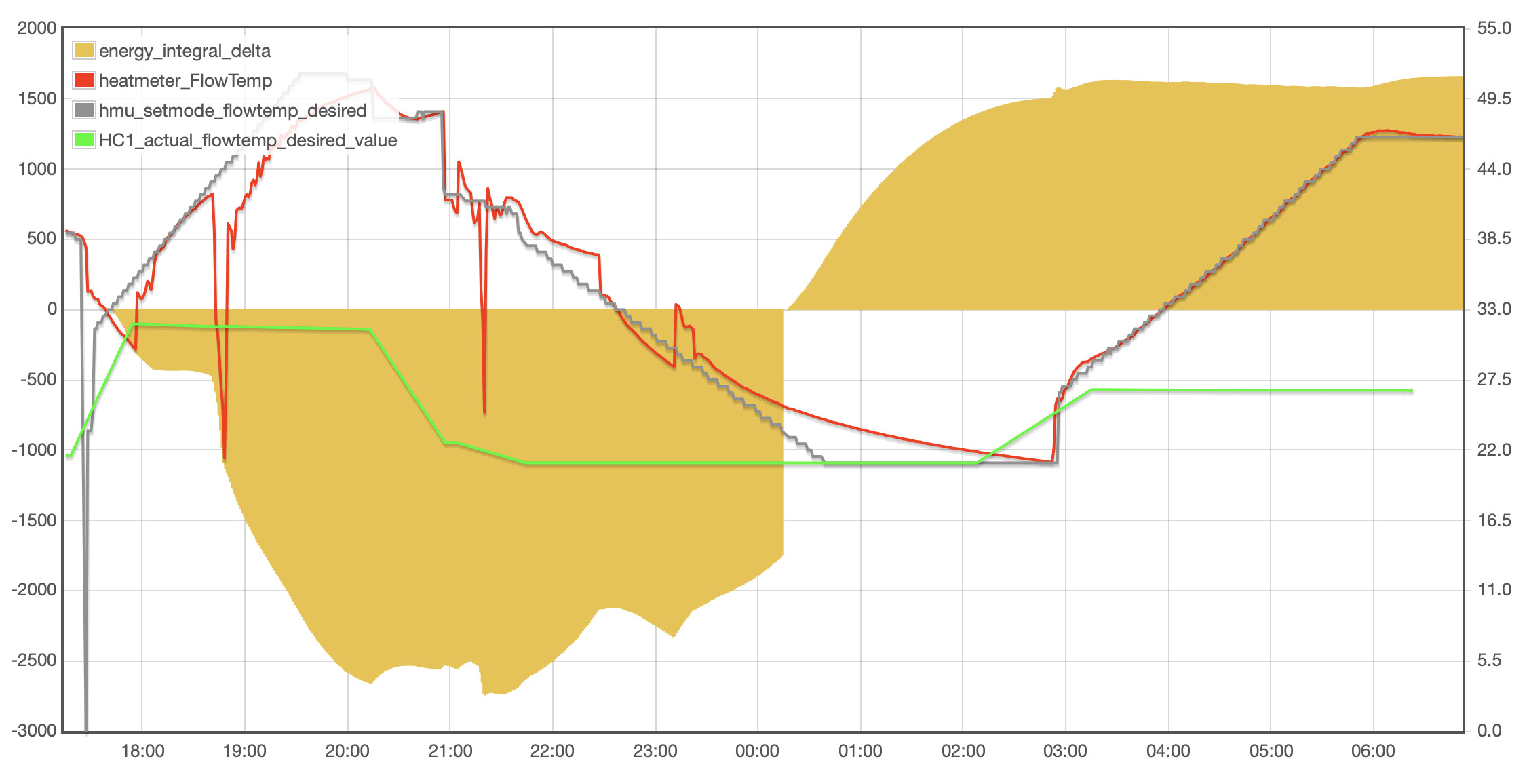
Has anyone else seen this before? I rebooted the outside unit at 17:30, and at that point the HMU and HC1 target are both the same - 32 degrees. The heat curve is 0.35.

But then the HMU keeps creeping up (which the flow rate aims for), way beyond the max I set (which it seems to ignore). The drop at 20:14 is me reducing the internal temp set point by 2 degrees - which reduces the green line (HC1) from 31 to 28 - and knocks the HMU from 51 to 48.

Have you got ā€˜adaptive heat curve’ enabled?

Nope, it’s disabled according to the VRC700.

I tried to create a energy integral chart on emoncms, like @Zarch did, which takes the flow temperature from the heat pump monitor, minuses the hmu_setmode_flowtempdesired, adds it to the energy_integral_delta feed amount, then writes it to the energy_integral_delta (effectively cumulative). It’s not perfect as I started it a few minutes after the reboot, but it’s not far away I think. There’s something weird about 00:15 - if you were to shift the whole shaded area down it gets back to zero pretty close to when the heat pump started back up about 02:50.

The green line is the flow temp HC1 is asking for, which matches the heat curve and indoor temp setting combination. Grey is the hmu target temp and red is flow temp.

I asked Chat GPT to summarise for me:

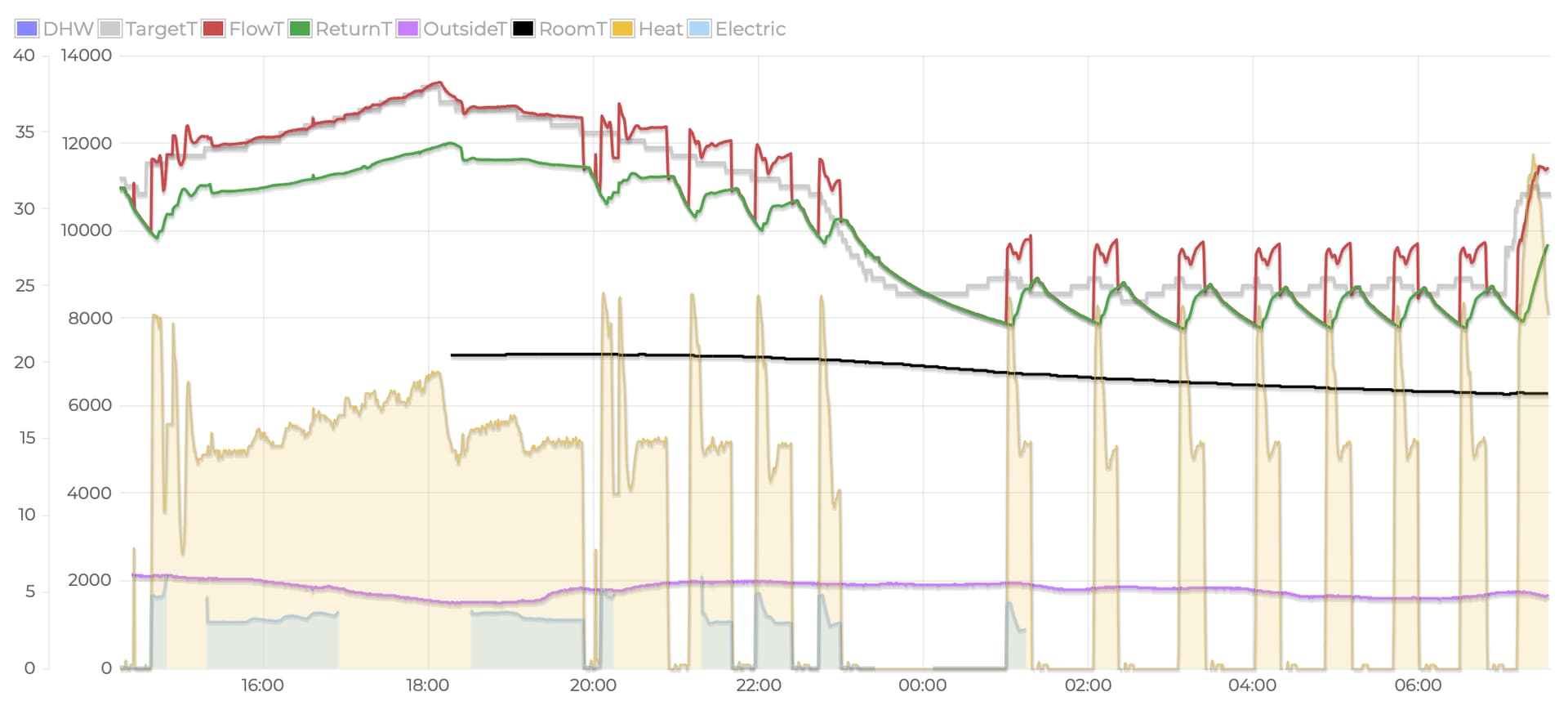
I’m seeing a repeatable fault on my Vaillant Arotherm Plus where the HMU (outdoor unit) steadily increases its own target flow temperature in staircase-like steps, even though Heating Circuit 1 (HC1) is requesting a fixed, much lower flow temperature. In my case, HC1 was calling for 27 °C at around 02:50 and stayed completely flat at that value for hours. Despite that, the HMU slowly ramped its target upwards from the same 27 °C starting point to around 47 °C, increasing in small, discrete increments every few minutes. The compressor was running the entire time this stair-step behaviour was happening, and electrical input power rose alongside the HMU target as it climbed.

This stepping behaviour continues until the HMU target is roughly 20 K above the HC1 target, and then it levels off precisely at that point. That ~20 K offset is extremely consistent in my system and is visible on the attached trace. I can reset the behaviour by power-cycling the outdoor unit, after which the target jumps back down and the whole ramp repeats under similar conditions.

In other words, my HMU appears to be increasing its own target independently of HC1, in fixed increments, until it hits an internal upper bound roughly 20 °C above what HC1 is actually asking for. Nothing in the house is changing, HC1 is stable, room temperature is stable, and outdoor temperature is stable—the only thing changing is the HMU’s internal target drifting upwards on its own. This seems to be a firmware-level issue in the HMU’s internal control logic, likely tied to how its ā€œenergy balanceā€ model behaves in certain hydraulic configurations - I am on firmware 0351.06.05 (before the 07 that @Zarch had the issue with). But the key point is: this behaviour is directly observable on my system, reproducible, and visible in the logged data.

Hi,

Do you have the [VF1] System temperature sensor connected? It can apply strange behavior to the desired flow temp., maybe is the VR10 defective

1 Like

I think you’ve nailed it, @Ulric !

A bit of background: my heat pump was installed with a HEX and a buffer back in 2020, originally glycol but then converted to water so I could fit the heat pump monitor. Both the Hex and the buffer were plumbed in wrongly so I was losing 50% of the heat due to that, plus the way it had been plumbed meant the far side of the house never got any heat. I replumbed it (more on that another time) and built in a bypass from the buffer so its open loop now (changed system design from 10 to 8). However, I completely forgot there was a temperature sensor in the back of the buffer!

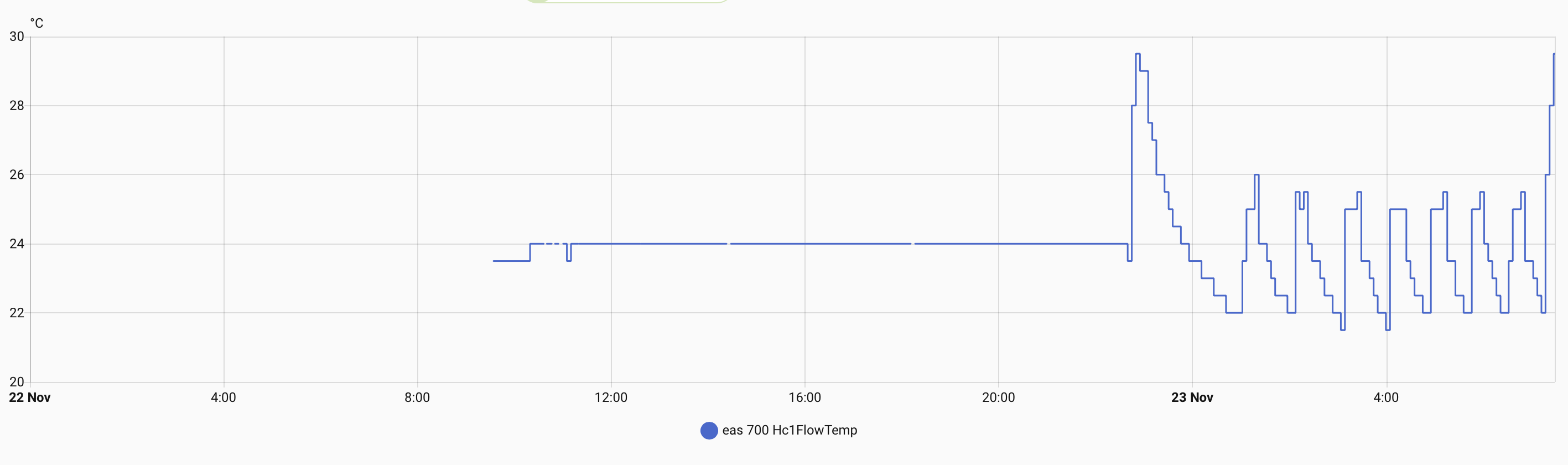
I traced the VF1 port to this temp sensor late last night, and moved it to the flow pipe, just before the 3 way valve for DHW. Below is the graph from home assistant showing the temp was a steady 24 all day, until I moved it, and now it moves in sync with the flow temp.

I’m now experimenting temporarily bumping up the heat curve to prove the problem is solved. I wonder if I can just remove the sensor from VF1? Might try that later, once proved this.

Many thanks @Ulric - will reply on this thread with an update later.

1 Like

Great!

On my side without buffer and in openloop I tested it. but desired flow temp was always changing and not stable so I just unplugged it and it works perfect without. The error message desappear after some hours.

My VF1 sensor is totally removed, I understand if running no buffer this is best practice. When my installer left - we have open with volumizer - he left the VF1 connected, we had actual flow temps way over desired and removing VF1 completely fixed this.

Remove VF1 now complete, have a Google, you’ll see much written on it. Vaillant, if called, would likely advise this.

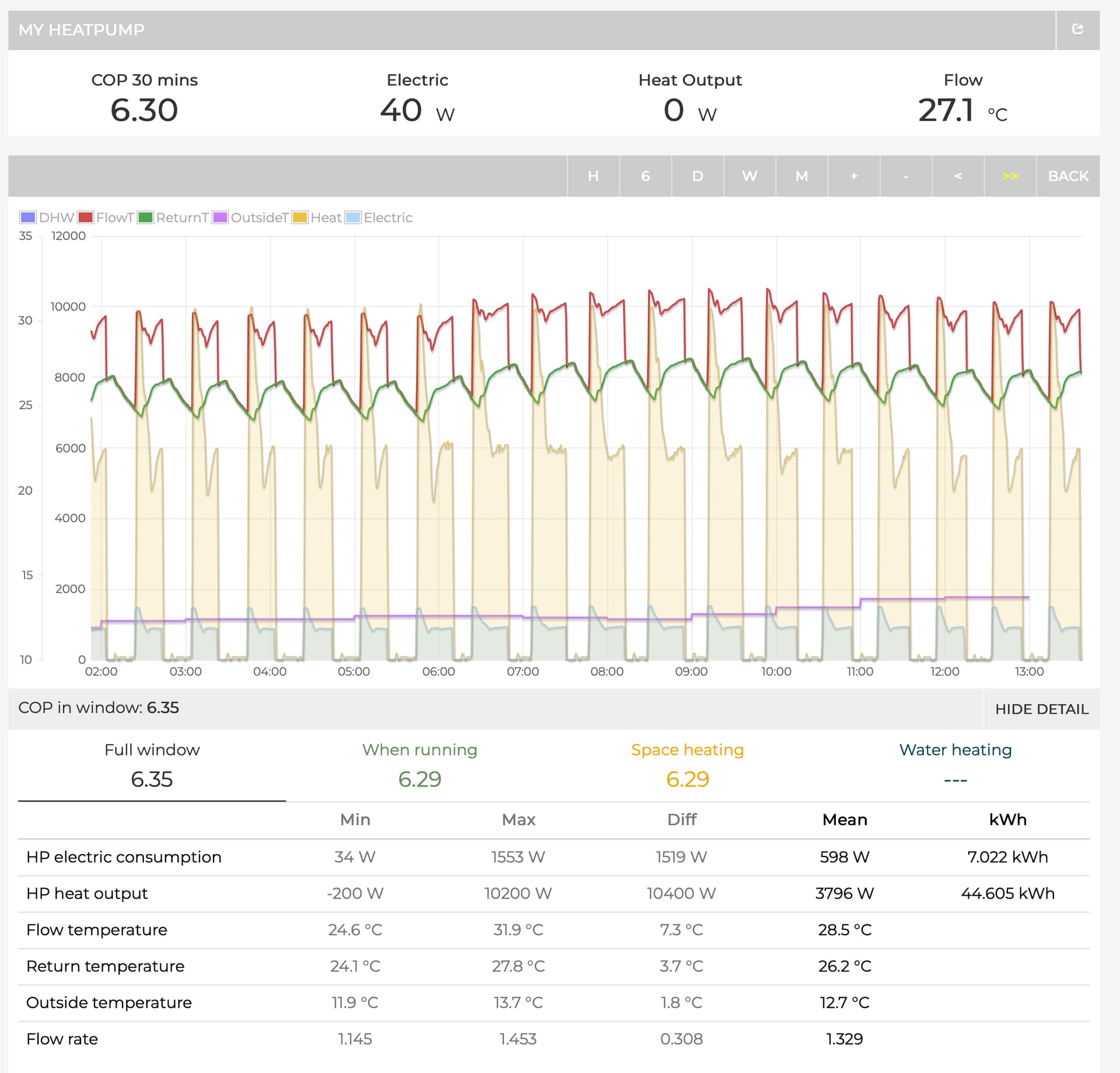
Just a small update. Connecting the VF1 sensor properly has worked wonders. My next stage is to disconnect it completely and see what happens, but I’m pleased with progress so far. Next stage is to replace the motherboard to update the firmware - as you can see from the graph below, I’m getting far too many cycles (it is quite warm at the moment).

1 Like

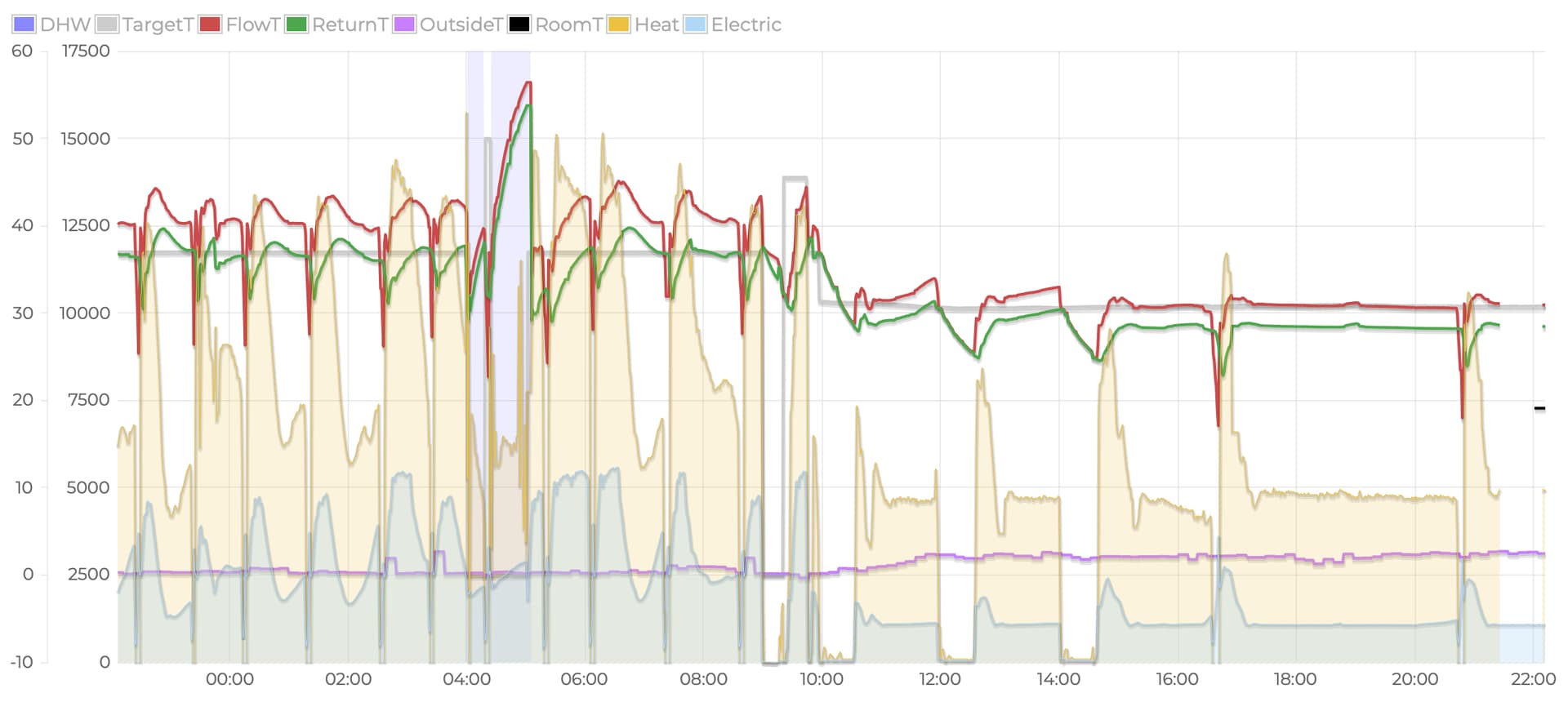
Another update - I finally got around to disconnecting the VF1 sensor (about 9:15am on the chart below). I wish I’d done it much sooner! Previously it was ramping up, running at 5kW, drinking electricity like it was going out of fashion. Now its much more like a heat pump should be - consistent. Now the flow hugs the target, whereas previously it was the return that hugged it for some reason.

I’m experimenting with flat heat curves and min flow temps, and when I increase, the DT widens (as we have UFH) but slowly reduces and we can have toasty warm temps for not much more than minimum modulation. I need another cold spell to properly test this - wish I’d thought to disconnect the VF1 when it was -7!

1 Like