I can feel it more on base of the unit and not the pipes.
Direct measurement with the accelerometer also shows similar, it’s a magnitude lower on the pipes after the flexis, but still transmitted through the base. My pipe arrangement is very simple though, hardly any is exposed outside.
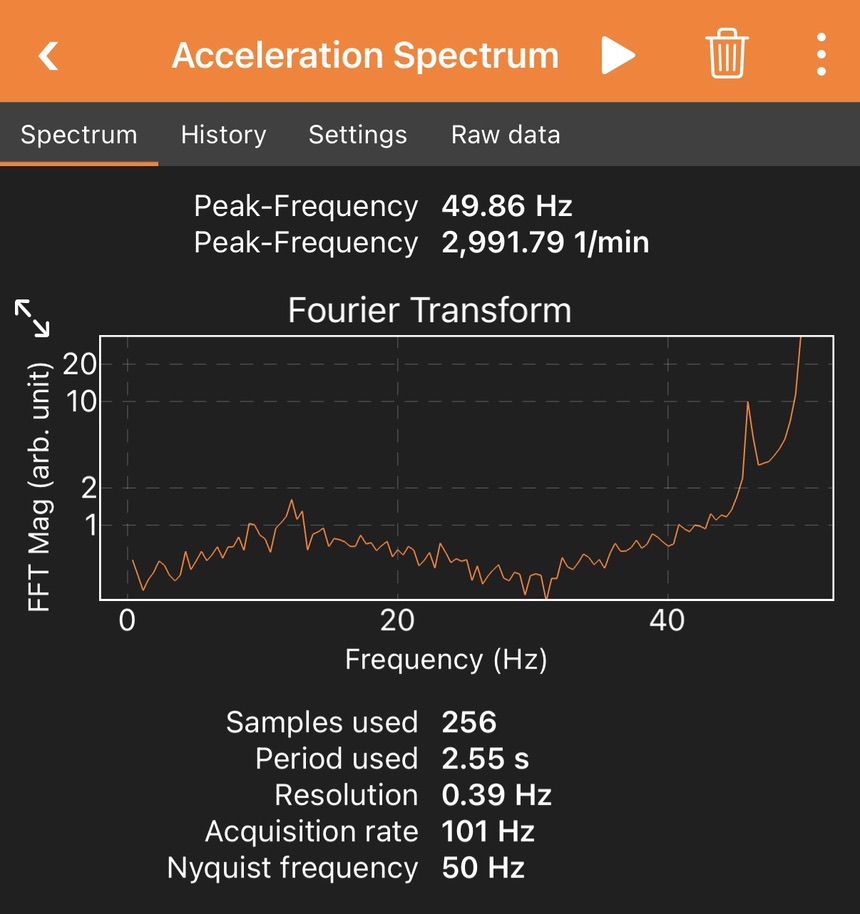
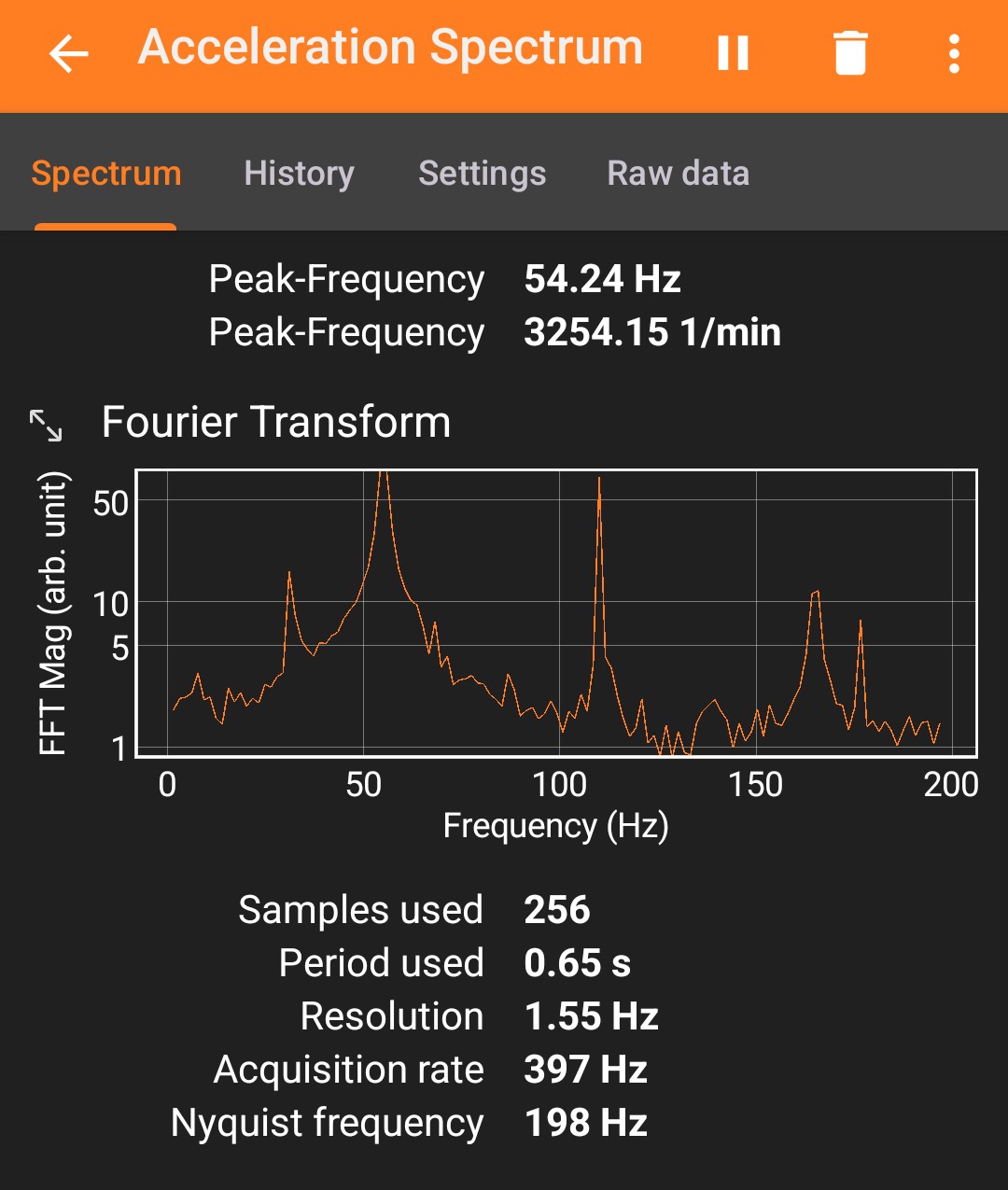
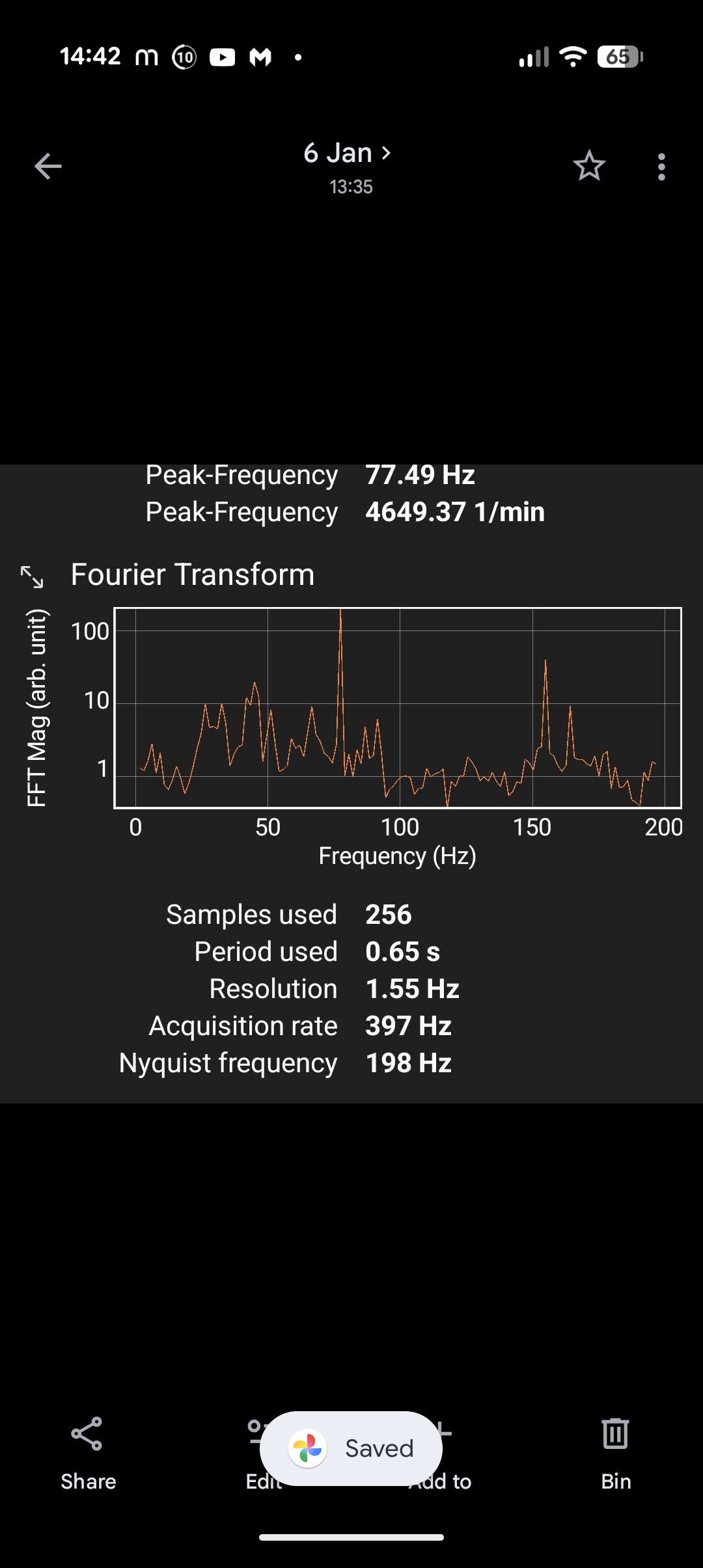
I found I couldn’t hear anything below about 10 on the arbitrary value of magnitudes on the acceleration FFT, and problematic resonance was anything above 100.
Quite easy to track these down once you can see them on the phone, adding mass can isolate each thing one part at a time and you can quickly get a sense of what’s going on.
I don’t think it was a specific fix for me, but that option was on the table. Which is good.
It was an update around April time I think. The control method is now way more complicated, you can see it modulates better too, my emoncms shows far less rollercoaster style energy use.
Hush mode helps massively.
The “noise” is seemingly just inherent to the cosy 9 and just must be a bad combo on my particular house. The updates essentially stop the fan ever reaching the rpm where it’s problematic. But it’s still there* if that makes sense. I.e. the engineer seemed confident that a replacement fan would result in the same.
I had to reach some new level of customer service to avoid getting gaslit.
They didn’t seem that interested in the accelometer data.
Engineer didnt have any more tooling than I have, e.g. No way to actually command the fan rpm.
I’ve finally managed to get to the same super engineers and finally making progress now.
Had our Cosy 6 replaced as the compressor didn’t sound too healthy. Unfortunately, didn’t improve the vibration/resonance issue inside the house. If I put my hand on the casing and the slab - I can feel the vibration from the compressor.
Next stage will be to switch to the raised base and potentially look at flexi/PEX/FlexEJ isolation on the pipework. It’s insane how I can hear the vibration on multiple walls throughout the house.
At the bottom under tools is “acceleration spectrum”.
Which gives you a FFT magnitude in an arbitrary unit over the frequency of your phones accelerometer. Critically there is no low band filtering like with a airborne microphone.
Phyphox is just a toolbox style app, it exposes all the sensors in your phone for use
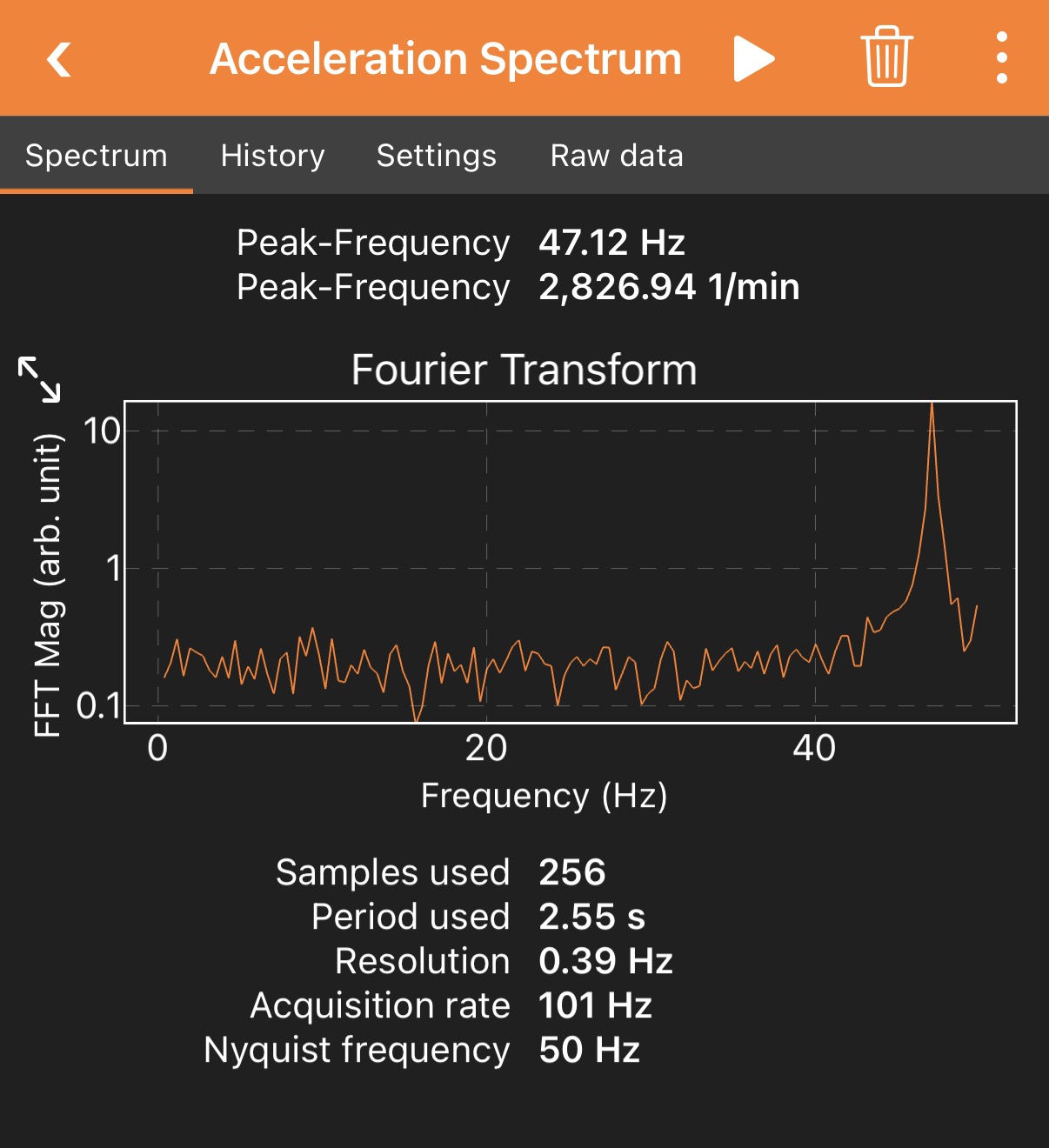
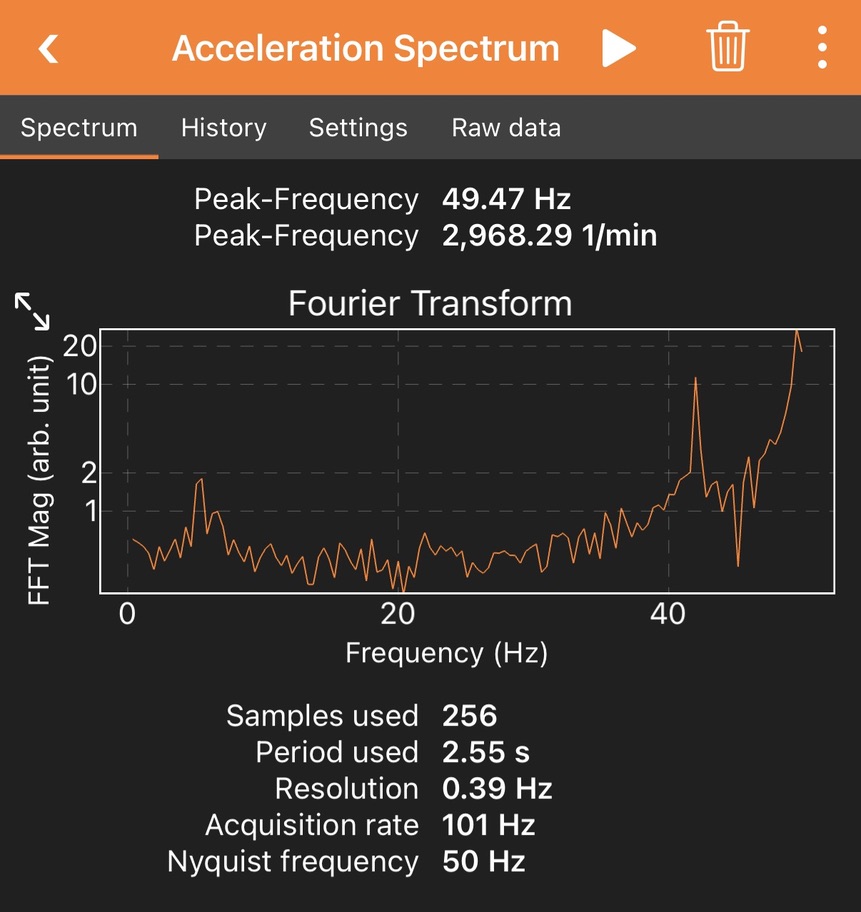
You should see the actual problematic frequency, and then several spikes equally spaced at higher frequency, these are the resonances of your system/house. You’ll probably find that anything over magnitude 10 to 100 is problematic and audible in a room, essentially the whole wall will become a loudspeaker.
Thank you. I’ll give that an go and be able to record before/after as changes are made to see the difference.
I’ve got quite a long pipe run up the side of the house and across the loft space, probably about 9 metres. It’s all clipped to walls and beams so any vibrations in the pipework is likely to make it way into the building fabric. But similarly with block and beam foundations, we’re probably seeing some of the vibrations make its way that as well.
Hopefully one way or another we’ll get this sorted. Does make me wonder how others don’t see similar issues or similarly how other heat pumps deal with compressor vibrations
It’s one of those “depends” type answers. Plenty of American style units are sat on a wide base on a pad and that’s it. At the same time plenty of mono style units are on the common isolation blocks you see.
I suspect it’s just a combination of a particularly resonant house with proximity of the pad to some kind of connecting foundation. It can even be that the slab is sat ontop of aggregate that is making it worse, or that the mass of the slab itself is not enough to effectively absorb it.
Also to expand further on your feet/vs clips it’s both really, they’re doing different jobs.
The internal dampeners are sized for the compressor mass and mostly stop it hammering the chassis. They don’t deal with the residual out-of-balance force that ends up in the casing. External feet are a second stage isolating the whole ~125 kg lump from the slab. Two stages in series only really work if the second is much softer than the first, so the feet need specifying rather than just being “rubber”.
For this reason the cosy leg kit isn’t “really” for isolation, it’s to allow easier installation. On my “early” version they are just hard plastic. So you can see room for improvement there.
Rule of thumb is the forcing frequency needs to be at least 3x the natural frequency of the mount, and realistically 5-10x before you get real attenuation. So find your dominant peak in phyphox first and work backwards. If it’s up at 50-60 Hz, EVA or neoprene pads (fn ~15-20 Hz) will do a lot; that’s what took the worst out of mine. If the compressor peak is down at 20-30 Hz, pads won’t touch it and you’re into springs. CIBSE Guide B4 has the selection tables; I ended up at 25 mm static deflection, fn ~3 Hz, (which luckily is cheap) but haven’t used them.
Be careful with the raised base. if the frame has a mode in your problem band you can make it worse. Mass and stiffness both matter.
With 9m clipped to walls and beams I’d look at the pipework before the feet. Classic guidance is to isolate every hanger and clip for the first 15 m or so from any isolated plant, so your whole run is inside that. Flexi connectors at the unit break the path at the unit only; after that every rigid clip is a direct injection point, and it bypasses anything you do underneath the unit. Block and beam kinda means sub-50 Hz goes everywhere.
Diagnostic order I’d use:
unit casing
slab next to the unit
pipe at the first clip
pipe at a mid-run clip
loft beam
the wall that’s singing
Whichever path stays over 10 units on phyphox is the one. For instance if the clips are loud and the slab is quiet, no amount of feet will fix it. rubber-lined clips or neoprene hangers, and a slack loop or a couple of soft direction changes near the unit would do it.
And if your wondering why everyone seems to not be able to discuss this it’s because we are late to the party. Everyone is chatting about dB(A) when it’s entirely pointless and we should be talking about a way to rate indoor noise from systems like room criteria curves.
It’s absolutely wild to just dismiss any information about sub 60hz sources creating vibrations in light construction.
Thanks for the very detailed reply and plenty of food for thought on what to consider in terms of both the base and pipe clips. I definitely agree with your last comment regarding how no-one is discussing this and the comments are instead all related to dB(A). They’re missing the key part which is the vibrations and I do wonder with some clever configuration you could probably tune a heat pump to the each environment its deployed.
Although my biggest gripe is weather compensation and asking a customer to tune the lower/upper curve values. I’m convinced it can automatically be optimised by machine learning based on the temperature sensors and rate of change. But that’s a whole other discussion.
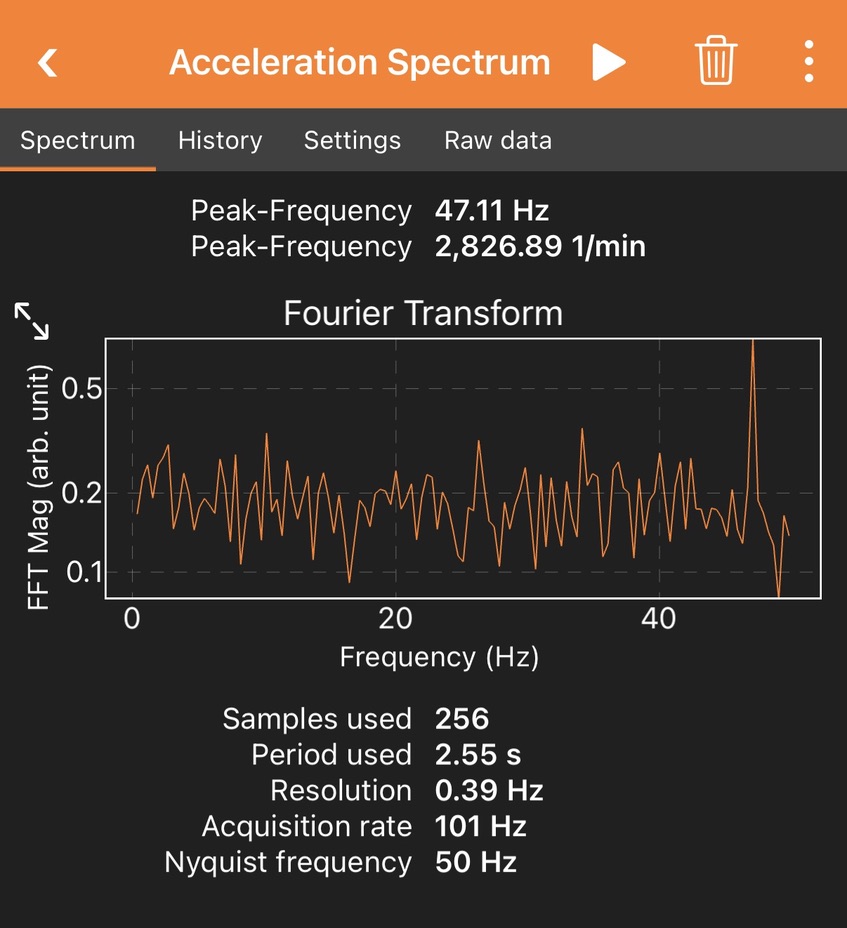
I gathered some data tonight on a DHW run to see what the peak Hz was being produced at various points: top of the unit, base of the unit, the pipework immediately behind the unit, the wall inside the house, pipework in the cylinder cupboard. I still need to do another measurement in the loft at the clips but I’m fairly certain it’ll fall into the same range 45-49Hz is the peak across all those locations.
The engineers are back on the Mon 7th Sept and based on the above, the plan is likely:
rubber-lined clips to replace the existing hard white plastic clips used throughout
base with scope for allowing pads to be slotted in (although I’m assuming new feet are softer rubber?)
Plan is to rework the pipework off the back of the unit with a new approach using PEX-A. Currently there are four 90* bends before the pipework goes up the wall to the loft. Instead, switching to PEX-A it can be changed to a smooth sweeping bend which will reduce resistance and being rubber it should help dissipate the vibration especially coupled with rubber-lined clips.
That’s the plan but scope for change on the day. Thankfully with the the phyphox app it’ll help compare/contrast with any changes made.
Haha you have accidentally gone the other way, your phones accelerometer is not high enough frequency to be super useful, it would be better to find a phone that goes up to 200Hz.
You are not really searching for the peak frequency, but looking at the magnitude at a particular problematic frequency that should “pop” out. But it does look like you have found it, and hopefully being able to live visualise aids in resolving easily.
Really large fans, pumps and plant do dynamically and/or are tuned away from problematic resonances. Because they would literally leave the building if they weren’t.
It’s a tricky beast, the standard used elsewhere also didn’t fairly represent low frequencies noise for some time and also it completely depends on the “stage” of the room. The sound power and sound pressure have a relationship but they are distinct things.
Thanks for sharing the comparison. I’ll see if I can borrow an Android phone which typically has a high resolution. Unfortunately all iPhones seem limited to 100Hz
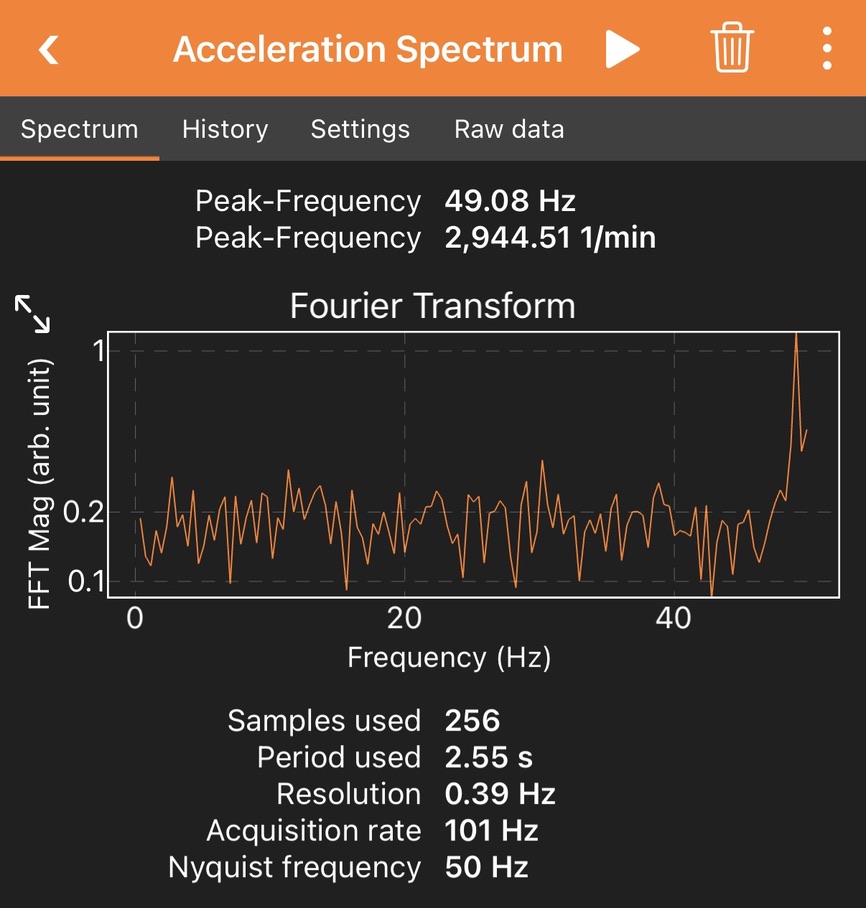
What results do you get on the slab and on the pipework or clips internally?
A similar profile; but the magnitude is below 1 now that the fan is not spinning at the problematic rpm.
When it was bad it was easily above 100 on slab and over 20 inside on the bedroom wall. Id say anything above magnitude 10 was audible in my house, keeping in mind is arbitrary unit.