Might as well post some internals now I have paid them.
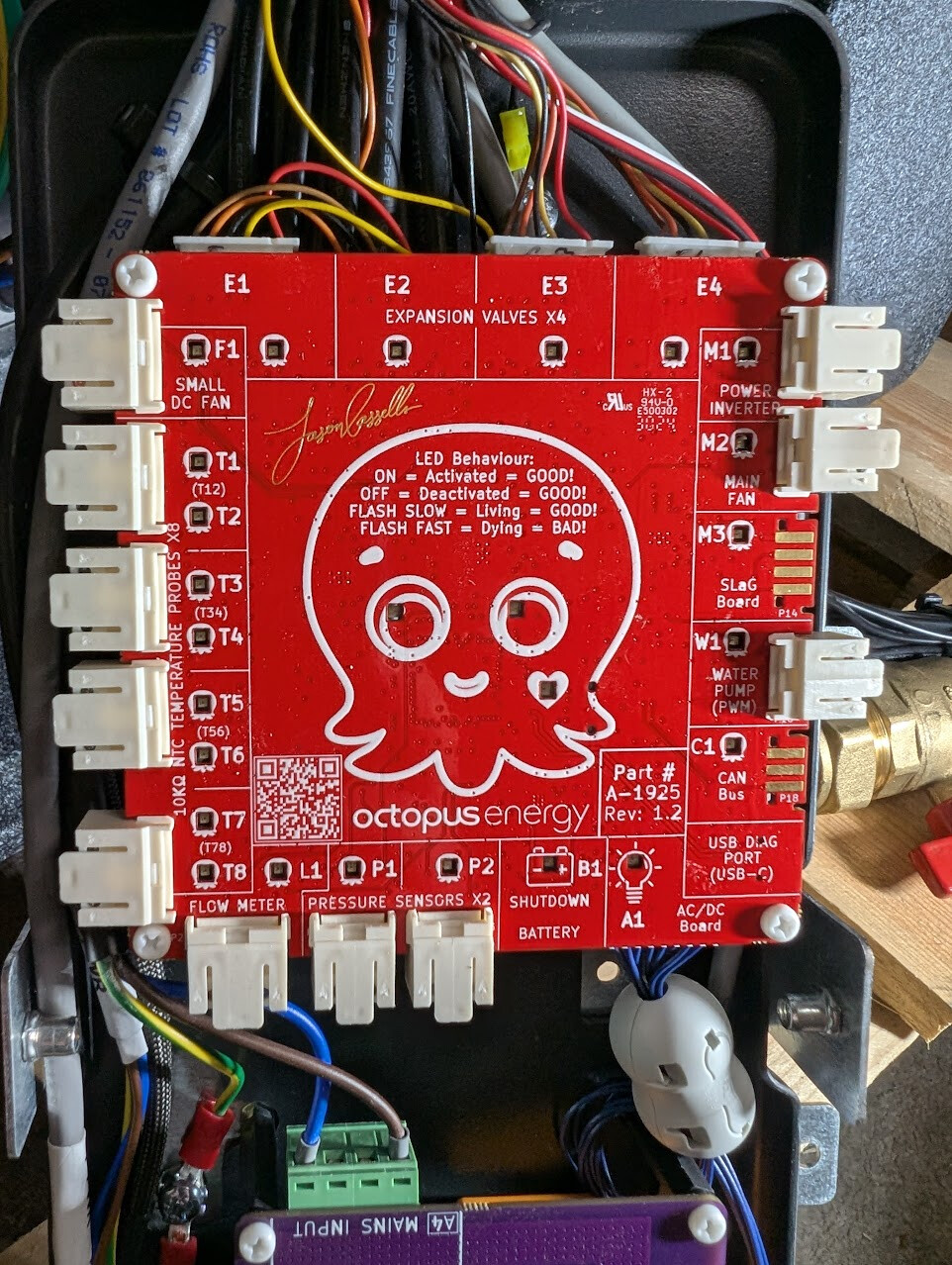
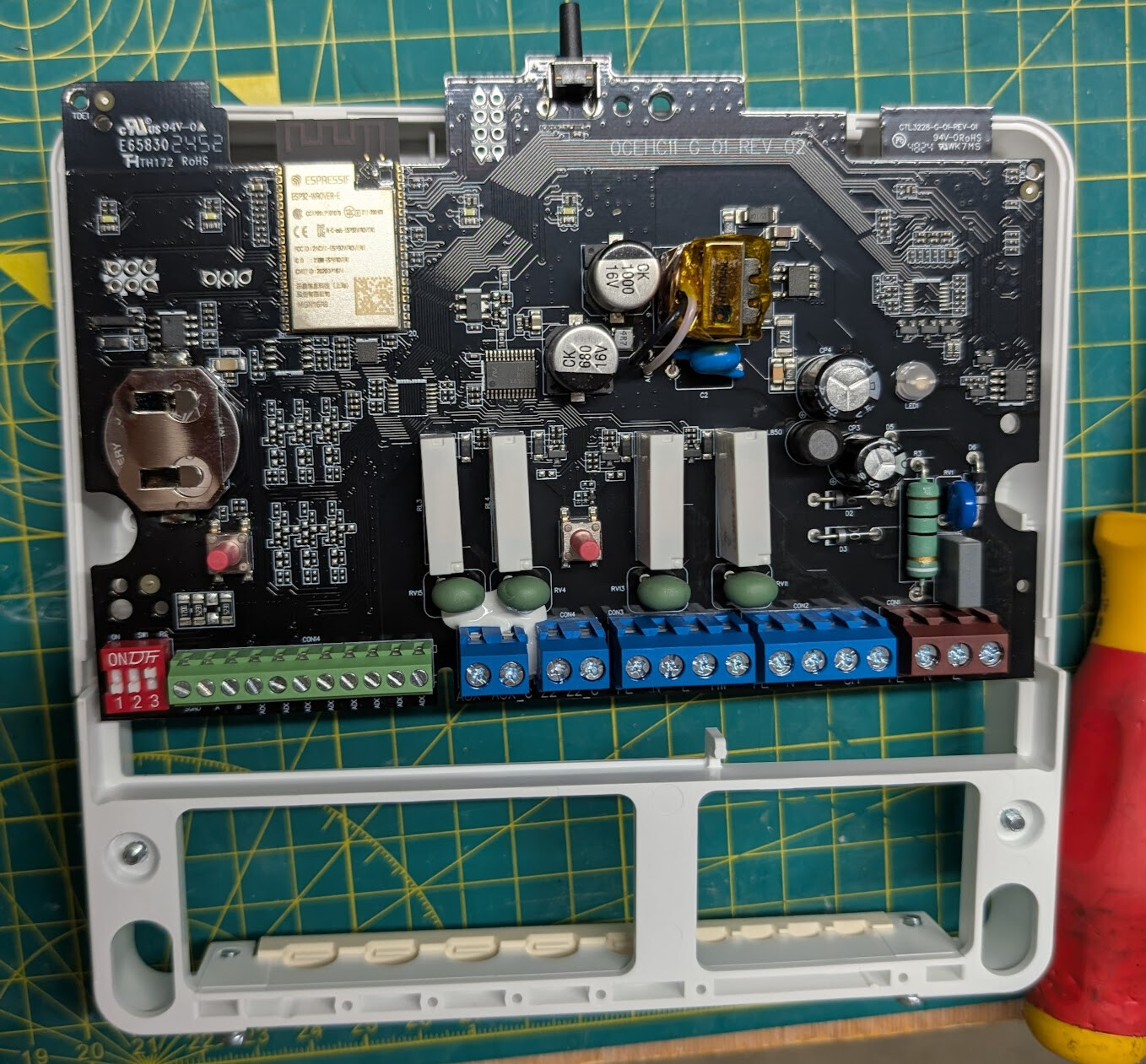
Cosy hub: Seems very similar to hive. esp32 rover and zigbee radio.

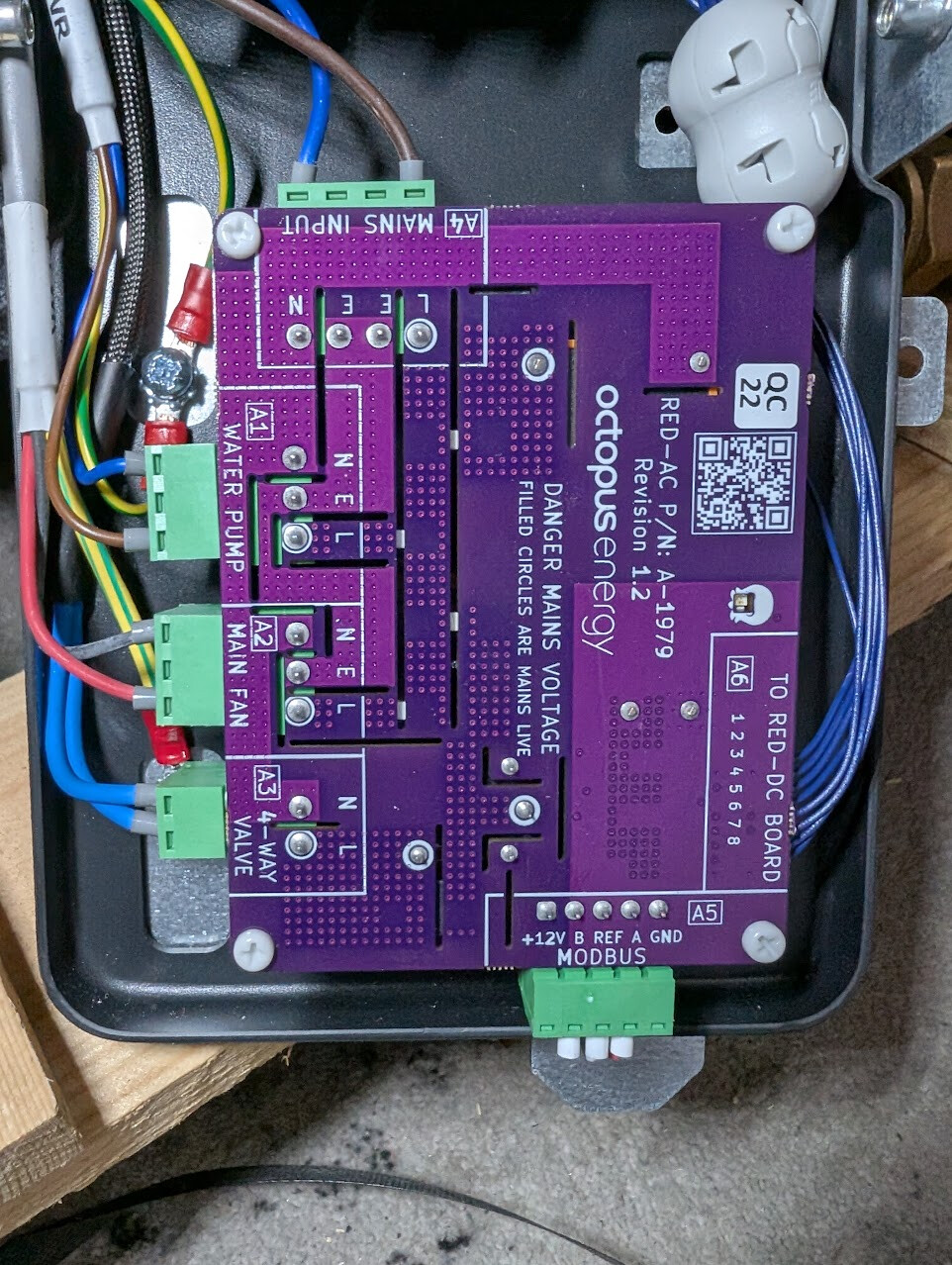
Heat pump:
Backwards firing smd leds… gold immersion signature… STM32G4… some nice effort went into it.
I have not long had an Octopus heat pump installed and am experiencing exactly the same issue you have.
It’s not loud, but more like a vibration that is in the walls. And I’m certain it’s because it’s so close to my property and sat on a paving slab. (The sub floor is poured concrete so no where for vibrations to dissipate).
I haven’t paid the bill yet, I’m waiting to be contacted by the R&D department but have been told, “it’s hard to raise a ticket because there is no evidence”
I’ve told them they need someone out to the property and it’s not something I can record on a phone.
Glad yours is better now. Fingers crossed I get a similar resolution!
Octopus were very proactive in finding the sound for me.
I couldn’t record it very well on my phone. Engineer had to come “experience” it, after it was experienced they worked to solve. I could record it with my RTA gear.
The office seemed happy to not progress with handover and payment until it was solved.
If it’s a low vibration like mine, it will come “out” of the walls at various null spots inside rooms and be clearly audible with a ear on a wall.
That being said it did get better after a week, but that was likely just the compressor settling in, the vibration / fan noise was always there.
I still think the root cause is the fan itself or the geometry of the air flow at the top of the cosy. It could be solved with a mass dampener at the top of the unit,.or by isolated legs. Or a look at the airflow. My house is similar; all beam and block suspended, which probably does contribute.
Super smart people have provided lots of advice about structure-borne vibration that causes walls or joists to vibrate and that is then heard inside as a low-frequency hum.
The dB(A) for the unit is meaningless because those test filter out low frequency.
@Swwils how you finding the Cosy with the base now that you’ve lived with it a bit longer?
I’ve got a similar issue (Cosy 6) with low hum / vibrations through the wall and resonance around the house. Similar construction with block and beam foundations. Pipework runs up the wall and through the loft space. I can feel vibrations on the pipework in the loft. There are flexi’s which are fitted inside the plastic trunking that runs up the wall but I can’t help feel this should be done closer to the unit and ideally not on the wall. Also, some of the pipework touches two beams which I think could be another source of vibrations. It’s frustrating as the actual fan is near silent and performance is brilliant. Just battling with solving this issue.
Hello hello,
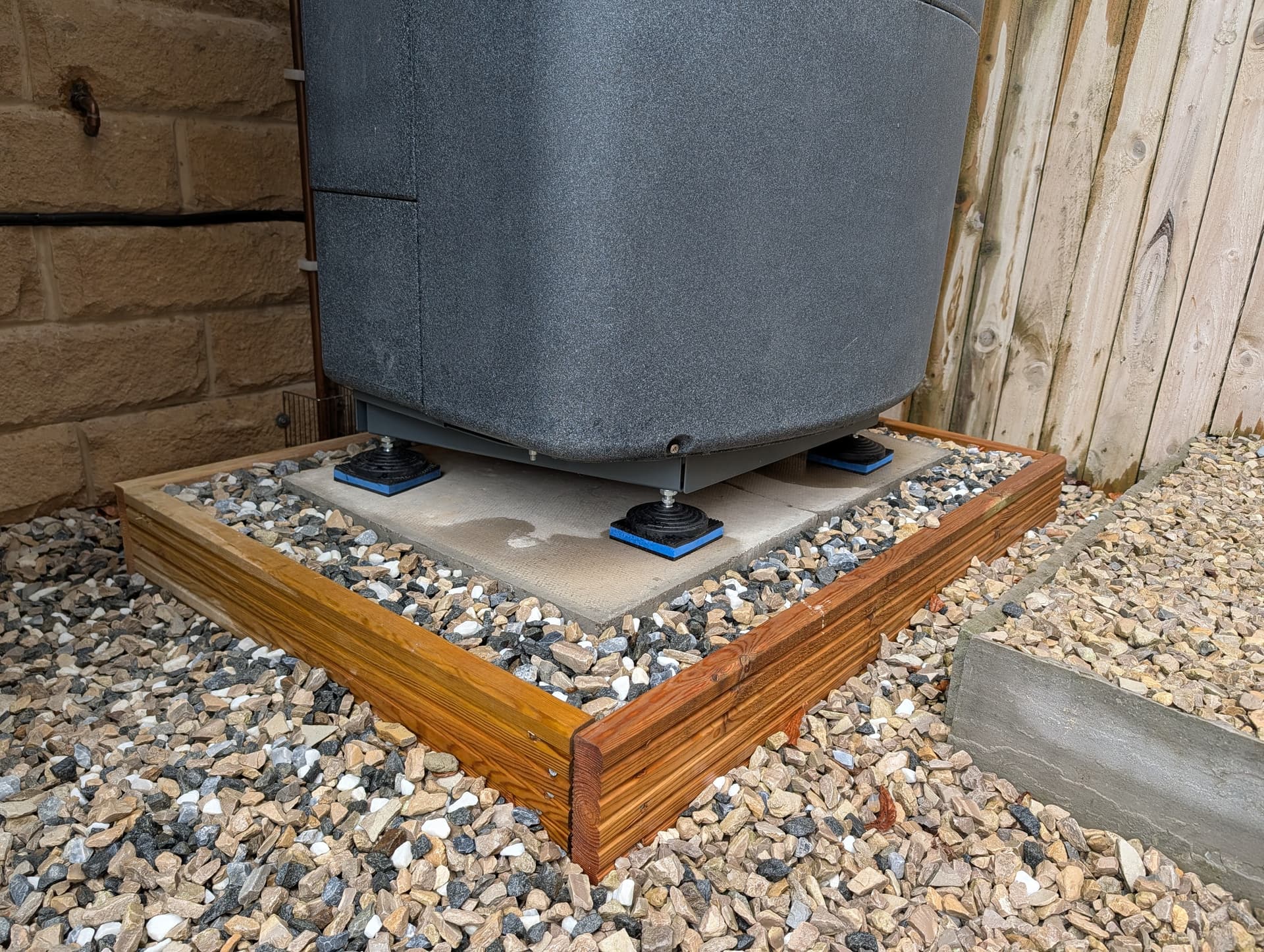
The leg base mostly solved it. My EVA blocks even more so. I can only really hear it at maximum ramp for a hot water call but it’s nowhere near as intrusive as it was.
Have they not put the flexi directly from the unit to the wall? Maybe ask them to troubleshoot and suggest a service bend with the flexis.
Other than this everything is great the performance has been excellente.
Can you post some photos of your install, with all of your mods visible? Intrigued!
Sure. You could calculate the required material and thickness with some maths but these were £15 on amazon for 4.
The leg base feet are kind of a hard plastic. So I’m sure later versions will be rubberised. You can easily just wind the legs up one at a time to place these under without moving anything.
Octopus have said they will visit and put rubber bushings around the central “bolt” too. I didn’t want to move the unit off the base on my own to do this.
In other countries, it’s very common to also have an isolating mount/strap for your first fexi joint to avoid vibration transfer, also your flexis should not go through the wall… basic isolation practices.
Does it ramp with fan speed? If it doesn’t your actual compressor mounts would need to be looked at. 
Yes - if the fan speed / load is low then inaudible. However, as soon as the temperature drops and the load increases this is where the low frequency hum becomes audible in the house at certain places. You can hear it with your ear to the wall as well.
I’m getting an acoustic survey carried out by Octopus to help pinpoint it.
Also, there has been a recent new firmware v5.3.2 which seems to have changed the behaviour a little bit. Making it what seems to be quieter when running at lower load. Not sure if you’ve noticed any change?
It crossed my mind what a Cosy 9 could modulate down for heat loss as alternative. Our house was calculated to be 4.8kW.
Have you managed to make any progress on the board? I’d have loved to get the in-built server accessible via the assigned-IP on the home network. You could then scrape the JSON data to feed into Home Assistant.
Is this still accurate? I am trying it with the generatePasswordForm function and its not working, although might be the wrong function
I’ve had octopus back out to do a noise survey, but it was just to rule out airborne noise.
It’s not airborne noise so, as such metering wasn’t helpful. Most meters of that type have low pass filters anyway.
In reply here, yes there have been improvements, via firmware or myself? I can’t tell exactly - because I had the keg kit installed, which helped about 10%, I then put EVA pads under each leg, this has helped about 80% and almost solved it. I can now only hear it on initially very hard ramps (for about 10 mins when it ramps up before modulation) or hot water calls. It’s still enough to be an “issue", so I don’t run the unit overnight.
Performance of the unit has been fantastic really, cold weather performance especially. It seems to treat heat loads and hot water calls very differently in its logic and defrosts are different between the two for some reason.
I’ve been slowly getting my WC linear dialed in, but really I’ve been using it as a drop in replacement for a boiler. . I do think my system needs a good balance.
The engineers have all been great, they seem to think the vibration is inherent to the cosy 9. They have invited me to go see some other units to confirm that. Then based on that we will see what we can do about further isolation.
Hub seems to be locked down now, but the modbus is sill there.
Once thing I did with the engineer here was to cover the rear of the evap with a sheet to starve the fan of air in different ways, this directly changed the “hum” so we can rule out the compressor.
Engineer seemed to think the fan RPM is pretty static across all operating modes, which I don’t think is the case, as such they didn’t have tooling/training to force max fan rpm.
A cosy 9 seems very large for that heat loss? It’s minimum is just above 3kW.
There was also a very large and good update at the end of August, which dramatically improved hot water cop and behaviour.
So just to clarify something, Octopus doesn’t put the Cosy on an EVA mount as standard?
No, the legs of the base kit are quite hard plastic, so wouldn’t really decouple anything.
The leg kit is very new, so I suspect this will change. My guess is that the keg kit is primarily intended to reduce groundworks as you could put it on non-level sites.
I think their standard install in on a paving stone that have deep gravel under it. So no direct physical connect to house walls unlike on a preexisting concrete patio.
Update here, I’m still trying to sort the last 10% of this resonance, since i can’t really run the unit at night. Performance is still good though ,but just cold house in mornings.
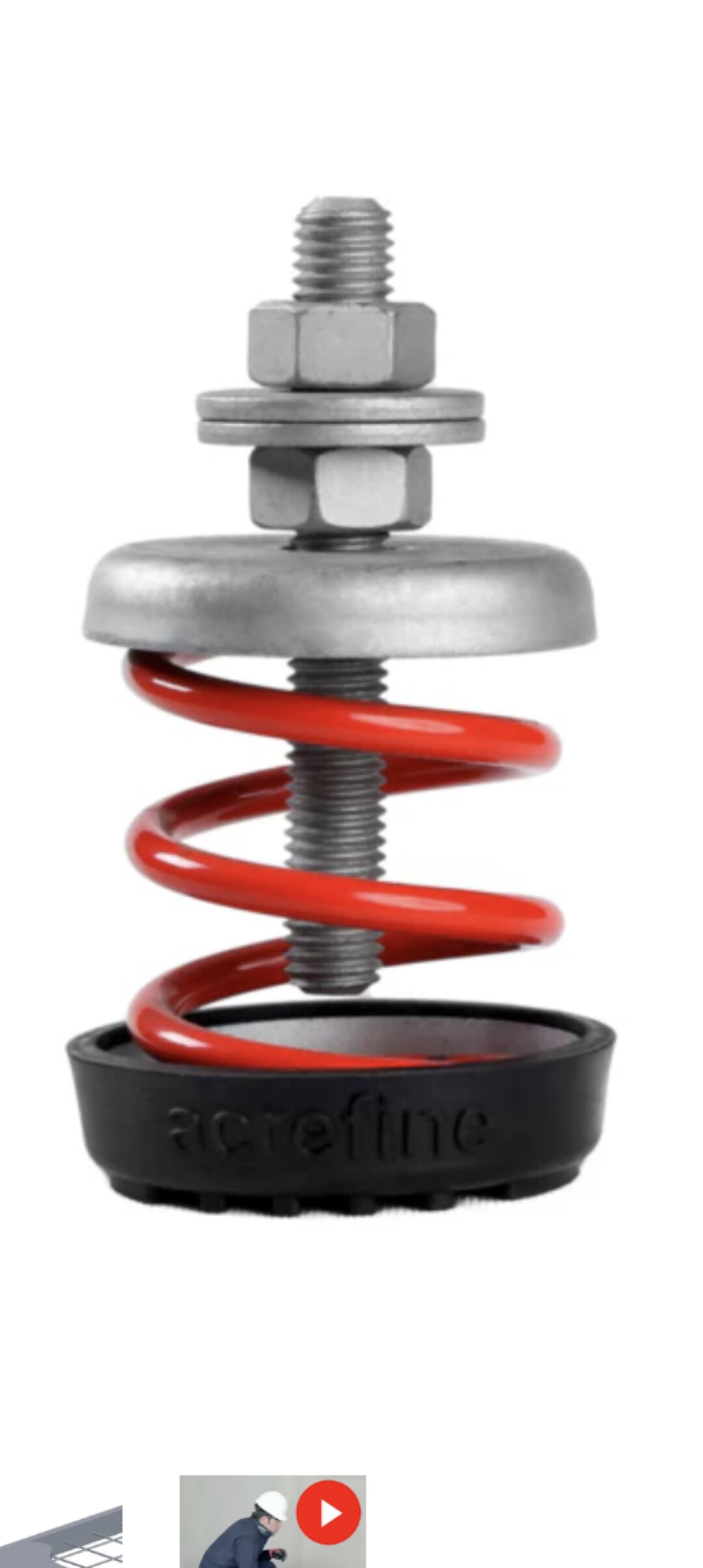
I’m going to try some proper spring mount legs next.
My latest communication with octopus is that noone else in the areas has the issue  , but they were still willing to help resolve .
Passed to the octopus tech team apparently, which should gather some more expertise.
It might be better to treat at source rather than isolate, lets see if the cosy has an accelerometer inside and I could write a software vibration compensation routine, seems like it would be straightforward to do.
Today I inspected the geometry of the fan area, IMO it’s got alot of “dead” space above the fan with nowhere with the air to go. I also noticed alot of excess flashing from where the case mold is joined together which surrounds the exhaust area for the fan.
I removed this excess flashing so this area is now smooth all around and… Its cut the fan “booming” and vibration significantly (or at least shifted the frequency a little so it doesn’t resonate as much) so now if describe it at about 5% as what it was originally. Still not great but getting there…
I can finally run the unit at night in certain modes.
Waiting for the spring dampeners to arrive, which will be a direct replacement for the legs.
(I also found out my phone has a really decent accelerometer and combined with phyphox app acceleration frequency spectrum tool was able to “visualise” the noise on a FFT magnitude 0-200Hz which was very handy.)
I’m still impressed with the performance of the unit, being able to start it at 04:00am will help alot with cold mornings.
This is really interesting - could you send photos of the ‘flashing’? And all the mods you’ve made to the Cosy so far beyond the stand you posted earlier?
To give some context, I’ve got Octopus coming out to re-lay the base, and they’re going to install an anti-vibration mat… Which is a different solution to the one they have provided to you…
A mat of the right material and thickness should work. The problem the have is doing that for the whole base of a cosy is £££, it’s why legs are great.