Yes I’d agree, the Octopus/CIBSE heat loss 50c flow radiator equivalent area for my installation is almost exactly the radiator area the tool gives for my (very roughly!!) estimated house at 40c. Fortunately, the house is closer to the tool estimate, rather than the Octopus/CIBSE, so arguably it was a bargain! Apart from the rubbish Daikin modulation of course…
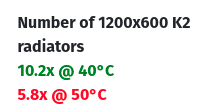
Would be helpful to see the Rated_Heat_Output in watts at Δ50, i.e. 2050 W per K2.
For my own system (pictured), this would come out at 20.9 kW, which isn’t far off the number I get with the Heatpump app’s ‘Calculate emitter spec’ feature.
1 Like
Here are my numbers.
170m2 detached. Originally 1960s, but altered significantly in 2014 so the default selections are difficult to match, for example half the exterior walls are from 1968, the rest are from 2014. The house has a warm roof construction which is better than the 300mm insulation option, and the windows aren’t triple glazed but are closer to this u-value than the default double glazing option.
At the time of the first survey (EoH trial) I had no understanding of the impact this would have of the efficiency of the heat pump. The installers surveyor went with worse case, but after a couple of months of poorly performing heat pump, it didn’t take much of a search around forums before I became aware of the underlying issue it had created, but the EoH trial wouldn’t accept the mistake.
Installers approximate selection:
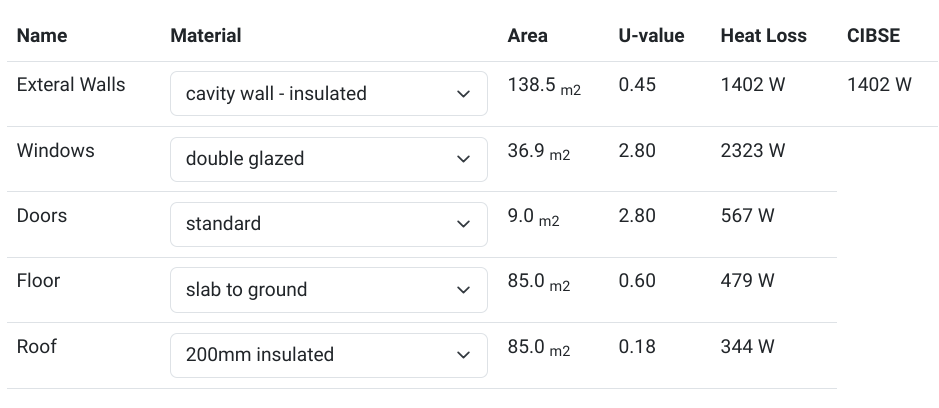
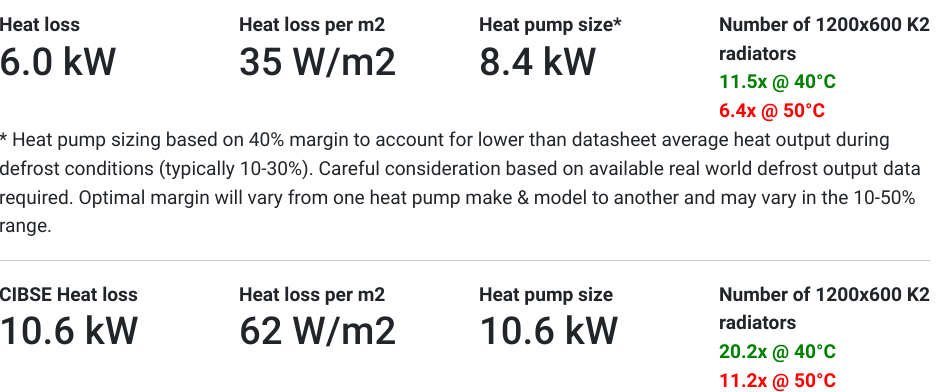
My selection:
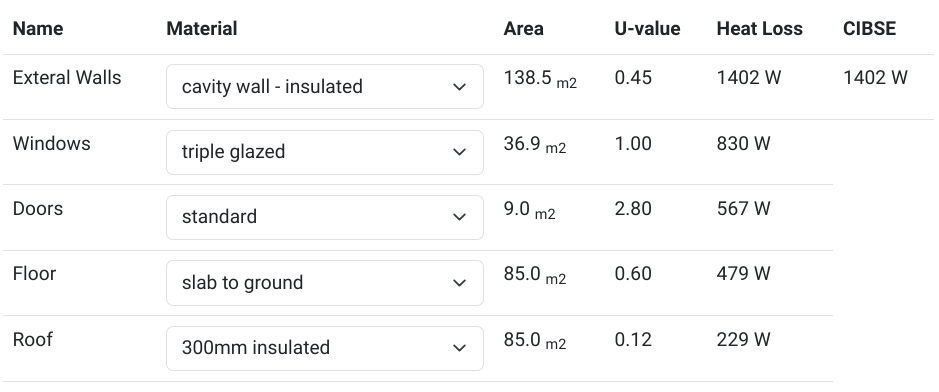
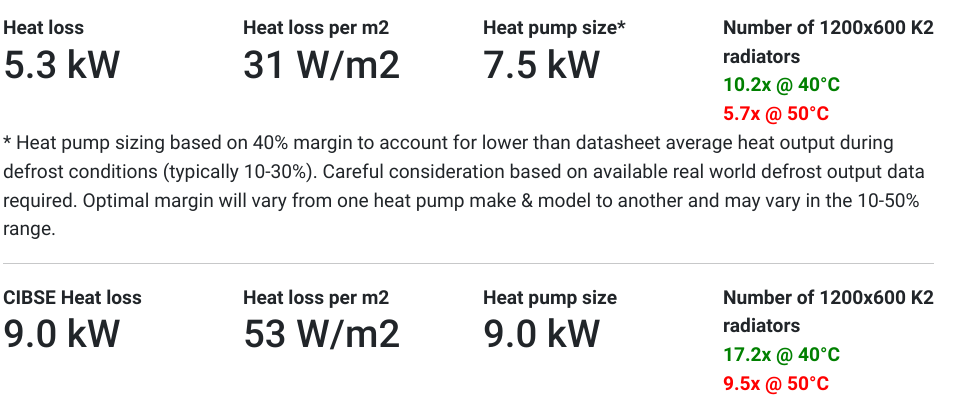
To be fair a 10.6kW estimated, compared to 7.5kW actual heat pump size doesn’t initially seem like a big difference, but it’s roughly a 40% increase in output. As mentioned many times, we know correctly sizing the heat pump can make a big difference, particularly with how some of the heat pumps manage their modulation (or lack of it). If all manufacturers can solve this problem it’ll make a huge improvement to how adaptable heat pumps can be.
Actual heat loss, using OEM kit is around 4.5-5kW, so with more accurate assumptions the simple heat loss tool seems to do well.
1 Like
A few comments based on my own Sept 24 installed Vaillant 7kwh system. The heat loss calculations lead to the 7kwh size. I “confirmed” this by plotting heat output from my gas boiler against inside-outside temperature difference. This gave maximum demand of 180kwh and design calculations assumed the 7kwh unit could give 8.4 kWh when pushed. And so with cop 3 would be plenty
Practice since has shown that:
At -3deg days cop is around 2.3 - so max heat output 150kwh if limit hot water
The lower than planned cop is not explained - falls between supplier and designer saying “it’s not us”. There must be enough data from installs to give firm guidance as systems are designed and so accurately predict cop. In my case it can see that max heat output is driven by 3.2kwh input x cop.
With demand pushing system’s limit it gives less scope for demand shift in time-of-use tariffa to reduce pressure on the grid - which would be in everyone’s interest.
Clearly systems designed to just meet demand has been the mantra as it means more constant running but this means less flexibility - e.g. demand shift
In my case I am moving away from Octopus Cosy to try OVO Heat Pump Plus as constant running may improve efficiency and my theoretical calculations show reduced cost - higher in summer but more than offset by lower winter costs when heat pump use is higher. I’d like to help the grid with demand shift but limited on cold days
Hope this was not too far off thread.
Does your house remain at your desired indoor set temperature during the cold spells, or does the ASHP struggle to maintain it?
At -3 Deg (maybe lower in the evening (outside struggles to maintain temperature - gets to 18.5 when we want 20. But this is only a few days per year so can always supplement. More recently it’s been run through Havenwise so I’m confident that the weather compensation/flow temperature etc is optimised to meet comfort demand.
I guess I could be proud that the system is well sized but fractionally too low. The 10kwh unit would have been much larger for where it would be sited.
So I’m happy. Would like to know how system design could have been improved to push up cop. It’s a simple system - 28mm pipe to 150litre cylinder, no buffering tank and plenty of emitter capacity in each room - B rated EPC upgraded Edwardian house but can do a few extra things to improve insulation/heat retention.
I just feel that design parameters and running algorithms could be standardised so that future users who just want optimum cop, minimum running cost, best tariff, install and forget (i.e. not Open energy enthusiasts) can be comfortable in making the switch to heat pumps.
1 Like