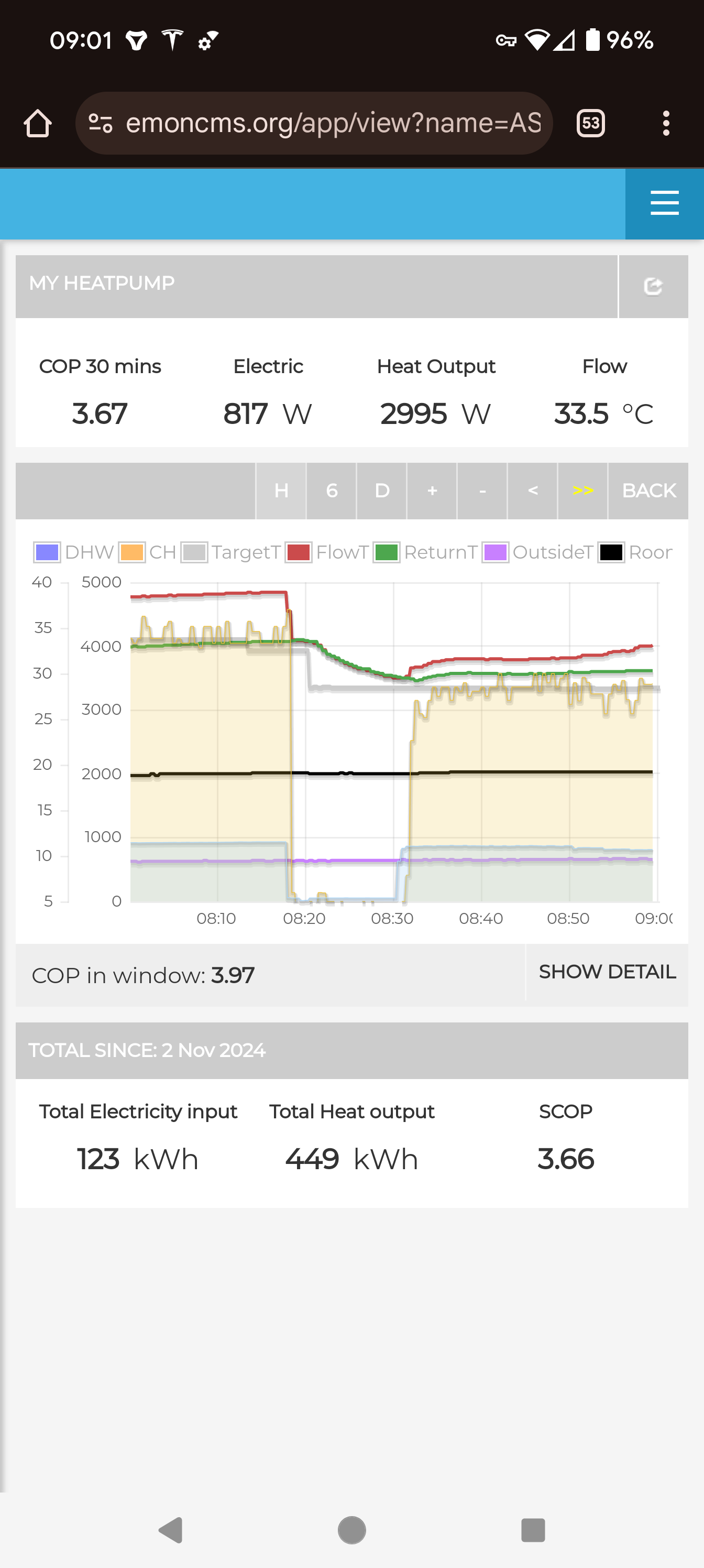
You need to have some cold periods to get a better baseline. Mine was running instrumented from mid-Dec 23 on. I looked at the average figures for heat loss*** throughout the period 18/12/23 - 16/03/24, which gave me an average 0.35kW/C coefficient. Applying that to the range (14, -10)C gives me flow temps of (24.6, 47.6) for my radiator configuration, so I set the WDC to 25C@15C, 48C@-10C. Since I also set the field setting [4-02] (Space Heating Off Temp) to 14C, above which the HP doesn’t do space heating, that meant that the lowest point of the WC curve was 26C, just above the 25C point at which it might have wanted to use the Backup Heater.
I am using an overshoot of 4C, field setting [9-04]. I am running WC/LWT control only, so no modulation - the Madoka is in a stupid place (duh, both me and Octopus techs!), so doesn’t relate to house average temp. The heatpumpmonitor.org data uses the Madoka number, which is why it’s 24C, but it’s more like 21-22C throughout, and very constant.
***Clearly you need the EmonCMS (home or cloud) data to do this, so it takes time! I used an equilibrium point of 14C, which is probably a bit low, but seems ok for us. So for every additional 1C below 14C, my house needs 0.35kW heat input.