I’ve had a quote from an installer for a Samsung Gen 7 R290 5kWh unit and a quote from Octopus for a Cosy 9 (9kWh)
Both did an in person heat loss survey, but I am struggling to understand why Octopus is opting for a 9kWh unit over the smaller 6kWh Cosy 6
I ran the numbers through heatpunk and loss is coming up at heat loss of 2682. The Samsung installer came to just under 3000W heat loss. Octopus said 5900W loss.
Flow temp I used on heatpumk is 46C. Samsung installer used 50C. Octopus a massive 65C
I suppose my question is, who do I believe is doing the correct calculations here and is there any advantage going to the Cosy 9 over the Samsung?
All good questions. @peggleg, and welcome to the forum.
According to the Octopus website Cosy heating | More than just a heat pump | Octopus Energy the rated output for the Cosy 6 is 5.2kW at LWT = 65degC and 5.6kW at LWT = 50degC. So if they assessed your max heat loss at 5.9kW (i.e. more than the Cosy 6 is rated for) they will likely propose the next size up, i.e. 9kW.
The other important heat pump number to get hold of from prospective vendors is the minimum output (i.e. turndown) as this is important in (undesirable) cycling especially during the “shoulder” months (Spring and Autumn), when the heat requirement is lower. If your house heat loss is less than the minimum heat pump output (when the compressor is running at minimum speed) it will have no option but to switch off for a while, and switch back on again when the circulating water or house temperature have cooled down. If this on-off cycling happens more than 2-3 times per hour it can shorten the life of the heat pump. So you really want to roughly match your maximum (winter) heat loss to the rated output of the heat pump - installing a larger one will probably result in more frequent cycling.
There are things you can do to reduce cycling (like increasing the hysteresis settings on the circulating water and room thermostats, or increasing the water inventory), but these are really treating the symptoms rather than the disease.
Vendors have at least two incentives to sell you a larger heat pump than you require - they make more profit, and also you are less likely to complain that your house isn’t warm enough. But a heat loss of 5kW sounds reasonable for an average size house with good loft insulation, cavity wall insulation, and double glazing.
Without knowing your house constuction details, my gut feel is “possibly borderline”. If your heat pump is too small you may find you have to increase your radiator sizes a lot to avoid a cold house. Having a little spare under the hood allows you to operate a night-time setback (when you need extra heat to re-warm the house in a reasonable time), and is insurance for those few really cold snaps we sometimes get in the UK.
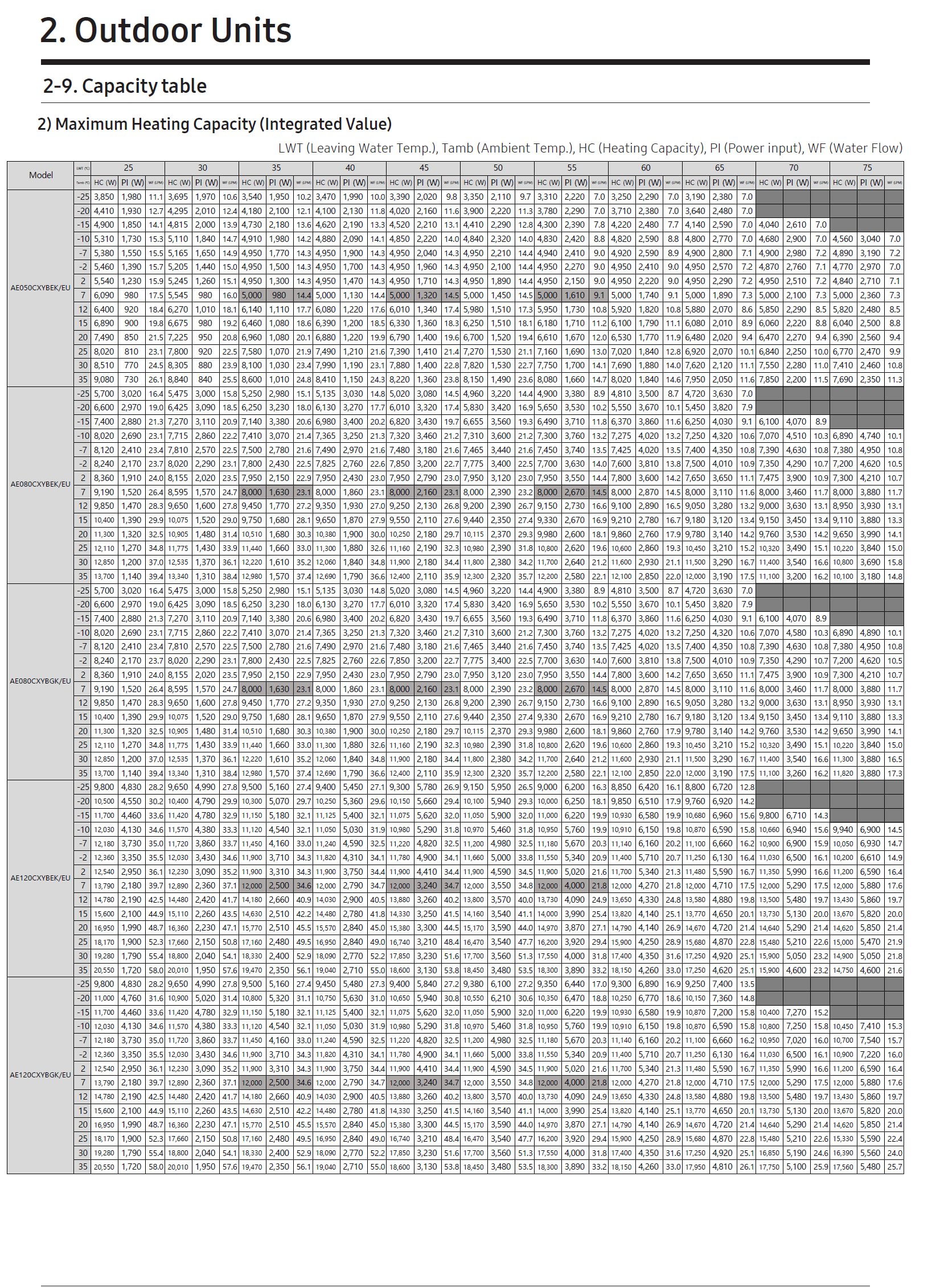
Not from personal experience, @peggleg (I have an 8kW HTQ), but have a look at Table 2-9 in the R290 Technical Data Book. It’s too large to upload here, but here’s a screenshot of part of the Table
You will see that the heat outputs (HC) vary significantly by LWT and OAT, and these numbers apply when the compressor is running at 100% speed (motor inverter frequency 50Hz). But I don’t know the minimum inverter frequency programmed into the R290 series controller. If I did, I could estimate heat output in proportion. For example, if it was 20Hz, I could multiply the above Table figures by 20/50 = 0.4 to get the (approximate!) minimum heat output. By way of reference, the minimum frequency on my HTQ is 20Hz when OAT < 7degC and 14Hz when OAT >7degC.
There are a few Gen7 owners on this forum who monitor their controllers. Maybe one of them can tell you the minimum inverter frequency, or if all else fails you could email the Samsung UK Tech Helpline at [email protected] (contact Nick Kirwan).
I have no experience of smart roomstats, @peggleg. But all the Samsung controller requires is a demand/no demand signal from the roomstat (plus some fooling about with factory settings on the controller, which your installer should be able to set up - or you can if you wish).
I have used a Tado since 2021 but now only as a convenient remote on/off. The Tado is not really suitable for heat pumps because when the room temperature gets close to the target it switches the HP off for 10-20 minutes at a time as if it were a boiler and that’s horrendously inefficient as the HP then has to add a lot more heat to the water which has cooled. I find that if I don’t switch off for about 2 hours, there’s little or no saving.
I took off all my Hive TRVs too but they can be useful in bedrooms to stop them getting too hot. You don’t want them calling for heat though.
What I do with the Tado now is set the target temperature to 25c and let the heat pump water law (Samsung Gen6 16kW) pass the appropriate amount of heat into the house, running 24 hours a day.
This works fine except when it’s really mild when it occasionally gets too warm in the house (like 23.5c or more) so I turn it off via the Tado.
The Heatpumpmonitor website has a list of heat pumps and their min & max outputs. HeatpumpMonitor.org
Looks like the minimum modulation is around 1.8kW and a maximum output of only 4.1kW (when including defrosts) for the 5kW Gen7. I would look to go up to the 8kW model of the Samsung range (which is what I have). That being said, I think (and many on here will agree) that the Samsung controls are fairly outdated and rudimentary so am not currently recommending them. I think Grant are leading the way on the budget end, Vaillant in the mid-range and Viessman at the premium end.
Do you have any idea what the heat loss of your property is? Can you estimate it from your current usage. If you currently have gas heating and a smart meter, you can look at your daily gas usage over winter, pick the coldest day and you can get a good idea of your heat requirements. Certainly accurate enough to know if it’s 3kW, 6kW or somewhere in between.
I found a very simple formula online yesterday that asyd you take your annual gas usage and devide by 2900 to get the pump size required… for me that worked out to a 3.2kWh unit
Great, 80kWh/24h = 3.33kW heat loss on that day, so that looks like the ballpark you are in
Therefore, Octopus’ estimate looks on the high side and you should have no issues with the smaller 5kW Samsung unit in terms of being undersized if that is the route you decide to go.
If you want to go with Octopus, I’d challenge their heat loss calculation, and give them the evidence from your actual gas usage to see if they would agree to the smaller Cosy 6 unit.