Apologies, I misunderstood. I thought you said that pwm was not active during DHW. I agree, the above alogrithum seems to correlate with my experience.
Dear all,
After few investigation on how to go higher CoP with the gen7, I’ve observed that the inverter pump PWM max value was quite driving.
Playing with FSV #4051 (1 = 100% max value, 2 = 70% max value), made my CoP go from 4.5ish to 5.5ish while heating the underfloor (as it’s better to heat low but for a long period to heat up the concrete and maximise the comfort).
While changing FSV #4051, I observed that the NASA message 0x40C4 was updated. And it came to my mind that the 40C4 might be holding the “max PWM value” for the pump. After few investigation, it sounds like I was right. And cherry on the cake, the 40C4 value is writable, implying the CoP is somewhat “manually” ajustable.
The only thing I don’t know yet, is: has the 40C4 any impact on the DHW cycle (which I don’t want, or maybe just for trying. Answer to that later today, when the DHW starts up).
In the end, this enables to better cap the minimum CoP (at the potential cost of cycling, depending on #2093 Temp control setting)
Cheers
Hi @Topaz,
Your observation is somewhat surprising - conventional wisdom is that changing the water flowrate (by changing the pump flow through PWM or other means) simply changes the deltaT across the heat pump (since Q=m.Cp.deltaT and Q and Cp are roughly constant). True, the pump power may be slightly reduced at a reduced flow, but equally your emitters will run at a slightly lower average temperature so you’d need to boost LWT to compensate which directionally increases the heat pump power consumption. I would have expected the net effect on CoP to be very small, not the 20% that you report. Perhaps you could give us a bit more data (LWT, RWT, flow rate, heat pump electrical power) from your controller display with #4051 in different settings?
Sarah
Yes, I was also surprised, however, my emitter having the same LWT entering it, it just gives “more time” for the heat to diffuse before returning to the heatpump with lower flowrate.
Here are some data, I’m trying to have a compounded graph:
With flow limit set to 100% (18L/min in my setup):
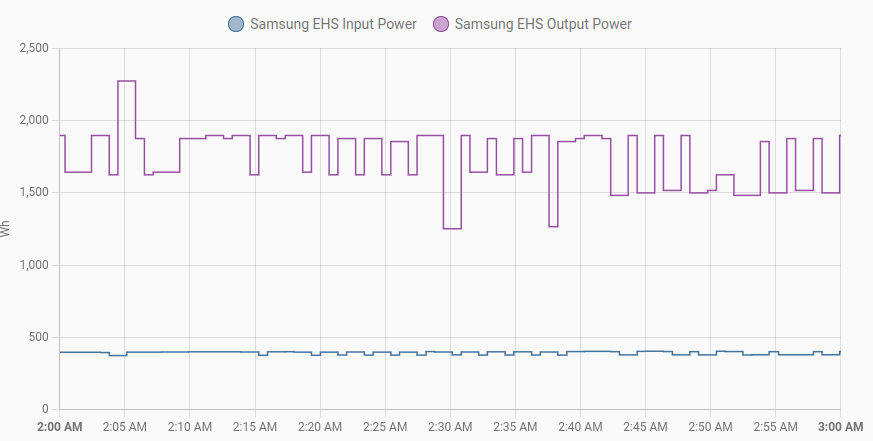
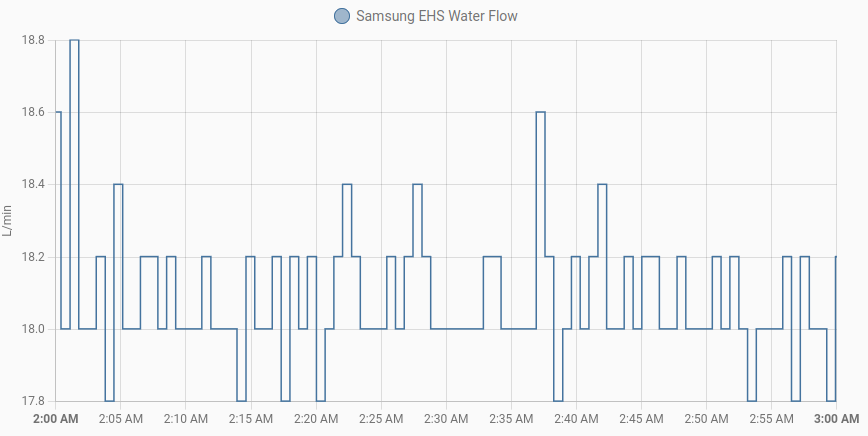
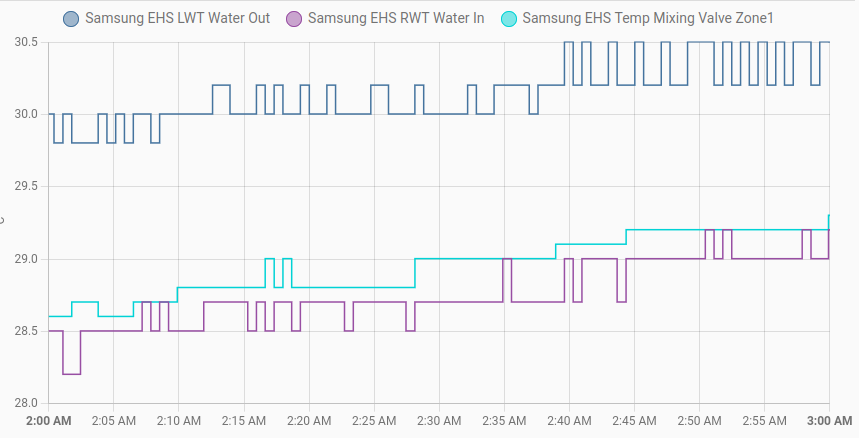
With flow limit set to 70% (13L/min in my setup):
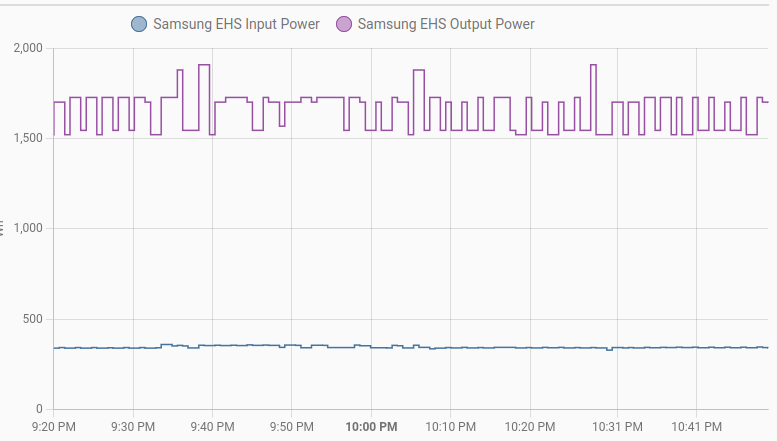
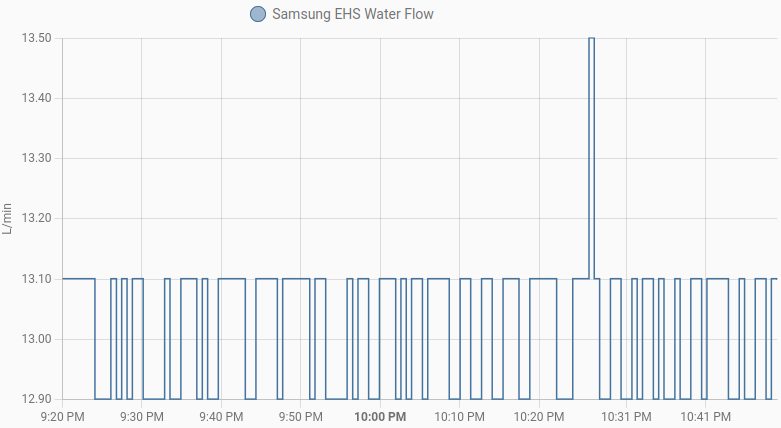
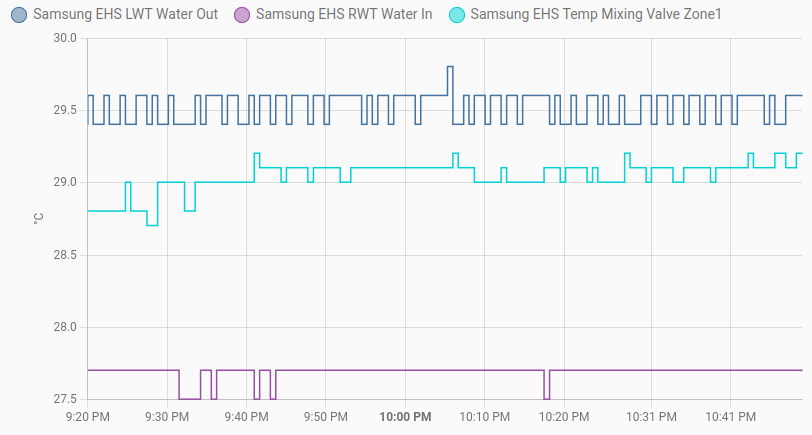
I don’t have a clean CoP display yet, but you have the averaging 1min consumption.
What I observe is that the global CoP raises faster with 13L/min setting than with the 18L/min setting.
Currently I’m trying the 7.2L/min setting too (I also wrongly set the setting to 0L/min, and it ended up in a raising LWT to 55°C (for 5 minutes) before I corrected. Therefore I’m sure the setting is not overriden by the ASHP, even when it’s clearly wrong).
Thanks @Topaz, very helpful outputs.
Your 100% PWM output looks like HP input ~400W, output~1750W (i.e. CoP ~4.4) while at 70% PWM output it looks like HP input ~350W, output ~1625W (i.e. CoP ~4.6, about 5% difference). Where did you get the CoP ~5.5 from?
Edit: I calculate that your (m.Cp.deltaT)s are very similar for the two cases. Assuming you have an ASHP, and that the fan power is included in the HP power, I wonder whether the fan was operating at a higher speed in one case than the other (the fan draws ~100W at full speed, so any reduced speed may account for part of the measured input power difference).
I’ve not been able to isolate when the zone 2 is live, because it was already way beyond ambient target. Also, the CoP was a transitory one, I’ve not correctly setup my statistic computation procedure. I’ll make sure to correct this.
But I remember spotting the value displayed on the fly yesterday when I was playing with the settings.
I’ll make sure to have some more long term statistics. I think this new setting is opening me a path for overoptimization, I won’t that nifty chance 
Cheers
I’ve been collecting new data this morning, and performed an averaging of value
Here is the input/output powers
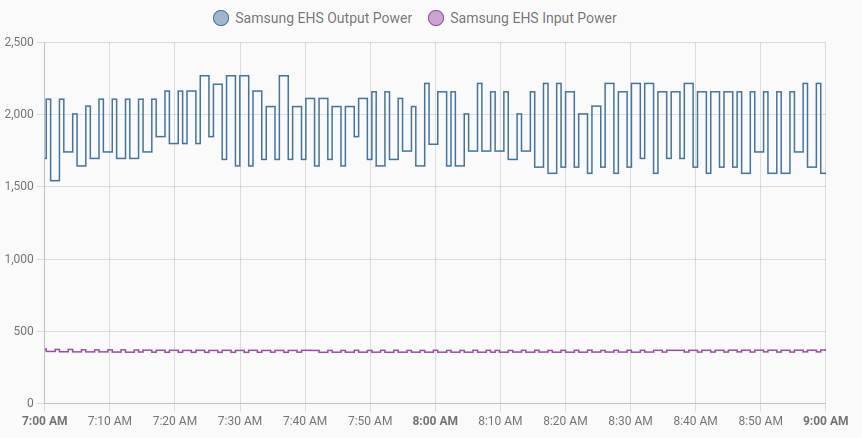
Flow and temps are the same as yesterday’s graph
The average input is 356W, the average output is 1960W, giving us a CoP of 5.5.
The only problem is that I have yet troubles to explain physically why is the CoP higher with lower flow rate when I consider the system as a whole (I only understand the local computation of output power from flow (LWT-RWT)1.162flow_liter_per_minute*60).
My only guess is that as it’s emitted through an underfloor, the water gets a longer time to loose heat while giving it to the concrete before the waters goes back to the heatpump. My architecture is a vessel heated by the heatpump and its internal pump (AE050CXYBEK/EU). And 2 auxiliary pumps one for each circuit from the vessel to the zone 1 and zone 2. the auxiliaries run full speed and are not bound to the speed of the internal HP’s pump.
Cheers
Another assumption could be that my insulation is not sufficient on the in and out between the vessel and the heatpump, and the lower flow rate makes the heat losses too high, hence allowing the HP to increase it’s CoP when the emission of the underfloor and the transmission tubes are added.
However I find it unlikely considering the insulation is 19mm, and that the tubes are not outside, as the HP is in my basement (pumping air from the basement, and flowing the air on the outside through a long duct)
Good morning @Topaz.
I think that there’s something a bit inconsistent in your data, which perhaps you can clarify. Your output power has risen from about 1650W (your previous graphs) to about 1960W (today’s graphs), yet you say that flows and temperatures are the same. Something must have changed… 
Also I’m puzzled by your
This should be Heat generated (W) = (LWT - RWT) (degC) x m (litres/min) x density (kg/litre) x Cp (J/kg/K) / 60 (s/min). If your fluid is water, at ~30degC density is 0.996kg/litre and Cp is 4180J/kg/K. Where does the 1.162 come from?
Edit: Your system description suggests that not much of heat leaving the heat pump doesn’t enter your required heated envelope. Typical external losses (heat pump located outside house, unheated plant room containing pump(s) and vessels) are unlikely to exceed 100-150W. Yours should be considerably less, as you suggest.
Dear Sarah,
I’m puzzled too about the number, I have yet to find the difference, and a way to trace that in a easily diff-ready way.
Also about the 1.162, this is 4180/3600. Which is the amount of watts required to heat up a litre of water of 1K. We manipulate the same numbers . I usually find it easier from a “science with the hands” perspective to think using that concept…
Cheers,
Edit: Your system description suggests that not much of heat leaving the heat pump doesn’t enter your required heated envelope. Typical external losses (heat pump located outside house, unheated plant room containing pump(s) and vessels) are unlikely to exceed 100-150W. Yours should be considerably less, as you suggest.
This is really bothering me. I’m wondering where and what I should monitor to understand better.
Is your set-up similar to the first sketch in https://midsummerwholesale.co.uk/pdfs/quick-start-guide-samsung-gen-6-kits.pdf (except that there are two secondary pumps - one to and from your radiators and one to and from your UFH)?
If I was you, I would be fairly relaxed about your CoPs - they are very good already, and probably all you can do to improve them more is to keep reducing your LWT (as long as the house remains comfortably warm…).
Sarah
My setup is similar to the first schematic of https://midsummerwholesale.co.uk/pdfs/quick-start-guide-samsung-gen-6-kits.pdf, I do have 2 secondary pumps in my case. I actually used the schematic from the Samsung installation manual which is very handy to avoid loosing track of the wires to be connected.
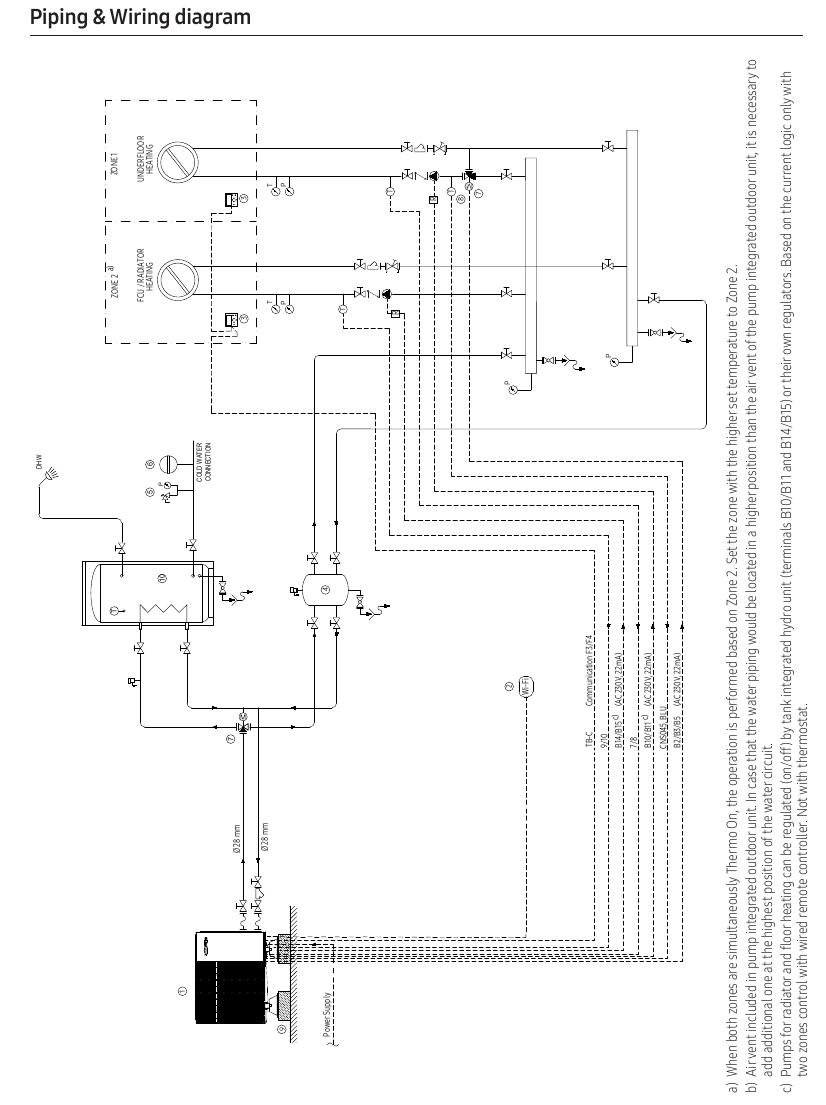
I’m still quite bothered by the PWM limit and its impact on the CoP, but I guess I start to understand something real simple, like measurement and accuracy, temperatures and with 1 decimal, so is the flow. Therefore, when flow is higher, temperature tend to be lower, amplifying their error in the output power computation formula. Maybe this is where the “missing” heat was hidden. It can represent up to 2 times 0.1K when dT is 2K, this is 10% error!
You’re right though, I won’t pursue complete optimization when I already reached something warm enough.
Best regards