Samsung Gen 6 Minimum KW Output

Hi All,

I have decided to go down the rabbit hole of trying to tune our heat pump,

After doing some research i have settled on the low and slow approach,

After making the changes all is looking well,

HP seems to be running at a constant 800W, @ 29c LWT. currently 5c outside temp and house is very warm throughout around 21 - 22 c.

Quite happy with how it is running although early days.

Does anyone know if you can run your HP at a lower kw output?

if i try change the low water law settings to anything below the 29c output remains at 800W?

Thanks
Darren

What size is your Samsung? The 12 kW and 16 kW Samsung (and also the 8 kW I believe) use the same compressor and are software limited, so 800 W sounds right unless you have a 5 kW model. It also depends on whether you are taking your reading from an independent meter or the Samsung display as the latter is calculated differently and not that accurate.

Welcome to the community @darrenb333 :slightly_smiling_face:.

Most compressors have a minimum operating speed to ensure they stay out of a condition called surge (instability caused by incipient reverse flow, which can cause mechanical damage). My own measurements indicate that the motor inverter on the Samsung HTQ 8kW compressor can run as low as 20Hz, and if this is still too high to meet process requirements the controller stops the compressor.

Compressor theory suggests that the power drawn by the compressor at any running speed depends on the throughput (in our case the R32 circulation rate, which is a function of the heat demand by the circulating water to the emitters) and the head, which depends on the inlet pressure (which is a function of ambient temperature) and discharge pressure (which is a function of the LWT).

So the minimum power drawn is not a fixed number, depending as it does on the above factors, but it seems to me that there’s not a lot you can do about it - it is whatever it is at the 20Hz lower inverter limit.

(In the HTQ series - which don’t seem to have a Samsung Gen number - all three models 8/12/14kW have the same compressor, so I’d expect the 12/14kW inverters to have the 20Hz lower inverter limit too.)

In response to @MikeJH’s comment about the Samsung remote display, he is quite right in that this is the total power to the Outdoor Unit - including the fan (on ASHPs) or the circulating pump (on GSHPs) and the electronics, as well as the compressor. The fan in particular is quite a large power consumer (100W or more at full speed) so can be quite a significant portion of the number shown on the remote display. If you have a power meter just on the compressor power supply you can expect to see a quite different number.

The foregoing is fairly consistent with what Samsung told me when I asked about compressor turndown - they said “about 4kW output for the 8kW unit” (i.e. about half of nameplate - not far off 20Hz compared with a nominal 50Hz full speed), and I certainly see my compressor stop when the heat duty falls below ~3.8kW.

Sarah

If you can get it stable at 800w that looks pretty good. My gen 7 8kw cuts out at anything between 2500w and 1100w. The internal flow meter seems wildly inaccurate as I get 27.3lper min at 80%pwm while openenergy is 17.85lpermin, also Samsung advise that “2.07kw is the minimum turndown on your unit”
Not sure it helps but seems a degree of randomness in there somehow.

FWIW I think for these little positive displacement units the limits are more driven by:

  • Motor efficiency / heating at lower frequencies
  • Internal leakage within the compressor becoming material
  • Bearing loadings being “in balance” or “in limit”
1 Like

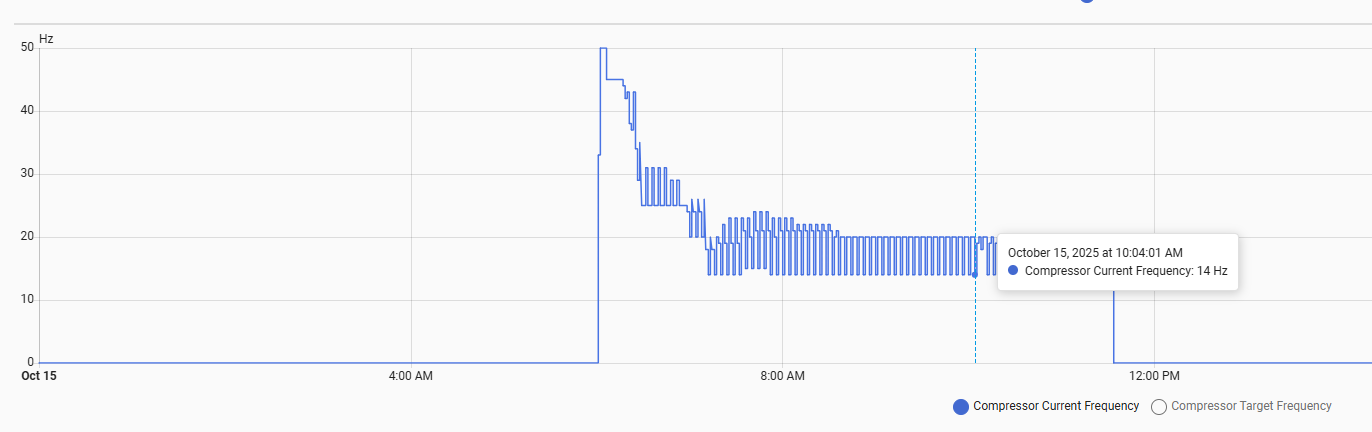
A bit old topic but mine HT Quiet R32 8kW can go as low as 14Hz. At this rate it’s pretty inefficient thought. I’m using roomstat so the pump is turned off only by thermostat exclusively. So If the temp can’t be reached because e.g. low flow temp then the the pump operates 24/7 at lowest flow temperature which can be achieved with actual conditions. For this reason the target flow temp can be overshoot. The modulation is very bad at these conditions and the input power fluctuates easily by 500W every minute or so. Pain to watch.

The biggest issue is in Autumn when there is ~10C outside. With low heat losses and oversized pump (yes, it is 14kW pump, not 8kW as declared by Samsung) and with radiators with low water volume it’s is pretty painful to drive with a good efficiency. My SCOP is around 2.8 - 3 which is not ideal.

Next time I will be much more clever and I wish those installers have at least basic knowledge about products they are selling and installing because normal user can’t understand this. Let’s see when it breaks but it can run for decades lol so I have to live with it now :slight_smile:

A minor observation to add to @Michal_S’s above. I also have an 8kW HTQ, and I’ve noticed an apparent anomaly in the minimum inverter frequency (MIF).

My settings: #2091 = 1 (i.e. 3rd party wireless roomstat, and WL cannot stop/start the compressor, only the roomstat can), and a large night-time setback so I set #2021 high initially for a quick re-warm of house then turn it down once the house is comfortable.

My observation: After start-up from cold, the MIF is 20Hz, but after roomstat takes control, MIF is allowed to drop as low as 14Hz (at least at mild OATs).

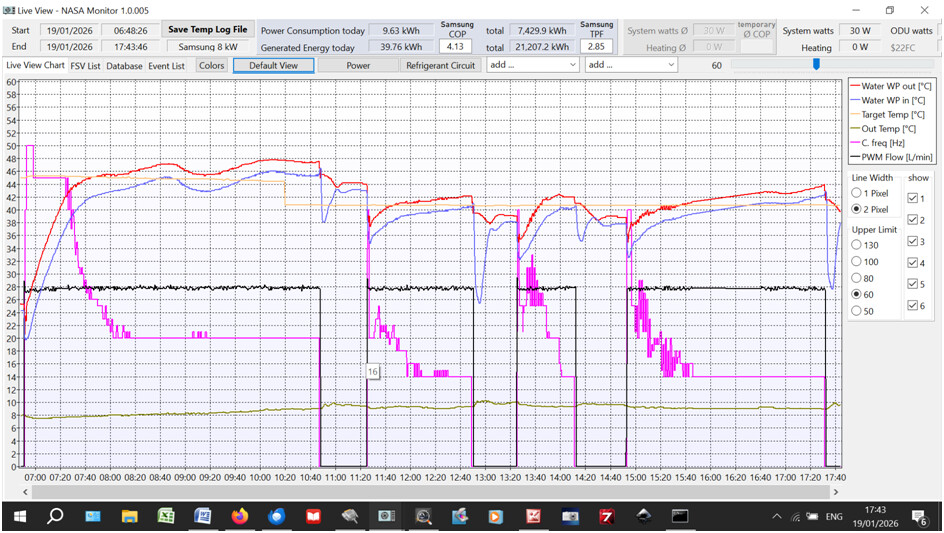
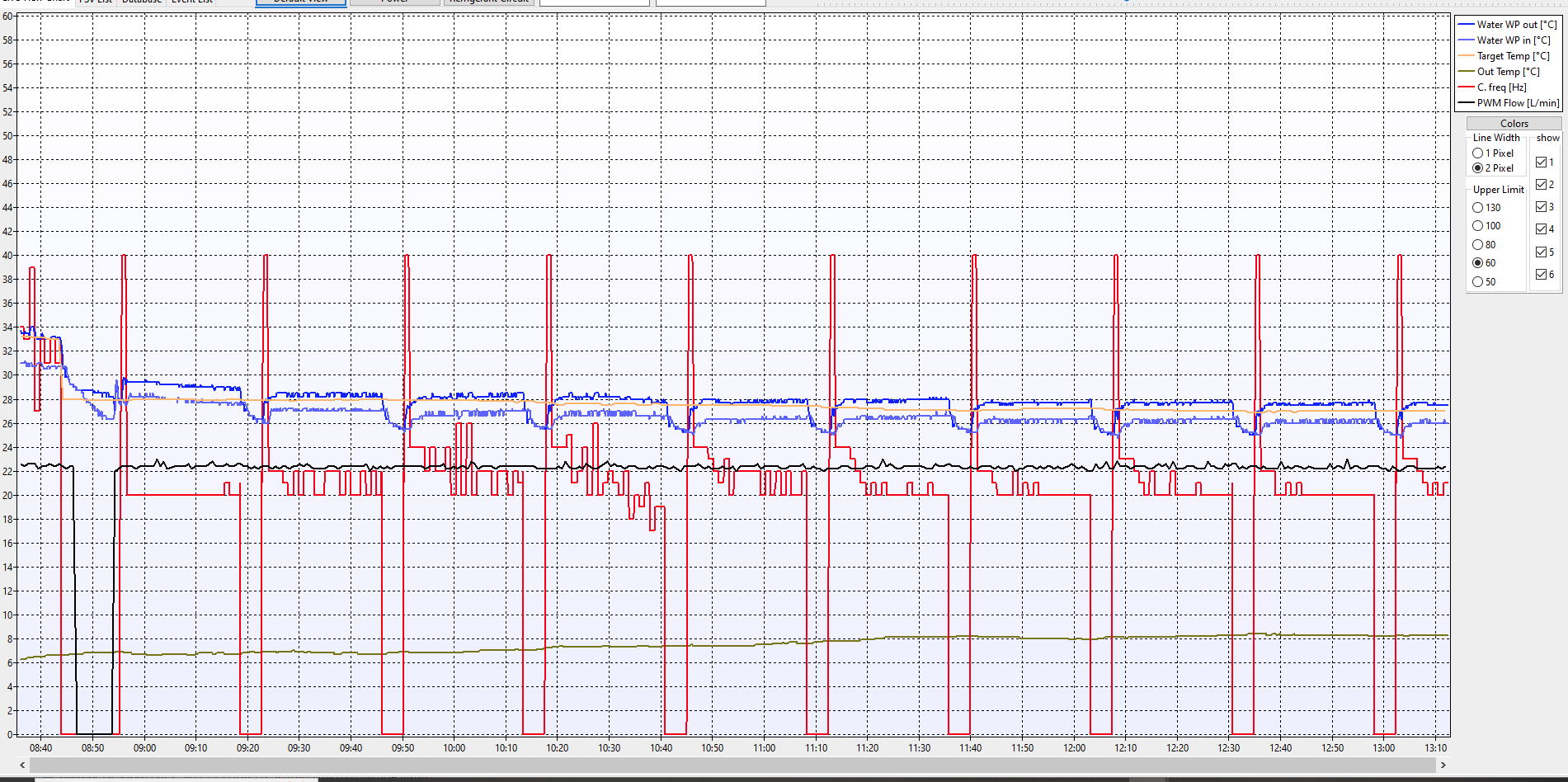
Here’s a trace of what happened recently after post-setback restart:

  1. You can see that LWT (red line) rose rapidly towards WL target (yellow line), and as it approached it, the inverter speed (magenta line) dropped to 20Hz, where it stayed even though LWT continued to rise above WL target (e.g. at 10:00).
  2. By 10:20 house temperature was comfortable so I reduced #2021 (see drop in yellow line), which now left LWT some 7degC above WL target.
  3. At 10:45 the roomstat was satisfied so it stopped the compressor, restarting it at 11:25 because the room temperature had fallen by the hysteresis setting on the roomstat (0.4degC).
  4. After heat pump restart, LWT was reheated back to (the new) WL target, and successively dropped the inverter frequency right down to 14Hz, where it stayed until the roomstat was once again satisfied at 12:50.
  5. This effect is more dramatically illustrated in the cycle starting at 14:50 - the compressor sat at its MIF of 14Hz for 90 minutes or more.

So it would appear that there are two MIF algorithms in the MIM controller - one for startup from cold, and a separate one for startup from warm.

If anyone is interested in the energy flows during the same period, here they are:

The running CoP for the day - at least until 17:48 - was 4.13, as shown at the top of the display. This is probably typical for a mild day (around 9degC per brown line in first trace) given the hard work the heat pump had done to reheat the house after setback. The minimum total (indoor + outdoor) input power (at 14Hz) was about 800W on this trace (yellow line), though I have seen it as low as 700W on other days.

1 Like

Hi Sarah,

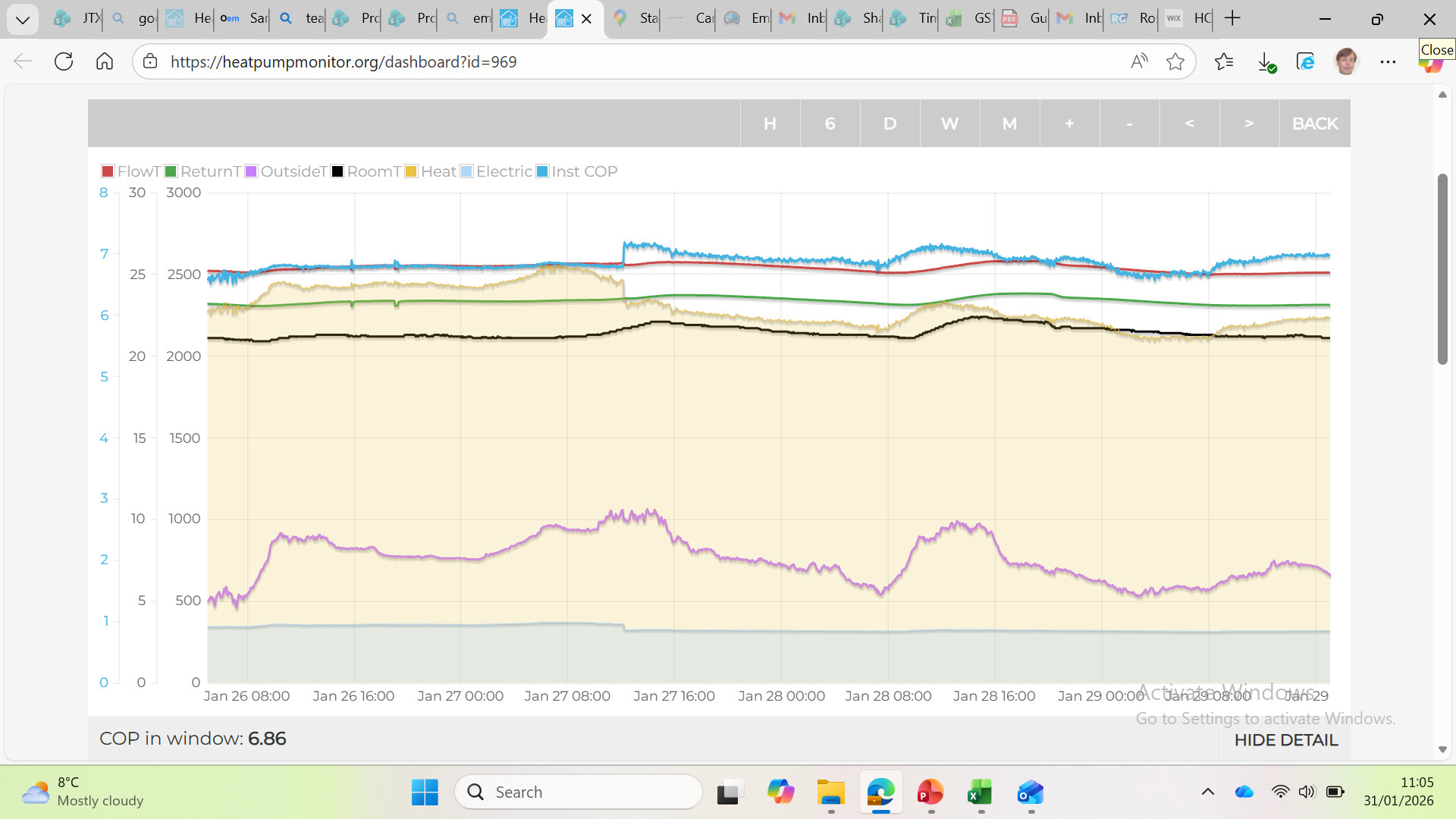
I haven’t posted before but have been following your posts and have been trying to optimise my Gen 6 since it’s installation last summer. In particular I have also been trying to get mine to run low and slow with minimum compressor speed. I now have it stable with compressor speed varying between 14Hz & 16Hz (thanks for the help setting up Waveshare!) with input power of between 284 Watts and 341 Watts and constantly producing around 2 - 2.5kW which is enough to keep a constant house temp of 21 degrees. My weekly COP is around 6.8. I am not using Water law but fixed flow. I intend posting on the Samsung Facebook group next week with some more detailed information as my settings and approach might work for others. My recent performance below, regards ,Tim

1 Like

Hi @tim_knights and a warm welcome to OEM.
That’s a very impressive performance you have there - congratulations on getting so far so fast! :slightly_smiling_face: Please share your setup details on OEM too (we aren’t all into social media…).
Sarah

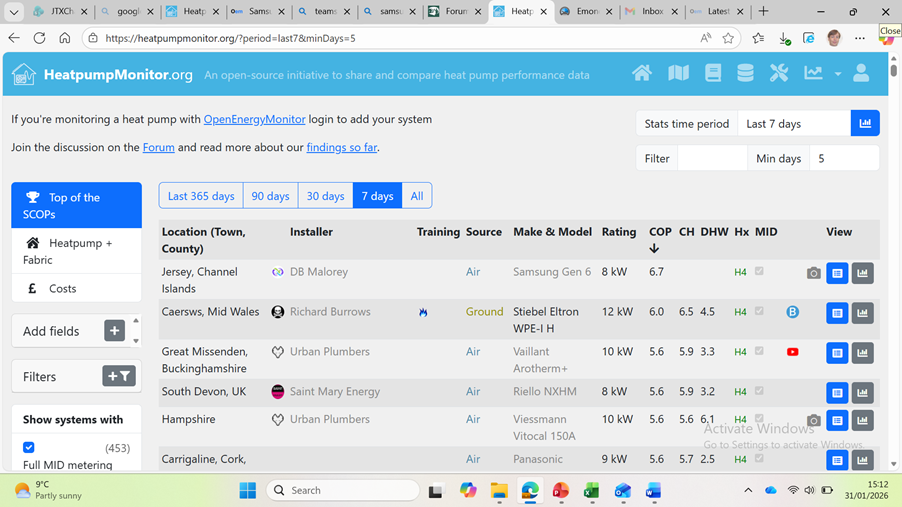
thanks Sarah, I posted them a few days ago though you need to select either Last 7 days or 30 days to see my entry- Jersey. My latest setup started on Jan 9th, apart from a few hiccups (self induced!) it’s been stable since then. Nice to see a Samsung top of the list!

Hi Tim,

That’s truly impressive. My gen 7 doesnt go below 20 hz and does lots of cycling, I’m on waterlaw, perhaps shouldn’t be from your posting! I’d be really interested to see how you did it?


Hi Peter,

I am doing a write up of what I have done, it might not work for everyone as I don’t use my Heat Pump for hot water so don’t know if that would have an impact but worth a try!

regards, Tim

Thanks @tim_knights, and be sure to include details of your FSV #209* settings. (I’ve only seen inverter frequencies below 20Hz since I changed #2091 to 1, for example.)

@JPB are those cycles of yours WL-induced or roomstat-induced? I’m guessing the latter because your LWT is tracking WL target nicely. If so, is your roomstat hysteresis-based or TPI-based? This can make quite a difference to heat pump cycle frequency.

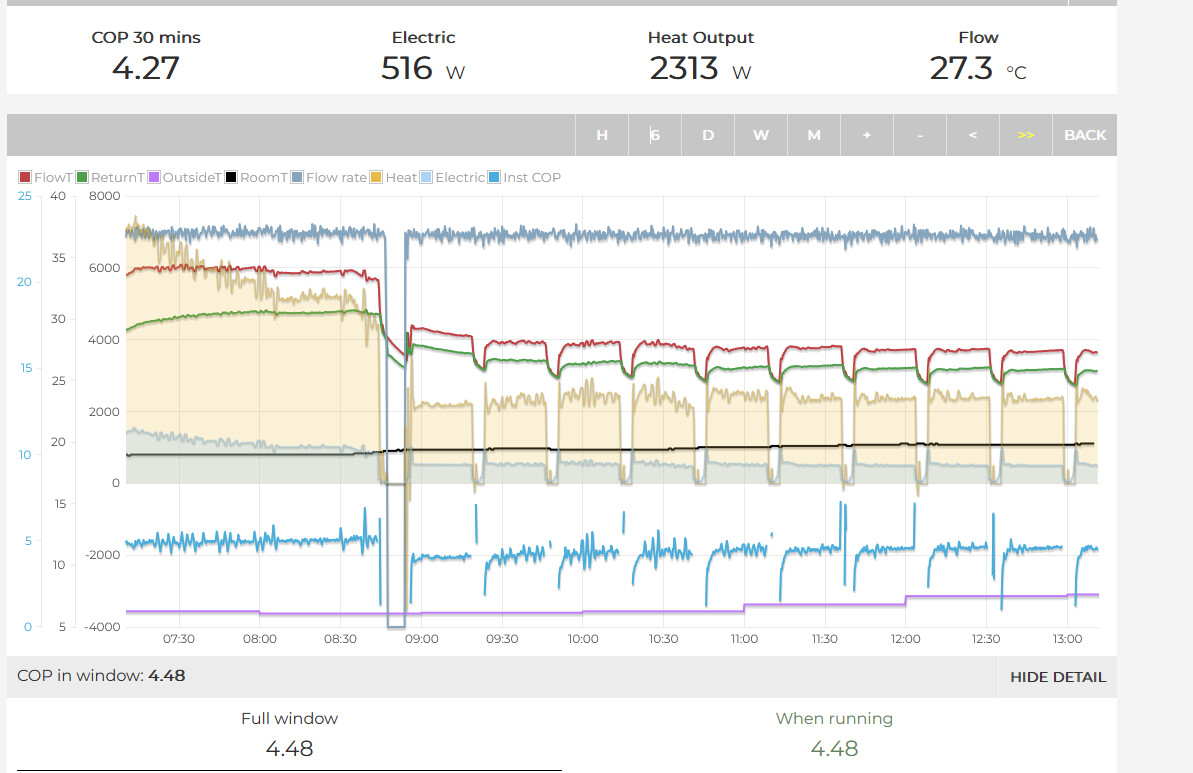
Sarah, I’m using the indoor unit thermostat, upgraded by Samsung to 1degree hysteresis. However it is set at 22 so only occasionally active at that temp and house mainly runs at 20.5 to 21 thanks to water law.

I have the hot water overnight at cheap rate and last night charged cyl to 51c, by 6.30 it was down to 24c without a tap being turned due to the cycling.

Wasn’t Samsung looking for info about the cycling issue from forum members recently?

Hi Sarah,

I have done a draft of the post I am preparing for the Samsung group but would appreciate any comments you have first, as below thanks

Path to a stable COP of up to 8.5 with a Samsung Gen 6 8kW

· Installed by local contractor to my design / specifications (based on the many posts I had read on the Forum thank you)

· Am in Jersey, so similar weather to South of the UK

· Self built detached house 350sq m, all underfloor heating (150mm spacing)

· High thermal mass as block built with external insulation

· High levels of insulation though not to Passivhaus standards

· Hot Water supplied by gel battery storage cylinder fed by solar (so not connected to Heat Pump)

· Old boiler was by oil with separate zone for each room

· No hydraulic separation (i.e. no buffer / volumiser etc)

· Changed to open loop by increasing temp setting on all thermostats to +25 degrees apart from lounge thermostat which was connected to heat pump controller (though not now used)

· UFH manifold mixers left in place but turned to maximum heat setting (so shouldn’t be activated)

· Monitoring using SNET-Pro 2 / Waveshare + Emoncms

· Tried all the usual settings on the controller, “Indoor Zone”, “Water outlet”, “Heat”, “Auto”, Water law, Thermostat controlled, fixed flow temp, different flow temps, different delta T / circulation pump settings etc and go some good COP numbers around 5

· However, whatever I did the Gen 6 seemed to never be in a stable state. It either did full cycling, ramping up flow temp and then shutting off for a number of minutes, or in the case of fixed flow temp it kept changing compressor frequency which I could also see from the input power fluctuating

· Like most the heat pumps fitted, in normal winter weather (i.e. not during the 1 or 2 cold spells we have per winter) my unit was clearly well over powered and likely that is why it wouldn’t stabilise.

So could I force it to work at a really low flow temperature and hence minimum output heat power and get it stable, well as it turns out yes!

· 2091 & 2092 set to not use

· 2093, suspect this should be set to not use but on mine it is on setting 3 however my controller is in an outside plant room so would never get to the required temperature.

· 2021 & 2022 both set to 25 degrees (so using water law setting but actually not doing any weather compensation)

· At a flow temp of 25 degrees my delta T became really low, so to compensate I set circulation pump to minimum setting which helped

· Delta T now around 2 degrees as opposed to recommended 5 degrees but Heat pump doesn’t seem to mind

· Set controller to “Auto”- as documented this shouldn’t make any difference to operation but it really does!

· Then followed this procedure: Increase flow temperate offset on front panel by 1 degree and leave system for a couple of hours, then change back to 0. The flow temp should then reduce down to 25 degrees and stay there. Note- without doing this I found the heat pump could go into a compressor oscillation cycle where it keeps cycling through compressor speeds and won’t break out of this. (Maybe Weather compensation also sometimes causes this instability?)

So how does it perform?

· I did the above on Jan 9th.

· Really is Low & Slow! Heat pump consumption between 284 Watts & 341 Watts which seems to correlate with compressor speeds of 14 – 16Hz, which I believe is as slow as it will go.

· Around 8kWh total usage per day which at £0.15 cheap heating tariff is £1.20 per day currently, way less than half what Oil was costing

· Circulation pump constantly using 13 Watts

· Heat output above 2kW which is enough to keep the house a pretty constant 21 degrees

· Instantaneous COP of up to 8.7 and sometimes above 8 with external temperatures between 2 & 11 degrees

· Self inflicted issue on 24th Jan, we had one UFH loop that was never turned on, I turned it on and the flow temp dropped as expected, but rather than just recover back to stability it went into the compressor oscillation cycle again (left it for 24 hours and it was stuck) so had to do the +1 degree for 2 hours then back to 0 degrees on the controller and it went back to being stable.

· As of end Jan seeing weekly COP of just under 7

Next steps

· Of course I haven’t tried these settings in a cold spell. I am hoping that it will simply be case of raising my outlet temperature by a few degrees to compensate for additional house heat loss.

· It will also be interesting to see what happens when outdoor temperatures increase with such a small delta T. I suspect I will quickly get to the point where I can’t dissipate enough heat and will run into cycling, maybe increasing outlet temperature will help and opening the windows :blush: Worst case I just start using external thermostat.

· It will be interesting to see if I can make it stable below or above 25 degrees and keep the COP / low compressor speed, at some point I will try

Points of note

· I am hoping the above will work for some

· I don’t know what the impact of doing hot water cycles will have on your systems

· I also have a large emitter area (circa 1.5km of UFH pipe) and suspect I am able to run such low flow temperatures (and hence high COP) as I can still dissipate the required heat and therefore reach stability

· I am able to use my high thermal mass to absorb any daily fluctuations in internal temperature from external temperature changes which weather compensation would normally be required for

· Isn’t it nice to see a Samsung at the top of the tree :blush:

· I very much look forward to hearing what you can achieve, please don’t hesitate to contact me with any queries. I am no expert but have had some experience now in optimising this unit.

I suspect your cycling in the graphic is due to your fsv 2093 setting. If you change it to setting 1, your cycling should stop, but LWT may rise above target slightly.

That happens if there are antifreeze cycles, when space heating is off and outside air temperature is below 5C. It shouldn’t happen if there is cycling during space heating though.

Hi @tim_knights.

I’m flattered by your faith in my editorial abilities :thinking:.

No problem with your words, but you might wish to bear in mind that publicising exceptional CoPs like yours might invite intense scrutiny in some quarters (some folk see being “top of the SCoPs” as a sort of competition), so it might be idea to pre-empt some obvious questions by adding some words on:

  1. The quality (accuracy) of the data your CoP/SCoPs are calculated from. If you have a reputable 3rd party professionally installed CT meter (appropriately voltage-compensated) for energy consumption, and a MID-certified heat meter for energy generation, then say so. If you are basing your numbers on the Samsung-fitted instruments, then these may be prone to some error. For example, I know that my LWT and RWT sensors differ by about 0.8degC when the circuit has been offline for several hours, so given that my (LWT - RWT) deltaT is typically 2.5degC, my energy production (calculated from Q=m.Cp.deltaT), and thus my CoP, may be 30% adrift. Again, an acknowledgement (better still an estimate) of possible errors might be helpful to your readers.
  2. It would be a good idea to state your measurement boundaries. @Timbones summarised them in HeatpumpMonitor: Immersion heater vs. System Boundaries - #2 by Timbones, but there are whole threads devoted to the subject. This would let your readers know whether they are comparing like-for-like.

Please don’t take the above as criticism, you’re doing better than most owners, but qualifying your data where necessary may avoid answering some difficult questions…

1 Like