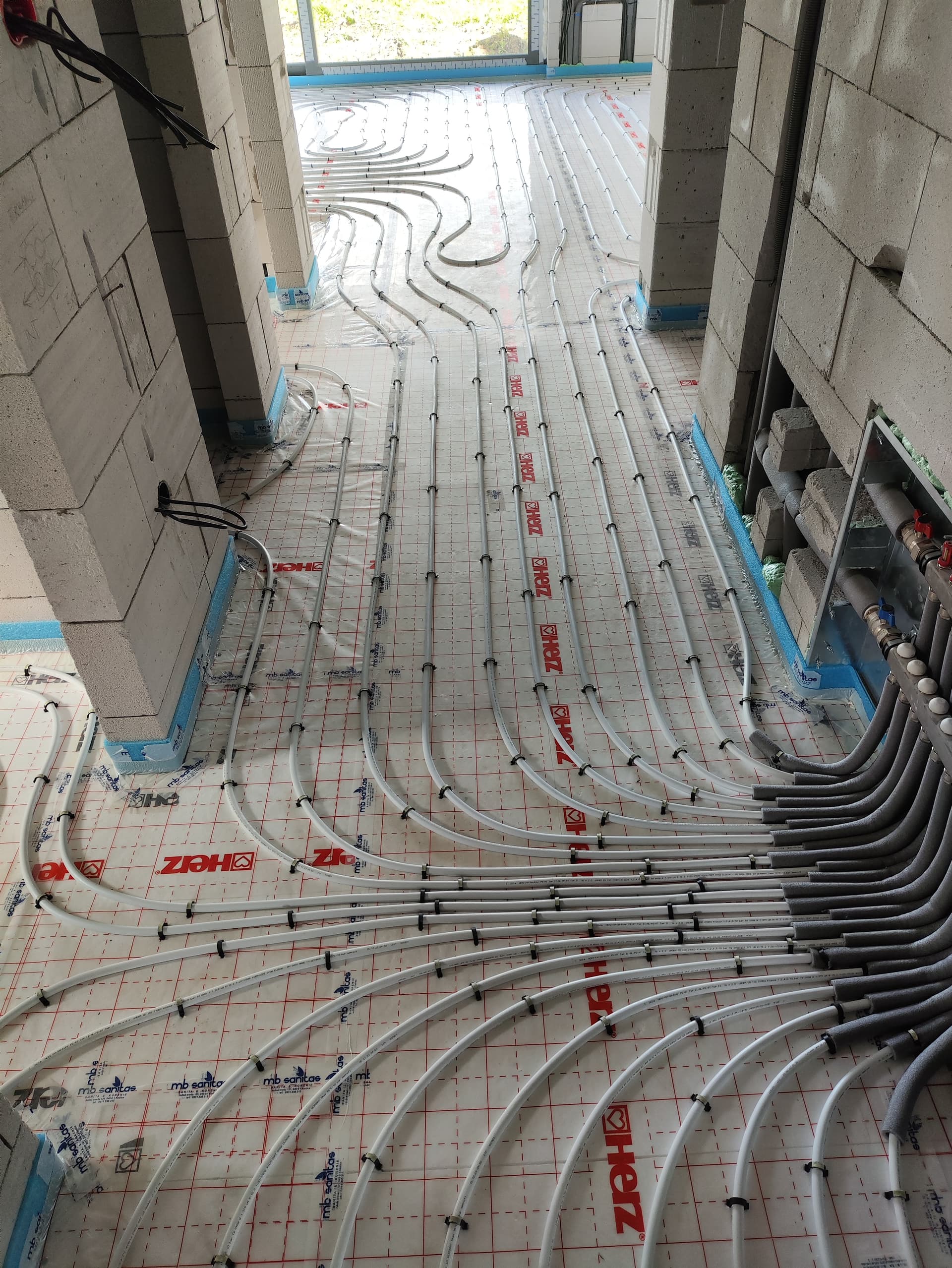
Hi, first I will try to describe the system briefly
-Heat pump model is samsung AE160CXYDGK/EU
-The house is quite large: 455 m² total (75 m² basement + two floors of 190 m² each).
-All floors are heated, and about half of the ceilings are heated as well (these ceilings will primarily be used for cooling in summer, but I can run lower water temperatures when I use them for heating).
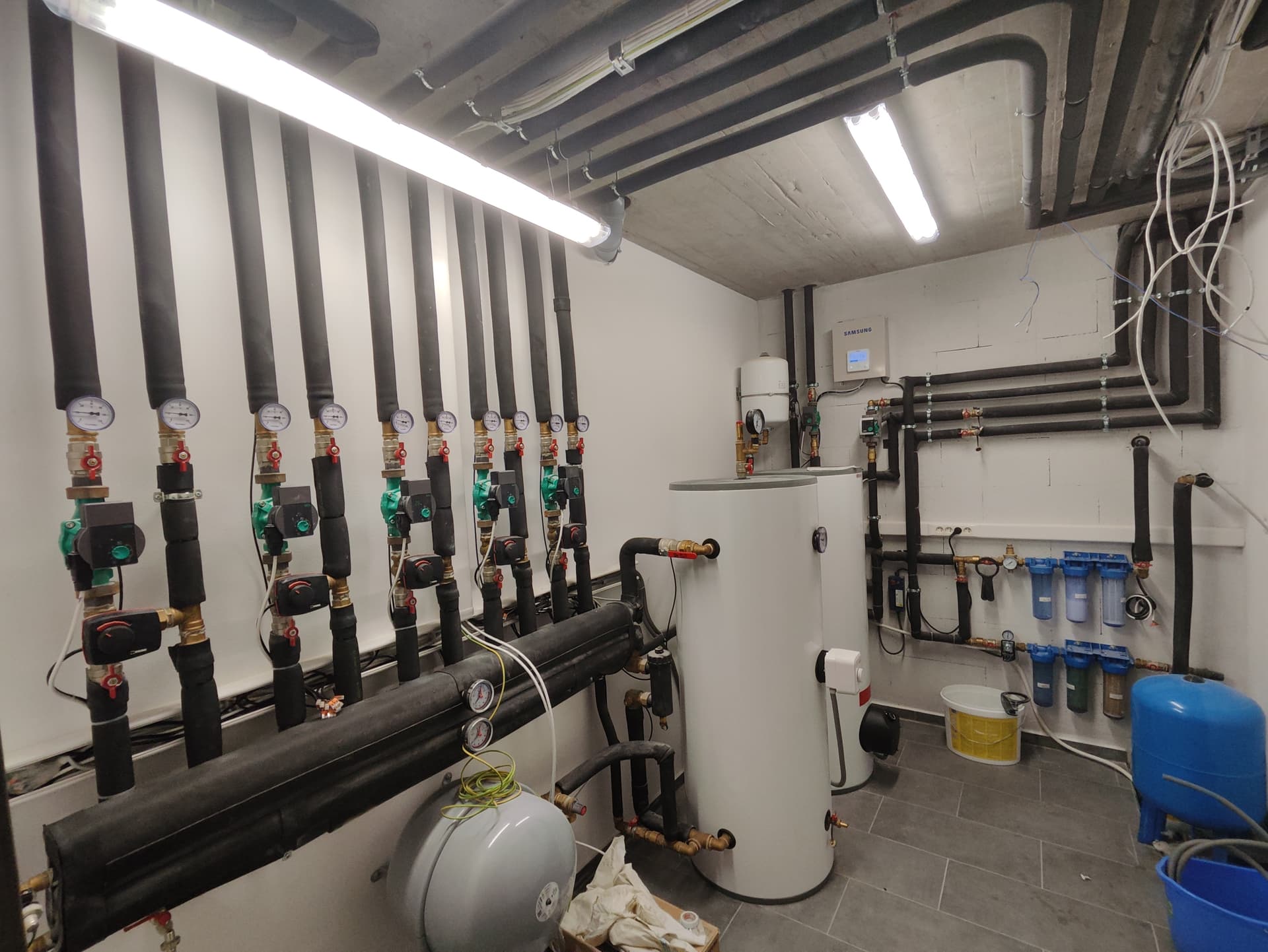
-There is a 250 L buffer tank and an additional 250 L domestic hot water tank
-The house is not insulated yet (insulation planned in a few months).
-There are 67 floor/ceiling circuits, each 80–120 m long, split across 5 circulation pumps.
-The control system is external (Taphome), which manages zones, the pumps, and also the heat pump via Modbus.
-There are 25 heating zones, each with its own thermostat.
How heating demand works:
When any zone drops below its set temperature:
Taphome turns on the heat pump via Modbus (unless it’s already running due to another zone).
The thermal actuators for that zone open the circuits.
The assigned circulation pump (one of the five) turns on.
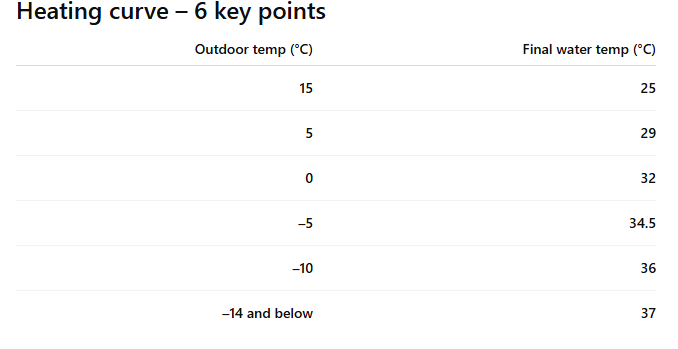
Heat pump is set to “Water outlet mode”, and temperature of the water is controled externaly from that taphome system according to the “heating curve”
Even in a house this large, uninsulated, with all this control and Modbus communication, the heat pump sometimes cycles like crazy
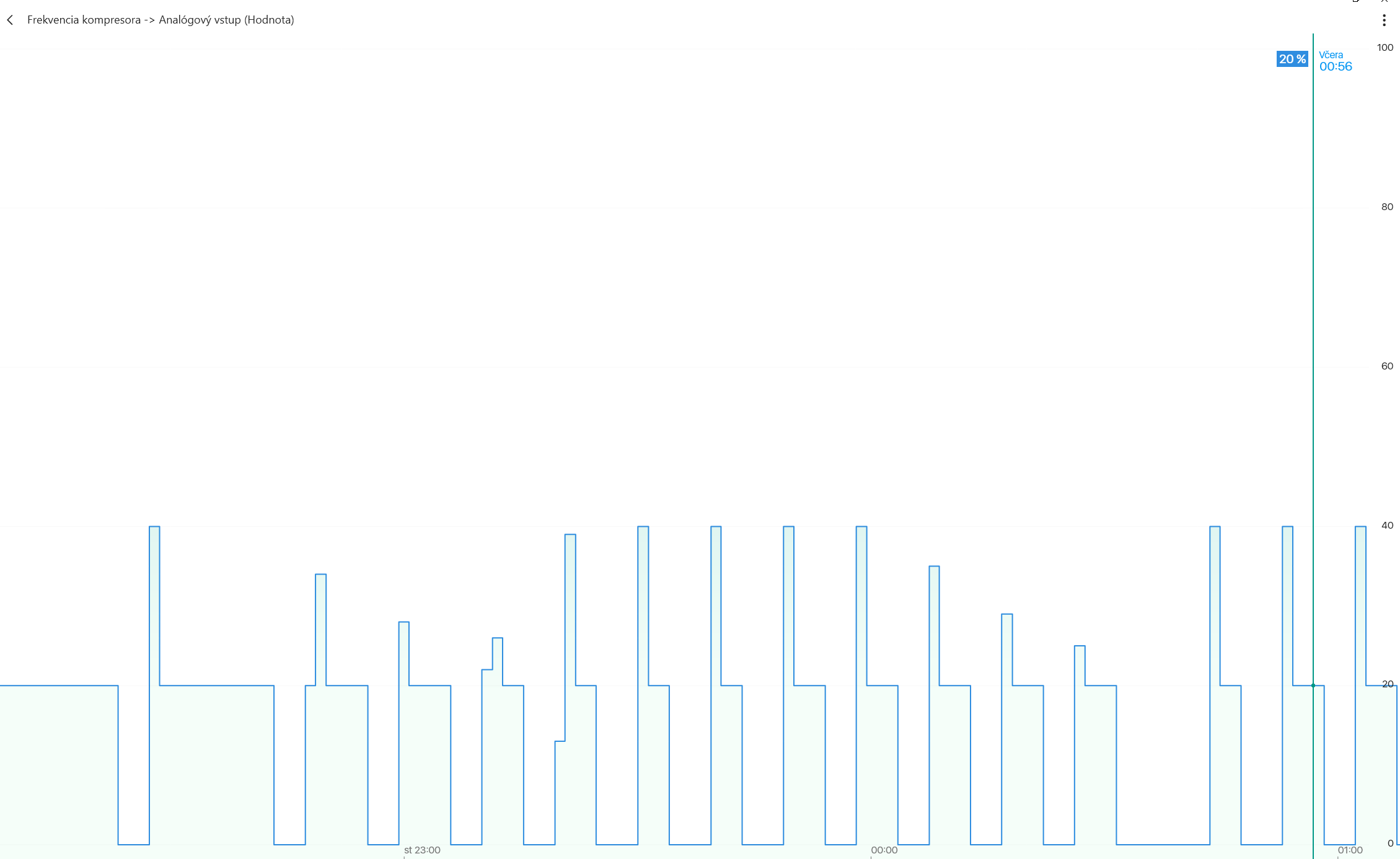
For example: outside temperature 9 °C → the heat pump was cycling in 5-minute intervals all night.
Compressor frequency graph shows it dropping to 20 Hz (which I believe is minimum) and then to zero
I think you’ve correctly identified the issue. When a low number of your zones are open, you don’t have enough emitter to dump the heat from your heatpump. Most people will say that the best way to run a heatpump is with no zoning, also known as fully open. This means you’re always using your full emitter output which you will find dramatically helps. The Samsung controls in particalur react badly to cycling, often turning on immediately after turning off.
My recommendations would be to reduce your zoning. This will not only decrease cycling, but it should increase your efficiency too. To avoid overheating rooms, you need to make sure you are using weather compensation (whether locally on the Samsung controller or from your 3rd party system) and dial in the balancing of your radiators. I recommend using FRVs from Firepower for this, but at around £32 each, they’re not cheap. With the WC and balancing dialled in correctly, you shouldn’t need any zoning at all and you will run much more efficiently. Maybe, if you have to, limit it to a MINIMUM of 20 zones on.
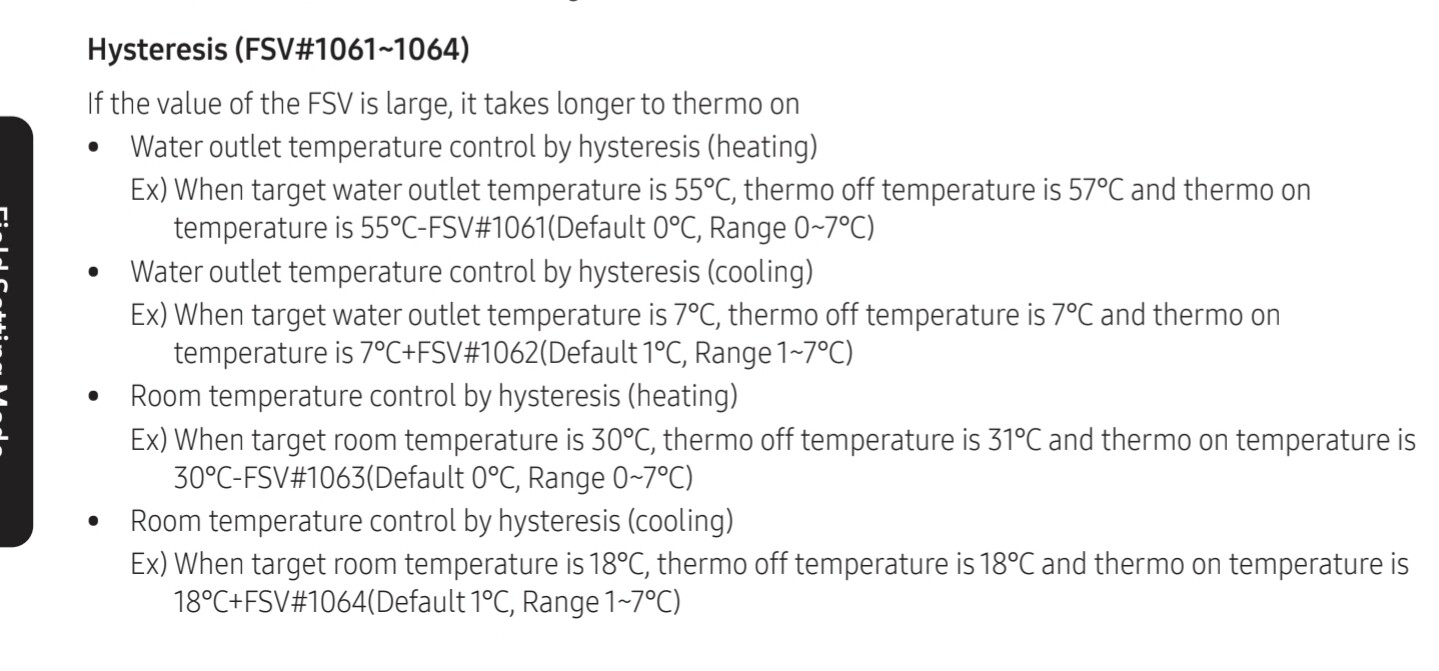
Secondly, check on your controller if you have #106* Field setting values. These control the hysteresis of the heatpump and should stop it switch back on immediately after switching off which will reduce cycling. You’ll be looking for #1061 in particular. Older models dont have these settings, but you can get them with “just” a new PCB. What you set this to will depend on your set up, but i have mine set to 3.5, which keeps the heat pump off for around 1 hour after cycling off. You’ll find a decription of how this works here:
Thanks for the detailed explanation. There are a few specifics about my system that make the situation a bit different from typical radiator-based setups:
There are no radiators in my house at all.
The entire house is heated using floor heating (pipes embedded in concrete), plus part of the ceiling. This means the system has much higher emitter capacity and also a significantly larger thermal mass compared to radiators. In practice, each zone behaves like a buffer tank(because of the concrete heat capacity).
There are big windows, there is fireplace, there is a heated basement…
-So on the sunny days, zones on south are getting a lot of heat from the sun, which will throw of the balancing
-When there is fire in the fireplace, zones around it are getting a lot of heat from the fire, which will throw of the balancing
-Weather compensation does not apply to the basement, as it is underground… so in the cold days it would be too hot in there without zoning, while on warm days it would be cold.
-Same zones will be used for cooling in the summer, where I need to watch out for dew points etc.
So I dont think it can work properly without zoning…
So far I have tried to change FSV1061 to 3,5°C and done some tests. I tried to run only 4 smallest zones possible(batthroms, small halway, closet…) and it was 30minutes on/5minutes off cycle, so we are getting somewhere!
I will definitelly focus to run as many zones as possible at once.
I used FSV 2093 to reduce cycling (thanks @Topaz).
I’m using an external thermostat and water law on a Gen6 AE160RXYDEG and changed the FSV value from the default to “Room temp ON/OFF or WL interlink ON/OFF (Water pump 3)”.
The result is the heat pump keeps going rather than cycling, the internal temperature may become warmer than desired but overall it uses the same or less energy and obviously less wear & tear from cycling.