TL;DR: My split Panasonic (Aquarea J‑gen, R32, ~7 kW) has, over about a week, lost almost all heating capacity in DHW mode. It now draws roughly the same power it “produces” (COP ≈ 1), the compressor discharge sits at 92–98 °C for the whole cycle, high‑side pressure only reaches ~21 bar, and it can’t push leaving water past ~47 °C toward its 59 °C target. Mild weather, quiet mode, forcing Powerful, a reboot and a full overnight power‑off all make no difference. No error code. Does this look like refrigerant undercharge/leak, an EEV/restriction, or something else — and is it safe to keep running while I wait for a tech?
Use: domestic hot water tank (also space heating, but the problem shows clearest in DHW‑only mode).
Monitoring: HeishaMon → Home Assistant, and cross‑checked on the Panasonic wall controller (so the readings below are the heat pump’s own, not a monitoring glitch).
Location/ambient: Lithuania, summer; outdoor air 19–20 °C during all the readings below.
Symptom and timeline
Before (early–mid July): DHW heat‑up ~35 → 55 °C in about 2 hours, COP ~3–4.
Now: runs 5–9.5 hours, tops out around 44–51 °C, COP ≈ 1.
Onset: progressive decline over roughly Jul 18–24 — not a sudden trip. Heat output per cycle dropped a bit more each day while power draw stayed the same.
The data, with the concerning bits flagged ():
COP ≈ 1.0–1.33 — consumed ≈ produced (e.g. 1000 W/1000 W at full power; 600 W/800 W now). Should be ~3–4 at 20 °C ambient. This is the headline problem.
Discharge temperature 92–98 °C, sustained for the whole cycle (97 °C under Powerful; 92 °C now). Dangerously high and a compressor‑damage risk if kept running.
High‑side pressure only ~21 bar — R32 needs ~33–37 bar to condense hot enough for 50–59 °C water. It physically can’t build head pressure.
Leaving water ~47 °C vs 59 °C target; tank stuck ~44 °C — never reaches setpoint.
Evaporator (outdoor pipe) 12–14 °C at 19–20 °C ambient — barely pulling any heat from the air.
Progressive decline Jul 18–24, and yesterday it ran ~9.5 h continuously without finishing.
Water flow healthy (10.9 L/min), all temp sensors plausible, no error code — which is what narrows this to the refrigerant circuit rather than flow/sensors/electronics.
Unresponsive to quiet‑off + Powerful, to reboot, and to the overnight power‑off — ruling out mode/weather/automation/monitoring.
My questions
Does this look like refrigerant undercharge / a leak, or a refrigerant‑side restriction (stuck EEV / blocked filter‑drier), or could it be a failing compressor?
Anything else worth checking before I call a refrigeration engineer?
Is it safe to keep running with discharge at 92–98 °C, or should I leave it off / use the immersion until it’s looked at?
Thanks — happy to post any other HeishaMon parameter or a screenshot of the produced‑vs‑consumed and discharge‑temp graphs.
What an excellent analysis, @kiprasbiel.
Are you able to log any additional R32 circuit conditions? I’m thinking of compressor suction pressure and evaporator inlet temperature.
From your problem description, I’d agree with your guess of poor R32 circulation, but the fact than the problem has been progressive over several days suggests to me that it’s probably not your EEV sticking or a compressor problem. And your evaporator deltaT sounds OK if I understand your data correctly. So to me that all hints at a gradual loss of refrigerant, and I’d be inclined to get an engineer round for a professional diagnosis sooner rather than later.
I’m not familiar with Panasonics, but there is probably a high temperature trip on the compressor discharge (you could check the error code listing in your manual for this), but I’ve seen sustained - for 10mins or more - comp disch temps of well over 110degC on my own DHW runs (also an R32 ASHP), without any noticeable problems.
Mmmm yes, I go along with Sarah’s thinking. it does seem like a leak. I dont think 100c on dicharge is too dangerous, but its getting near… I think 21 bar R32 is only about 35c . Given the discharge is so hot, the suction pressure/temperature is probably well sub-zero (-degC).. Pressure difference across compressor very high, volume flowrate low, meaning that discharge gets very hot.
Probably a good idea to give it a rest and get it sorted. Given its split, the likely candidate is one of the flare connections. It’s amazing that nobody have made a better refrigerant joint.
I’d just leave it off and use the immersion for now. Discharge stress like that will damage the compressor, and a split-system leak is almost certainly a flange—you can’t DIY that anyway.
Would you like to borrow an R32/R134a sniffer @kiprasbiel? (heated diode sniffer that detects flourinated gases)
If you’re in Vilnius you can visit and pick it up from Krokuvos g. If you’re elsewhere I can post it. You’ll soon see if a flare is leaking.
I’ve also got a vacuum pump, gauges, and flaring tools if you want to pump down the unit (recover the remaining gas to the outdoor unit, seal it inside, then rework the connections yourself. You still need to refill the system though; so might as well ask any of the AC installers to weigh out the existing gas and add the correct mass again once the leak is fixed.
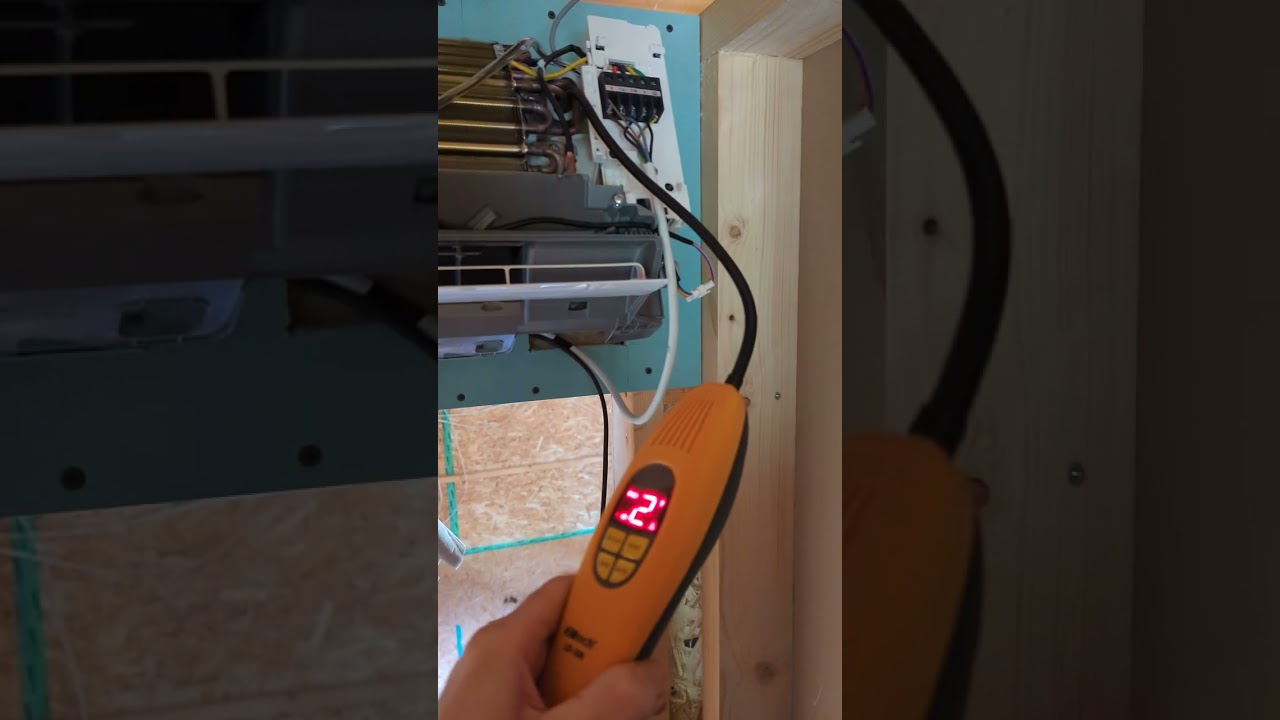
This is the leak detector looking for a leak in our mini split - it was not my flares but instead a factory braze that was leaking:
That would have passed a nitrogen test.
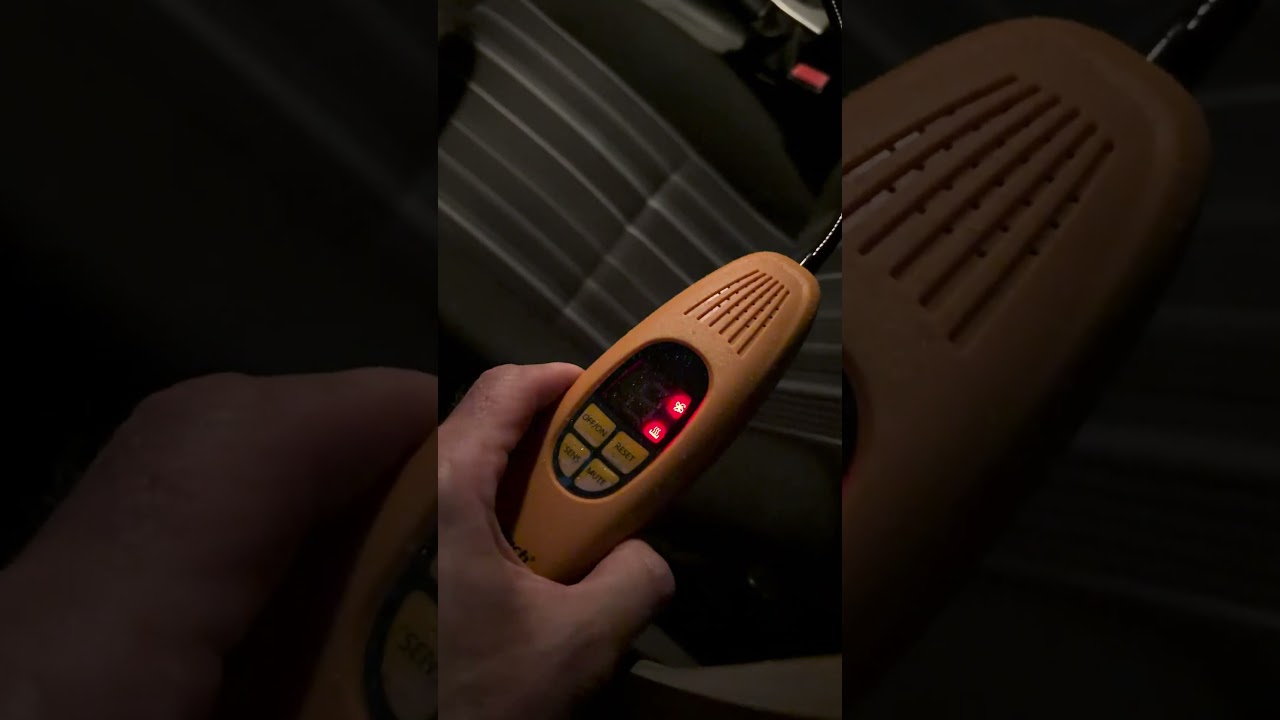
And here is condemning the evaporator in the car leaking like a sieve:
Sensitivity limit is 3 grams per year in still air from a joint. Hitting 7 inside the car says it’s empty within a month or two. Propane fill incoming for that one.
 ):
): Water flow healthy (10.9 L/min), all temp sensors plausible, no error code — which is what narrows this to the refrigerant circuit rather than flow/sensors/electronics.
 .
.