Panasonic Aquarea Heat pump configuration

Hello,

Since November I’ve been living in a 100mp apartment that has a panasonic aquarea WH-UD-09JE5-1 split heat pump. I’ve tried to configure it properly and have a few concerns. I’ve asked the installer for help, but he doesn’t seem to know much or is not interested to explain. No matter what I say he says everything is fine with very little explanations. I’ve also tried to contact panasonic on multiple emails, but nobody answers.

My objective is to keep the temperature around 22 degrees.

I should start by mentioning that the room thermostat was off by around 2 degrees and that the installer told me to put this on -2. But I’ve found in the manual that this says EACH sensor. Could this influence all temperatures in the system?

image

Also, there is no buffer and no other extra circulation pump, beside the internal one.

The HP thermostat doesn’t seem to influence the logic much. For example, if I set it to 23 degrees, the temperature in the room where the thermostat is will be anywhere between 22.25 and 23.75. From what I’ve read the thermostat is not very important and it’s the compensation curve that dictates most of the logic.

Recently I’ve gained access to the aquarea installer app and I can see all the charts and play with the settings much easier. I’ve watched many videos and read many posts, but I still can’t figure everything out. Unfortunately, I can’t find much about panasonic as it doesn’t seem to be very popular.

I’ve played with the heat curve and this is what I have for the past 3 days. Unfortunately, it’s not winter anymore here, so I can’t test below 0.
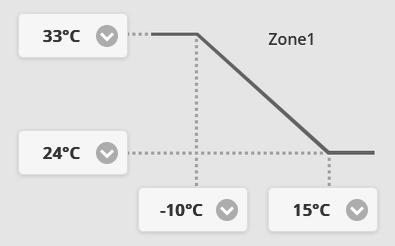
The temp is anywhere between 22.5 and 23.5. Thermostat still set at 23. I assume I need to decrease the lower temp from 24 to 23 or 22.

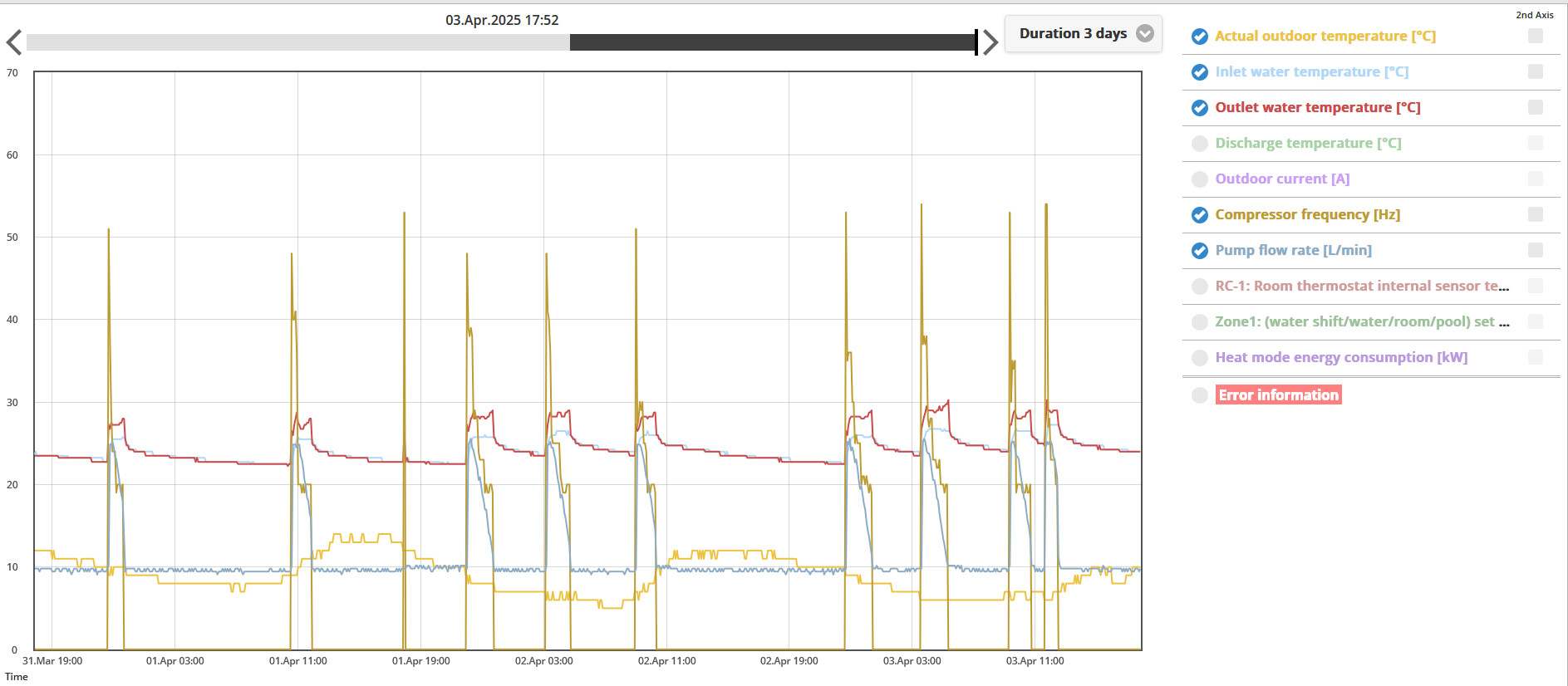
Delta T is 5, but the charts show the difference to always be between 2 and 3 degrees. Here are the charts for yesterday and today
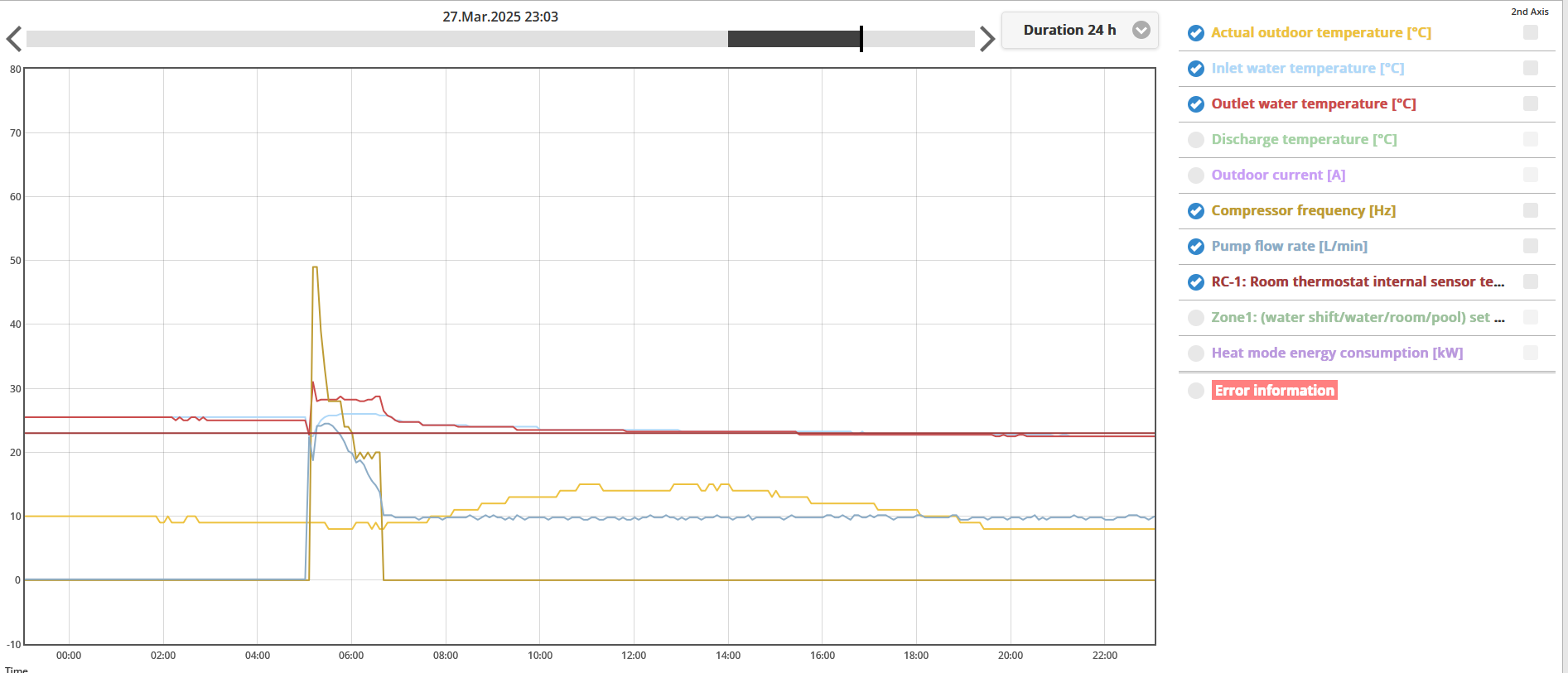
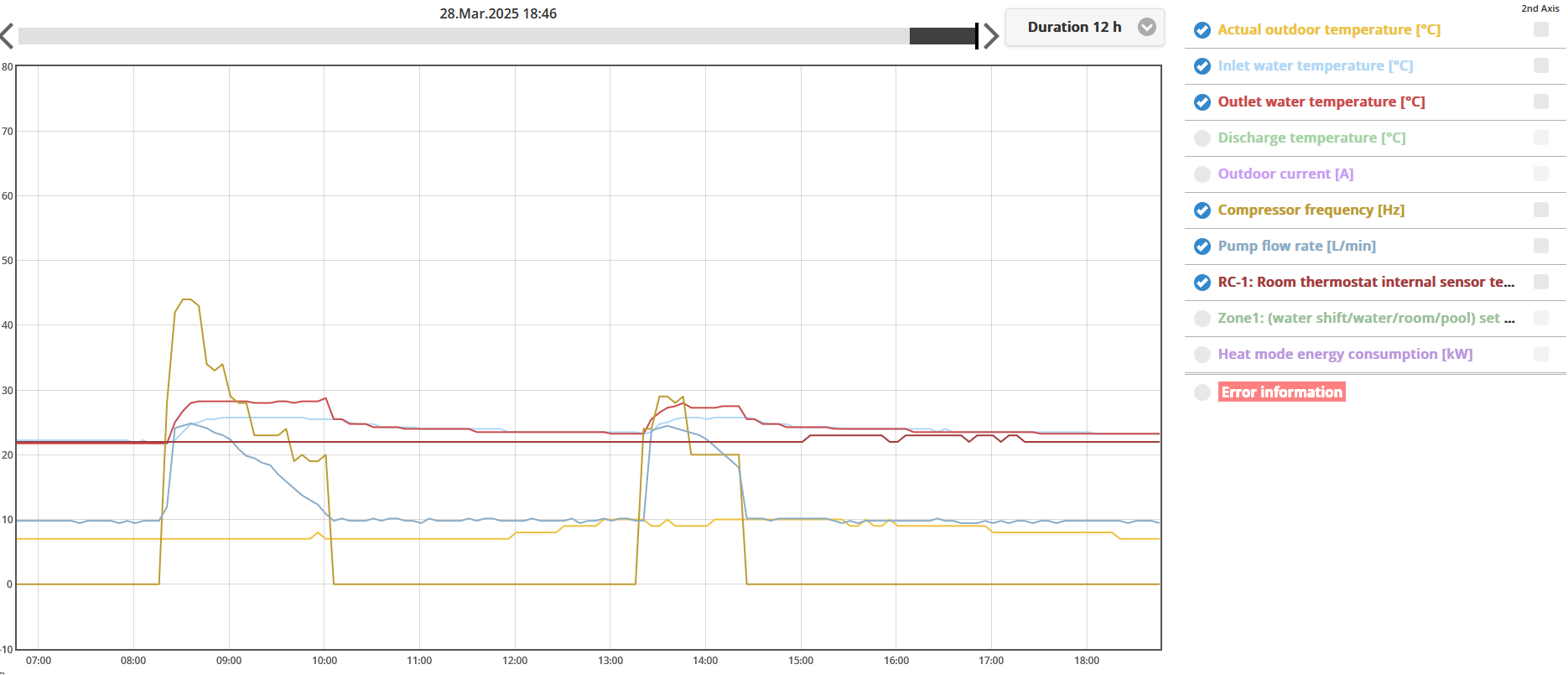
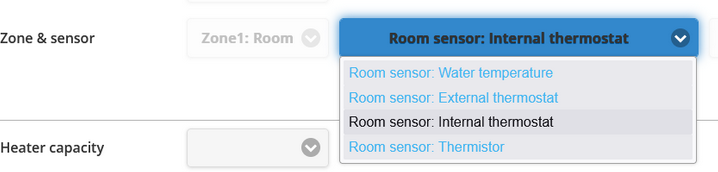
The room sensor config is set to Internal Thermostat, meaning the HP thermostat in the room. Should I set this to water temperature, meaning the HP flow temperature?
The flow pump is set to run based on delta T. The other option is maximum duty. The maximum duty selector on the right is available for both options. I reduced this once hoping to get a better delta T, but it didn’t seem to make any difference. Should i reduce it more?

I also don’t understand why the circulation pump is always on as you can see in the charts above (darker blue line). It ramps up when the HP is on, then goes to around 10 when the HP is off.

When should the HP turn on? When the inlet temp is below the temp on the compensation curve for a certain amount of time?

When should it turn off? When the inlet temp is above the temp on the compensation curve for a certain amount of time?

Do you think a buffer is required for the system? The manual says “Using a Buffer tank is the ideal installation design. This allows the setup of a heat pump and heating circuit to operate at their optimum level of performance and efficiency. The buffer tank also provides open water volume between heat pump and heating circuit, which also helps reduce the stop/start cycles of the compressor. Where underfloor is connected, the volume stored allows a quicker response time. Stored volume also allows more efficient defrost cycles, without the need for direct electric backup support to be activated”, but I’ve seen opinions on this, both pro and contra, so I’m not sure anymore.

In case it helps, here are the service manual and the installation manual:

Thank you
Welcome, Tudor, to the OEM forum.

Not any more, I have promoted you. So please post your missing image here.

Hello, Robert,

I have edited the initial post.

Thank you

1 Like

Hello @tudro2001

Is the issue that this variation in temperature is too great? that you would like finer control of the temperature? e.g ± 0.1? or something like that?

That curve is impressively low, but we would need more information about the system to know if it’s the correct curve. It seems that your house is staying at a high internal temp without much heat input at the moment judging by the charts, is it a very well insulated house? is most of the heat coming from solar gains?

Quick answer is no you shouldn’t need a buffer, that’s usually a red herring but for a more informed answer it would be good to understand more about your system. Is your system radiators or under floor heating or both? Do you have your TRV’s or/and zones open/ working as a single zone?

Is the main issue so far the variation in internal temperature? and that you want finer temperature control?

Hello @TrystanLea,

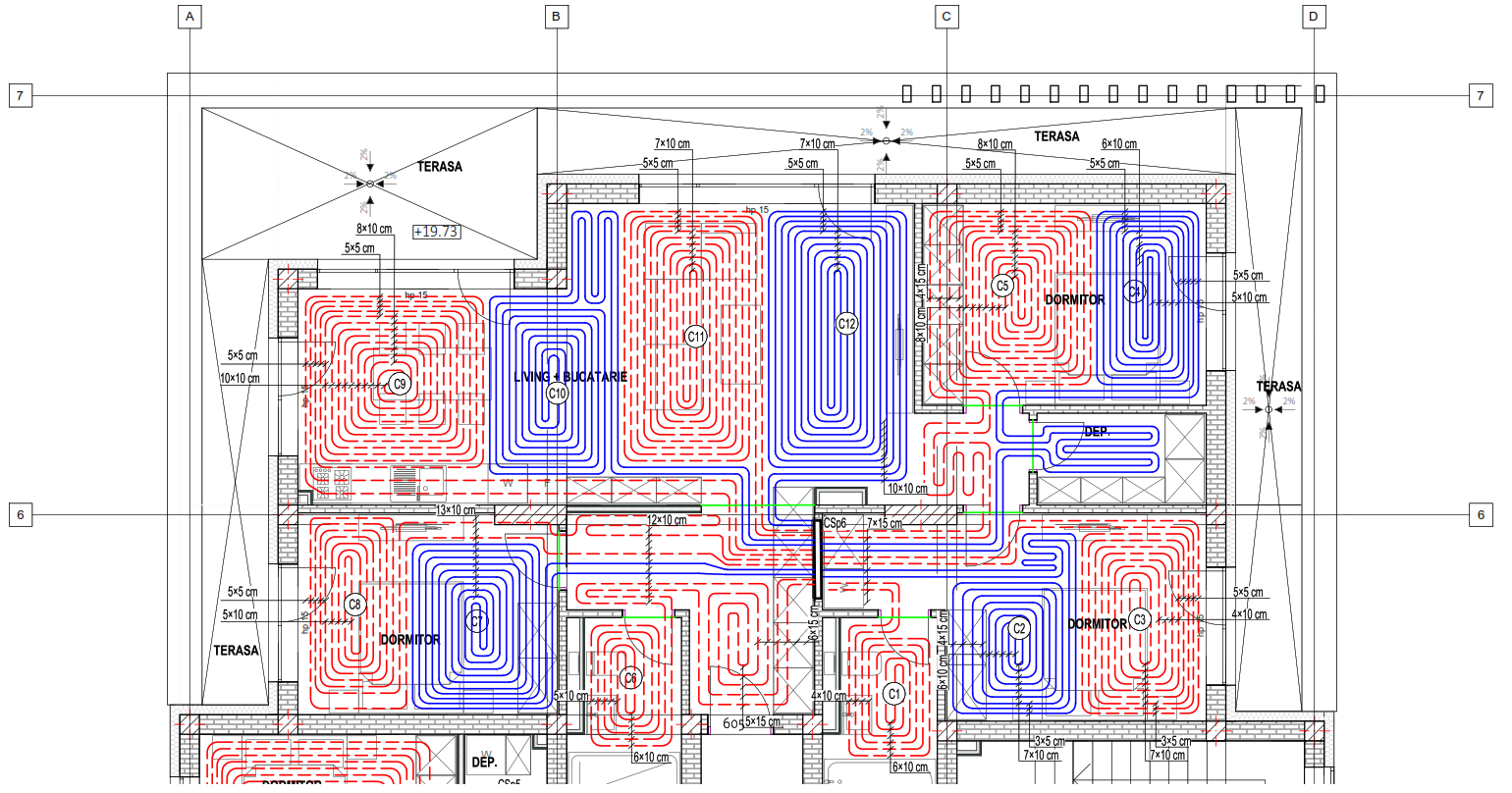
Thank you for your answer. Sorry, I forgot to mention it’s under floor heating. Here are the floor plans

The building is new, finished in 2023. Insulation is done with 15cm wool and the windows are triple pane. There is only one zone and only the HP’s thermostat. The HP is used only for heating. There isn’t that much solar gain, the orientation is W - N - E and for the past 2 days it’s been cloudy and raining.

The main issue is that the temperature variation is a bit much for me. Before I had access to the charts and configs I used only the thermostat, as the installer told me. If I would set it to 23 degrees, I would get between 22.25 and 23.75. That 23.75 was not ok for me, especially during the night. I’m using ruuvi sensors to monitor the temp and I tested them to make sure they are calibrated.

I also tried to set it to 22 degrees, but then it would get too cold sometimes, because the temperature in my daughter’s room is always around 1 degree less than the rest of the house. So, with 22 degrees set, it would go down to almost 21 in the house and down to almost 20 in my daughter’s room. I tried to fix this from the distributor and increase the debit in her room, but with no luck, especially during the night, when the doors are closed. I checked with a thermal camera and the floor heating is working ok in her room. I was thinking that maybe if the circulation pump would run slower when the HP is on, maybe it would reduce the difference.

I would like to be able to obtain a more consistent temperature, even if it’s colder in my daughter’s room. For example, get something between 22 and 23 in the house and between 21 and 22 in her room. I know it’s not possible to get ± 0.1 control, but at least a 1 degree variation instead of 1.5.

This is the consumption i had:

  • january 397kw with an average outside temp of 0 degrees. COP 3
  • february 326kw with an average outside temp of -3 degrees. COP 3.3
  • march 123kw with an average outside temp of 7 degrees. COP 4.5

It’s more in january than in february even if the avg is bigger because I was away in december during the holidays and they said that it’s ok to set the thermostat to 18 degrees. So before I came back in january I set it up to 23 again and it worked hard for almost 2 days and 60+kw.

Beside the main issue, the others are:

  • is it ok for the circulation pump to always be on? Right now it’s been running non-stop for 2 days. And before that it stopped only because I changed some settings and whenever you change something everything turns off. From what I see on heatpumpmonitor most of them run all the time, although at slower speeds than mine.
  • can I get a better COP? I was expecting at least a 4 during winter from what I’ve read
  • understand how it decides when to turn on and off. For example, right now the inlet temp = outlet = 22.5 and thermostat shows 22 degrees and it’s set to 23. I would expect it to turn on.
  • if a buffer is recommended or not

Thank you

I cannot really help you with the Panasonic I’m afraid. I just wanted to comment that the underfloor looks to be well designed with attention to large windows where they even used 5cm spacing. Nice.

I don’t know if you can really expect COP of 4 with average outside temps around 0 degrees, but I would also expect it to be better then 3.

Am I right that the WH-UD-09JE5-1 is a 9kW heat pump? That seems like a lot for that property.

Thank you for your comment. If that product code that I have from the installer is correct, then it seems to be 9kw. What would have been a more appropriate capacity? All the windows are >2m in height, it’s the last floor and there are no neighbors on 3 sides.

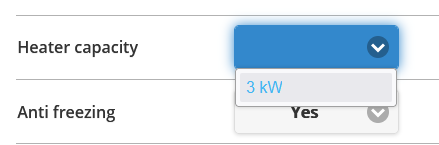
In the settings I can only set heater capacity with 2 options: nothing and 3kw. But I think this refers to the electrical element:

3 days ago I changed the room sensor to water temperature instead of thermostat. It seems to maintain the temperature better, with less than 1 degree variation. Here is the chart for the last 3 days. No idea what the 3rd spike was all about. Couldn’t have been the defrost as there were >10 deg outside.

Regarding my first post:

  1. Sensor temperature offset: I said that I had set it to -2 and that it might influence all the other sensors. That’s not true. I was just looking in the manual which doesn’t say more and forgot that once you enter the Sensor setup section, you can select the desired sensor.
  2. Flow pump maximum duty: as long as it is set to deltaT, it doesn’t matter what I set for maximum duty as it always reverts to 0x91. I guess it’s just a bug in the app as the field should have been disabled when deltaT is selected for pump flowrate.

Hi @tudro2001

I install Panasonic, based in the North of Scotland and find they perform well once dialled in.

I generally use open circuit with no buffer and with no thermostats controlling the heat pump, just water temperature/weather compensation control - I only use zone control for individual bedrooms, or maybe rooms with high solar gains if required. You may also need to check/balance the UFH zones.

Obviously every house/installation is different and will need some fine tuning for best results, but for starters, set pump control to 5 degree delta T (ignore the manual max setting) and dial in the weather compensation curve, for staters try 35 @ -20 & 23 @ +15. Unless it’s wildly out, make small (+/- 1-2 degrees) changes and allow a day or two before further adjustments. Also try setting the outside ambient heating off to around 8-12 degrees (it switches off the pump and goes into standby at 3 degrees above this and back on 1 degree above).

Apart from that, I generally set them to run 24/7 and if you wish you can tinker with some timed offsets (+/- 1-2 degrees) to try and maximise any time of use tariffs etc, but would avoid big set backs, or intermittent heating with UFH. There’s a number of other settings that would need checking, but easier to do that via the pro partner portal.

1 Like

Hi @Lakee

Thank you very much for the info. I’ve sent you a PM.

Hello,

Just to wrap this up, @Lakee was a real gentleman and helped me with the configuration and answered my more or less stupid questions :slight_smile:

Thank you to everybody else for your answers, too. Nice to see you get better help from strangers than from the actual installer.

Have a nice day

2 Likes

SYSTEM DETAILS:

  • Heat pump: Panasonic Aquarea 12kW R290 (WH-WXG12ME5)
  • Buffer tank: [100 liters]
  • Distribution: DAB Evosta 2 pump to 4-floor distribution circuit
  • Radiators: Aluminum, single-pipe connection per floor
    * Floor 1: 4 radiators
    * Floor 2: 2 radiators
    * Floor 3: 4 radiators
    * Floor 4: 4 radiators
  • Location: Spain, Palafolls (Mediterranean climate)
  • Winter temps: 0-15°C typical, occasional -2°C

CURRENT SETTINGS:

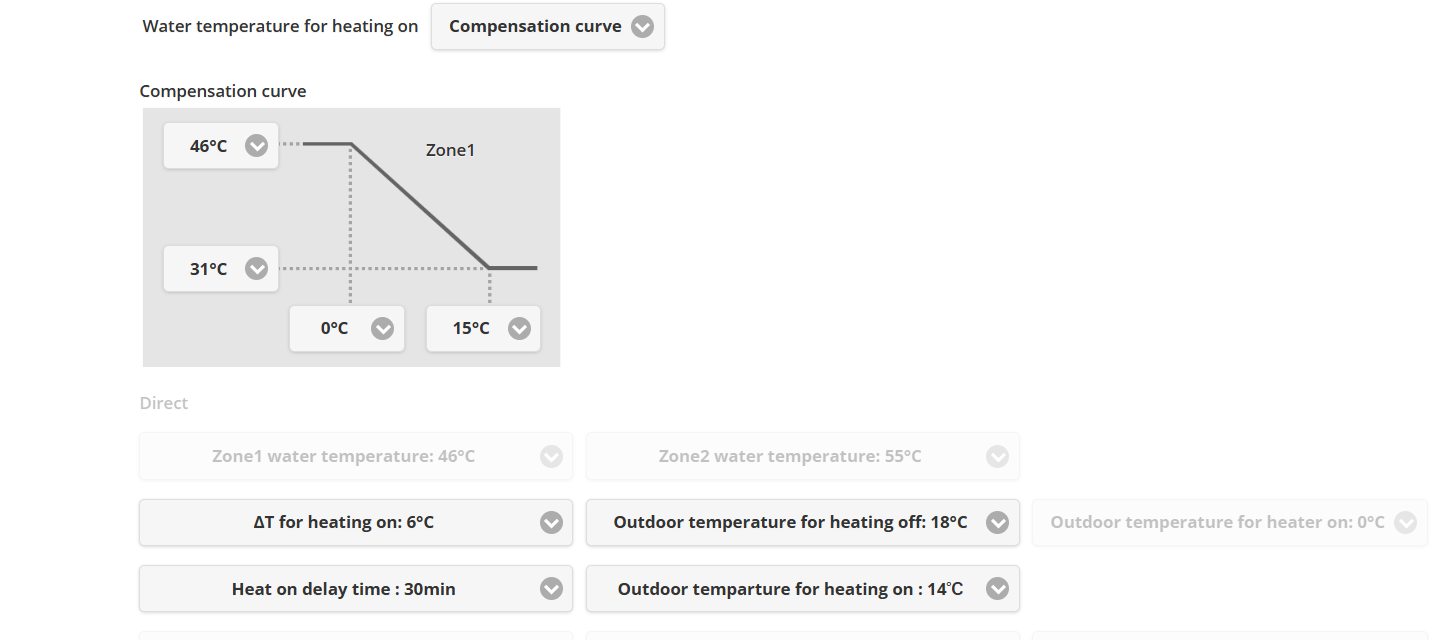
  • Compensation curve: 46°C @ 0°C outdoor, 31°C @ 15°C outdoor
  • ΔT for heating on: 6°C
  • Heat on delay: 30min
  • Heating OFF outdoor temp: 18°C
  • Heating ON outdoor temp: 14°C
  • Control mode: Weather compensation (internal thermostat set to 24°C)

PROBLEM:
Currently outdoor is 9°C at night, indoor is 19°C (target 21-24°C), but
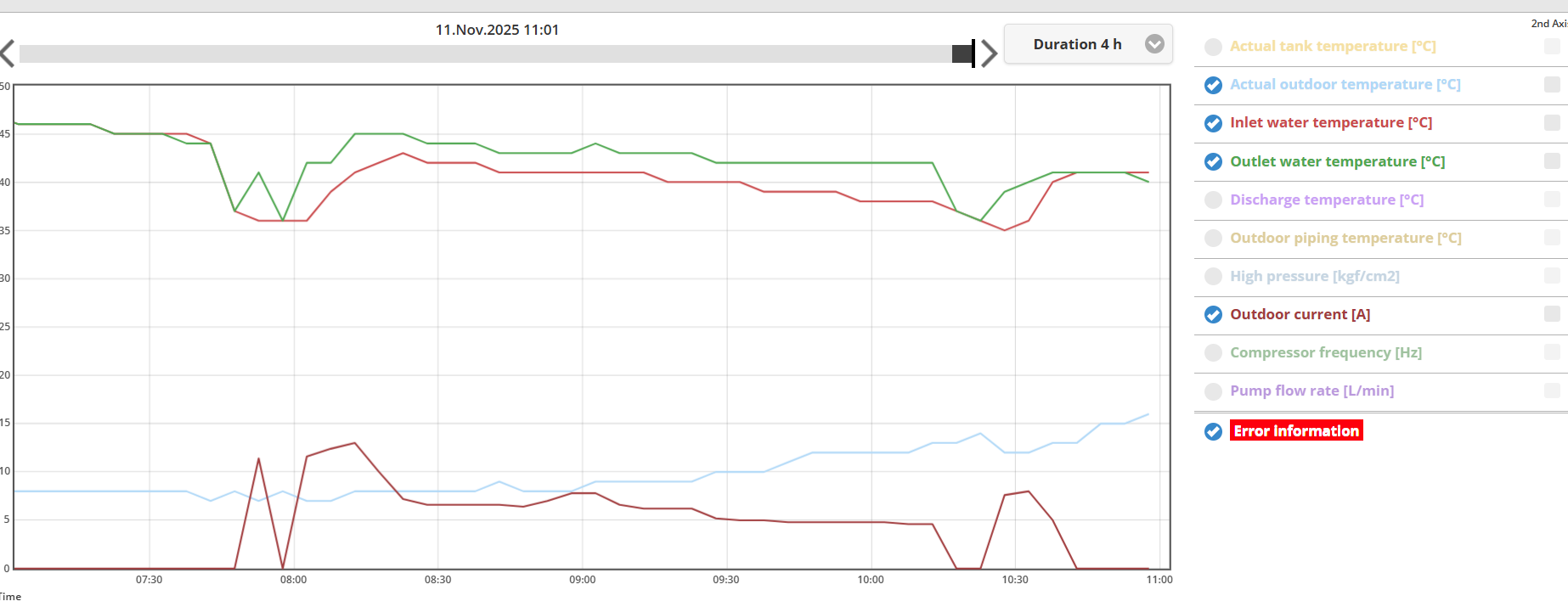
system keeps cycling on/off. Looking at my monitoring graph, I see:

  1. Inlet and outlet temperatures often match (Delta T = 0°C)
  2. Outdoor current drops to zero frequently (compressor stopping)
  3. System stops heating before indoor reaches target temperature
  4. This creates temperature swings and discomfort

GOAL:
I want the system to:

  1. Maintain continuous operation (minimal cycling)
  2. Actually reach the indoor temperature target (21-24°C)
  3. Operate efficiently without wasting energy
  4. Not turn off when there’s still heating demand

QUESTIONS:

  1. Is my compensation curve (46°C/31°C) too high or too low for Spain?
  2. Should I adjust the curve so system heats more at 9°C outdoor?
  3. Is ΔT = 4°C correct for single-pipe + buffer tank setup?
  4. Should I change from weather compensation to different control mode?
  5. Any other settings I should adjust to prevent cycling?

WHAT I’VE TRIED:

  • Turned down kitchen radiator (where thermostat is located)
  • Using weather compensation mode instead of direct thermostat control
  • System configured with internal thermostat, but kitchen heats faster
    than other rooms

im trying to figure out the best setting to prevent the pump to stop cycle all the time, like to maintain the temperature, currently configured to internal thermostat, setting temp to 24, but since the thermostat is in the kitchen and the distribution circuit is also in the kitchen, kitchen heats pump faster, so i turned down the radiator in the kitchen to make it similar temp as other place in the house.

Hello Kunan,

I suggest you remove the buffer tank and secondary pump and run the system open circuit, with the Panasonic internal primary pump suppling the radiators directly - you could repurpose the buffer by repiping it inline (2 pipe connection) on either the flow or return as a volumiser, which may help increase system volume if need be.

I would also suggest you use pure weather compensation rather than any room stats if possible, with maybe TRVs just in bedrooms to allow for cooler temperatures, but it’s important that the bulk of the system is open circuit with no third party controls. You will then just need to dial in the weather compensation curve to suit, which will depend on how the radiators are sized relative to required load (bigger rads need require lower flow temperature). This should give you a simpler, more efficient system with less cycling etc.

Also make sure the system expansion vessel is sized and set correctly.

Hello @tudro2001

I have the same problem with the installer… At first, everything looked fine until I started to ask questions about finetuning, and now it seems that my installer does not know much about it and just says “everything is working fine, you don’t have to be worried about”… And such an answer of his makes me extremely mad, because room temperature is way too hot for us, so how can it be “everything is ok, don’t worry”…

Could you please share how you got access to all these charts and settings? Because I couldn’t find anything like this in the Panasonic Comfort Cloud App, and it seems that these are only accessible by the installers through aquarea-service.panasonic.com and only installers can play with all these settings.

Hello @JuDrus

First you need to create an account on https://aquarea-service.panasonic.com You have a sign up button. Doesn’t matter that it says ‘installer’, nobody checks.

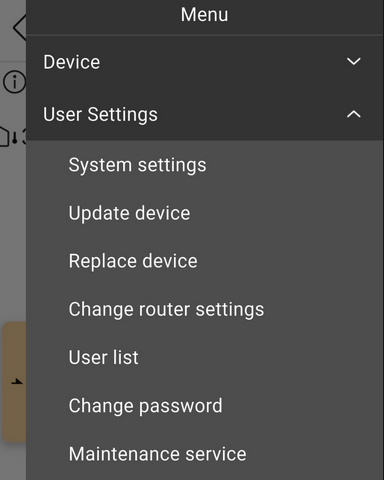
Then you need to go in the Comfort app, select your device, click on the hamburger menu in the top right, select User Settings, select Maintenance service. There you have to Terminate the existing service (the installer’s service) and add your own, based on the account you’ve created in the first link. Make sure to check that you don’t void your warranty if you remove the installer’s access.

1 Like

Thanks for the fast and thorough reply. But yes, sadly, it would break my warranty… I feel like Panasonic really lacks in “modern” control options. So I guess I would have to go to my cellar and play with all these settings using the main block.

No problem. You might need to put the block in maintenance mode for some of the options. You can find the details in the manuals I posted in the first post.