NIBE F2050 Hot water controls issue

I had some controls issues with this heat pump, which have been solved in a separate post :slight_smile:

Now, whilst the space heating is purring along, now the DHW (hot water) is cycling.

The hotwater is scheduled to ‘Economy’ (43-46C) only between 1300 and 1600

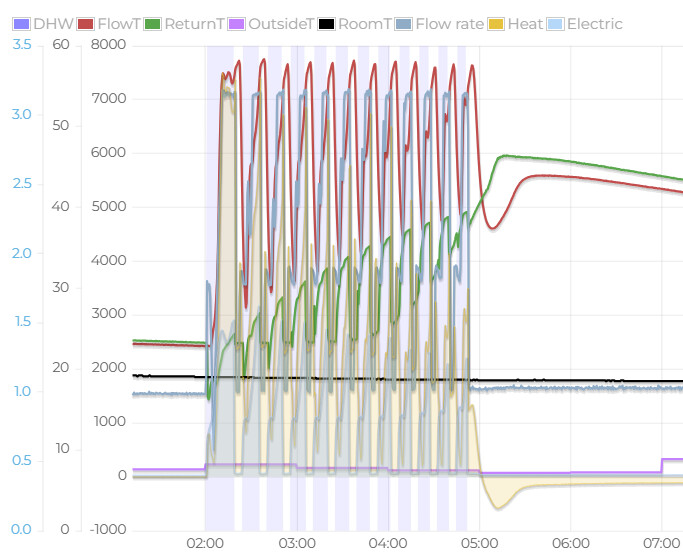
This morning (unscheduled) the heat pump came on with the familar fast-cycling behaviour to top up heat in the cylinder.

DHW use has been zero in this period, so its just topping up heat loss from the cylinder.
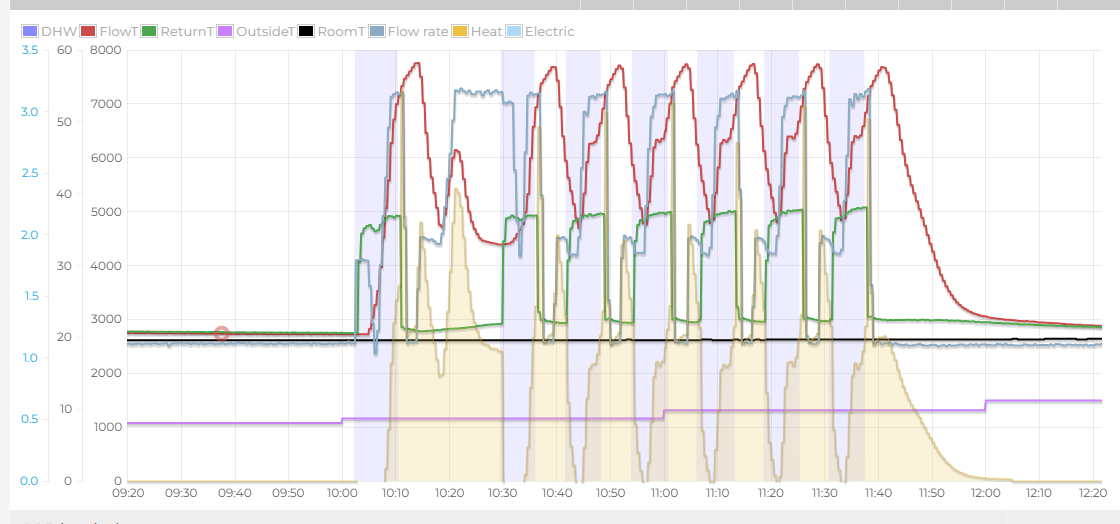
The heat pump generated 4kWh in this window. This is too much for cylinder heat loss.

S1 has virtually no demand ; at 21C all morning, so I dont think the 4kWh is space heat.
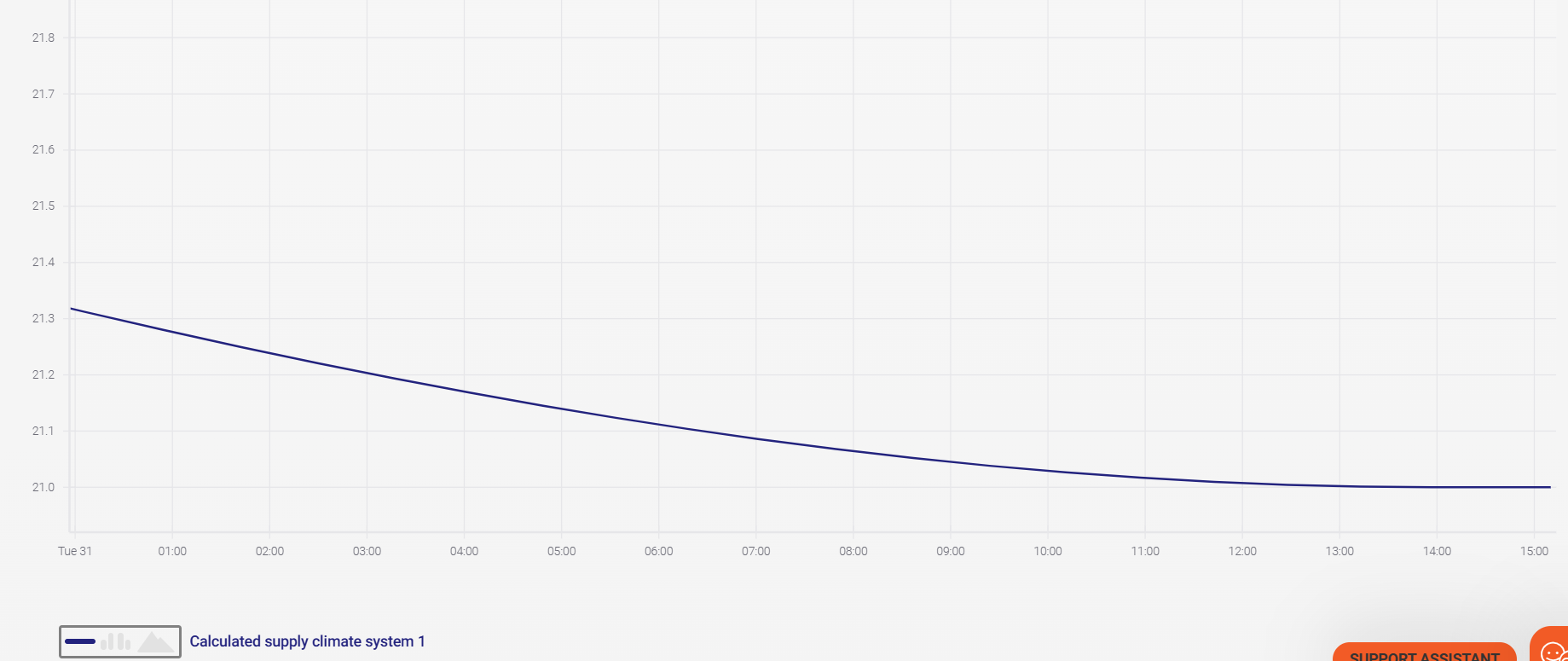
The supply line warmed up in that period, from 21C to 23C; hardly enough to heat hot water. Yet we saw the heat meter reporting F&R temps around 65/40C.
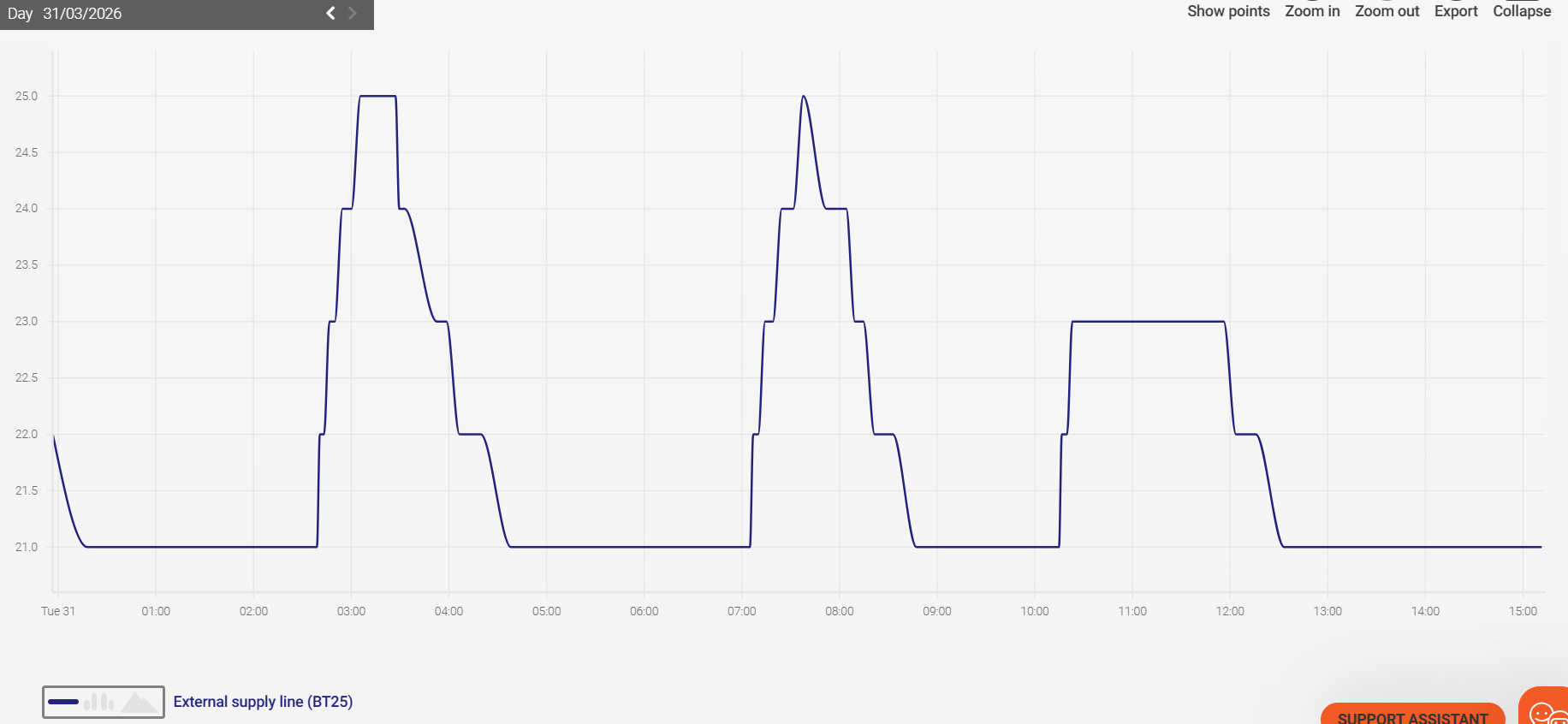
Degree minutes for that period; does this show space heating demand being met 1000-1200
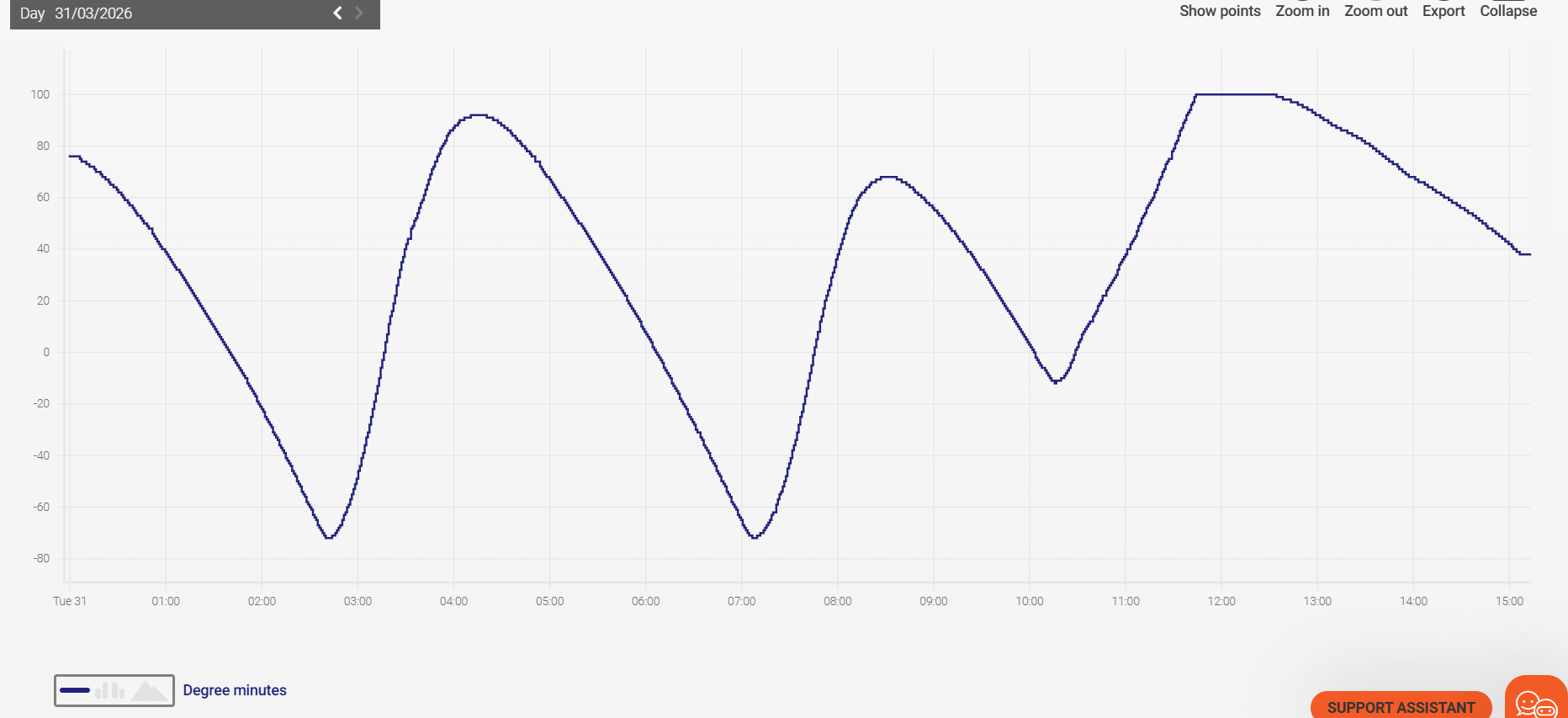
The hot water BT6 does show some top up to the cylinder; from 39C to 41C.

It does feel like an issue with the DHW tank sensor. The sensor is well pushed into the sensor pocket.

>Why is DHW charging out of schedule

>Why is it using 65C to generate DHW at 41C

>Why is it cycling

>Why is it using so much heat

>Why is the cylinder at 41C and not 43/46C
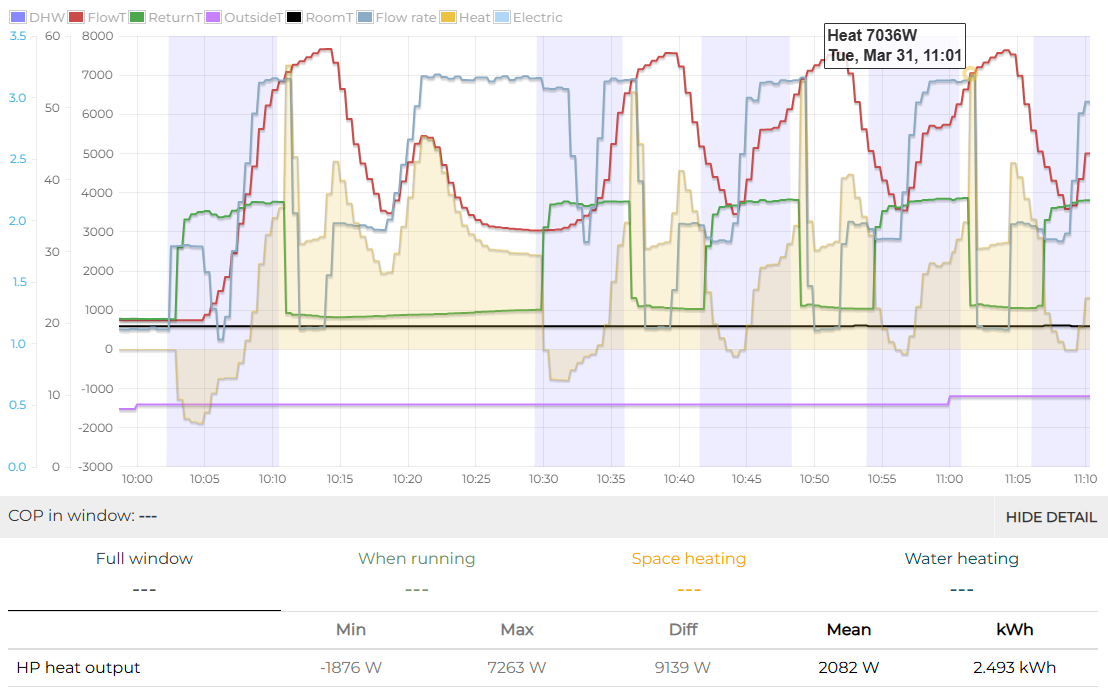
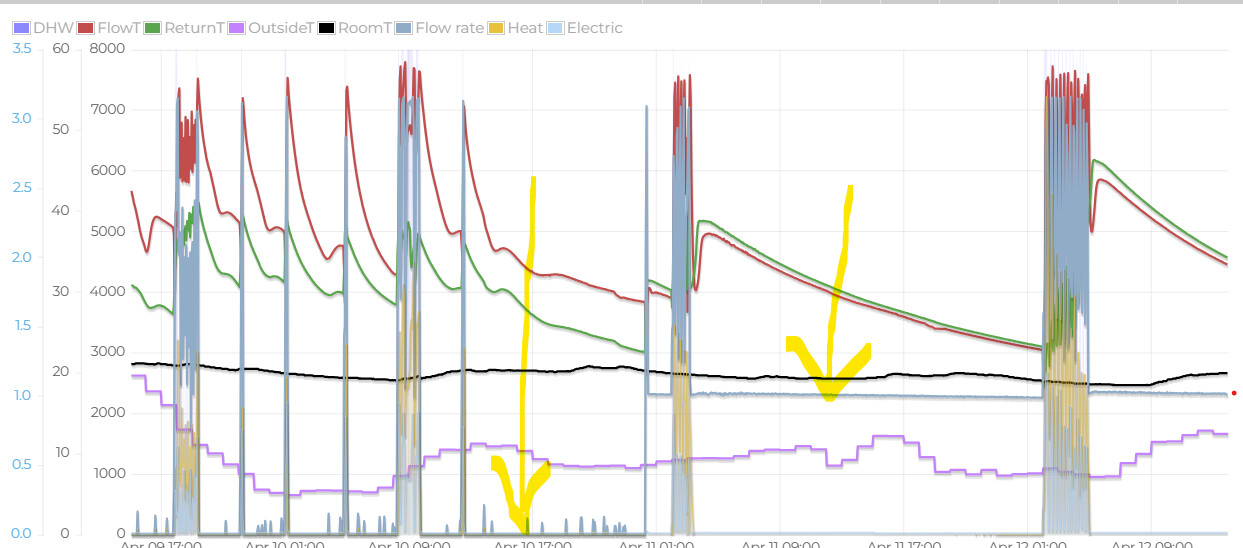
Heres a plot inc ‘defrost’

It feels like the system is coming on to top up hot water (because sensor is not reading true temperatue of the cylinder, possibly).

The pump ramps up, a load of cylinder hot water is pushed around the buffer and primary loop (and lost to outside).

The call for HW ends (how?). The diverter valve changes position.

Even though there is no call for space heat, the pump continues to run (why so?). Hot water is pushed from the buffer into the space heating pipes. As there is no call for heat, this heat is also lost; by over heating the room.

I have no idea how the 65C water is being generated as the HP is generating no hotter than 22C and the tank is full of 40C water. I’m pretty certain the immersions are off- but I will check.

This is quite strange behaviour!

Does the DHW go through the buffer? How is the buffer piped? Is it a volumiser? It’s not ideal for the DHW to be doing through a buffer, usually buffers / volumises if required are installed on the space heating circuit after the diverter.

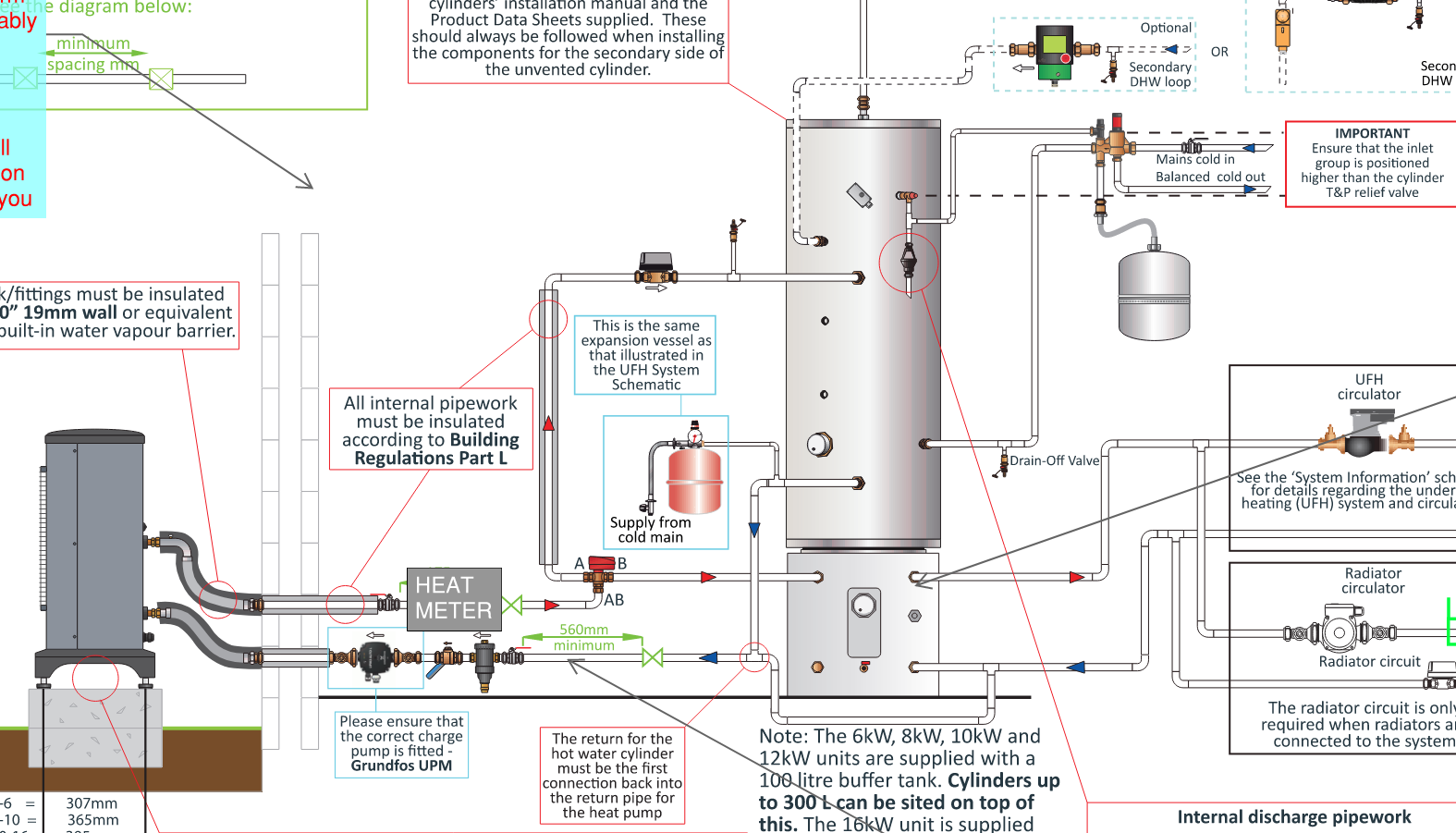
I think we checked this before, but are you sure the heat meter sensors are on the primary pipework before the diverter valve on the flow and after the DHW tees back in on the return?

Where is the supply line sensor located compared to the heat meter hot sensor? I would have expected these two sensors to read the same?

Hi Glyn

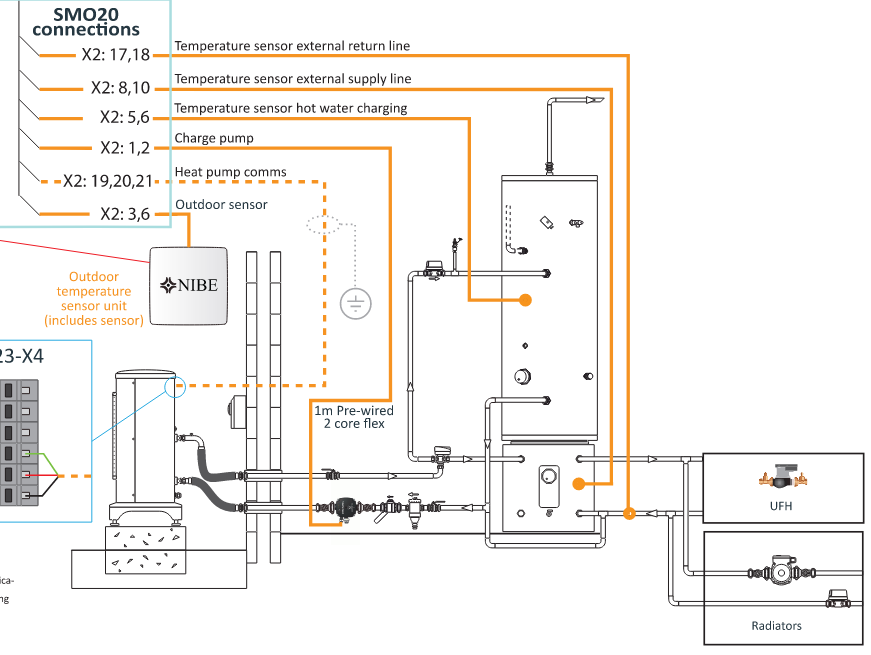
Schematic here.

DHW doesn’t go via a buffer, but once the diverter valve turns back to ‘B’ if the pump is running on, it will push water around buffer and primary loop.

I suppose the only ‘bypass flow’ from cylinder to buffer(&primaries) would be whilst the diverter was travelling between ‘A’ and ‘B’ which might only be a few seconds. If the valve isnt fully closing that might explain it.

Where is the supply line sensor located compared to the heat meter hot sensor? I would have expected these two sensors to read the same?

Externally; on the Heat pump flow I expect; which is a few meters from the heat meter which is in the plant room. Youre right they shoudl read the same. I should check the supply line sensor is properly in position.

Got it, that looks fine.

Can you check the two-port valve is opening during DHW operation?

1 Like

There’s very little configurability with DHW on a NIBE system - basically you get to choose the DHW ‘mode’ (Economy, Luxury etc.) and set the Scheduling. There are some more advanced settings hiding in the Installer menu where you can play with the temperature ranges for each ‘mode’ - but that’s pretty much it.

I agree it sounds like there might be an issue with the DHW cylinder sensor. The hypotheses would be that if that is reading low, the NIBE controller will think it needs to heat the DHW tank - but when it tries to do that it finds it’s already hot (i.e. the Return temperature is high) so it raises the Flow temperature even higher to maintain the Delta-T.
Your graphs aren’t showing a high Return temp though… only a high Flow temp…

Is there plenty of thermal paste between the sensor and the pocket in the DHW cylinder?
Is the sensor in the correct pocket (about half-way down the tank)?
Might be worth checking the sensor by dunking it in a mug of hot water and comparing with a thermometer.

It’s very odd if the controller is heating the DHW when that is ‘blocked’ by the schedule. I have my DHW schedule set so it only attempts to heat the DHW tank between 04:30 and 05:30 and I’ve never seen it try to run outside those times. Might be worth double-checking the DHW schedule is ticked as ‘active’ - though any issue with the scheduling wouldn’t explain the cycling…

Note the External Supply Line sensor (BT25) is on the ‘heating’ side of the diverter valve, so that isn’t expected to register the high flow temperatures on the DHW circuit:

  • This is by design, so the Degree Minutes algorithm can track the ‘deficit’ on the heating side during DHW (and Defrost) cycles
  • There’s another sensor built into the Outdoor unit which reports the Flow Temperature leaving there (BT12, I believe). That reading should correlate with the heat meter Flow Temp.

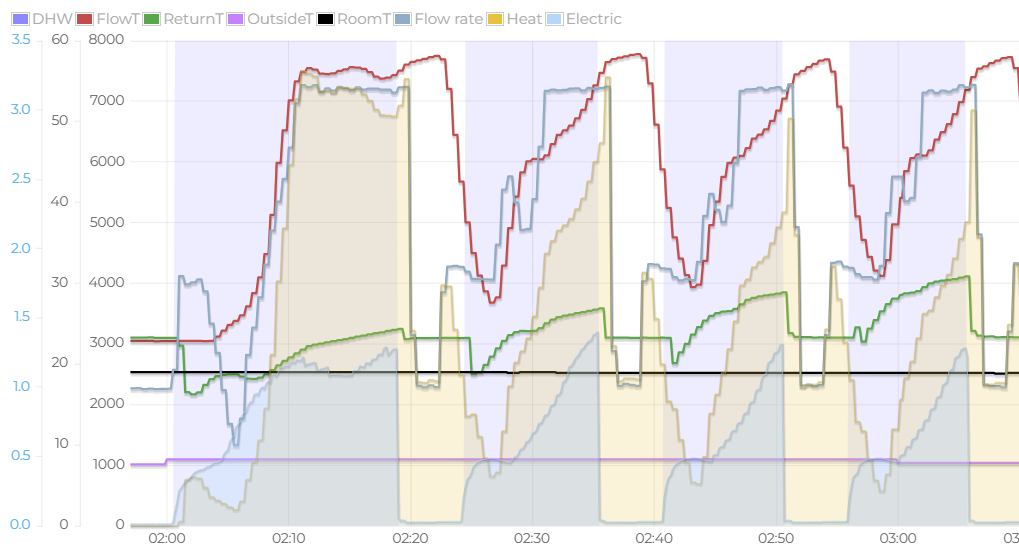
I’m still puzzled by the Green line (Return T) on your myHeatpump graphs, which I’d expect to be much more closely mirroring the Flow Temp. On reflection it makes sense that the Green line shoots up as soon as the diverter valve switches to DHW (as indicated by the purple shading) - when it starts seeing return water from the DHW coil rather than the heating buffer tank - but then the Return T barely changes as the Red line (Flow T) goes way higher.

My experience with NIBE systems is that the Flow Temp is managed to maintain a (configurable) Delta-T with the Return Temp, so the Flow Temp only increases because the Return Temp increases - but that’s not what we’re seeing here.

It’s certainly worth checking the diverter valve, but the decent flow rate reported by the heat meter (and the Green Return T line values) imply there’s good flow through the DHW coil - but then where does the high Flow T disappear to if there’s decent flow???

1 Like

David youre right re supply line sensor- its in the buffer which is heating side only

I found BT12 plot which is, as you expected, matching the higher temperatures.

When I next get an opportnuity I’ll check the cylinder sensor and add paste, and check operation of the diverter valve.

1 Like

Since I last posted ive sorted the scheduling; by actively scheduling OFF periods it holds off the hot water charging.

The diverter looked like it was operating fine ; from what I could tell on a video call.

The plumber/original fitter has visited; he moved the HW sensor from the top 1/3rd to the bottom 1/3rd position in the cylinder.

He added thermal paste to the sensor pocket.

He didn’t (wouldn’t) calibrate the sensor but he assures me its right because plumbers ‘just know’ these things :), I will keep sensor calibration as the likely contributor.

The hot water charging is still cyling rapidy- Off for about 6minutes and On for between 14 and 9minutes, gradually increasing frequency as the cylinder heats up.

Heat pump still running too hot (56C) to generate 43C hot water.

In between HW bursts, the pump keeps running, and this pushes 56C water around the heating buffer, and primary, and around the heating circuits too in all liklihood. This heat is ‘lost’.

COP recently; mostly HW, very little heating 1.2-2.0.

Ive contacted nuheat (who supplied us with this flea circus of a set up) and I will let you know what they respond.

Any comments gratefully received.

Two views of the same time period below

Finally, I just noticed that, despite there being no call for heat, no schedule for heat or hot water, the pump is now running 24hrs, which it wasnt before;

Thanks for the update. It’s good that the controller is honouring your scheduling for hot water but clearly there’s still an issue!

I’m going to loop in a couple of other people in case they haven’t spotted this thread and they have something to contribute:

  • @prwv who has a very similar installation - also designed by Nu-Heat (I recognised the stye of their schematic diagrams) - which I believe is working well, after resolving some thermal syphon issues caused by having two DHW cylinders
  • @etchelsa who is an expert on the settings which influence the running of the charge pump (and more generally on the operation and configuration of NIBE systems)

Normally I’d expect to see the charge pump running all the time - provided the outside temperature is below a (configurable) threshold value which indicates that space heating might be required. However, as you’ve noted, this does mean that water is being continuously circulated from the Buffer Tank to the Outdoor Unit and back again.

Given that your BT25 sensor is installed in the Buffer Tank (rather than just stuck to the flow pipework) you’re not relying on pumped circulation just for the sake of that sensor, so you might be better off having the charge pump switch off completely between cycles. Sam will be able to confirm, but I believe that can be achieved in Menu 5.11.1.2 by changing the setting from Auto to Intermittent.

None of that helps explain the rapid cycling on Hot Water runs though…

The fundamental issue seems to be that despite the very high Flow temperature being recorded by the Heat Meter on a Hot Water run, the Return temperature only creeps up slowly (presumably as the DHW cylinder heats up slowly) - with the big questions being:

  • Why is the controller choosing to deliver such a hot Flow, when the Return is around 30 degrees colder (at the start of the Hot Water run)?
  • Why is so little heat being transferred to the DHW cylinder, such that it takes about 3 hours to heat up (despite a ridiculously high Flow temperature)?

The Hot Water configuration settings are in Menu 5.1.1 and it’s probably worth checking that “charge method” is set to “delta temp” rather than “target temp” (though even with “target temp” you’d think it might aim for a 45C flow rather than a 55C flow).

David

1 Like

Thanks David

I dont have access to menu 5 on my set up unfortunately- so I cant check those settings remotely.

Nuheat have got back to me. They offer a credible culprit- low flow rate.

It is achieving 3l/m during hot water charge and

2 to 3 l/m during heating and

1 l/m when no demand.

Which is quite low flow.

This might explain why its ramping up temperatures:

“The unit runs, there is a back up up of heat in the condenser trying to be sent around the cylinder coil: This reaches limit temperature & the heat pump stops temporarily; The diverter valve then temporarily reverts to the buffer position (causing the buffer heating), and once the condenser cools it reverts to DHW mode, and so the cycle repeats as the cylinder slowly climbs in temperature. This is indicative of some for of blockage or restriction in the circuit between the heat pump and (at least) the DHW cylinder. Its unclear if a similar issue exists on the space heating circuit to the buffer.

In the first instance we’d recommend undertaking all the necessary checks to identify where such a restriction may lie. This includes checking/cleaning the particulate filter; Checking that the 2-port motorised valve on the cylinder flow is held fully & permanently open; That the VST diverter valve is moving fully into the Hot Water position when running in DHW mode; And that there is no air trapped in the cylinder coil.”

Their explanation makes sense, so I think that’s a good diagnosis from them. Interesting that Nu-Heat are not surprised to see the heat pump reverting to CH mode when it hits its temperature limit, which explains the rapid cycling in and out of DHW mode.

For comparison, on my system I’m getting over 1000 litres / hour through the DHW coil, i.e. about 17 litres / minute (at 56% circulation pump speed), so if you’re only seeing a maximum of 3 litres / minute that is indeed very low. I guess the filter is the first / easiest thing to check - and it’s disappointing that the installer didn’t check that already.

Out of curiosity, I presume myUplink shows your circulation pump at 100% during a DHW cycle, as it tries to achieve a decent flow? It will be interesting to see how that reduces - and the flow rate increases - when whatever is causing the blockage is cleared.

[ I must admit I thought the flow rate looked OK from your graphs, since the shape of the blue trace seemed reasonable and I’d not realised that it was the pale blue numeric scale at the far left which was the flow rate, in litres / minute. My Kamstrup heat meter reports flow in litres / hour, so I’m used to seeing much bigger numbers. ]

David