I have a NIBE S2125 + S320 heating system installed and monitored with EmonCMS since May 2024 [1]. This winter I have noticed that most of the defrost cycles have been executed with the DHW instead of with the ‘heating water’. NIBE refers to such defrosts as ‘tank defrosts’ in their documentation. These tank defrosts are not only inefficient (since the DHW is warmer than the heating water), but also results in a number of low flow warnings and alarms since the flow is much lower when performing a tank defrost compared to a normal defrost. According to the S2125 manual, a defrost requires at minimum a flow of 19.2 l/min, but a tank defrost only reaches 12.6 l/min which explains the low flow warnings and alarms. When a normal defrost is performed using heating water (see, e.g., [2]), the flow is > 20 l/min.
Does anyone know which conditions trigger a tank defrost? I have all heating circuits open and my house has more than 200 m^2 of underfloor heating (concrete floor) so the thermal mass should be more than sufficient for a normal defrost.
NIBE system ‘Tank Defrosts’ is not a topic that has come up on these forums before, as far as I know, but other NIBE installations seem to have been doing those in recent days due to some unusual weather conditions, requiring more defrosting than usual.
It looks like the NIBE controller is making a decision about where to source heat for a defrost based on the temperature of the heating water - presumably the temperature of the Return from the heating circuit. Some installations have sensor BT71 (‘external heating medium return’) which would seem to be a sensible sensor input to base that decision on.
You have the S320 Indoor Unit? The manual for that doesn’t mention BT71 but instead says BT3 is the temperature sensor on the Return from the heating circuit.
Do you have any data for BT3 and how that compares with the Return temperature logged to emonCMS (which I presume is from your Heat Meter)? The expectation would be that if that sensor reports a temperature which is considered ‘too cold’, the controller does a Tank Defrost instead. The threshold value for ‘too cold’ is perhaps somewhere around 25C.
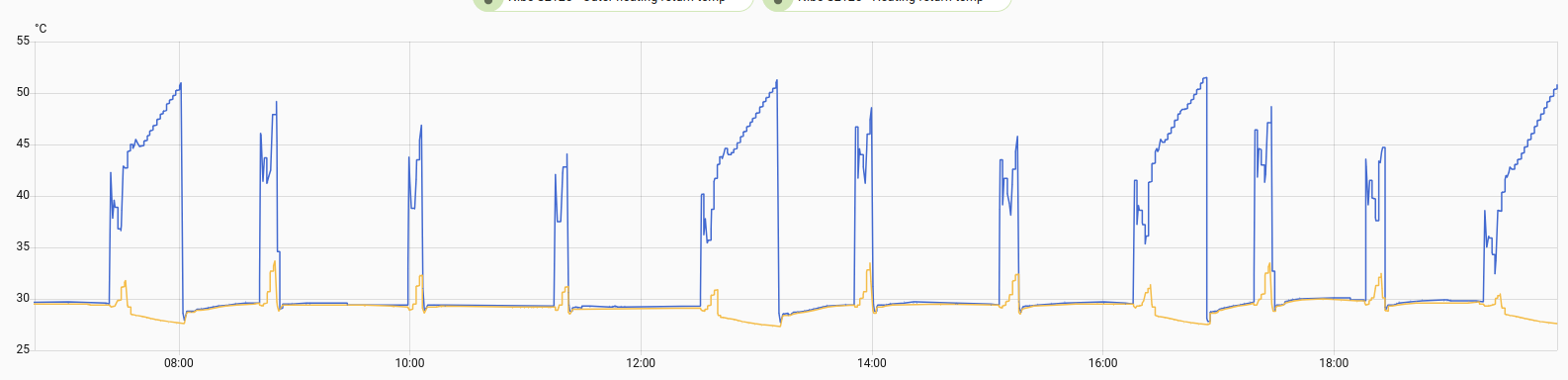
Thanks a lot for the inputs. Yes, I have the NIBE VVM S320 indoor unit. The return temperature (BT3) is the same as the return temperature of what you can see in the logged return temperature on EmonCMS ( HeatpumpMonitor.org ) when the system is heating up the house. When producing the DHW, it changes a bit, but not by much. I have logged both (for today) on my Home Assistant, and you can see them both in the plot below (blue is return from the heat pump (what is logged by EmonCMS) and yellow is BT3).
The water seems hot enough for defrosting, and I do not understand why it sometimes works correctly as for example here: HeatpumpMonitor.org (Dec 30, 2025) where the return temperature is lower than now.
This fall/winter, most defrosts have been tank defrosts (I would say around 80 % of them). Last winter, I also observed tank defrosts, but only around 10-20 % of the time. I have increased the heating curve in December to see if increasing the return temperature would help, but that does not seem to be the case.
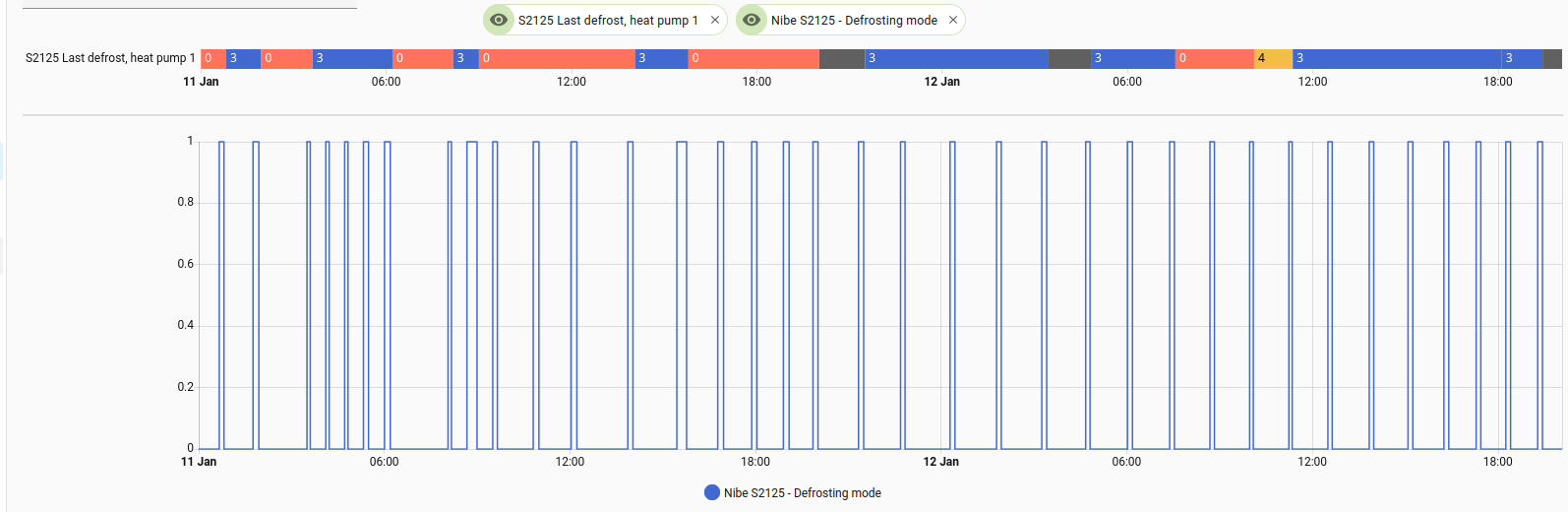
Another observation, I have made the past couple of days, is that the defrosting fails around 50 % of the time. This is illustrated below where the ‘last defrost’ indicates whether a defrost was successfully completed (value of 0) or failed (value greater than 0). 3 means that a defrost failed due to low flow while 4 means that a defrost was ‘aborted due to low LP’ (not sure what LP refers to). Black is unavailable. The defrosting mode (blue curve) indicates the defrost cycles. Despite this high failure rate, I do not observe any ice build up on the outdoor unit.