Pretty sure it’s reverse circulation, hot water was running there and I could feel the return to the rads hot. It’s connected to the return from the coil on the cylinder. Not sure why it would have been done that way. Three way valve etc is in the attic above the hotpress so I assume they could have just continued the old radiators return up there and connected in? Even if they add a non return valve now on the rad return it still means when the rad circuit is on its pumping through the cylinder coil? Which probably doesn’t make much difference.. it’s funny my family were complaining the house was way to warm and blaming the heatpump.. I was explaining all it as doing was heating water last month but it’s also putting some heat back into the rads during the hot water cycles probably 1.5 times a day. Probably not helping the efficiency of the hot water cycle either
Mine does exactly the same. After the hot water cycle the valve moves back to the default CH position and a small amound of warmth can be felt on the top of the radiators in our loft conversion. I don’t think it would be enough to actually warm anything up in my case, but I would prefer it not to do it. When the installer comes out to service it in a couple of months I’ll mention it to him
It’s definitely reverse circulation on ours. Hot water is going into the return from the cylinder coil into the rad return.. they probably shouldn’t have plumbed it this way. Installer is going to come back to fit a non return valve on the return to rads..
After my DHW cycle i can feel a big chunk of hot water go round the pipes, makes them click a lot with expansion. I’ve never really felt the rads but would imagine it wouldn’t heat them up much but you can absolutely feel it in the pipes. Goes hot then cool.
Just an update on this for those who were interested in firmware updates on their Grant outdoor units. I had an engineer out yesterday to replace the coolant (a preventative measure they’re carrying out on all 4kW units, after some P03 errors seen on this model in other places).
Apparently, this process with the programmer is no longer necessary as the update can be carried out via the control unit in more recent versions. So if you’re up to date on your controller, you should also be up to date on your external unit.
Interesting, that would indicate that maybe some 4kW units were shipped with low refrigerant. This does not seem to be the case on your unit, since I can’t see any difference in Carnot performance after the engineer visit yesterday.
Did you ask the engineer why your circ pump speed is always cycling? Your unit is the only 4kW unit I’ve seen which does this. This behaviour seemed to start after the outdoor unit FW was updated? It’s quite strange https://heatpumpmonitor.org/dashboard?id=717&mode=power&start=1783436650&end=1783442830&flow=1&carnot=0.41700000000000004
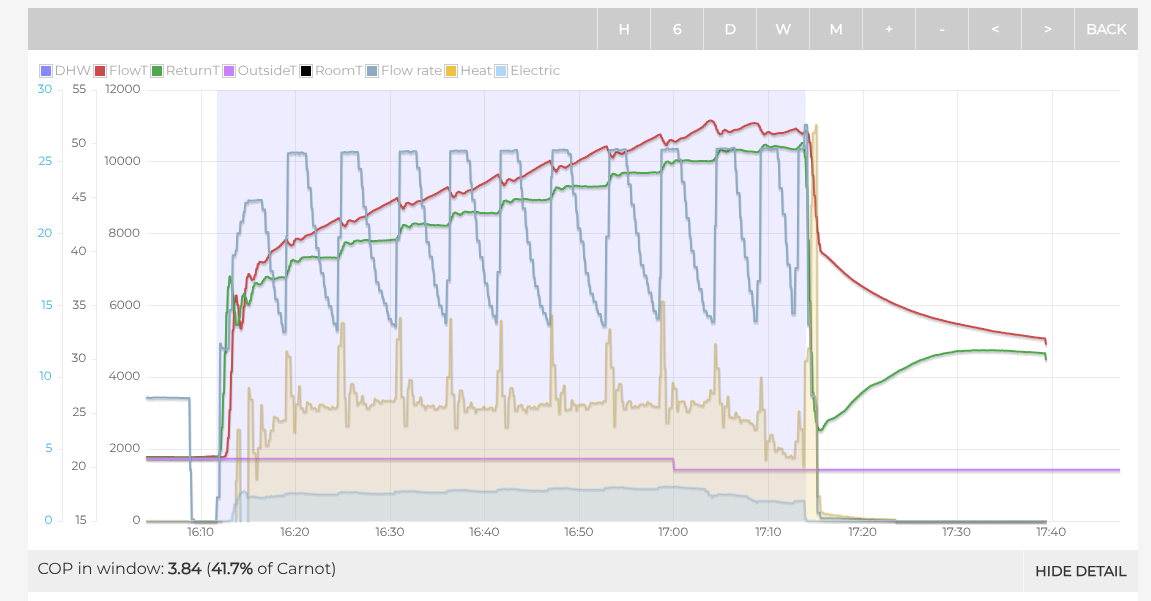
Yeah, I agree there’s never been a P03 error on mine and so I won’t see any improvement. I’d hoped he might address the oscillation issue, but it’s been referred up to the technical team. Their previous answer was that it was to do with the flow temps I was running at causing flow to drop and then go into recovery, but this is not the case in the summer time where I’m only heating hot water.
@Durruti Don’t suppose you know the version of the controller you need do you? I last updated mine a few months ago, I’m on S024.25. According to EcoNext my heat pump firmware is 86.
Would be good to get the heat pump updated to take advantage of the fan speed settings.
That don’t make any sense, since it’s doing it for DHW. Also, there are other 4kW units running low flow temperature that doesn’t have the issue. It doesn’t seem to affect performance, it’s just a bit odd! Can you hear an audible change in flow rate? I’m assuming you’ve tried to reset the pump speed setting to default?
I’m considering getting the FW updated on my outdoor unit so I can play around with the pump speed settings, but I’m keen to avoid this.
Are you aware of the controller auto-updated the ASHP firmware now @glyn.hudson? Not sure if you had a newer controller firmware and were aware of the changelog.
No, first I’ve heard if that. As far as. I’m aware there is no public change logs, but you can get an idea of the changes by doing a diff compare on the manual version.
My outdoor unit is running an old version, so will require a manual update.
Random unrelated one Glynn (although this seems t be the “Anything Grant R290” thread now anyway! :D) - what are you (and anyone else) doing in the summer with your ASHPs? I forgot mine now has pump blockade off so it’s just sitting there pumping a bit pointlessly, what are you you doing to avoid this, do you just manually turn on pump blockade?
The pump will stop once it switches into summer mode. I’ve set this to happen when the outdoor temp reaches 19C. Then will revert to winter mode when the outdoor temp drops below 17C. The setting for this is under the Weather Sensor setting
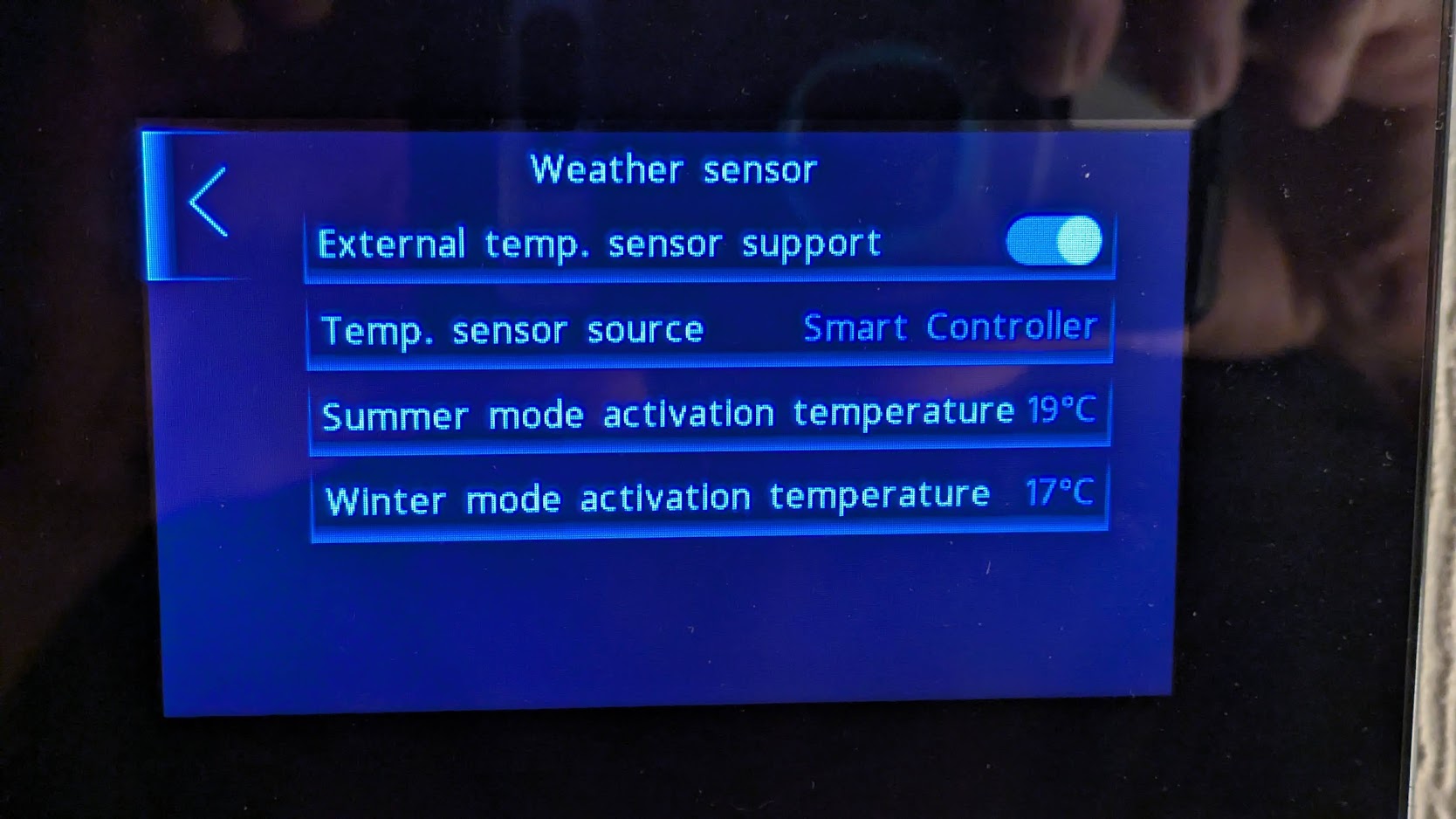
Check the mode of the heat pump is set to Auto, so it will automatically switch between winter and summer mode.
Ahhh gotcha, yeh mine is set purely to winter. What else does this setting do? The manual seems very unclear on it!
I think it just a hard cut-off, as soon as the outdoor temperature reaches this threshold it will stop all space heating and switch to cooling (if enabled).
I know this started as a DHW thread :-). Anyway, we finally moved in over the weekend and just have the Grant 6.5kwh up and running. Was surprised to see my DWH cop is around 3.2. As it was 27° i thought i would be into the 4s. @glyn.hudson - I know you have the heat geek cyclinder - do you think this is worth 0.5-1.0 of a COP. We have the grant 300l cyclinder… Hard to get info on the coil size. My target temp is 45°, cyclinder is about 6m from the HP. Primary pro on the 28mm pipework. The stat is low enough on the tank, hysteresis is 10. I have silent mode on, but it seems to run flat out at 7.2kwh 
As well as switching on silent mode you need to set a silent mode schedule to activate it.
Try moving the sensor to a higher pocket, ideally level with or higher than the top of the coil. It makes a big difference for efficiency if the thermocline layer is above the top of the coil I.e the tank is least 80% depleted. Having the sensor lower in the tank, even with a high hysteresis will result in the DHW being reheated when the thermocline is below the coil level.
So I have a solution to the oscillation problem, following up on the reply @LeeNuss added in Dec (that I missed in the thread), I’ve set the minimum flow to 50 and that has resolved the issue. I’ll try incrementally reducing from here to allow the max range possible.
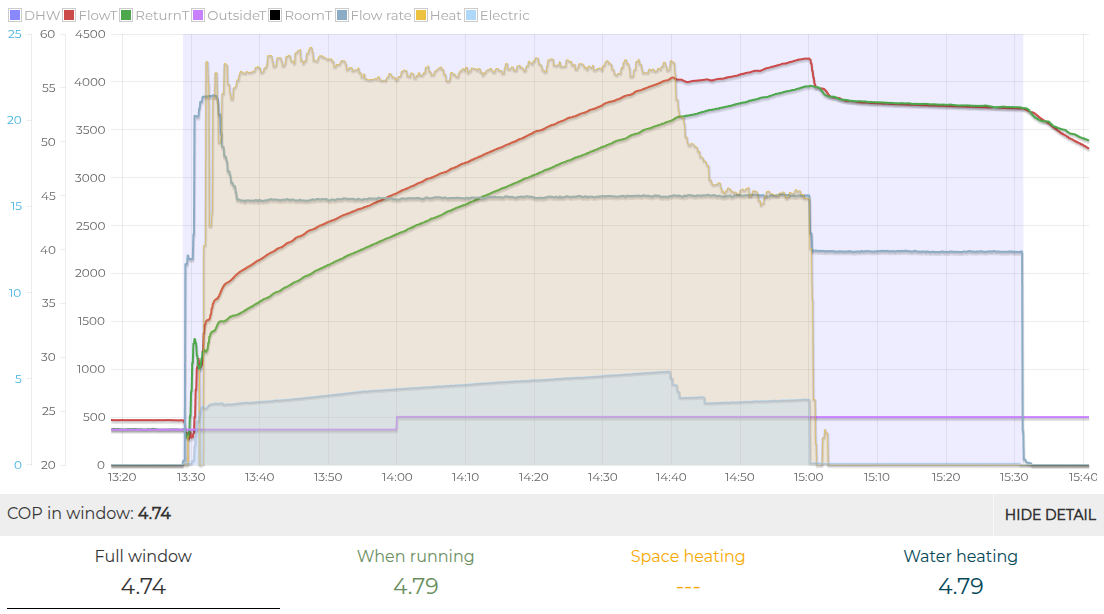
Regarding this Matt, did you get any more details? Are they saying that if you have an up to date version of the controller that it itself can update the ASHP firmware?
@MrW yes, that’s what I was told by the visiting engineer. he also said they’re working towards OTA updates, but sounded like that was some way off.