I plan to take occasional power measurements for several single-phase 110 VAC appliances at my home (washing/dryer ~1800 W, dishwasher, PCs, TV, etc.). I don’t want to use consumer Smart Plugs (Like Tapo, THIRDREALITY, etc) because of inductive loads of the related motors.
My ultimate goal is to learn about my power usage, but I’m quite limited on my budged to achieve this.
My plan is to build a small portable inline box (extension cord style) to put between outlet and appliance, with the meter inside the box and Home Assistant capturing measurements.
Is this TONGOU a reasonable / safe device to use in a portable inline box? The manufacturer diagram shows small breakers — are those breakers/fuses required even outside a electrical distribution box?
I should not need Current Transformers for this device, right?
Any gotchas for inductive loads (inrush current, surge handling) with that meter?
For the ~USD 35 price, could it be there any better alternatives to my selection?
Why do you think the inductive loads are an issue for the smart plugs? I’ve got Meross and Shelly smart plugs for dish washer and washing machine without issues.
The manufacturer claims the device meets a standard that would be appropriate here in Great Britain, so I think it is likely to be safe when you use it in the way you describe, that is plugged in to an existing socket outlet which is itself protected by an appropriate fuse or circuit breaker. In this case, overcurrent protection will be provided by the fuse or circuit breaker protecting that outlet.
Correct. Neither can you use this with a current transformer.
Like @Andre_K, I don’t anticipate a problem if you are connecting normal domestic appliances. I think this could be more likely to accurately record any inrush current, simply because it is rated to 50 A, which is likely to be greater than a Smart Plug.
I would caution against installing this in a small enclosed box without adequate ventilation.
Hi André,
What I understand is that when switching Appliances that have motors in them, there is a peak of current that may be over the ~15A limit that the contacts of the Smart Plugs.
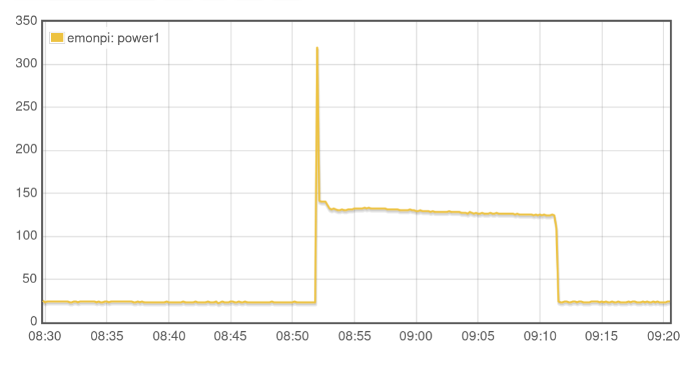
There will be a peak of current, called “inrush”, as you say. Here is my combined refrigerator/freezer starting - the vertical axis is watts (not current), captured by an emonPi with an averaging time of 9.8 seconds. From the graph, the average power over the 9.8 s interval was about 300 W. The peak probably lasted less than 1 s, so the peak power could have been about 3 kW or more, so about 13 A - which is the continuous rating of the plug and socket. The current when it is running is about 700 mA at a power factor of 0.65, which gives a real power of a little over 100 W as shown. The voltage at the time was about 235 V rms, 50 Hz.
Whether it will be greater than the continuous current rating of the Smart Plug, and whether this matters, might be very hard to find out.
I think if you as a normal person buy a smart plug in your local electrical shop, it should be suitable to use for switching and monitoring the things you would expect to switch or monitor with it. If you buy from the manufacturer or an electrical wholesaler, this might not apply because the seller can expect you to be qualified and therefore you should know whether it will be suitable.