Is COP & SCOP too abstract?

I think it would be really useful if the home page (heatpumpmonitor.org) listed the Watts/C or even Watts/C/m2 for the various installations. How many watts does my property need to raise it 1C in temperature. This would give an indication of the property’s insulation performance, which is tangible and improvable. The COP, while it is an understandable value, it is a measure of the heating system performance not the property. I understand that changing the weather comp will affect the COP, so there is a link to the property thermal efficiency inherent in COP & SCOP.

I could have a poorly insulated property, with a large ‘oversized’ heat pump very large heat emitters and be achieving a very good S/COP, but be using say 500W/C.

I believe my property needs about 200W/C to achieve 20C, which is about 0.8W/C/m2. I’d love to be able to compare this to other properties. COP is a bit too ‘abstract’. I think most people can understand watts per degree Celsius. Now, if I could see that many others were using 100W/C, 0.4W/C/m2,…

I also think that the information about property types and efficiencies would help with the (dis)information war.

I have never fully believed that chasing the COP is the whole story.

Hello @Staedford did you see the fabric page, it gives figures in kWh/m2 which is a common metric for building fabric efficiency: HeatpumpMonitor.org

1 Like

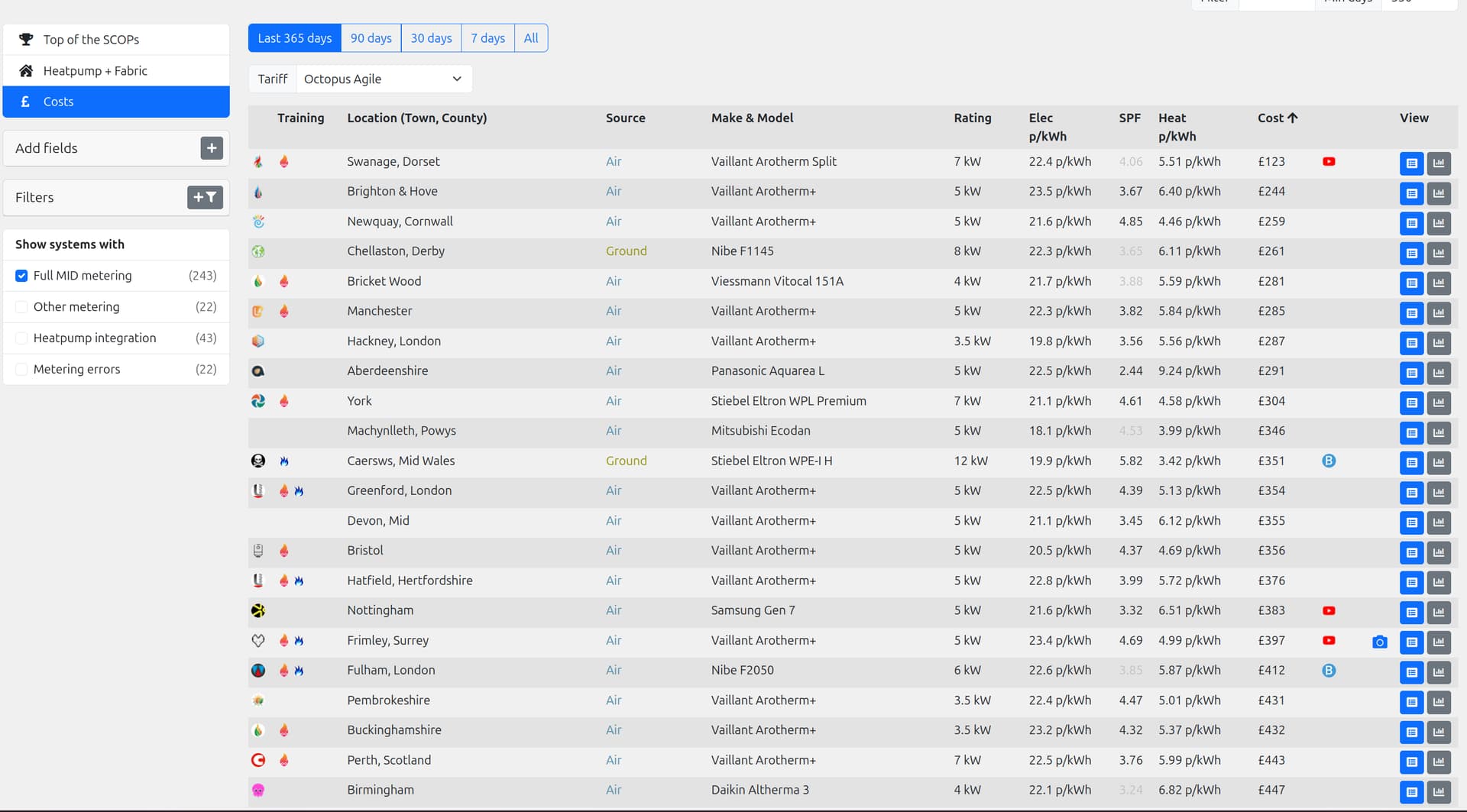
There’s also unit cost and total cost:

all metrics have their faults.

There are so many poorly configured heat pump systems in the UK that are running less efficient than they could, if a system is getting SCOP 2.8 and you could actually get 4 out of it whilst also optimising for tariffs why would you not want to do that? Couple that with good building fabric and it’s a win all round.

1 Like

I’m not a big fan of CoP as the only or even the primary metric; it’s notable that the systems at the top of the Heatpump + Fabric dashboard report distinctly average SPF figures, despite having the best-performing building fabric.

However, a key target audience for Heatpumpmonitor is people who currently have a gas boiler and are considering switching to a heatpump instead - without significantly changing their building fabric. Those people are well aware of the per-kWh price differential between Gas and Electricity (4.67 by the 1Q2026 Ofgem Price Cap rates) and CoP / SCoP / SPF figures are directly comparable with those price differentials (adjusted for gas boiler efficiency) as a predictor of ongoing heating costs.

In that context, I’d argue that SPF and CoP are more relevant and less abstract than kWh/m2 or W/C/m2 to a large proportion of the target audience. As Trystan pointed out, there are alternative dashboards (with highly configurable columns and sorting) for people looking for alternative viewpoints.

2 Likes

Trystan, thanks for the reply and sorry for the delay in getting back to you. If a league table of COP/SCOP is your aim, then that is achieved. I agree, we should optimise COP, there is no question about that. Note I did not say maximise COP. I am saying that the heat transfer coefficient (htc) should also be there, beside the insulation level field, which is subjective. I am not (not) saying the COP should be removed.

What am questioning is the priority of COP on the interface. COP is an indication/mixture of the installation quality and the running regime, the building insulation, the emitters,…..

The kWh/m2 measurements, whether elect or heat are influenced by the comfort level, so is particular to the user.

If you could work out the htc, this is a direct measure of the building performance, somewhat irrespective of user comfort levels, so is a truer indication of the performance of unmodified insulation, some insulation,….. to code whatever standards.

1 Like

David thanks for the reply. Firstly I am not arguing for kWh/m2, rather W/C/m2, I think properly written W/C(m^2), the heat transfer coefficient to be published on the main interface, perhaps as a first step on a journey. you can then compare through colours how various insulation levels are performing,… can an unmodified house really compete with slightly modified, heavily modified,… code 6, pasiv,… you’ve got (much of the) the data damn it!

If the gas/oil users are your audience, why then does the page not open on the costs page, where is the horizontal line that says, all the users above this line users that can heat their home for less than a oil or gas user, without significantly changing their building fabric. I could go on,…..

So an oil/gas user could visibly see, that there are real people with actual systems heating there house for same or less, with little or no change to fabric.

You can see my reply re. htc to Trystan. Htc is less subjective, I believe.

I suppose I think that the information on the site could be flexing is muscles more.

I don’t agree that COP is less abstract than “how many watts are needed to raise one square metre by 1C”. TBH I was not really suggesting replacing COP with htc, rather adding HTC, not replacing, apologies if I inferred that.

I am not agruing against COP, I am saying that is is a very particular thing, it relates to setting, installation, yes insulation,…..

HTC is clean, it is not related to any heating system,…simply the property. I can see that I have not communicated this well, the fact that you are comparing htc relevance to COP or SFP. I’m saying, fight the propaganda war with the data you have. Show that unmodified or properties with modest insulation mods can (can) heat for the same or less cost than oil or gas!

I agree, this should take the house indoor temperature vs outdoor temperature into account and be normalized to kWh/m²/K.

3 Likes

Yes Andre, I think the cost screens should also include a costs/m2, this would help with comparisons between systems and properties, how do we in the UK compare to those Scandi experts?