Yes this is correct, you dont need much, but you need a bit.
Maybe here on your system? Emoncms - app view
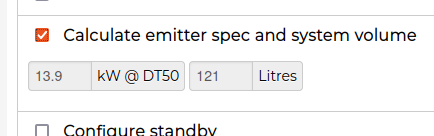
It really needs some way of filtering out the spikes at the end of hot water cycles as that really throws the result e.g 290L here.
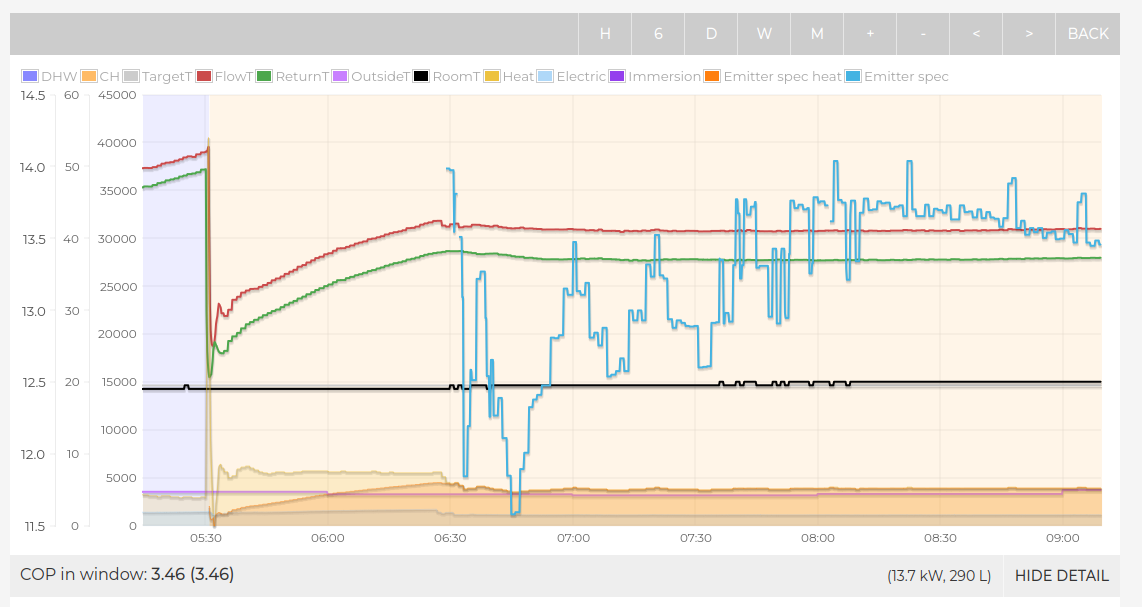
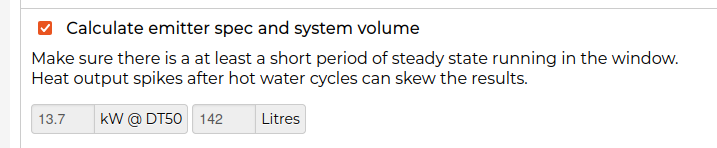
Nice! This makes it much easier to see why the heat pump is in stable running vs cycling.
It might be helpful to add a checkbox to “Lock” the calculated volume radiator output so that it doesn’t jump around when looking at different parts of power graph. I have to go a loooong way back to find stable enough data.
1 Like
Thanks @Timbones, do you mean to lock the radiator output spec?
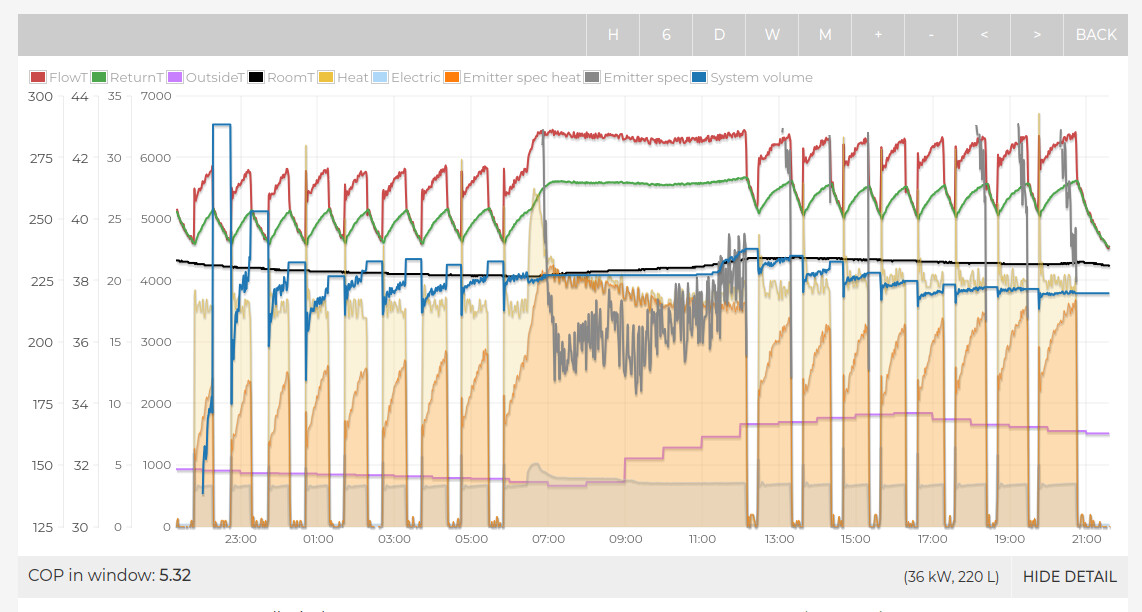
I’ve added a plot of how the calculated system volume evolves as it proceeds through the window, which gives a useful insight into how well the calculation is doing. As you can see in this example, there’s some errors early on that become smaller as time progresses, in other times you can see errors building it doesnt take long to see when a result looks more plausible
Sorry yes, I mean radiator output.
1 Like
Hmmm, it’s still quite unstable at times…
This is now implemented and it works well.
Latest version (note emitter size, and system volume printed next to hide detail):
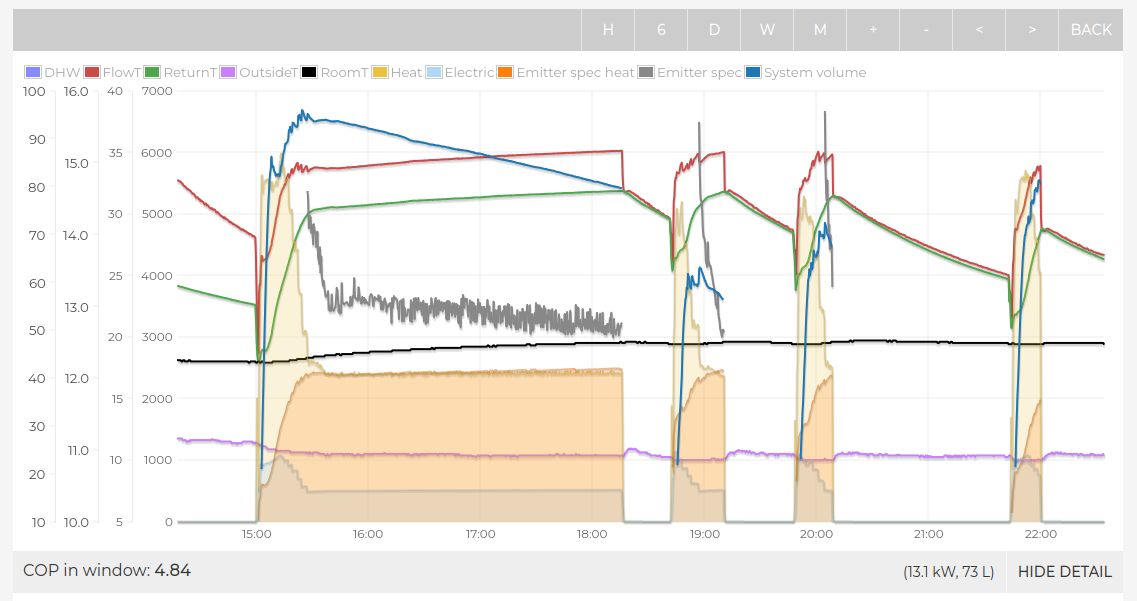
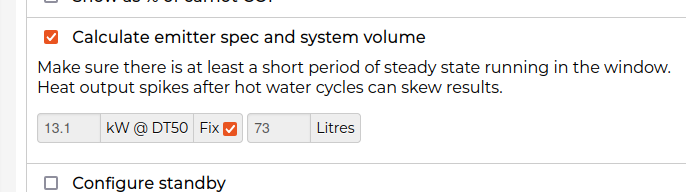
The try fixing the radiator spec:
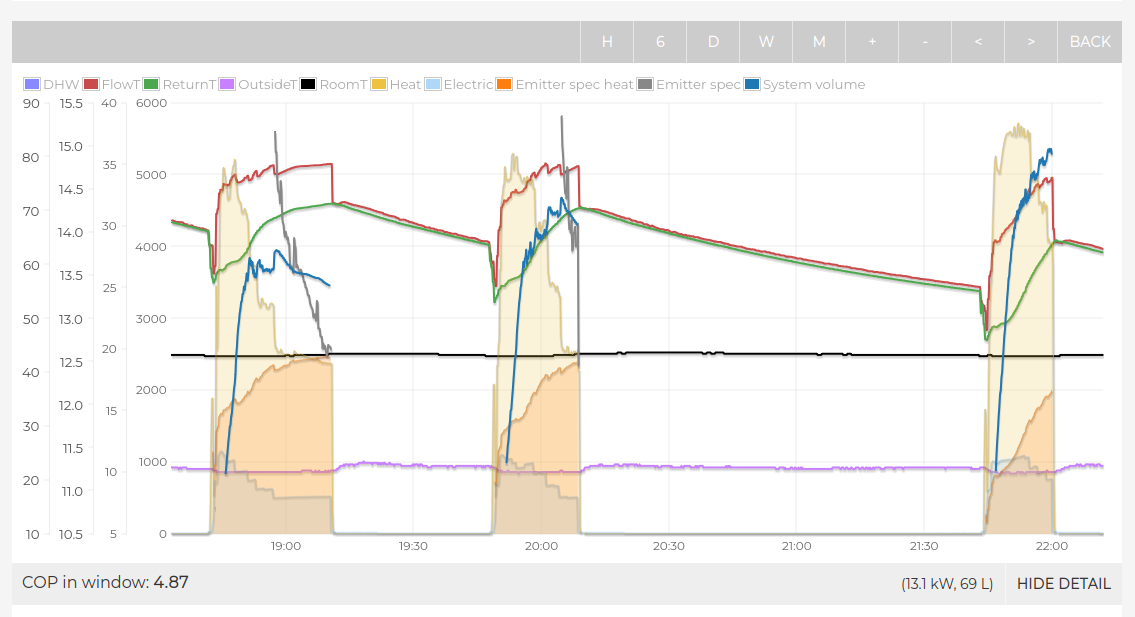
you can then zoom in on the cycles without steady state running e.g:
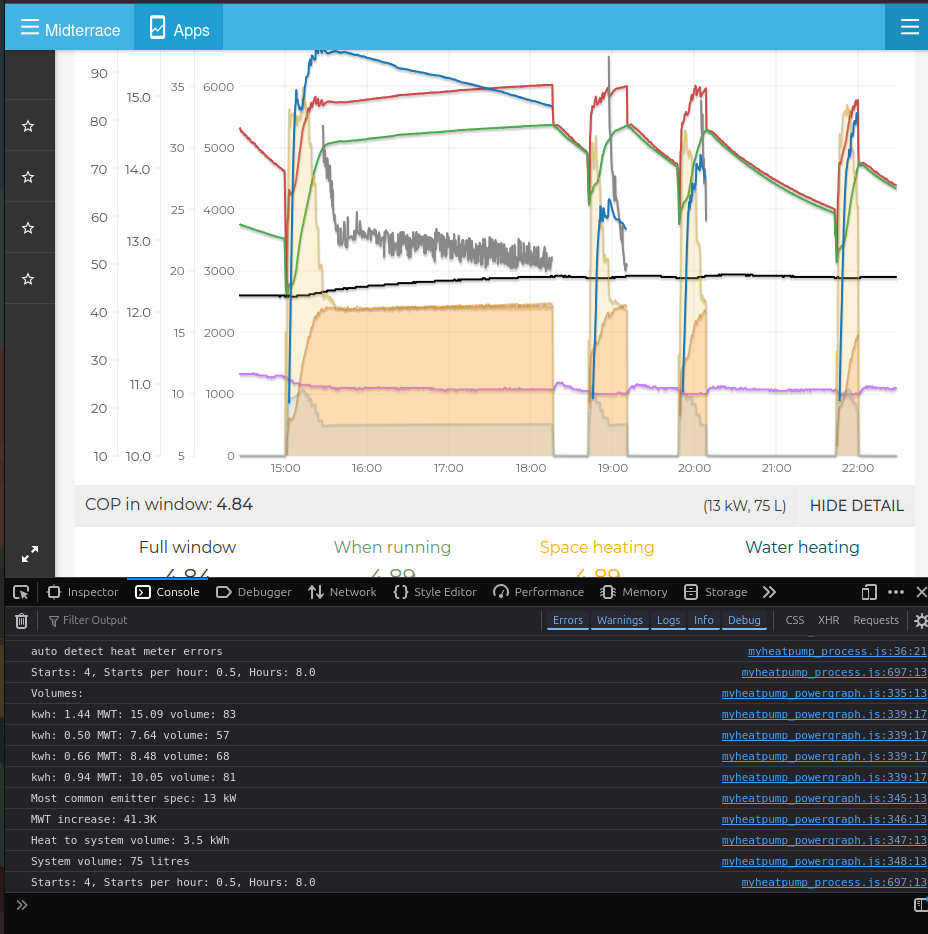
There’s also a bit of info in the development console, including the calculated volume for each cycle individually that might be useful for testing:
1 Like
@ajdunlop I think you system has around 100L, what do you think?
Noting in the first post above that I calculated my system volume based on radiator volumes and pipe length to be 73L the results seem pretty good on my system.
Interestingly the radiator capacity seems to be around 13 kW at the moment, down from 15/16 kW last year which is a bit strange…
I think I worked out that it was around 100L sometime last year.
It’s a bit hard to estimate as we have a number of non standard radiators (large old single panel and towel rads).
I’m really annoyed that last time I had to drain down some of the system that I forgot to measure how many buckets of water came out.
I’m more and more coming to the conclusion that our system could really do with a bit more volume. We have kickspace heaters that don’t provide much volume and I’m planning to increase the emitter output by adding a couple of concealed fan coil units at some point but again these aren’t going to help with volume.
It looks like I regularly lose 20-25% of my 100L capacity at the minute, I assume through the bedroom TRVs shutting off.
Revisiting this specific cycle to look at again with new functionality:
https://emoncms.org/cryosphere?mode=power&start=1700106950&end=1700119570
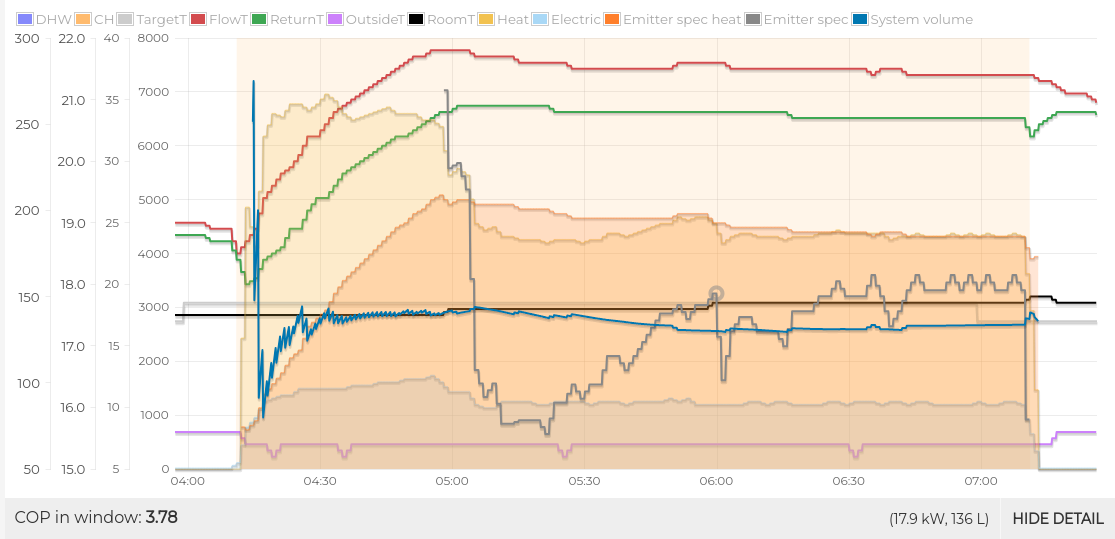
Does this show the effect of radiator fans turning on at 6am? The volume doesn’t change.
Caveat: the indoor temperature is not very precise - single room in 0.5° increments.
1 Like
Like the info being produced here, but I haven’t been able to make it work for my Daikin system.
Would there be a way to add a fixed room temperature, so this calculation can work for those of us not reporting internal temperature via OEM? My house only varies between 19.5C & 20.5C during the heating season so I’d be happy to estimate from 20C. Or do you think this isn’t accurate enough?
Sure, added in:
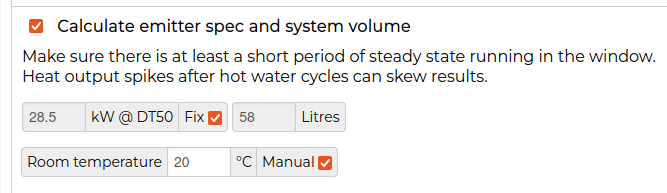
Im not sure that it’s that reliable / accurate but maybe interesting to experiment with…
1 Like
Trying to work out emitter output on a system with underfloor is interesting… much less stable, with results anywhere from 48-95 kW @ DT50 depending on the period… I guess reflecting the ability of the slab to just soak up heat at low flow temperatures… I think this system is probably closer to 60 kW @DT50 in reality but would be great to validate… https://emoncms.org/app/view?name=MyHeatpump&readkey=1548bb92f8413211bb7c36cfa154ac94&mode=power&start=1704537000&end=1705734000.
1 Like
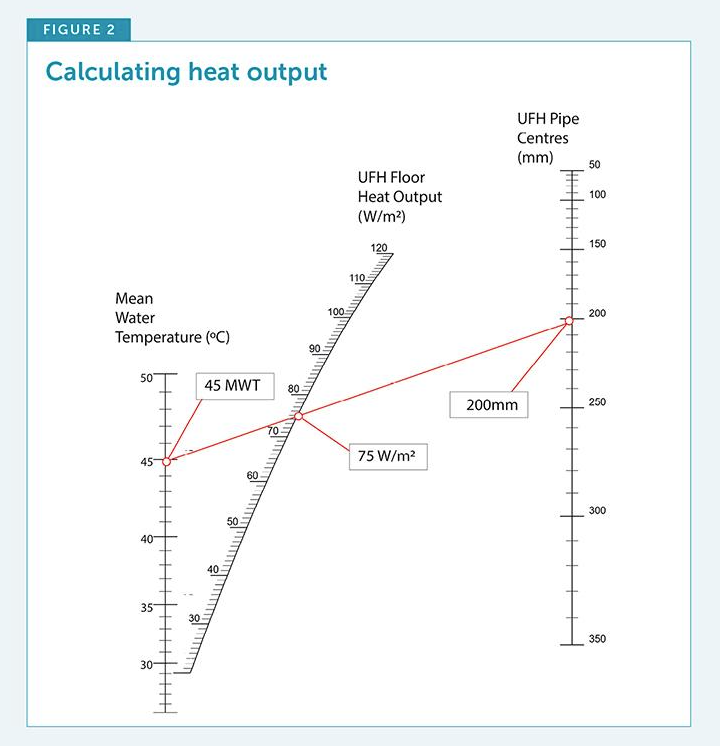
Another factor is the “n-coefficient” as defined by EN 442, usually 1.3 for most radiators. I’ve struggled to find a suitable value for underfloor, but one source suggests 1.15 with this chart.
On a related note, I found a spreadsheet that had 1.1 for fan coils and 1 for fan convectors.
2 Likes
You should be able to infer n from the temperature decay when the circulation pump is running but the compressor is off. It’s just a question of fitting the right equation (it’s not a pure exponenial).
2 Likes
So here’ my attempt at calculating n from measurements.
The general idea is that radiator heat output is proportional to (T_Flow-T_room)^n = deltaT^n, with n the radiator coefficient. The temperature decay during the compressor-off time is then given by the differential equation d(deltaT)/dt = -k * deltaT^n. If n = 1, the solution is the well-known exponential decay.
We can just plug this into Wolfram Alpha (ChatGPT o1-preview also does a good job here) to get the solution (can we get LaTeX or some form of Markup equations here in the forum?  )
)
deltaT(t) = (deltaT_0^(1-n) + (n-1)kt)^(1/(1-n))
I then raised my flow temperature for a bit to get some proper data. Note that the solution depends both on an accurate flow but also an accurate room temperature at the location of the radiators. This becomes more important if room and flow temperature are very close.
Here’s flow and whole-house indoor temperature (I have temp sensors in every room and calculate a weighted average house temperature). I download the data as csv from Emoncms and process it in Python fit_n.py.txt (3.5 KB). This will directly work with emoncms exported csvs.
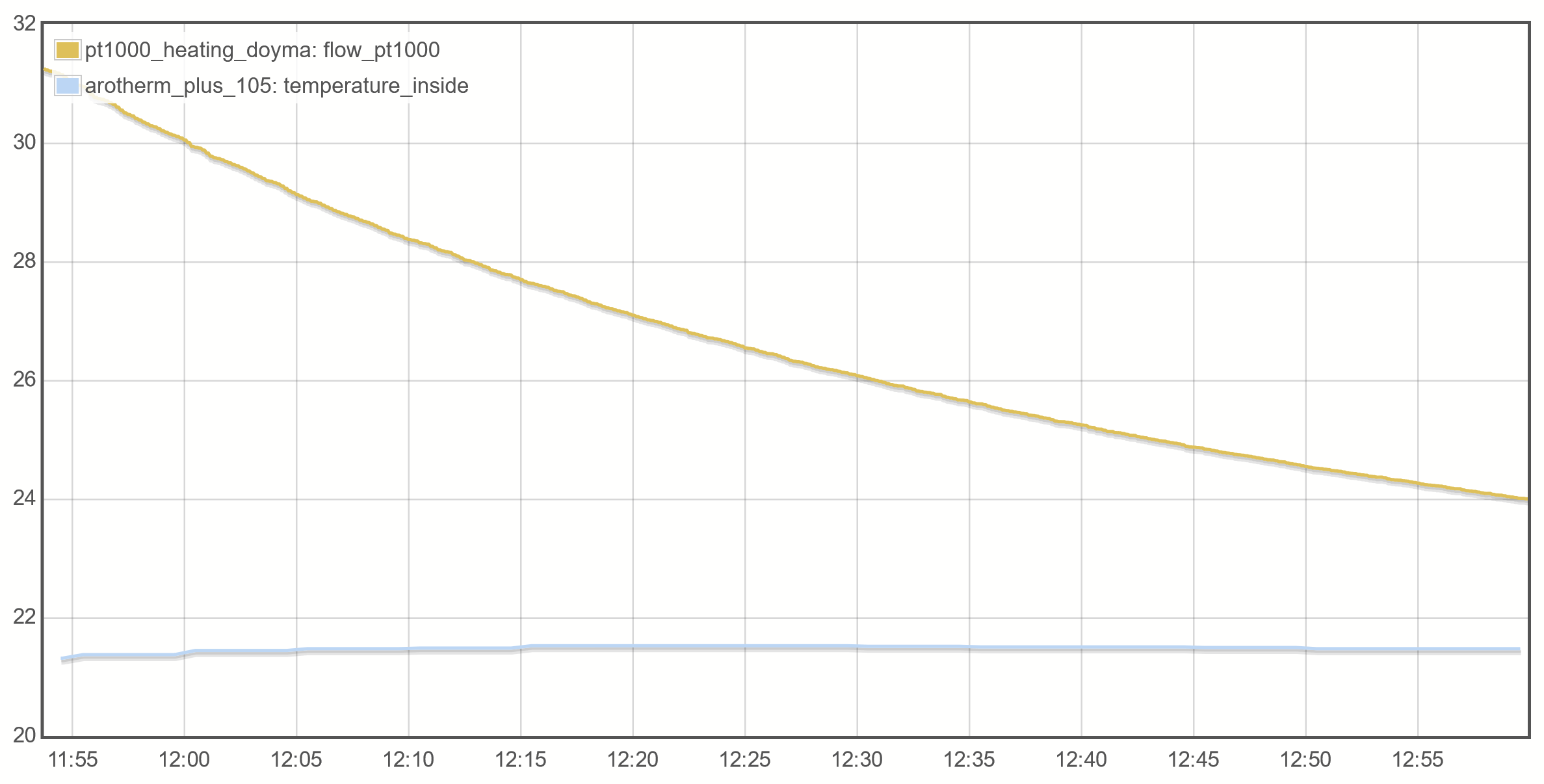
The fit works nicely and I get an n of approximately 1.18.
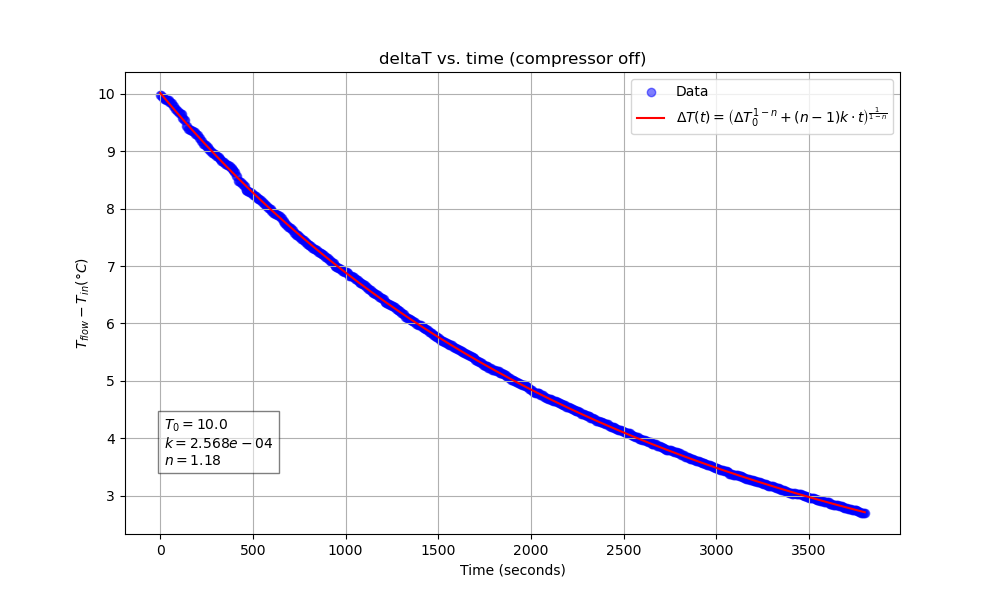
As stated before, this is very sensitive to the room temperature measurement. Adding/subtracting 0.5°C and redoing the fit yields 1.29 and 1.07 for n, respectively. I think the value is quite ok for my house, as I have mostly Type 33 and 22 radiators and not all are equipped with fans. Also my pipes are not insulated so there’s some UFH-type characteristic in there too.
2 Likes