have you missed one of your pictures to show the differences
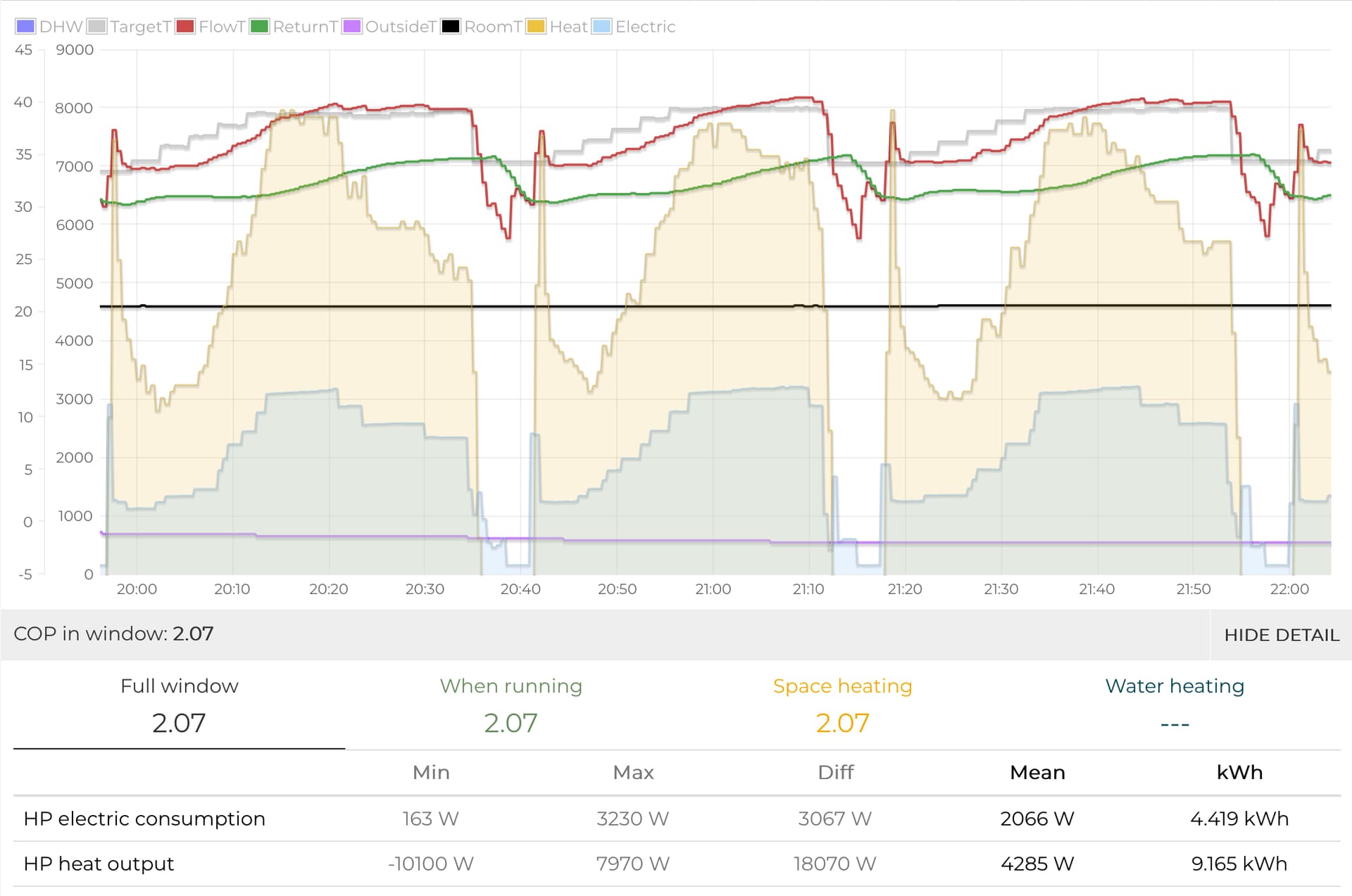
no that chart shows the cycle before and after the defrost. dropping the LWT helped keep the heat output lower, which hopefully reduces the work for the compressor.
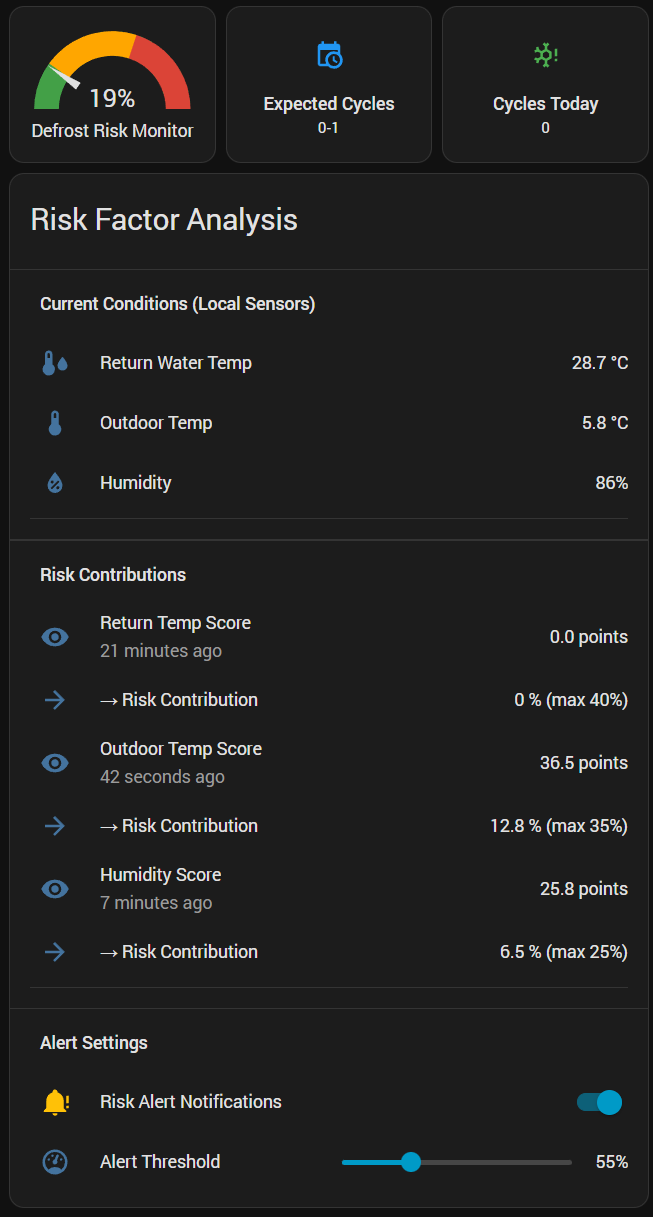
I’ve also been letting AI chew through a CSV log file I’ve been keeping for the heat pump and its come up with some thoughts. Its thinks my defrost issue is actually caused by the return temp rising over 33C, a low delta, which combined with outdoor humidity and temperature, raises the defrost risk.
The issue I have is I still have radiators sized for an 11kW Daikin and a heat loss of 9.1kW, when my actual heat demand is 4.2kW and have an 8kW Daikin. This means I can run at very low flow temps but consequently a very low delta between flow and return.
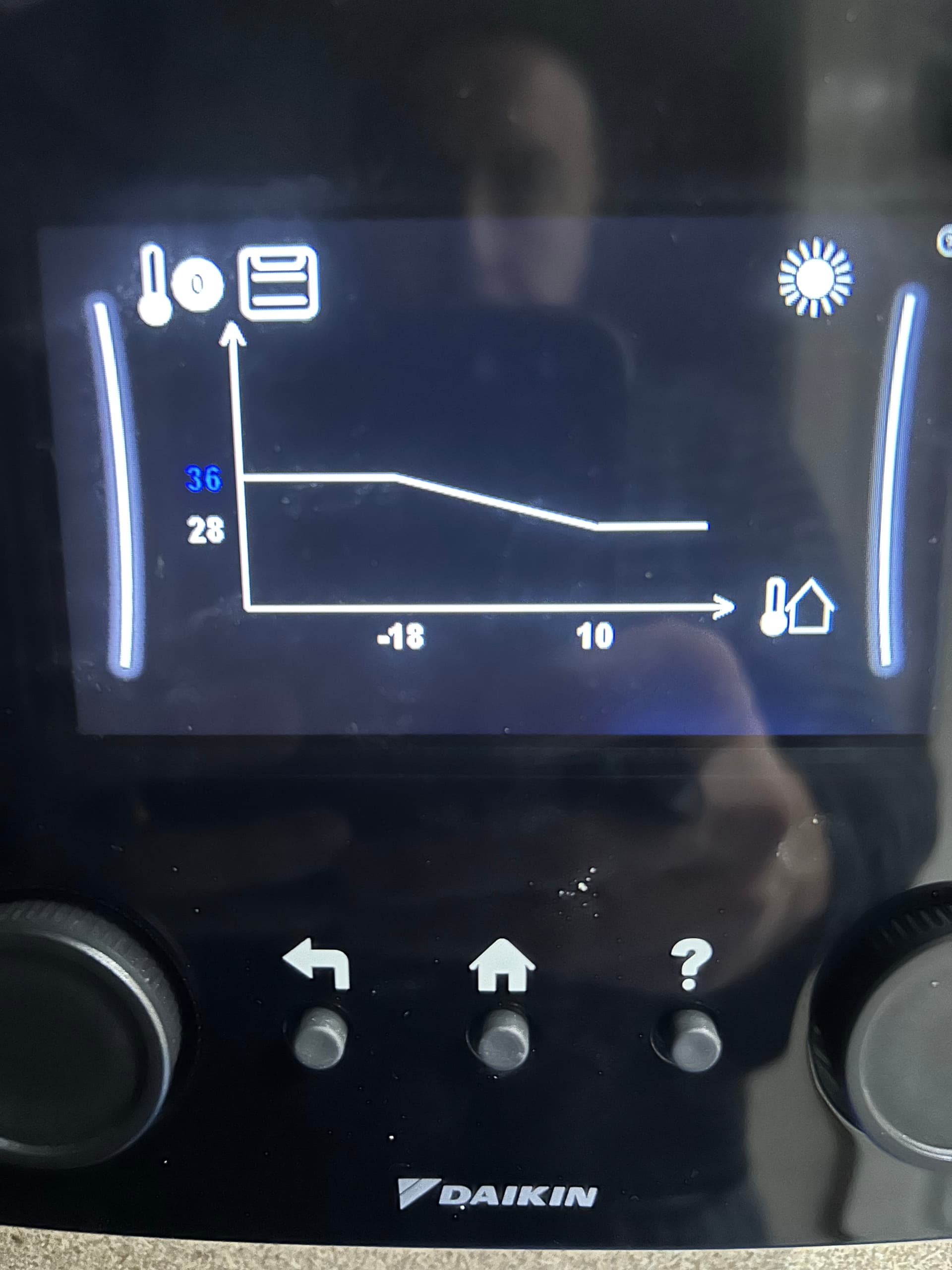
The AI agent has suggested keeping my flow target at no more than 39C, which should keep the return less than 33C for about 95% of the time.
39C shouldn’t be a comfort issue as the only time I feel like I need more is with a strong easterly wind, which I can deal with differently. I had bumped it up to 43C at the cold end
Lets see if its suggestions help.
Can you explain the link between radiator size and heat pump size please, I don’t get it?
Surely your radiators are sized to suit the heat loss of a room at a design flow temperature?
The hot water coming from one heat pump is the same as any other.
Why would your radiators suit an 11kW Daikin and not an 8kW Daikin?
As you know, I have been on the same journey and my radiators work equally as well with my 8kW as they did with my 9kW.
What do you need to change?
Your flow temperature seems mighty high.
I assume your radiators are too small?
But if that is the case, they were too small with the 11kW too, just like mine were.
My return temperature is about 10c lower than yours, my evaporator still ices up.
The water doesn’t go anywhere near the evaporator, I don’t see the link.
My experience is that icing is more likely the harder the heat pump is working, more air at a higher speed passing over the evaporator creates ice quicker.
Thinking about it a bit more.
As Octopus overstated your heat loss by a factor of two, your radiators must be bigger than they need to be to meet the heat demands of your home at the designed flow temperatures so that means you can run at much lower than designed flow temperatures.
I can see a problem the other way around, if your heat loss was twice what was calculated and the radiators would therefore be too small and have to run at excessively high temperatures that the heat pump couldn’t deliver.
But having a lower heat demand than designed for and now having a more suitable heat pump can only make this better, surely?
The majority of the time I get good results with really very economical heating and good comfort, albeit a constant fight against overheating in certain rooms, mitigated by smart TRVs.
Here is my current LWT, live data.
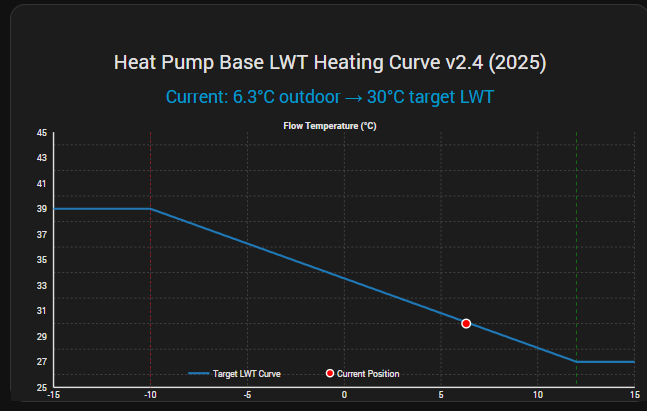
My heat loss was calculated at 9.1kWh and an 11kW Daikin was installed. Actually I was told I needed to fit an extra 2kW plinth heater in the kitchen as the 11kW Daikin may not be able to cope at times. I didn’t go ahead with the plinth heater. Later the 11kW was swapped for and 8kW and straight away was more economic and comfortable to run.
Wind direction plays a huge part in my heat loss, with an easterly wind (1920s solid stone) needing a very different curve to westerly winds (2024 built extension.
The algorithm used to calculate the heat loss and radiator sizing just didn’t work well for my house.
Here are the radiators
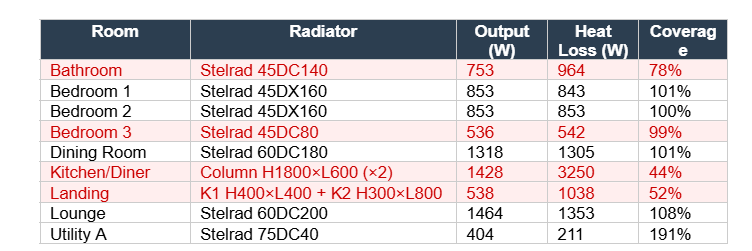
The warmest room in the house is the kitchen, despite according to the survey being massively under radiatored according to the survey.
This is the resulting heat demand since March of last year
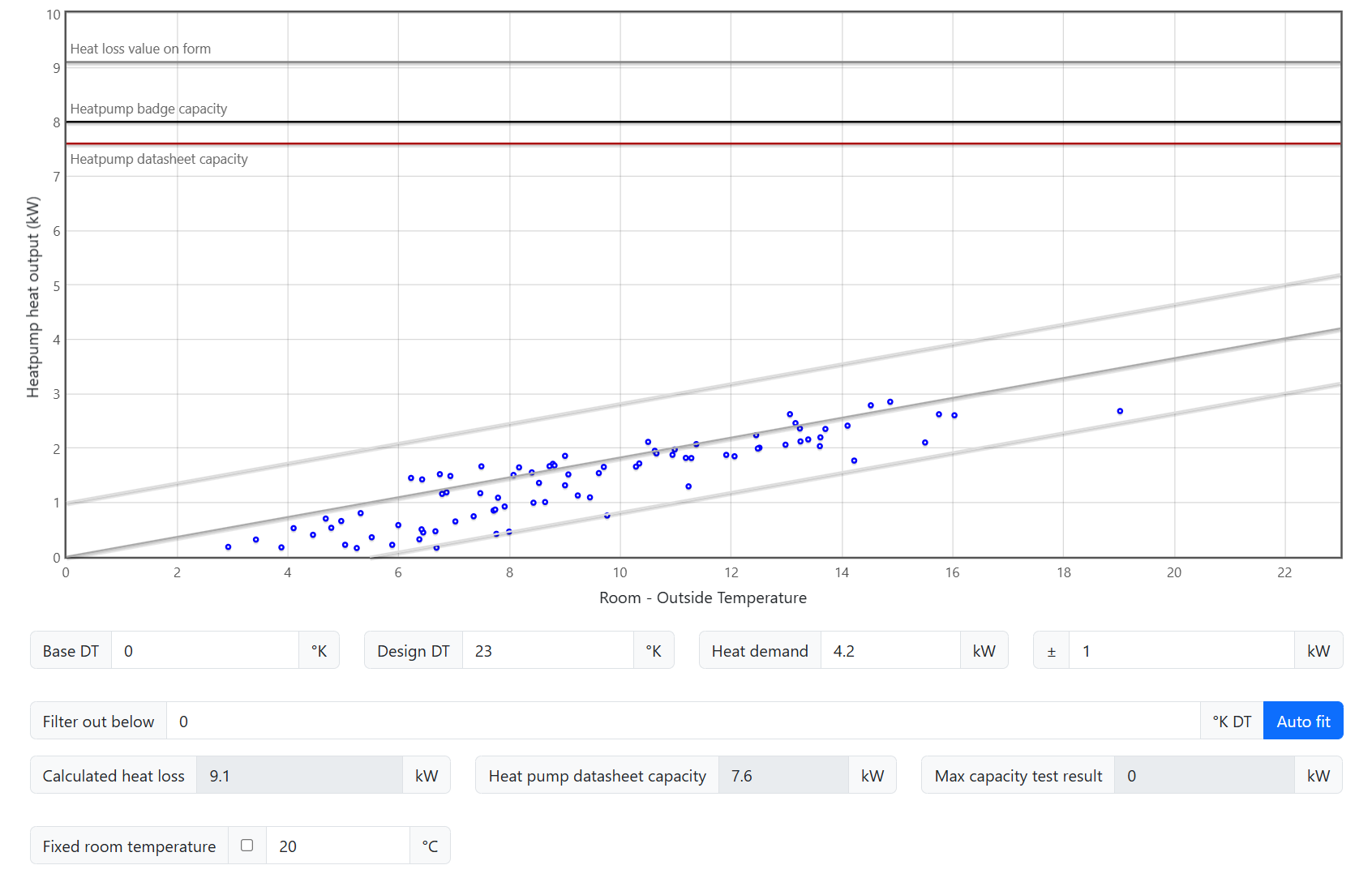
I think its fair to say the design was poor for the house.
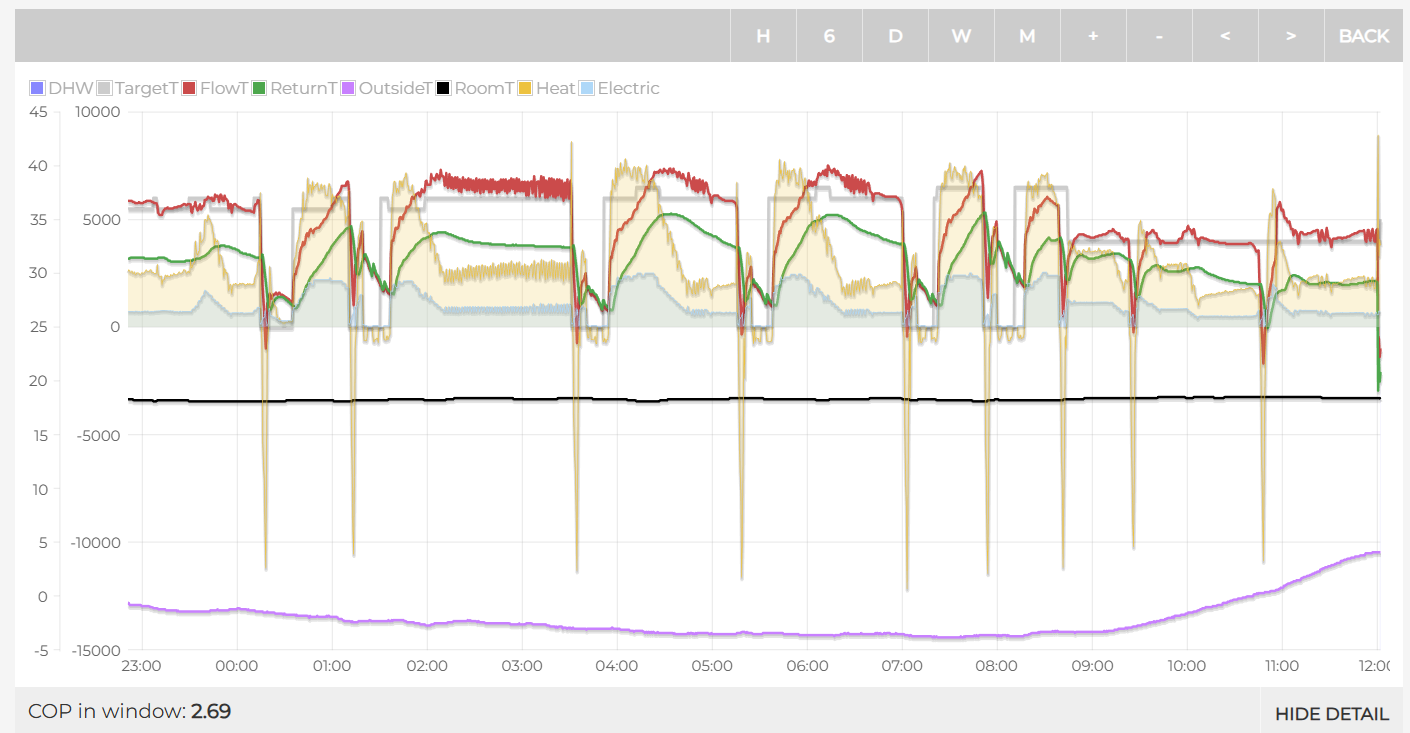
defrosts remain painful
Do you have two radiators in any of your rooms ,
Maybe shutdown some of them as an experiment ?
So you’re reducing the amount of heat you rads can supply and then reduce flow temps which in turn should reduce return temps ??
I’ve shutdown down one of the k3 rads which has helped me a lot ( but there is a k2 rad on other side of room , I’m also in similar situation moving from a 9 kw heat to a 6 kw ( both Daikin ) but my lwt are a lot lower than yours . Heat loss is also around 4 kw @ -2
There’s nothing wrong with the defrosting.
9 times in 13 hours.
Mine was defrosting once an hour.
I’m not sure what you are expecting?
Your 11kW would have been defrosting twice an hour in the same conditions and much more aggressively.
Defrosting is a real efficiency killer , anything to reduce it is a bonus and the compressor stops starting and stopping as often
I am not so sure it is that damaging to efficiency with a Daikin.
Looking at OEM is appears worse than it is.
Whilst you get negative heat for a while when the heat starts going back in the house you get a boost in efficiency from the heating cycle starting again.
I don’t think there’s a lot of difference between it defrosting and not, a few percent.
On a COP of 4.00 with 5% defrosting it comes down to 3.80 without taking any account of the gain a start up, not really life destroying 
Yesterday was my worst and I lost 4.2% according to OEM
You lost 2.6%
I think it’s about as good as it will ever get.
My 9kW was significantly worse, defrosting started at around4c outside and was quite extreme, once every 23 minutes.
I agree if you take steps to reduce the amount of defrosting , but we have all suffered from continuous defrosting , which can knock efficiency’s down to half and at the same time reducing internal temps or not getting hot water to desired temps
So reducing or doing what you can to get out of the death spiral of defrosting is good , even though you will get one from time to time
I agree Chris, and we have solved it.
Our defrosts are neither continuous, hell or painful, Mark’s aren’t either!
I am not sure why he thinks it is?
They are all perfectly acceptable to my mind, or even better than that actually, they are minimal.
I don’t think they can be eliminated entirely.
I don’t think the uk lends its self to eliminating them completely , but and minor improvement we can find certainly helps ,
and maybe the manufacturers will one day catch up and maybe eliminate it
I was just looking at my defrosts today.
Each one consumed about 35W of electricity and took about 300W of heat from the house and lasted for around 5 minutes.
That’s very gentle.
I am very happy with how the 8kW Daikin family performs.
The issue I’m having is a 5 min defrost is followed by 45 mins of really aggressive operation, with the heat pump practically running flat out consuming 2KW+, then going back into defrost, it just doesn’t get a chance to drop back to it’s steady state consuming around 5-600W.
This has some knock on effects.
My battery which normally lasts most of the day can be exhausted before lunch.
The constant flat out for 45 mins then off for 5 is causing thermal shock in my pipes, meaning frequent clicking, creaking and banging, which in turn is keeping us awake. Fyi, we have tried addressing the plumbing but as yet no plumber wants to know. We have another coming to look on Wednesday.
The behaviour of your heat pump is not consistent with any of the others that have gone from a 9/11 to an 8 or 6.
One thing to note is that your heat pump is the same as mine so it should behave the same way in the same conditions.
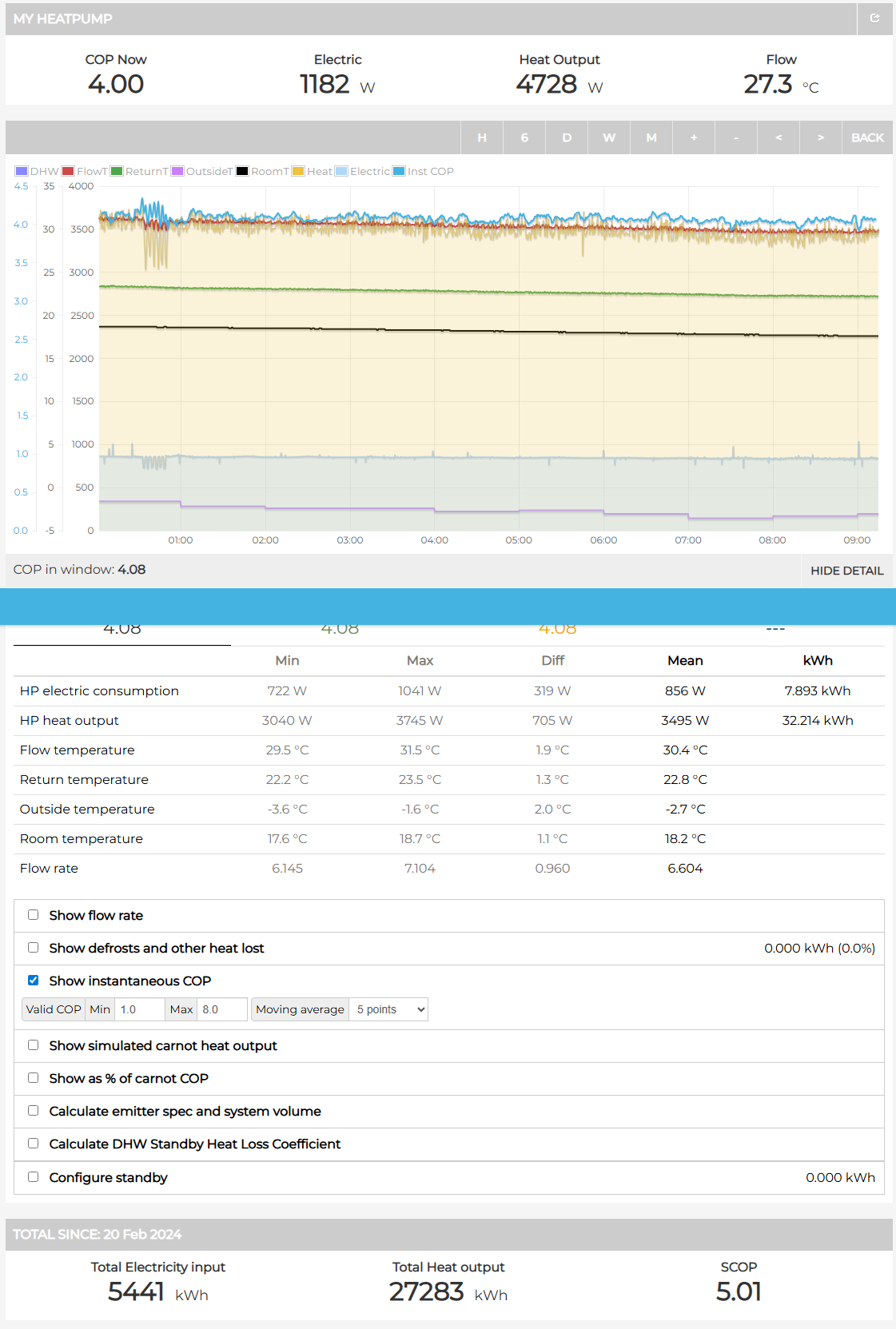
This is mine this morning.
You should be able to achieve similar results.
You have a similar heat loss to me.
There is no way this heat pump will consume 500 to 600W in these conditions, you are dreaming
What flow temperature are you running at these kind of outdoor temperatures and what heat are you producing?
Yeah, in these conditions your steady state is going to be at least 1kW at 0 and 1.4kW+ as it was earlier at -3 to -5. Even if you achieved a reasonably excellent COP of 3 at -5 you’d still only be looking at a 4.2kW output with a 1.4kW input.
Interesting topic! I decided to try this out and with some help from Gemini, came up with an automation that drops the LWT by 5c and gradually ramps it back up over 15 minutes. The results are limited (because I forgot about the Onecta API limit and ran out), but over a two hour window and comparing it with a similar two hour window earlier that same day (where TargetT, OAT and ORH% are broadly similar), it appears to have reduced defrost cycles and increased COP by 10%.
Before:
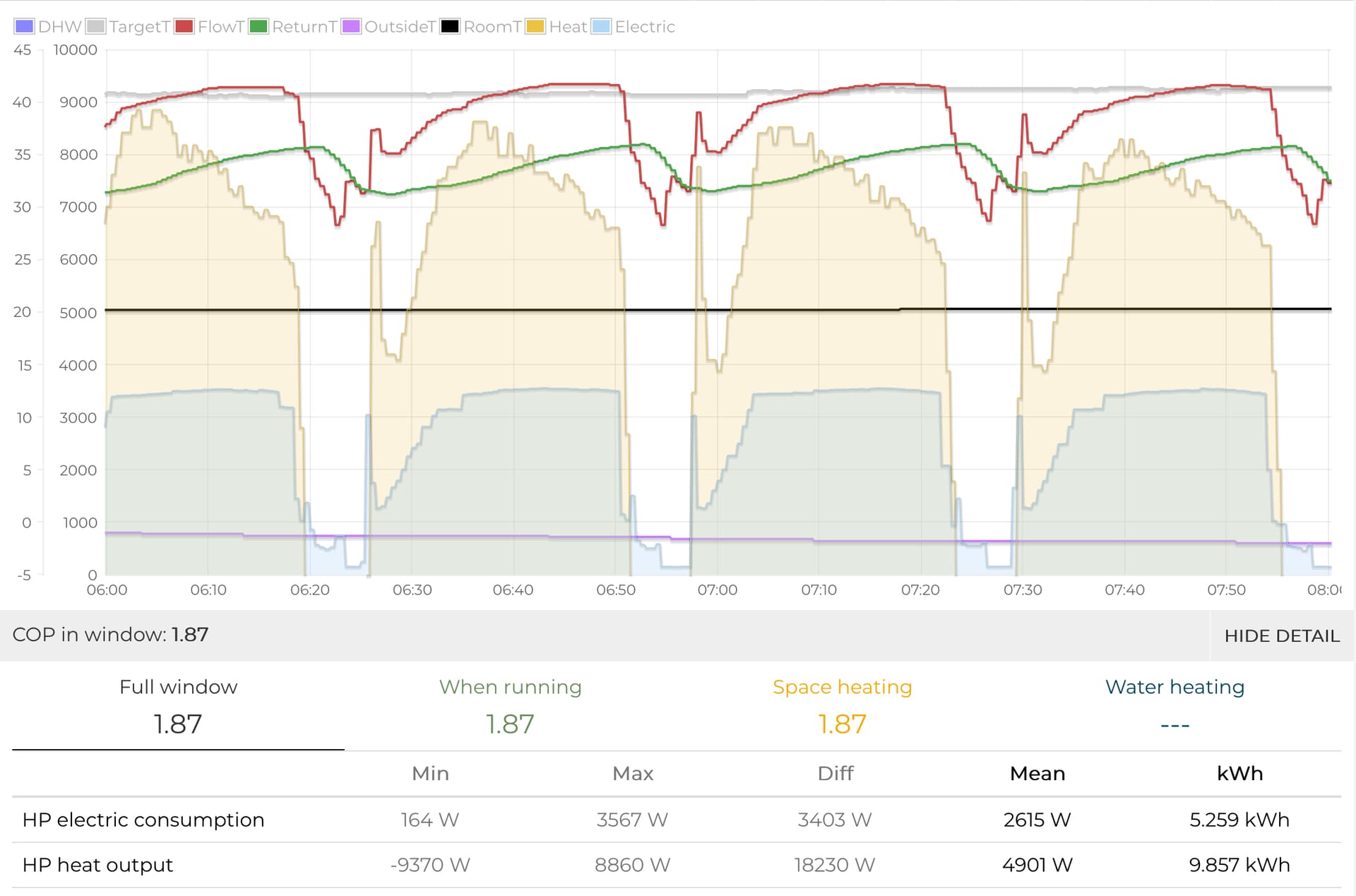
After:
You can see input power has reduced, both in kWh and also mean/max.
Of course, heat output has reduced as well but this doesn’t appear to be at any cost to room comfort. I think what we lose in heat output by slowly ramping up, we regain later by losing a defrost cycle.
Unfortunately, I couldn’t test for longer as I ran out of API calls for the day and now the weather is warming up but I thought it was an interesting experiment building on the working @Chris_Hill and @Mld were doing. I’m going to keep running like this and see how it goes. I’ve now turned off automatic API polling of the Onecta integration since using ESPAltherma means I don’t need any info from it regularly and hopefully that’ll stop me running out of API calls.
Thoughts on all this?
I’ve been doing something very similar, though manually - I don’t yet have ESPaltherma attached, so don’t get data at a high enough rate. I can tell a defrost is starting because the pipes start clanking. And I do have some temperature probes on flow/return pipes in the airing cupboard.
(I have my ESP32 programmed and ready to attach, but figured it was probably a bad idea to risk breaking the heating while it’s been so cold…)
Like you, I plan to turn off the polling via the API, and use it only for sending change requests.
It’s pretty instant on the altherma app / integration with home assistant
On a related note, on milder days when the hp is cycling, I had been considering a similar trick of dropping target water temp slightly when it turned off, to encourage longer off and on cycles. But then it occurred to me that I should be able to get a similar effect by increasing the overshoot, and making a corresponding reduction of the upper end of the WC curve. So in theory it can stay on until exceeding the overshoot, but when it turns off (I assume) it has to stay off until it has dropped far enough below the WC target.