I’m trying to work out how many hoops will I have to jump through to install something like a 4kW Grant 290 (or maybe 3.5 kW Vaillant) whilst using my existing primary pipework, and still get the BUS grant (if indeed that is likely to be possible at all).
This question is a bit of an epic. Unfortunately it’s not a straightforward problem…
Our house is a 1920s semi-d in Brighton. I did a load of work to upgrade the building fabric and extend it gradually over the past 15 years. As is often the case most work was done in the first couple of years. I got quite enthusiastic with air tightness and insulation.
I designed and installed the heating system in 2013 or so.
When we bought it, the house had a 4 year old 24kW Vaillant combi boiler. In 2013 GB grid CO₂ intensity was 3.5x higher than now, and heat pump performance was a bit worse (also the now-banned high-GWP R410a was the most common refrigerant), so the effective CO2 emissions of boilers and heat pumps were comparable at that time. We decided to stick with gas for a while longer.
The rest of the heating system was 20+ years old. The boiler needed to be moved to make way for a new staircase (and the ground floor was being scrapped due to wood worm and tediousness of insulating suspended timber floors), so only the boiler was kept.
Fortunately I designed the new heating system as a single temperature system with a mix of UFH and radiators and a design temperature of 35°C.
Since then, the boiler has been configured to only use its minimum attainable modulation in heating mode (approx 6.5 kW), and set for 35°C flow temp. It probably operates at something around 95% to 100% sensible efficiency (fun fact, the maximum “efficiency” of a condensing gas boiler is about 115% because “100%” is defined as all heat recovered without condensing).
On the coldest of days it fires for something like 4 hours (I wish I had some accurate data on this, but it’s difficult to tell because it starts cycling after about an hour).
Annual gas consumption for all heating and hot water is about 1,800 kWh. The adjoining house has been unoccupied and unheated for the past year. Cooking, and washing is electric. No solid fuel (no chimneys any more!).
We’re a family of four, most washing is with showers (for which we have drain water heat recovery with ~50% end to end efficiency). Other than that, maybe one or two baths per week. Gas boiler efficiency probably averages ~90% in DHW mode or so (there is also a flue gas heat recovery device) but maybe a bit worse because it often short-cycles during showers in summer months.
Looking at recorded gas usage, it’s about 35 kWh per month in late spring (we don’t heat between end of March and mid October typically), so assuming similar year-round that would be 450 kWh for DHW, leaving 1350 kWh or so for heating.
Based on the heating degree days estimation method (12 °C basis instead of 15.5 °C because it’s close to Passivhaus levels of heating load), that gives 1.45 kW peak heating load at an indoor temperature of 21 °C.
Based on my rough estimate of coldest day boiler maximum firing times, instead gives ~ (6.5kW * (4 hrs / 24 hrs)) = 1.08 kW.
I’ve done a heat loss calculation using the deprecated MCS spreadsheet, and my own figures for U Values (plus modifications for MVHR).
With next door unoccupied, and my estimate of the houses’ current leakage rate of 1 (ACH50), and assuming 85% efficient MVHR, that gives 2.1 kW.
Pessimistically switching to 3 ACH50 and 79% MVHR gives a heat load of 2.8 kW.
I haven’t done a proper blower door test, but I could do if that’s likely to help convince!
Both of those heat load figures use slightly higher room temperatures than we actually heat to, and of course ignore all “incidental gains” like body heat, cooking and standby electrical loads (all in all probably 500 W or so).
So, I thought I was being cunning at the time, but when I installed some external wall insulation about 5 years ago, we ran some 22 mm PB barrier pipe inside the (250mm thick) wall insulation to use as a potential ASHP future primary pipework. This was a late afterthought and done in a hurry. The pipes are surrounded on all sides by at least 100mm of insulation (expect where they pass through AAC blocks where and have about 30mm of coverage, n.b. the blockwork is externally insulated, so any heat loss to the blockwork ends up inside the building).
If I scrap the 22mm primaries, then I’ll need to run new 28 mm primaries for an additional 3.5 metres outdoors. I might be able to replace them in-situ, but the scheme I have for that might not work and would probably end up destroying the 22mm pipes.
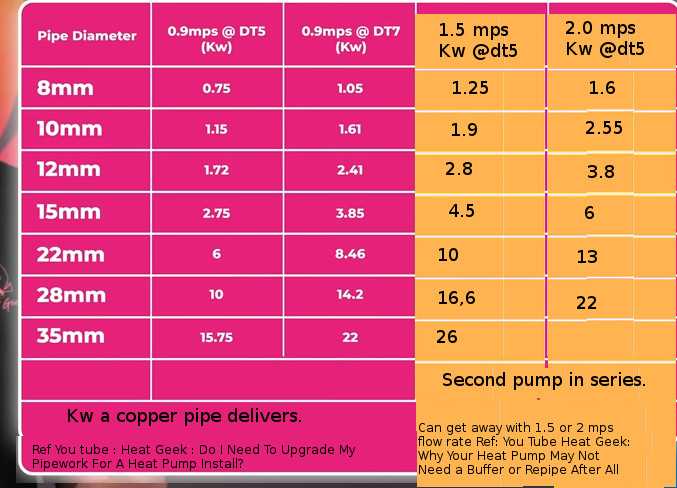
Assuming the 22mm pipes are to be kept, then if I stick to the CIBSE recommended limit of 350 pa/m pressure drop for primaries, that limits flow to 0.66 m/s. Grant’s “Maximum Flow rate required” figure of 11.77 litres/minute (4.1 kW at 5°K ΔT) would result in a flow rate of 0.77 m/s. Reducing that to 0.66 m/s limits the output power to 3.5 kW (or 0.62 m/s → 3.2 kW if I go with the MCS recommendation of 300 pa/m instead).
I have not yet done an index circuit analysis, but can do so if that would help answer the question.
I live in a dense urban area and will almost certainly want to leave the HP in silent mode. I think that using “silent mode 1” on the 4kW Grant 290 gives a maximum power output of about 2.8 kW. I’ll slightly oversize the DHW cylinder to accommodate the longer recovery time, but the fact that the showers have 50% efficient heat recovery means that shouldn’t be an issue (since the practical hot water recovery time should be about the same as if we had the 6 kW model running in non-silent mode).
As well as the silent mode option, I think I’m right in saying that there is a Grant firmware option which allows both the max compressor speed and pump modulation to be limited, which would presumably allow capping the output at 3.2 kW or 3.5 kW (giving a bit more headroom whilst still staying inside of the head loss and flow rate limits).
Cost in time and materials of replacing them with 28mm pipes is about £300 to £500 (50% chance of having to run them a different route so that they have a worse heat loss).
I’m confident the 22mm pipes will be fine as far as delivering sufficient heat into the building.
In practice, are any installers or Grant (or MCS themselves) likely to be happy with that too, so that the BUS grant can be claimed?
What are the potential pitfalls (if any)? Defrost mode?
Does defrost mode pull heat from the DHW or heating circuit? I plan to run the heating circuit open loop, but at the very least I could leave some or all of the UFH permanently on - these are a mixture of pipe in 30mm conventional screed, and pipe in 125mm concrete slab. For the concrete areas, that’s about 8 tonnes of concrete, so no problem with thermal mass.
Any thoughts?
Cheers,
Tim.