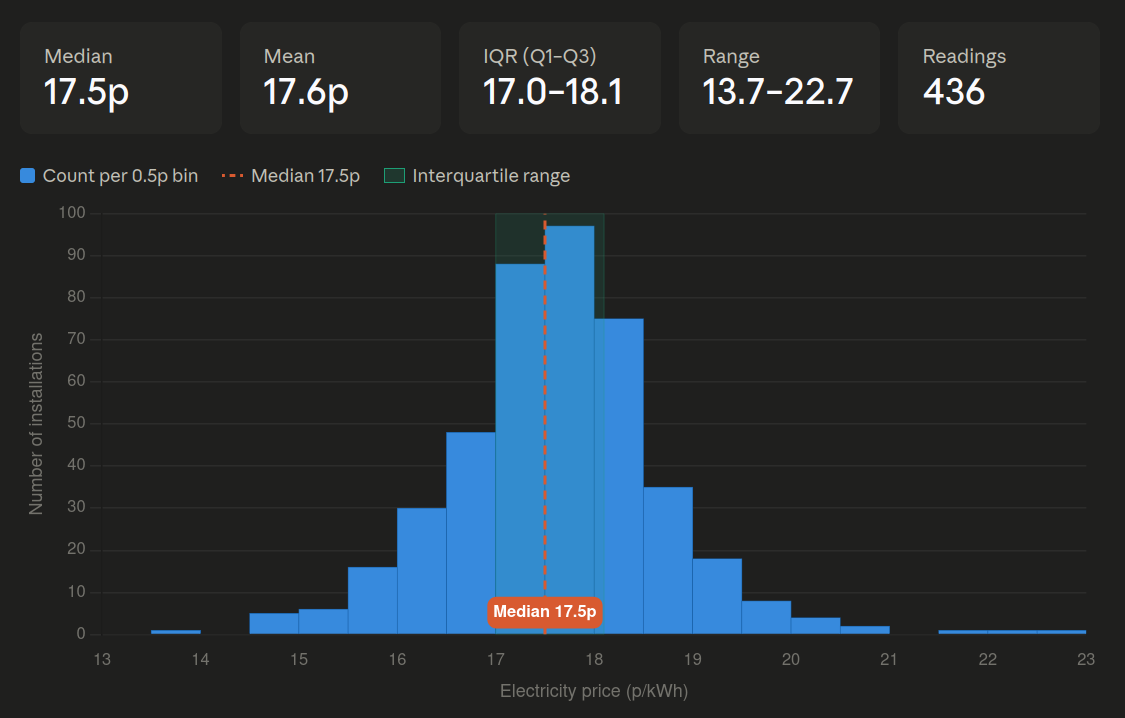
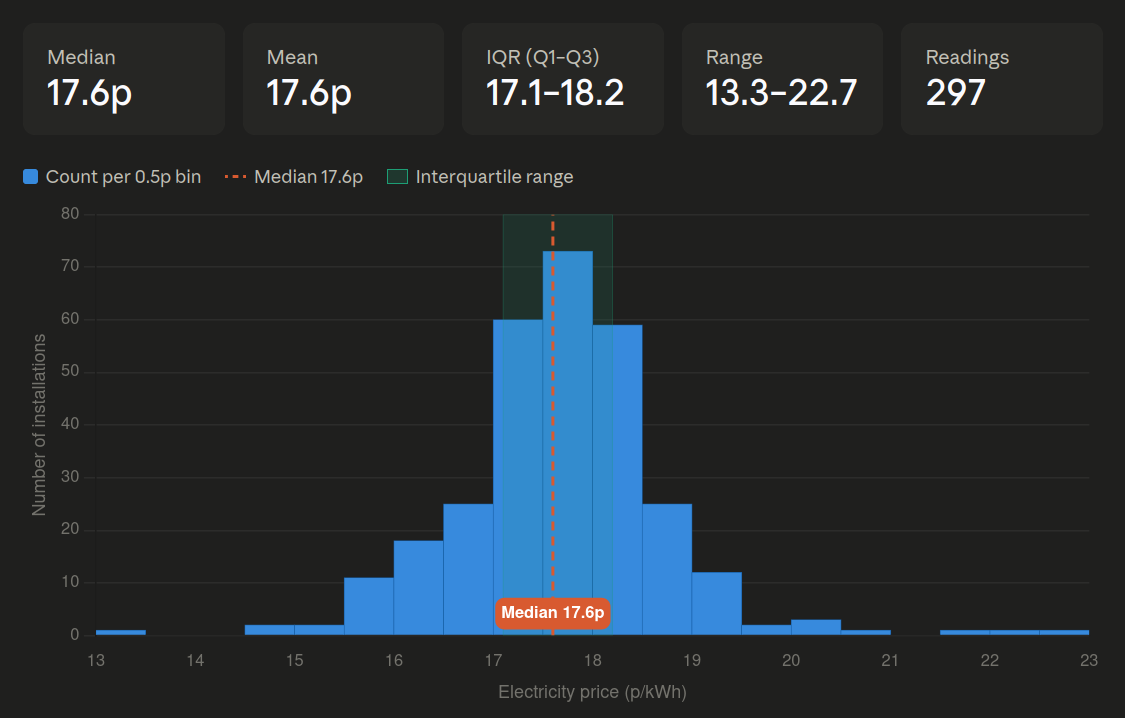
Running the following data through claude to quickly calculate and visualise the median and mean unit rates that HeatpumpMonitor.org heat pumps would achieve on different time of use tariffs (assuming no change to their current running pattern of course).
Useful for back of the envelope spark gap calculations, e.g with gas at 7.3 p/kWh, the median spark gap for heat pump monitor systems if they were running on agile would be 2.41.
As I understand it the mean e-SCOP equivalent to the mean SCOP 4.0 on 26 p/kWh price cap for these would then work out to be 5.9.
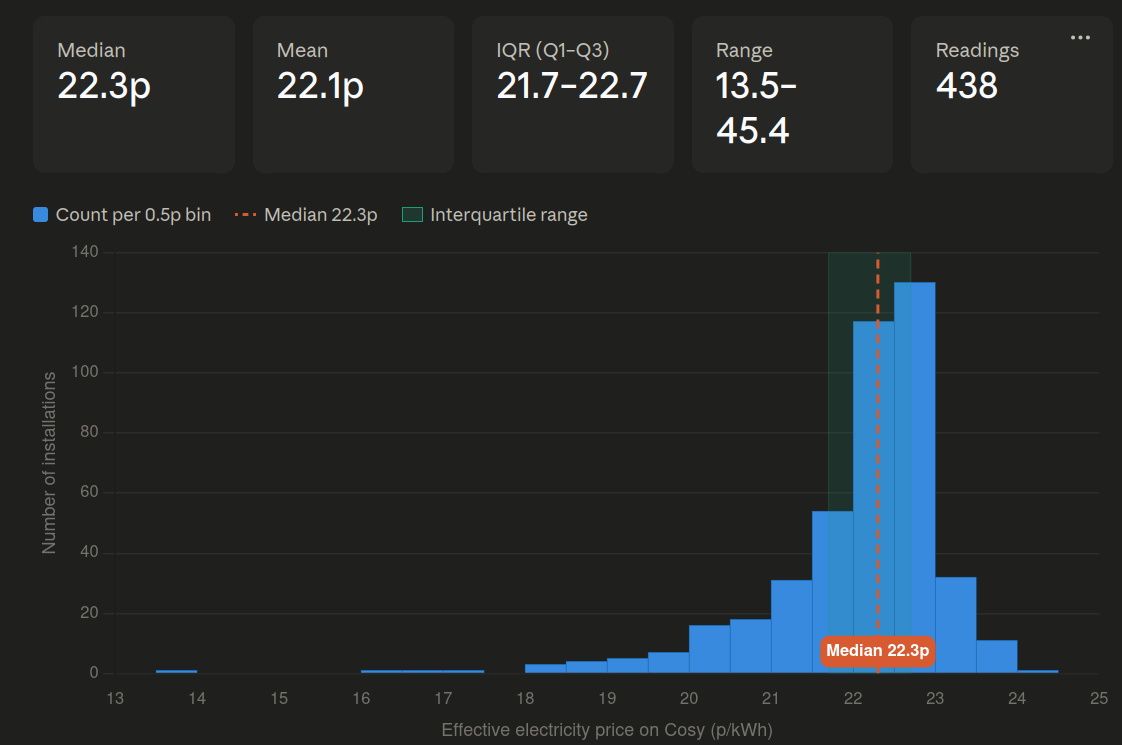
Running the same on all systems if they were running on Octopus Cosy, showing that in general if most heat pumps shifted to cosy they would be worse off than agile but there are clearly some outlier systems that are achieving maximum optimisation on their chosen tariffs E.g:
Important caveat that owners would do better if they shifted the load into the cheap periods, even though this is not optimal running for a heat pump.
Add a modest battery, and you can effectively run all day at the cheap rate, charging up 3 times a day. I averaged around 15p/kWh last winter using a combined strategy on Cosy, beating the average rate for the previous winter on Agile (it was unusually expensive then).
Agreed, and we can see the owners that have done this in the distribution. It’s probably a fairly safe bet to say the median cost reflects no time shifting, the minimum’s of ~13.5 p/kWh are close to the maximum achievable optimum (without a battery) and 15-16 p/kWh on agile and maybe 18-19 p/kWh on cosy is probably closer to normal optimisation? assuming only a few users are shifting their consumption and that part of the tail reflects the gains made..
My system is not on heatpumpmonitor, but I can confirm that the winter in which I ran my system on Cosy with load shifting and no battery, I was able to average 19-20p import for the winter.
With a battery, we now only import at Cosy cheap rate, recharging 3 times per day.
Hello @BenY there’s no field to enter the tariff your on now. What we do instead is use the half hourly electricity consumption of each system and see what it would cost to run that system on the different tariff options; agile, go, cosy, e-on next pumpted etc.
The owners that have optimised to one of these tariffs will likely come out cheaper on the tariff than the median which will more likely reflect more normal comfort / always on running strategies.