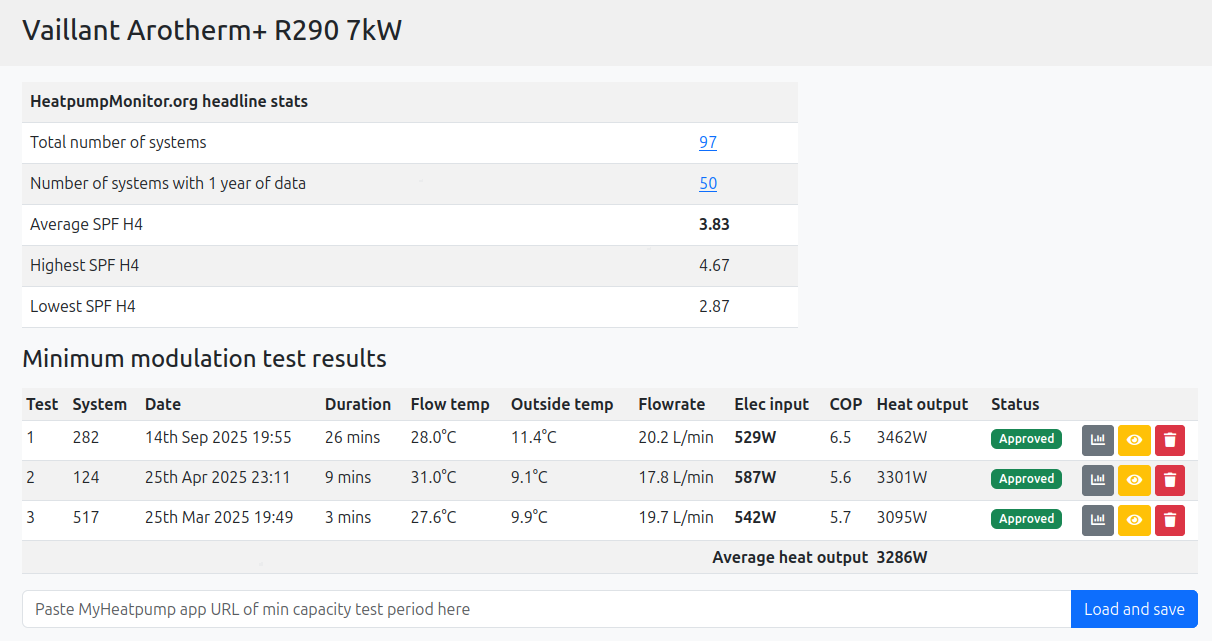
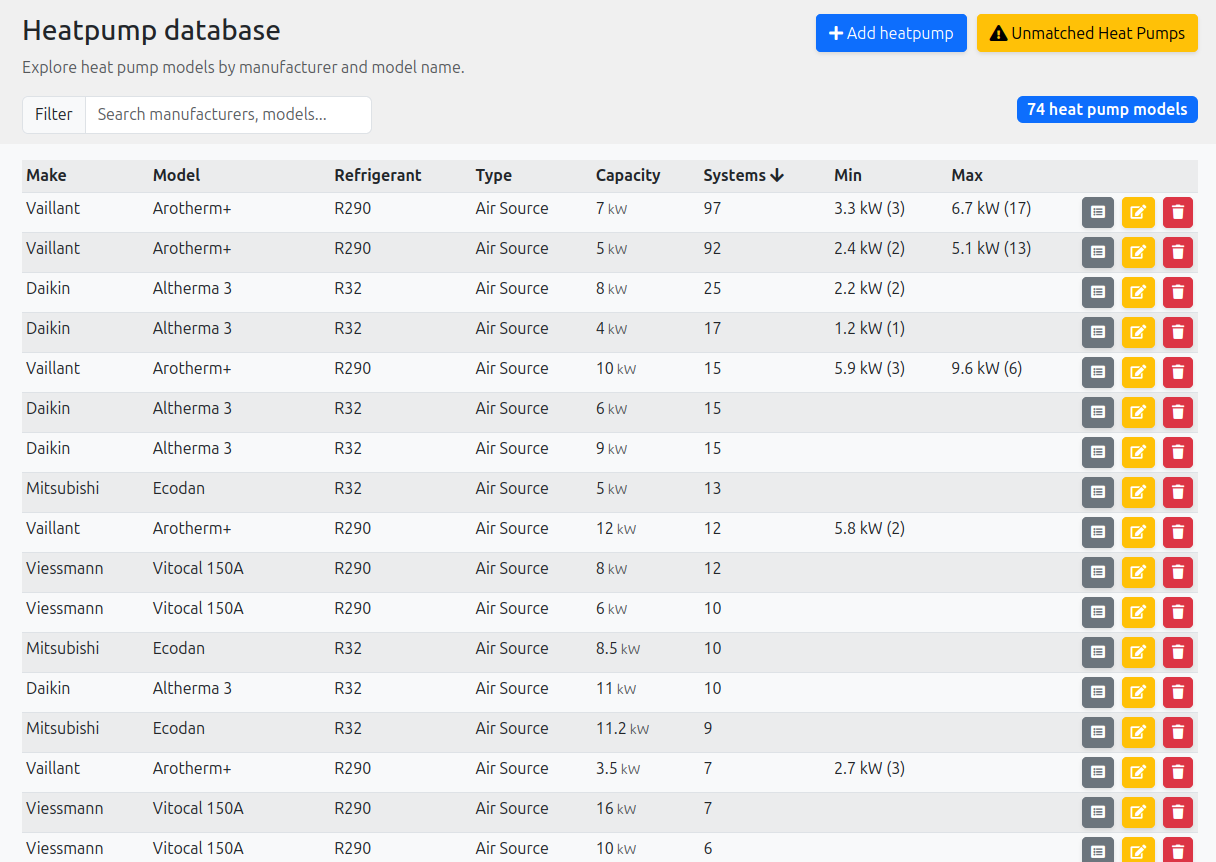
The heat pump database tool now has the option to add minimum modulation test data. This should be a really useful set of data points alongside max output to aid with unit sizing:
A couple of interesting things this brings up so far:
The modulation range of the 10 kW Vaillant arotherm looks quite narrow, between 5.9 kW at minimum and ~9.6 kW at maximum. Yet this heat pump can perform very well even when the heat loss of the property is near the minimum modulation point. This suggests that well controlled degree-minute based cycling can compensate very well for a narrow modulation range.
The minimum modulation of the 12 kW arotherm is basically the same as the 10 kW - which is what we would expect given the understanding that the 10 is just a derated 12.
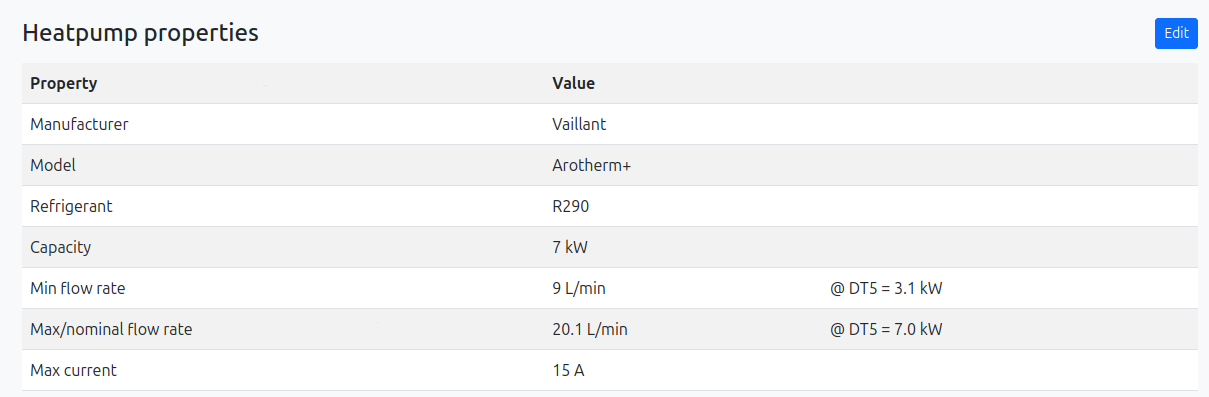
For Vaillant units the minimum flow rate x DT5 x 4150 J/K.kg gives a minimum output that matches observations quite well - but this does not hold for the 9kW Grant R290.
The minimum modulation on the Grant R290 9 kW unit is impressive, being fairly close to the minimum output of the 5 kW Vaillant and Ecodan.
Hi @TrystanLea Definitely a useful set of data points! Can you tell us what the method is for both min and max and in particular how one can be certain that the min and max are truly being measured given that both may be limited by the downstream system or demand?